
 Worksheets
Conceptual Physics Midterm Spring 2021
Total questions: 67
Worksheet time: 58mins
The synthesis of large collection of info, well-tested, verified scientific hypotheses is
fact.
law or principle.
theory.
hypothesis.
In science, an educated guess is called a
hypothesis.
theory.
law.
fact.
True or False: An object at rest experiences no forces.
True
False
True or False: An object moving at a constant speed in a straight line requires a force to continue moving.
True
False
What is required to change an object's state of motion?
A force.
A zero net force. (Balanced Forces)
A non-zero net force. (Unbalanced Forces).
Object's can change their state of motion without a force.
An object is in motion. What are the ways it can change its state of motion?
It can speed up.
It can slow down.
It can change direction.
All of the above.
When an object is at rest it is said to be in...
dynamic equilibrium
static equilibrium
not enough information
When an object is moving at a constant speed in a straight line it is said to be in...
dynamic equilibrium
static equilibrium
not enough information
When something has speed in a certain direction it is called ___________.
motion
position
velocity
speed


Force is a -
push or pull
only a push
only a pull
none of the above


A 50 kg skater pushed by a friend accelerates 5 m/sec2. How much force did the friend apply?
45 N
15 N
10 N
250 N
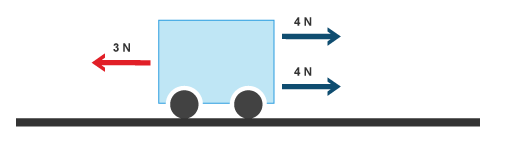
Shona cycles at an average speed of 8km/h. How far has she traveled if she cycles for 4 hours? *pay attention to the units being used!
55km
32km
43km
32miles
A car accelerates from a standstill to 70 m/s in 10 seconds. What is the acceleration?
0.7m/s2
7m/s/s
14m/s2
none of the above
A car accelerates from 15 m/s to 60 m/s in 30 seconds. What is its acceleration?
2 m/s/s
3 m/s/s
1.5 m/s/s
0.75 m/s/s
In Newtonian physics, ________________ is any motion of a body where gravity is the only force acting upon it.
kinematics
free fall
mechanics
velocity
The standard acceleration due to gravity (or standard acceleration of free fall),is the nominal gravitational acceleration of an object in a vacuum near the surface of the Earth. It is defined by standard as:
9.8 m/s.
9.8 m.
9.8 m/s2.
9.8 s.
Juan is standing on the top observation deck of the Eiffel Tower in Paris at a height of 300 meters. He drops his cell phone. How fast will the phone be traveling when it hits the ground? Ignore the effect of air resistance. d = g x t^2 / 2
9.8 m/s
76.68 m/s
149.76 m/s
46.99 m/s
If an object is in free fall for three seconds, how fast will it be falling? v = g x t
9.8 m/s
19.6 m/s
29.4 m/s
39.2 m/s
Heavier objects free fall faster than lighter objects.
True
False
Which would hit the ground first if dropped from the same height in a vacuum—a feather or a metal bolt?
the feather
the metal bolt
They would hit the ground at the same time.
They would be suspended in a vacuum.
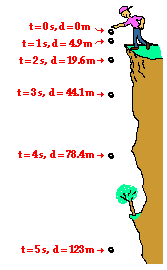
What happens to the velocity of a ball as it is dropped off a cliff?
It decreases at a uniform rate
It increases/accelerates at a uniform rate "constant rate"
It is constant
It increases at a non-uniform rate
A deer running 15 meters per second due west
The unit that goes with mass.
Centimeter
Liter
Inch
Gram
The one that is affected by gravity.
Volume
Mass
Weight
Ego
The unit that goes with weight.
Kilogram
Newton
Milliliter
Mile
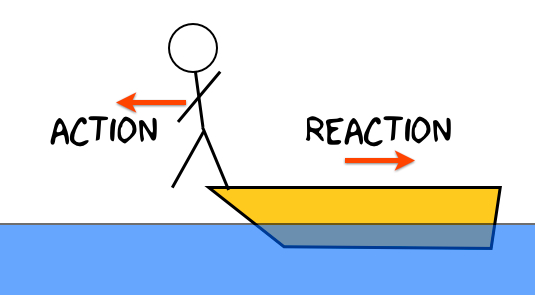
Newtons law states that for every action, there is an_________ reaction
unequal and opposite
stronger and opposite
equal and similar
equal and opposite

Force always come in________
waves
triplets
pairs

Which path represents the projectile motion? hint: the resultant vector of the horizontal and vertical component
(A)
(B)
(C)
What will hit the ground first, a bullet fired horizontally from a gun or a bullet dropped from a gun at the same height?
bullet fired from a gun
bullet dropped from the same height
they both will hit the ground at the same time because the x-component and y-component of motion are calculated independently
A 9300 kg railroad car traveling at a velocity of 5 m/s strikes a second boxcar that weighs 5000 kg at rest, after the collision both boxcars move together. At what velocity will the combined boxcars move after the collision? net mv before = net mv after
18.6 m/s
3.25 m/s
7.5 m/s
1.86 m/s
A boy kicks a football with a force of 20 N, the time the force acts for is 0.3 s.
Calculate the impulse on the ball. Impulse = F x t
1 N*s
6 N*s
33.3 N*s
None of these
Which of the following is the formula for impulse?
FΔT
ma
mv
mc2
Which piece of evidence could be used to BEST support this claim:
High school students should be required to wear uniforms.
At one school that recently required students to wear uniforms, attendance went up and bad behavior went down.
When adding everything up, a school uniform could end up costing more than $200.
A student reported, "Allowing us to wear our own clothes gives us a chance to show our unique style and independence."

A 5 kg bowling ball, a 0.25 kg baseball, and a 0.05 kg golf ball are dropped from a 100-meter high building. A camera catches the motion of the balls as they pass specific markers (in meters,m) on the building. The times (in seconds, s) that each object passes the markers are listed in the table below. Which of the following conclusions is true?
Light objects fall faster than heavy ones.
All objects fall at the same rate regardless of mass.
Heavy objects fall faster than light ones.
Objects of different shapes fall at the same rate.
Using your knowledge of the Law of Conservation of Energy, which of the following statements best explains the following scenario?
“A peanut has 1000 J of energy. A student sets up an experiment to measure the amount of energy found in that peanut using a soda can with water. The student lights the peanut on fire and measures the change in temperature of the water. Using this data the student calculates there to be 250 J.”
The original amount of energy recorded for the peanut was incorrect, since there cannot be a difference in energy before and after the reaction since all energy is conserved.
The system in the experiment is open. 100% of the energy is not transferred to the water in the soda can. A majority of the energy is transferred to the surroundings.
When the peanut is burned 750 J of energy is destroyed and does not make it to the soda.
750 J of energy is converted to smoke, which explains the difference in the amount of energy.
A scientist is conducting a study to determine how well a new medication treats ear infections. The scientist tells the participants to put 10 drops in their infected ear each day. After two weeks, all participants' ear infections had healed.
Which of the following changes to the design of this study would most improve the ability to test if the new medication effectively treats ear infections?
Have participants use ear drops for only one week
Have participants put ear drops in both their infected ear and healthy ear
Create a second group of participants with ear infections who use 15 drops a day
Create a second group of participants with ear infections who do not use any ear drops

Students are exploring how the atmosphere helps sustain and protect life on the earth’s surface. Student A says that life is sustained because oxygen is a major component of the atmosphere. Student B says that life is sustained because greenhouse gases warm the air near
the surface.
Based on your knowledge and what is presented in the picture, Which student is correct and why?
Student A is correct because living organisms need Oxygen to breath.
Student B is correct because greenhouse gases keep our planet the correct temperature.
Both Student A and Student B are correct. There are multiple ways that Earth’s atmosphere contributes to sustaining and protecting life on Earth.
Neither student is correct. Earth’s atmosphere is most important for the ozone layer which shields us from harmful UV radiation.

A residential developer is planning to build some houses on a property next to a wetland with a pond and a stream. The criteria for the project are listed below:
● Six lots for houses
● Intact forested areas
● Forested area between wetland and lots for houses
The diagrams in the image shows two designs for the project.
Which statement best explains why one of the designs is more appropriate (or sustainable for the environment) for the project?
Design 1 is more appropriate because it provides each house with access to the wetland.
Design 1 is more appropriate because it provides larger lot sizes with more forest areas.
Design 2 is more appropriate because it provides each house with privacy on all sides.
Design 2 is more appropriate because it provides wetland protection with uninterrupted forest areas.
Imagine that you remove all the atoms from a dog. What remains?
The same dog, because living organisms are not made up of any atoms.
The molecules that make up the dog, because molecules are not made up of atoms.
The cells that make up the dog, because the cells of a living organism are not made up of atoms.
Nothing, because living organisms are made up of matter, and all matter is made up of atoms.

