
 Worksheets
A level Physics
Total questions: 70
Worksheet time: 1hrs 8mins

Which of the following changes could cause the photocurrent to stop?
Which of the following changes occur?
Energy of electrons: increase.
Energy of electrons: no change.
Energy of electrons: increase.
Energy of electrons: no change.

Plank's constant is determined by:
The work function is determined by:
The threshold frequency is determined by:
1. No electrons are emitted below the threshold frequency.
2. Above the threshold frequency the energy of electrons depends on the frequency of the light.
3. Increasing intensity increases the number of emitted electrons.
Which (if any) of these observations can be explained by a wave theory of light?
What is Hookes law?
Extension is directly proportional to length
Extension is directly proportional to force applied
Extension is inversly proportional to force applied
Peter Pan isn't nice
Denisty it measured in what units?
kgm3
kg2m
kgm−3
inchyards
Tensile (a) is force applied per cross sectional area
Tensile (a) is a measure of how to material stretches
A brittle material is one which:
Doesn't deform plastically but breaks when the stress is too high
Deforms plastically
Deforms elastically and will return to its original shape
Deforms to a new shape with little force
The elastic limit is the force above which a material will (a) deform
Area under a force-extension graph represents
(a)
What is Young's Modulus?
StrainStress
StressStrain
ΔLAFL
∞
How do you find the Young's Modulus from a stress-strain graph?
Area under the line
Gradient of the line
Integral of the line
ΔyΔx

Which graph represents a wire which has plastically deformed?
Left graph
Right graph
2 points on a progressive wave are 1/3 of a wavelength apart. The distance between the two points is 2cm. If the speed of the wave is 10 ms-1 what is the frequency of the wave?
5Hz
20Hz
167Hz
1500Hz
Which of the following waves cannot be polarized?
Visible light
Radio waves
Ultrasonic
Gamma
A guitar string of length 80cm vibrates with a third harmonic frequency of 305Hz. What is the wavelength of the wave?
244cm
53.3cm
16.2cm
3.80cm

What is the approximate phase difference between the waves shown?
2π
3 π/2
π
π/2
When comparing X rays with visible light, which statement is correct?
X-rays travel faster in a vacuum
X rays have a higher frequency
Only X rays can be polarised
X rays do not show diffraction effects
Which of the following describes the type of wave produced on a stretched guitar string after it has been plucked?
Stationary, longitudinal, electromagnetic
Stationary, transverse, mechanical
Progressive, longitudinal, electromagnetic
Progressive, transverse, mechanical
Two light wave sources with the same frequency and with a constant phase difference are said to be ….
Polarised
Diffracted
Coherent
Longitudinal
Charge =
Current x time
Current/time
Time/current
IQ

What is Kirchhoff's First Law based off?
The law of conservation of charge
The law of conservation of momentum
The law of conservation of energy
The law of conservation of mass
What is Kirchhoff's Second Law based off?
The law of conservation of charge
The law of conservation of momentum
The law of conservation of energy
The law of conservation of mass
The greater the number density...
The greater the conductivity of the material
The less conductive the material is

A
B
C
D

A
B
C
D

A
B
C
D

A
B
C
D

5.1m
10m
51m
100m

10N
12N
20N
40N
Which is equivalent to the ohm?
J C–2 s–1
J C–2 s
J s
J s–1

A
B
C
D

A
B
C
D
In a parallel plate capacitor, if the distance between the plates is doubled while keeping the voltage constant, what happens to the capacitance?
A) It doubles
B) It halves
C) It quadruples
D) It remains unchanged
What is the relationship between the electric field (E), potential difference (V), and distance (d) in a uniform electric field?
A) E = V/d
B) V = Ed
C) V = E/d
D) E = V + d
Which of the following is equivalent to a temperature of –100°C?
–373 K
–173 K
173 K
373 K
A pure solid is heated at its melting point. While it is melting the
mean kinetic energy of the molecules of the solid increases.
mean potential energy of the molecules of the solid increases.
temperature of the solid increases.
temperature of the solid decreases.
Which of the following is not an assumption of the kinetic model of ideal gases?
All particles in the gas have the same mass.
All particles in the gas have the same speed.
The duration of collisions between particles is very short.
Collisions with the walls of the container are elastic.
What is the definition of the mole?
The amount of substance that has the same mass as 6.02 × 10²³ atoms of carbon-12.
The amount of substance that contains as many nuclei as the number of nuclei in 12 g of carbon-12.
The amount of substance that has the same mass as one atom of carbon-12.
The amount of substance that contains as many elementary entities as the number of atoms in 12 g of carbon-12.

An ideal gas is contained in a thermally insulated cylinder by a freely moving piston.
The gas is compressed by the piston and as a result the temperature of the gas increases. What is the explanation for the temperature rise?
The rate of collision between the molecules increases.
Energy is transferred to the molecules by the moving piston.
The molecules of the gas are pushed closer together.
The rate of collision between the molecules and the walls of the cylinder increases.

What happens to the pressure and to the volume of the gas inside the balloon?
volume decreases
volume increases
volume decreases
volume increases
what is internal energy?
total of random distribution of KE and PE in a system
total of random distribution of KE in a system
sum of random distribution of PE in a system
individual KE and PE of molecules in a system
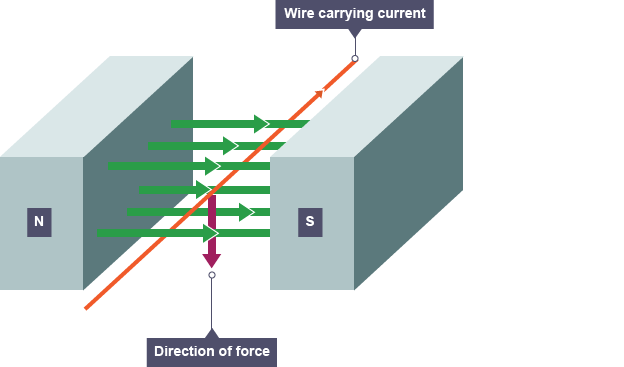
Why might a current-carrying wire be placed between a magnetic field?
To increase the current from the interaction of magnetic fields
To increase the voltage from the interaction of magnetic fields
To produce a force from the interaction of magnetic fields
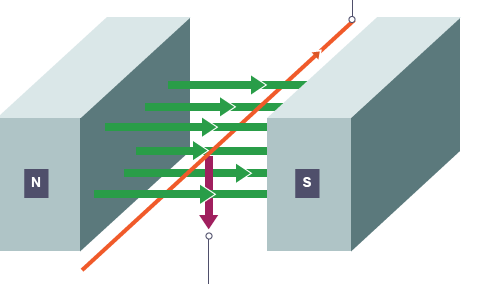
What direction is the force/motion in the following diagram?
Perpendicular to the magnets
Downwards
Parallel and through the magnets

What angle must there be between a magnetic field and a conductor in order for the maximum force to be exerted?
180
45
90
270
Give two ways you can reverse the direction of a basic dc motor?
Reverse the current
Keep the current the same
Reverse the magnetic field
Keep the magnetic field the same

What motion does this velocity-time graph show?
Constant Deceleration
Increasing Deceleration
Increasing Acceleration
Decreasing Acceleration
Archimedes Principle says the Upthrust on an object equals...?
The weight of the object
The weight of the water displaced
The mass of water displaced
Mass x gravity
What is ALWAYS conserved in a collision?
Kinetic Energy
Potential Energy
Momentum
Mass
What is the term for the point where the amplitude of a stationary wave is always zero?
node
antinode
crest
trough
What is the term used to describe the stress value at the point of fracture, calculated by dividing the breaking force by the cross-sectional area?
tensile strength
breaking strength
shear strength
yield strength

Two balls of masses m and 2m with initial velocities 2v and v collides as shown. After the collision, the mass m travels to the right a velocity of v. How much kinetic energy is lost?
0.10 mv2
0.25 mv2
0.33 mv2
0.50 mv2

A cell of internal resistance r and electromotive force (e.m.f.) E is connected in series with a resistor of resistance R.
The resistance R and the e.m.f. E remain fixed. The internal resistance r of the cell changes over time.
Which graph best shows the variation of the current I in the circuit with the internal resistance r?


Water waves of wavelength λ are incident normally on an obstacle with a narrow gap. The width of the gap is equal to λ. The waves from the gap emerge over an angle θ as shown.
The gap is slowly widened. Which changes, if any, occur to θ and to the wavelength of the emerging waves?
θ decreases, λ remains the same
θ increases, λ remains the same
θ remains the same, λ decreases
θ remains the same, λ increases

A rubber cord hangs from a rigid support. A weight attached to its lower end is gradually increased from zero, and then gradually reduced to zero.
The force–extension curve for contraction is below the force–extension curve for stretching.
What does the shaded area between the curves represent?
the elastic potential energy stored in the rubber cord
the thermal energy dissipated in the rubber cord
the work done on the rubber cord during stretching
the work done by the rubber cord during contraction
Continuos water waves are diffracted through a gap in a barrier in a ripple tank. Which change will increase the diffraction of the waves?
increase the frequency of the waves
increase the width of the gap
reduce the wavelength of the waves
reduce the width of the gap

θ1 =35°, θ2=25° What is the refractive index, n, of water?
1.37
1.36
1.35
1.34

The critical angle in the diagram is 43 degrees. What is the angle of refraction at the critical angle?
Less than 43
Equal to 43
More than 43 but less than 90
Equal to 90 degrees

Even numbered harmonics (multiples of fundamental frequency) do not form in a closed pipe because
the pipe “fits” only an odd number of quarter wavelengths
the pipe “fits” only an even number of quarter wavelengths
the pipe cannot put an anti-node at the open end
the pipe cannot get enough air to vibrate in the pipe at these lengths

The pipe length of A is 0.18 m. Sound travels at 343 ms-1 Calculate the frequency of the sound produced.
686 Hz
1905.56 Hz
343 Hz
1429.17 Hz
The pipe length of B is 0.25 m. What is the wavelength of the sound produced?
0.25 m
0.5 m
0.75 m
1 m
The pipe length of C is 0.25 m. What is the wavelength of the sound produced?
0.25 m
0.5 m
0.75 m
1 m
The pipe length of D is 0.65 m. The frequency of the sound produced is 1200 Hz. Calculate the wave velocity.
120 m/s
600 m/s
343 m/s
780 m/s

