wayground logo

Free Printable Worksheets

Font size

S
M
L
XL
Worksheets

Circuits and Power Review

Total questions: 66

Worksheet time: 1hrs 5mins

Name
Class
Date
1.
What size resistor would produce a 3 Amp current flow with a 12 Volt battery
a)
1 Ohm
b)
3 Ohms
c)
4 Ohms
d)
12 Ohms
2.
What is current measured in?
a)
Ω (Ohms)
b)
V (Volts)
c)
A (Amps)
d)
W (Watts)
3.
What is resistance measured in?
a)
Ω (Ohms)
b)
V (Volts)
c)
A (Amps)
d)
W (Watts)
4.
What is Resistance?
a)
The flow of electrons
b)
Electric potential difference
c)
A battery
d)
The ability to reduce the flow of electrons
5.
Electricity that flows in a closed path is called a
a)
path
b)
current
c)
circuit
d)
light
6.
The mathematical relationship among Voltage, Current, and Resistance
a)
Faraday's Law
b)
Tesla's Law
c)
Edison's Law
d)
Ohm's Law
7.
Current times Resistance equals
 (I X R)
a)
Power
b)
Voltage
c)
Amperage
d)
Ohm
8.

Voltage divided by Resistance

(V / R)

a)

Current

b)

Power

c)

Ohms

d)

Watts

9.
If the Voltage stays the same and Resistance is increased, Current will 
a)
Increase
b)
Decrease
c)
Stay the same
d)
X
10.

Speakers need a household voltage of 110 V to push a current of 5.5 A through them. What is the

resistance of the speakers?

a)

10Ω

b)

20Ω

c)

30Ω

d)

40Ω

11.
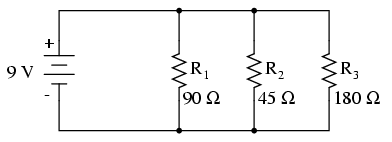
This is an example of a ______ circuit
a)
Series
b)
Parallel
c)
Open
d)
Dihexihedral
12.
What kind of circuit is this?
a)
Series
b)
Consecutive
c)
Parallel
d)
Training
13.
A series circuit has ____ path(s) that the electric current can take. 
a)
One
b)
Two 
c)
Three 
d)
Four
14.
What type of circuit is used in your house?
a)
Light Circuits
b)
The best circuits
c)
Series Circuits
d)
Parallel Circuits
15.
What is the type of circuit that stops working when one bulb goes out?
a)
A broken circuit
b)
Parallel Circuit
c)
Series Circuit
d)
A metal circuit
16.
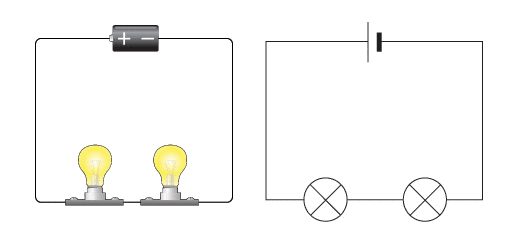
What will happen if one light bulb is removed from this circuit?
a)
The other bulbs will go out.
b)
The other bulbs will stay on
c)
The other bulbs will get dimmer.
d)
The battery will become stronger.
17.
Electrical power can be calculated using
a)
Resistance x Voltage
b)
Voltage x Current 
c)
Voltage ÷ Current
18.
The voltage supplied to a circuit is 17 V and the current running through is 10 A. What is the power generated?
a)
170 W
b)
170 A
c)
1.7 V
d)
1.7 W
19.

What is the unit of Electrical Power?

a)

Joule

b)

Watt

c)

Where

d)

Amp

20.

Match the following loads with the power they will draw on a 100v supply.

a)

150w

1.

1.5 amp load

b)

15w

2.

0.15 amp load

c)

6.6w

3.

0.066 amp load

d)

1500w

4.

15 amp load

21.
Calculate the current when the potential difference is 10V and resistance is 2Ω
a)
5mA
b)
5A
c)
20A
d)
0.2A
22.
How many volts are in a circuit with a battery that has a resistance of 10 Ohms and a current of 2 Amps? 
a)
.5 Volts
b)
5 Volts
c)
20 Volts
23.
What is the power of a 20V bulb with 5A through it?
a)
100W
b)
100V
c)
6.3W
d)
6.3A
24.
What is the power of a 3V light bulb with 20 A running through it?
a)
0.15W
b)
6W
c)
60W
d)
6.67W
25.

In the equation P=IV, what does P stand for?

a)

Power

b)

Potential

c)

Polarity

d)

Possibility

26.

An electric bulb is connected to a 220V generator. The current is 0.50 A.

What is the power of the bulb?

a)

440W

b)

220W

c)

110W

d)

55W

27.

In the equation, P=IV, what does I stand for?

a)

Current

b)

Incandescent

c)

Impulse

d)

Insulator

28.

In the equation P=IV, what does V stand for?

a)

Joules

b)

Volts

c)

Watts

d)

Five

29.

Match the following

a)

series circuit

1.

has only one path for electricity to flow

b)

parallel circuit

2.

has more than one path for electricity to flow

c)

open circuit

3.

electricity does not flow because there is a break in the circuit.

d)

short circuit

4.

current high due to lack of resistance

30.
a)
Series circuit
b)
Incomplete circuit
c)
Parallel circuit
d)
Power source
31.
Does this diagram represent a series or parallel circuit?
a)
series circuit
b)
parallel circuit
32.

This is an example of a ______ circuit

a)

Series

b)

Parallel

c)

Open

d)

Dihexihedral

33.

What type of circuit is shown?

a)
Single circuit
b)
Parallel circuit
c)
Combination circuit
d)
Series circuit
34.
As the resistance of a circuit increases, the current will
a)
increase
b)
decrease
c)
stay the same
35.
What is the unit for resistance?
a)
Volts
b)
Amperes
c)
Ohms
36.
What word means how hard it is for electrons to flow through.
a)
Current
b)
Voltage
c)
Resistance
d)
Power
37.
What is the type of circuit that stops working when one bulb goes out?
a)
A broken circuit
b)
Parallel Circuit
c)
Series Circuit
d)
A metal circuit
38.

What is the voltage across a resistor with a resistance of 10 ohms and a current of 3 amps?

a)

10V

b)

20V

c)

30V

d)

40V

39.

What is the formula to calculate electrical power?

a)

P = IV

b)

P = IR

c)

P = V/R

d)

P = I^2R

40.

In a parallel circuit, if one component fails, the rest of the components will:

a)

Stop working

b)

Continue working

c)

Explode

d)

Increase resistance

41.
What is the power of a 20V bulb with 5A through it?
a)
100W
b)
100V
c)
6.3W
d)
6.3A
42.

What is the device shown?

a)

Electromagnet

b)

Solenoid

c)

Generator

d)

Motor

43.

Which three materials would allow you to build an electromagnet?

a)

Battery, Wire, Nail

b)

Battery, Tape, Paper

c)

Wire, Nail, Paper Clip

d)

Sandpaper, Tape, Wire

44.

What makes electromagnets different from regular magnets?

a)

they can be switched off and on

b)

they use less energy

c)

they are more user-friendly

d)

they do not pollute the environment

45.

What will the magnets in the picture do?

a)

Attract

b)

Repel

c)

Neither attract nor repel

d)

Both attract and repel

46.

What will the magnets in the picture do?

a)

Attract each other

b)

Repel each other

c)

Both attract and repel

d)

Neither attract nor repel

47.

Are the magnets in this picture attracting or repelling?

a)

Attracting

b)

Repelling

48.
What is the Voltage of a circuit that has a resistance of 5 Ω and a current of 2 A?
a)
25 V
b)
10 V
c)
2.5 V
d)
0.4 V
49.
How many Volts would we need to produce a current flow of 8 Amps through a 6 Ohm resistor
a)
12 volts
b)
24 volts
c)
1.3333
d)
48 volts
50.
How many Volts would it take to push 1 Amp through a resistance of 1 Ohm
a)
10 volts
b)
1 volt
c)
48 volts
d)
5 volts
51.
What size resistor would produce a 3 Amp current flow with a 12 Volt battery
a)
1 Ohm
b)
3 Ohms
c)
4 Ohms
d)
12 Ohms
52.
If the Voltage stays the same and Resistance is increased, Current will 
a)
Increase
b)
Decrease
c)
Stay the same
d)
Not enough info
53.

The voltage of the battery is 8 volts. If the current must double but the light bulb is remaining the same, the battery must be replaced by one with ____ volts

a)

16 volts

b)

8 volts (the battery voltage won’t change)

c)

4 volts

d)

More information is needed

54.
What is the power of a 20V bulb with 5A through it?
a)
100W
b)
100V
c)
6.3W
d)
6.3A
55.
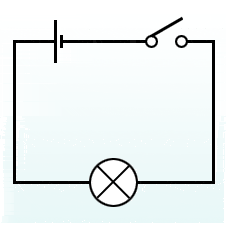
this circuit is .....?
a)
open
b)
parallel
c)
closed
d)

short

56.

What is the formula to calculate electrical resistance?

a)

R = V/I

b)

R = I/V

c)

R = P/V

d)

R = V*I

57.

What is the unit of electric current?

a)

Ampere

b)

Volt

c)

Ohm

d)

Watt

58.

If a circuit has a resistance of 5 ohms and a current of 2 amps, what is the voltage across the circuit?

a)

10 volts

b)

5 volts

c)

2.5 volts

d)

1 volt

59.
The flow of electricity requires a
a)
complete path
b)
incomplete path
c)
insulated current
d)
complex circuit
60.
With the engine running the charging system produces 14.5 Volts what would the current flow be if a resistance of 6 Ohms was present
a)
2.41 Ohms
b)
2.52 Ohms
c)
2.1 Ohms
d)
0.3333 Ohms
61.

In the circuit shown below, the battery voltage is 20 volts. What will be the reading of the ammeter shown in the circuit?

a)

1.50 A

b)

0.50 A

c)

0.40 A

d)

0.20 A

62.
How would flipping the magnet in this experiment change the current?
a)
The current would not change
b)
The current would go to the right
c)
There would be no current
d)
The current would go CRAZY
63.

Which activity will produce the highest current?

a)

Move the magnet bar into the coil while the coil remains stationery

b)

Move the coil into the magnet bar while the magnet remains stationery

c)

Move the coil and magnet towards each other

d)

Move the coil and magnet away from each other

64.

What type of current is being produced?

a)

Alternating

b)

Direct

65.

What happens to the current if the voltage is doubled and the resistance remains constant?

a)

It doubles

b)

It halves

c)

It stays the same

d)

It becomes zero

66.

If a circuit has a resistance of 10 Ohms and a current of 2 Amps, what is the voltage across the circuit?

a)

5 Volts

b)

10 Volts

c)

20 Volts

d)

40 Volts