
 Worksheets
Matter in our surroundings
Total questions: 70
Worksheet time: 41mins
Which one of the following is an example of a fluid?
Oxygen
Carbon
Phosphorus
Sulphur
235K = _________°C
38
-20
20
-38
Which of the following statements is NOT true?
The molecules in a liquid and a gas can flow.
The molecules in a liquid are arranged in a regular pattern.
The molecules in a gas move about randomly at high speed.
The molecules in a solid vibrate about a fixed position
Name the process by which dry ice changes into carbon dioxide gas.
Evaporation
Condensation
Sublimation
Vaporisation
At what temperature liquid water and steam co-exist?
At the melting point of ice
At the boiling point of water
At the freezing point of water
At the condensation point
Melting point of ice is
273.16K
373.15K
100°C
250.18K
Which of the following undergoes sublimation?
Sodium chloride
Potassium chloride
Ammonium sulphate
Ammonium chloride
In which of the following conditions, the distance between the molecules of hydrogen gas would decrease?
Increasing the pressure on hydrogen in a closed container
Increasing the volume of the container of hydrogen gas
Heating the container
Some hydrogen gas leaking out of container
Which one among the followings has a fixed volume but no fixed shape?
Carbon dioxide
Ice
Kerosene
Xenon
A few substances are arranged in the increasing order of ‘forces of attraction’ between their particles. Which one of the following is the correct arrangement?
oxygen – honey – sugar
oil – air– salt
juice – salt – oxygen
salt – air – sugar solution
Which one of the following is an example of a fluid?
Oxygen
Carbon
Phosphorus
Sulphur
235K = _________°C
38
-20
20
-38
Which of the following statements is NOT true?
The molecules in a liquid and a gas can flow.
The molecules in a liquid are arranged in a regular pattern.
The molecules in a gas move about randomly at high speed.
The molecules in a solid vibrate about a fixed position
Name the process by which dry ice changes into carbon dioxide gas.
Evaporation
Condensation
Sublimation
Vaporisation
At what temperature liquid water and steam co-exist?
At the melting point of ice
At the boiling point of water
At the freezing point of water
At the condensation point
Melting point of ice is
273.16K
373.15K
100°C
250.18K
Which of the following undergoes sublimation?
Sodium chloride
Potassium chloride
Ammonium sulphate
Ammonium chloride
In which of the following conditions, the distance between the molecules of hydrogen gas would decrease?
Increasing the pressure on hydrogen in a closed container
Increasing the volume of the container of hydrogen gas
Heating the container
Some hydrogen gas leaking out of container
Which one among the followings has a fixed volume but no fixed shape?
Carbon dioxide
Ice
Kerosene
Xenon
A few substances are arranged in the increasing order of ‘forces of attraction’ between their particles. Which one of the following is the correct arrangement?
oxygen – honey – sugar
oil – air– salt
juice – salt – oxygen
salt – air – sugar solution
The substances which occupy some space and having some mass called
Particles
Impure substance
Ions
Matter
Particles of matter having space between them is called
Interstitial space
Intermolecular space
Vacant space
None of the above
On which factors evaporation does not depend
Humidity
Temperature
Surface area
Quality of matter
The temperature at which vapour pressure of liquid is equal to atmospheric pressure is
Melting point
Freezing point
Boiling point
None of the above
Which is known as dry ice.
CO2
H2O
Fruit ice
Both a &b
The amount of heat which is used to change the state of matter not for increase the temperature is called
Latent heat
Specific heat
Heat capacity
None of the above.
The process in which solid is directly convert into gas is called
Condensation
Boiling
Evaporation
None of the above.
Convert 473k into degree Celsius
(a)
What is the unit of pressure?
(a)
What will be the impact on the density of matter if we heat or decreases the pressure of the matter?
Increase
Decrease
First increase then decreases
First decreases then increase
None of the above
The substances which occupy some space and having some mass called
Particles
Impure substance
Ions
Matter
Particles of matter having space between them is called
Interstitial space
Intermolecular space
Vacant space
None of the above
On which factors evaporation does not depend
Humidity
Temperature
Surface area
Quality of matter
The temperature at which vapour pressure of liquid is equal to atmospheric pressure is
Melting point
Freezing point
Boiling point
None of the above
Which is known as dry ice.
CO2
H2O
Fruit ice
Both a &b
The amount of heat which is used to change the state of matter not for increase the temperature is called
Latent heat
Specific heat
Heat capacity
None of the above.
The process in which solid is directly convert into gas is called
Condensation
Boiling
Evaporation
None of the above.
Convert 473k into degree Celsius
(a)
What is the unit of pressure?
(a)
What will be the impact on the density of matter if we heat or decreases the pressure of the matter?
Increase
Decrease
First increase then decreases
First decreases then increase
None of the above
In which state of matter , process of diffusion is fastest?
Liquids
Gases
Solids
Semi - solids
The state of matter which is found to be more stable at lower temperature:
Solid
Liquid
Gas
BEC
During summer, water kept in an earthen pot becomes cool because of the phenomenon of:
diffusion
transpiration
osmosis
evaporation
A few substances are arranged in the increasing order of 'forces of attraction'between their particles.Which one of the following represents a correct arrangement?
Water,air,wind
Air,sugar,oil
Oxygen,water,sugar
Sugar,juice,air
On which factors evaporation does not depend
Humidity
Temperature
Surface area
Quality of matter
when 2-3 crystals of potassium permanganate are dissolved in water, the colour of water will be
blue
green
yellow
purple pink
The fifth state of matter is given by?
Subhash Chandra Bose
Albert Einstein
Satyendra Nath Bose
Both Satyendra Bose and Einstein
which condition out of the following will increase the evaporation of water?
increase in temperature of water
decrease in temperature of water
less exposed surface area of water
adding common salt to water
Seema took a 100 ml beaker and filled half the beaker with water and marked the level of water. She dissolved some salt with the help of a glass rod and recorded water level again.
The water level increases appreciably
The water level decreases
The water level remains the same
There is little increase in water level.
Which of the following is not a characteristic of matter?
Matter is made up of extremely small particles
There is no space between particles of matter
The particles of matter are continuously moving
The particles of matter attract each other.
Shivam visited an LPG unit and found that the gas can be liquified at specific conditions of temperature and pressure. Help him to identify the correct set of conditions.
High temperature and high pressure.
Low temperature and low pressure.
Low temperature and high pressure.
High temperature and low pressure.
If we keep cold drink bottle in freezer, what will happen?
Water will change into ice
Cold drink bottle will break
CO2 gas will get solidified
Nothing happens.
Choose the correct statement out of the following
Conversion of solid into vapours without becoming liquid is called evaporation.
Conversion of vapours into solid without becoming liquid is called sublimation
Conversion of solid into liquid is called sublimation.
Conversion of liquid into vapours is called fusion.
Which of the following will produce severe burns ?
Cold water
Hot water
Boiling water
Steam
Ice floats on water because
it has higher density than water
it has lower density than water due to more volume
it is solid
it is low melting solid
Latent heat of fusion is amount of
heat energy required to change 1 kg solid into liquid completely at its melting point.
heat energy required to convert 1 kg solid into liquid at room temperature
heat energy required to change 1 g of solid into liquid completely
heat energy required to change 1 kg of solid into liquid at any temperature.
Latent heat of fusion is amount of
heat energy required to change 1 kg solid into liquid completely at its melting point.
heat energy required to convert 1 kg solid into liquid at room temperature
heat energy required to change 1 g of solid into liquid completely
heat energy required to change 1 kg of solid into liquid at any temperature.
Which of the following has minimum kinetic energy ?
Particles of ice below 0 °C
Particles of water at 0 °C
Particles of water at 100 °C
Particles of steam at 100 °C
Which of the following cannot be separated by sublimation?
Iodine and NaCl
Iodine and Ammonium chloride
Camphor and Sodium chloride
Naphthalene and Sand
When water gets solidified into ice, then heat is:
absorbed
evolved
first absorbed then evolved
initially evolved then absorbed
Which of the following statement is not true regarding the characteristic of matter?
Particles of a matter are randomly moving in all directions.
Kinetic energy of the particles increases with a rise in temperature
Kinetic energy of the particles of all maters remains the same at a particular temperature.
Particles of matter diffuse into each other on their own.
Which of the following statement is correct?
Materials existing as liquids at room temperature have their melting and boiling points lower than that of room temperature.
The phenomenon involving the transition of a substance from solid to liquid state is called sublimation.
To convert a temperature on the Celsius scale to Kelvin scale, subtract 273 from the given temperature
The density of ice is less than that of water.
Which of the following cannot be considered a form of matter?
atom
water
cold
electron
Which of the following phenomena always results in the cooling effect?
condensation
sublimation
crystallisation
evaporation
When heat is constantly supplied by a burner to boiling water, then the temperature of water during vapourisation
Rises very slowly
Rises rapidly until steam is produced
First rises and then becomes constant
Does not rise at all
When water at 0°C freezes to form ice at the same temperature of 0°C, then it
Absorbs some heat
Releases some heat
Neither absorbs nor releases heat
Absorbs exactly 3.34 x 10⁵J/kg of heat
Which one of the following statements is not true?
The molecules in a solid vibrate about a fixed position
The molecules in a liquid are arranged in a regular pattern
The molecules in a gas exert negligibly small forces on each other, except during collisions
The molecules of a gas occupy all the space available
In which of the following conditions, the distance between the molecules of hydrogen gas would increase?
(i) Increasing pressure on hydrogen contained in a closed container
(ii) Some hydrogen gas leaking out of the container
(iii) Increasing the volume of the container of hydrogen gas
(iv) Adding more hydrogen gas to the container without increasing the volume of the container
(i) and (iii)
(i) and (iv)
(ii) and (iii)
(ii) and (iv)
A student heats a beaker containing ice and water. He measures the temperature of the content of the beaker as a function of time. Which of the following will correctly represent the result.
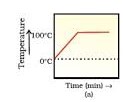
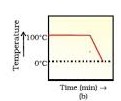
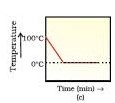
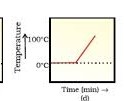
which condition out of the following will increase the evaporation of water?
increase in temperature of water
decrease in temperature of water
less exposed surface area of water
adding common salt to water

