
 Worksheets
Physics Ch 4 Forces & the Laws of Motion
Total questions: 67
Worksheet time: 2hrs 43mins
Name
Class
Date
1.

What is the net force?
a)
5000 N right
b)
4000 N right
c)
40 N left
d)
4000 N left
2.
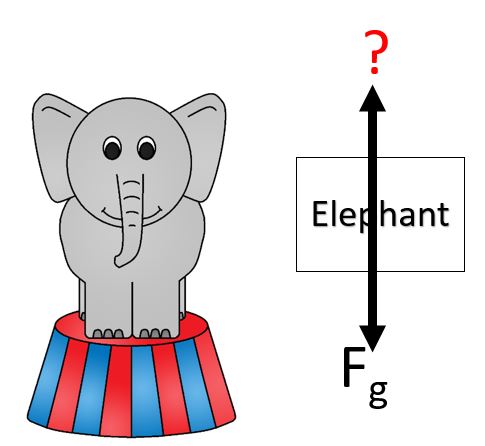
Name the missing force...
a)
weight force
b)
normal force
c)
applied force
d)
frictional force
3.

Name the missing force...
a)
applied force
b)
weight force
c)
tension force
d)
drag
4.
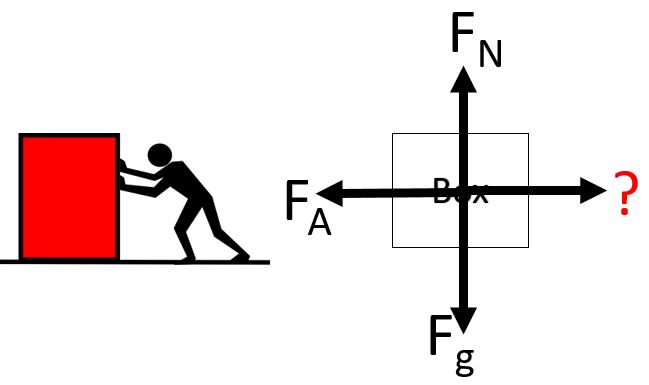
Name the missing force...
a)
frictional force
b)
weight force
c)
thrust
d)
buoyant force
5.

Calculate the net force acting upon the object.
a)
7.2 N northwest
b)
8.5 N southwest
c)
2 N northeast
d)
10 N northeast
6.

a)
1.) A surf boarder, on his surfboard, is coasting to the right sliding into a sandy beach.
b)
1.) A motorcycle is driving at a constant velocity down the highway.
c)
1.) A dog is pulling on his leash, dragging his small owner across the porch.
d)
1.) A bowl of tomatoes is resting on the kitchen counter.
7.
A person is pushed forward into their seatbelt when a car stops. Which of Newton's laws explains this motion?
a)
1st law
b)
2nd law
c)
2 and 3 law
d)
3rd law
8.

a)
1st
b)
2nd
c)
3rd
9.

a)
1st
b)
2nd
c)
3rd
10.

a)
1st
b)
2nd
c)
3rd
11.
Objects tendency to resist change
a)
Friction
b)
Inertia
c)
Force
d)
Gravity
12.

A magician pulls a tablecloth out from under dishes and glasses on a table without disturbing them.
a)
Newton's 1st Law
b)
Newton's 2nd Law
c)
Newton's 3rd Law
13.

Pushing a child on a swing is easier than pushing an adult on the same swing, because the adult has more inertia.
a)
Newton's 1st Law
b)
Newton's 2nd Law
c)
Newton's 3rd Law
14.

A soccer ball accelerates more than a bowling ball when thrown with the same force.
a)
Law of Inertia
b)
Law of Acceleration
c)
Law of Conservation of Momentum
15.

This person bought coffee and put it on the seat next to them. If they stopped quickly and the coffee spilled which law would that represent?
a)
Newton's 1st Law
b)
Newton's 2nd Law
c)
Newton's 3rd Law
16.

When you step on a Lego, you push on the Lego and the Lego pushes back on you.
a)
Newton's 1st Law
b)
Newton's 2nd Law
c)
Newton's 3rd Law
17.
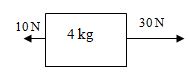
Calculate the Acceleration.
a)
20
b)
5
c)
.2
d)
80
18.

Calculate the Acceleration.
a)
8
b)
1
c)
.125
d)
5
19.
An object of mass 30 kg is falling in air and experiences a force due to air resistance of 50 newtons. Calculate the acceleration of the object.
a)
-8.1
b)
-.666
c)
-11.5
d)
-.83
20.

A horse pulls forward on a carriage with a given force. By Newton's Third Law, the carriage must be pulling on the horse backward with an equal and opposite force. Given this, what explains why the horse and carriage can move forward?
a)
The cart is rolling on wheels and has a smaller frictional force while the horse's hooves have more friction with the ground
b)
The cart's force is only in reaction to the horse's force so it does not define direction of movement
c)
The forward and backward forces are equal, so it actually can't move forward
d)
The forward force of the horse is just big enough to overcome the backward force of the cart and start the cart forward
21.
A bus hits a bug and the bug splatters on the windshield, which acceleration is greater?
a)
The bus
b)
The bug
c)
They are the same
d)
not possible to determine
22.
A bus hits a bug and the bug splatters on the windshield, which force is greater?
a)
The Bus
b)
The Bug
c)
They're the same
d)
Gravity acting on the bus
23.
A book rests on a table. The force of gravity pulls down on the book with a force of 20 newtons. What prevents the books from accelerating downward at 9.8 m/sec2
a)
The table presses back up on the book with an equal and opposite force of 20 newtons.
b)
The table presses back up on the book with a force greater than 20 newtons.
c)
The table and the book together are accelerating downwards at 9.8 m/sec2
d)
The inertia of the book holds it up
24.
When gravity pulls a skydiver towards the Earth, the reaction force is...
a)
The skydiver pulling the Earth.
b)
Air resistance
c)
The weight of the skydiver
d)
Drag
25.
In the interaction between the skydiver and the Earth, which object will accelerate most and why?
a)
The Earth will accelerate more due to its inertia.
b)
The skydiver will accelerate more due to air resistance.
c)
The skydiver will accelearate more since he/she has less inertia.
d)
Both the Earth and the skydiver acceelrate eqyually due to Newton's third law.
26.
An object is moving at a constant velocity. What can you say about the forces on it?
a)
They are unbalanced
b)
They are balanced
c)
They are all acting in the same direction
d)
There cannot be any forces on it
27.
Name the 2 factors that affect acceleration of an object
a)
velocity and time
b)
distance and time
c)
mass and force
d)
mass and time
28.
The measure of the pull of gravity on an object is ___________________.
a)
motion
b)
weight
c)
speed
d)
friction
29.
You hit a wall with a stick. The equal but opposite reaction is _____
a)
the wall pushes against you
b)
the stick pushes against you
c)
you push against the stick
d)
the wall pushes against the stick
30.

What does this tool measure?
a)
weight
b)
meters
c)
mass
d)
force
31.

What does this tool measure?
a)
weight
b)
meters
c)
mass
d)
force
32.
Which of the following never changes no matter where in the universe?
a)
weight
b)
force
c)
mass
d)
pounds
33.
A person would weigh less on on the Moon than on the Earth because . . .
a)
Moon has more mass, and therefore more gravity
b)
Moon has less mass, and therefore more gravity
c)
Moon has more mass, and therefore less gravity
d)
Moon has less mass and therefore less gravity
34.

Which of the following will change with different gravitational forces?
a)
mass
b)
amount of matter in an object
c)
weight
d)
kilograms
35.

Scientists measure weight using which SI unit?
a)
Pounds
b)
Newtons
c)
M/S
d)
Kg
36.
Which law explains why you need to wear a seat belt?
a)
First
b)
Second
c)
Third
d)
Gravity
37.
A force acting in the opposite direction of an object in motion
a)
Gravity
b)
Buoyant
c)
Friction
d)
Normal
38.

The picture shows which one of Newton's Laws?
a)
1st Law
b)
2nd Law
c)
3rd Law
39.
A person punches a wall with 100 newtons of force. How much force does the person experience on his fist?
a)
50 Newtons
b)
100 Newtons
c)
200 Newtons
d)
Need more information
40.
When a fly crashes into a bus. The forces are the same. Why are the effects so different?
a)
The bus has more mass so it reacts less
b)
The bus has less mass so it reacts more
c)
The bus is heavier
41.

Why does this work?
a)
Objects at rest stay at rest
b)
Objects in motion stay in motion
c)
Every action has an equal and opposite reaction
d)
Momentum
42.

What type of friction is not moving?
a)
static
b)
dynamic
c)
kinetic
d)
rolling
43.
Which is NOT a contact force?
a)
drag
b)
friction
c)
gravity
d)
acceleration
44.
Why does a truck carrying cement blocks take longer to brake than the exact same truck, with the same force exerted by the brakes, with no cement blocks?
a)
It has more mass
b)
The breaks are stronger
c)
Friction of the road
d)
The push of the road up and the push of gravity
45.
Which will have the smallest change in motion?
a)
a small force on an object with little mass
b)
a large force on an object with little mass
c)
a large force on an object with large mass
d)
a small force on an object with large mass
46.
A newton is equivalent to which of the following quantities?
a)
m/s2
b)
kg•(m/s)2
c)
kg
d)
kg•m/s
47.

The free-body diagram represents a car being pulled by a towing cable. In the diagram, which
of the following is the gravitational force acting on the car?
of the following is the gravitational force acting on the car?
a)
5800
b)
13 690
c)
14 700
d)
13 690 - 14 700 = -1110
48.
A car goes forward along a level road at constant velocity. The additional force needed to bring the car into equilibrium is
a)
the normal force times the coefficient of kinetic friction
b)
greater than the normal force times the coefficient of static friction.
c)
zero
d)
equal to the normal force times the coefficient of static friction.
49.
A late traveler rushes to catch a plane, pulling a suitcase with a force directed 30.0° above the horizontal. If the horizontal component of the force on the suitcase is 60.6 N, what is the force exerted on the handle?
a)
95.6
b)
53.0
c)
70.0
d)
65.2
50.
A sculpture is suspended in equilibrium by two cables, one from a wall and the other from the ceiling of a museum gallery. Cable 1 applies a horizontal force to the right of the sculpture and has a tension, FT1. Cable 2 applies a force upward and to the left at an angle of 37.0° to the negative x-axis and has a tension, FT2 . The
gravitational force on the sculpture is 5.00 × 10³N. What is FT2?
gravitational force on the sculpture is 5.00 × 10³N. What is FT2?
a)
8310 N
b)
4440 N
c)
6640 N
d)
3340 N
51.
A free-body diagram of a ball falling in the presence of air resistance would show
a)
a downward arrow to represent the force due to gravity and an upward arrow to represent the force of air resistance.
b)
an upward arrow to represent the force due to gravity and a downward arrow to represent the force of air resistance.
c)
only a downward arrow to represent the force of air resistance.
d)
only a downward arrow to represent the force due to gravity.
52.
Accelerations are produced by
a)
forces
b)
velocities
c)
accelerations
d)
masses
53.
When an object reaches terminal velocity its acceleration is
a)
0m/s2
b)
4.9m/s2
c)
9.8 m/s2
54.
A cart is moving with a constant force. A load is suddenly added to it, such that the carts mass doubles. What happens to the cart's acceleration?
a)
it quarters
b)
it halves
c)
it stays the same
d)
it doubles
55.
Recall: a= ∑F/m
You push with 30N on a 10kg chest. There is a 5N friction force. What is the acceleration?
You push with 30N on a 10kg chest. There is a 5N friction force. What is the acceleration?
a)
0m/s2
b)
2.5m/s2
c)
3m/s2
d)
6m/s2
56.

The diagram above shows a box being pulled up the ramp. Which letter represents applied force?
a)
A
b)
B
c)
C
d)
D
57.
If the force of friction on a sliding object is 10N, how much force do you need to apply to maintain a constant velocity (if it is already moving)?
a)
0 N
b)
less than 10 N
c)
more than 10 N
d)
10 N
58.
When all of the forces acting on an object add up to zero, it is called:
a)
equilibrium
b)
status quo
c)
inertia
d)
normal
59.

The parachuter pulls his ripcord and deploys the parachute. As soon as the parachute opens, what is true?
a)
His acceleration is upward
b)
He has almost no air resistance
c)
His velocity is upwards
d)
All of these are true
60.

What is the terminal velocity of a parachuter with an open parachute compared to one with a closed parachute?
a)
The open parachute has a zero velocity
b)
The open parachuter has the same constant velocity as the closed parachute
c)
The open parachuter has a slower constant velocity than the closed parachute
d)
The open parachuter is accelerating
61.
How much force would it take to accelerate a 4.0 kg object that speeds up from 3.0 m/s to 29 m/s in 8.0 seconds?
a)
13 N
b)
3.25 m/s
c)
3.25 N
d)
3.25 m/s2
62.

Given the FBD, which of the following must be true?
a)
The frictional force must be accelerating the system to the left.
b)
The box must be accelerating to the right.
c)
The box must be moving to the right.
d)
The FBD is incorrectly drawn. This situation isn't possible
63.

Which of the following is not true about the system?
a)
T3 is equal to the sum of the magnitudes of T2 and T1
b)
T3 is equal in magnitude to Fg
c)
The x- components of the T1 and T2 and equivalent but in opposite directions
d)
The system is in equilibrium.
64.

Match description with free-body diagram.
a)
A force is applied to the right to drag a sled across loosely packed snow with a rightward acceleration. Neglect air resistance.
b)
A football is moving upwards towards its peak after having been booted by the punter. Neglect air resistance.
c)
A car is coasting to the right and slowing down. Neglect air resistance.
d)
A skydiver is descending with a constant velocity. Consider air resistance.
65.

Match description with free-body diagram.
a)
A book is at rest on a tabletop.
b)
A gymnast holding onto a bar, is suspended motionless in mid-air. The bar is supported by two ropes that attach to the ceiling. Diagram the forces acting on the combination of gymnast and bar.
c)
An egg is free-falling from a nest in a tree. Neglect air resistance.
d)
A flying squirrel is gliding (no wing flaps) from a tree to the ground at constant velocity. Consider air resistance.
66.

Match description with free-body diagram.
a)
A book is at rest on a tabletop.
b)
A gymnast holding onto a bar, is suspended motionless in mid-air. The bar is supported by two ropes that attach to the ceiling. Diagram the forces acting on the combination of gymnast and bar.
c)
An egg is free-falling from a nest in a tree. Neglect air resistance.
d)
A flying squirrel is gliding (no wing flaps) from a tree to the ground at constant velocity. Consider air resistance.
67.
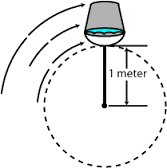
You swing a bucket of water attached to a string in a circle above your head. What keeps the water in the bucket?
a)
Friction
b)
Centripetal Force
c)
Gravity
d)
Inertia
100 %

