
 Worksheets
Cardiovascular Unit Review
Total questions: 43
Worksheet time: 43mins
What are the upper chambers of the heart called?
Pulmonary Veins
Atria
Ventricles
Vena Cava
Which of the following LEAST LIKELY applies to the tricuspid valve?
Deoxygenated blood flows through it
It is found on the right side of the heart
It has 3 cusps
It separates the left ventricle and aorta
Blood from the lower body enters the heart through what structure?
Superior Vena Cava
Inferior Vena Cava
Pulmonary Veins
Descending Aorta
Which of the following options BEST describes a relationship between the heart and lungs
The lungs send deoxygenated blood to the heart
Blood is sent to the lungs to get more carbon dioxide
Blood travels from the heart to the lungs through the pulmonary veins
The right ventricle has thin walls since it only has to pump blood a short distance to reach the lungs
Where would you expect to find the mitral valve?
Between the left ventricle and aorta
Between the right and atrium and ventricle
Between the left atrium and left ventricle
Between the right ventricle and pulmonary trunk
When following normal blood flow, which is LAST to receive oxygenated blood?
Descending aorta
Left ventricle
Left atrium
Ascending aorta
The heart is made of primarily what type of tissue?
Skeletal Muscle
Cardiac Muscle
Smooth Muscle
Adipose
(SELECT ALL THAT APPLY) Which of the following would you expect to find in a muscle cell of the heart?
Troponin
Myosin
Calcium
Tropomyosin
What structure of the heart is responsible for holding together adjacent cardiac muscle cells of the heart?
Pericardium
Desomosomes
Gap Junctions
Sarcomeres
Gap junctions are very important structures found within the heart. Which of the following DOES NOT apply to gap junctions.
Gap junctions allow ions to travel from one cardiac muscle cell to the next
Gap junctions are found in intercalated discs
Gap junctions are pores or openings between cardiac muscle cells
Gap junctions allow the four chambers of the heart to contract at the same time
What is the role of the sarcoplasmic reticulum found in cardiac tissue?
It releases sodium and potassium to help produce an action potential
It regulates the pace of the heartbeat
It releases ATP to power the cross bridge cycle
It stores and releases calcium into the sarcomeres
Which of the following statements is ALWAYS true
Arteries transport oxygenated blood
Veins transport deoxygenated blood
The systemic circulation sends blood between the heart and lungs
Veins transport blood towards the heart
This structure is responsible for regulating and maintaining the pace of the heart beat
Atrioventricular Node
Sinoatrial Node
Purkinje Fibers
Bundle of His
Which structure is responsible for being the primary location of gas, nutrient, and hormone exchange between the blood and body tissues?
Veins
Arteries
Capillaries
Lungs
Which of the following applies to elastic arteries
They transport deoxygenated blood
They make up the aorta
They have relatively thin walls
They help control vasoconstriction
Which of the following DOES NOT apply to most of the named arteries in the body
They are muscular arteries
They help control vasoconstriction
They are the smallest arteries
They transport blood to most of the major organs of the body
What structure would you least likely find a valve in?
Veins
Muscular arteries
The heart
Aorta
Which of the following statements is true?
Arteries have thinner walls than veins
Semilunar valves are found between the atria and ventricles
The wall of the left ventricle is thicker than the wall of the right ventricle
The rate of blood flow to tissues of the body remains constant at all times
Which of the following structures would you least likely find oxygenated blood in?
Pulmonary veins
Capillaries
Aorta
Superior Vena Cava
(SELECT ALL THAT APPLY) Which of the following structures would you expect to find deoxygenated blood in?
Aortic Arch
Venules
Pulmonary arteries
Pulmonary trunk
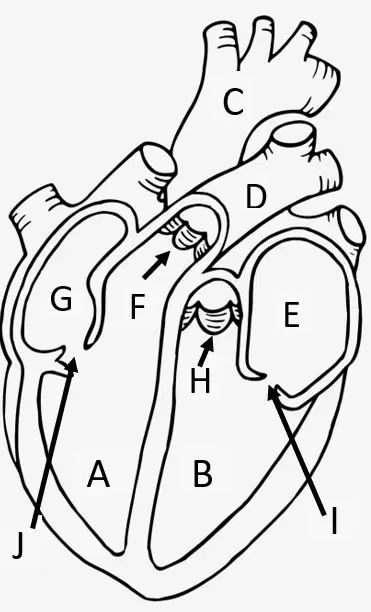
(ARROWS ARE POINTING TO VALVES)
Which structure is labeled "D"
Pulmonary Vein
Aorta
Superior Vena Cava
Pulmonary Trunk
(ARROWS ARE POINTING TO VALVES)
Which structure is labeled "H"
Pulmonary Valve
Aortic Valve
Tricuspid Valve
Mitral Valve
(ARROWS ARE POINTING TO VALVES)
Which structure is labeled "A"
Right Ventricle
Right Atrium
Left Atrium
Left Ventricle
(ARROWS ARE POINTING TO VALVES)
Which structure is labeled "I"
Mitral Valve
Pulmonary Valve
Aortic Valve
Tricuspid Valve
(ARROWS ARE POINTING TO VALVES)
Which labeled structure receives oxygenated blood first?
G
C
E
D
Which of the following is the liquid portion of blood?
Plasma
RBCs
WBCs
Platelets
The component of blood responsible for carrying out functions of the immune system
Plasma
RBCs
WBCs
Platelets
The component of blood responsible for blood clotting
Plasma
RBCs
WBCs
Platelets
The component of blood responsible for transporting wastes, hormones, and nutrients from your diet
Plasma
RBCs
WBCs
Platelets
The component of blood responsible for transporting oxygen and carbon dioxide throughout the body
Platelets
RBCs
WBCs
Platelets
Which of the following options shows WBCs listed in an order of most to least prevalent
Basophil -> Lymphocyte -> Neutrophil
Monocyte -> Eosinophil -> Basophil
Neutrophil -> Basophil -> Lymphocyte
Monocyte -> Lymphocyte -> Neutrophil
When would you expect a patient's blood to contain active platelets?
If the patient has a laceration causing bleeding
If the platelets are freely traveling all throughout the circulatory system
If the patient is fighting a viral/bacterial infection
If the patient is dehydrated
Where does the electrical signal of cardiac conduction end?
Atrioventricular Node
Purkinje Fibers
Bundle of His
Sinoatrial Node
Identify the pathway of cardiac conduction from start to finish
SA Node -> Bundle of His -> Purkinje Fibers -> AV Node
Purkinje Fibers -> Bundle of His -> AV Node -> SA Node
Bundle of His -> Purkinje Fibers -> SA Node -> AV Node
SA Node -> AV Node -> Bundle of His -> Purkinje Fibers
Which of the following structures if NOT involved with the pulmonary circuit?
Pulmonary Veins
The valve that the left ventricle forces blood through
The valve that the right ventricle forces blood through
Pulmonary Trunk
Which of the following options does not correctly identify the order that blood flows through the cardiovascular system?
Vena Cava -> Right Atrium
Left Ventricle -> Pulmonary Trunk
Pulmonary Veins -> Left Atrium
Pulmonary Arteries -> Lungs
Which of the following occurs in the heart as the cardiac conduction electrical signal travels from sinoatrial node to the atrioventricular node?
The right atrium contracts, and then the left atrium
The left ventricles contract at the same time
Blood is forced to the lungs and heart
Blood flows through the tricuspid and mitral valves
Which of the following occurs in the heart once the cardiac conduction electrical signal reaches the Purkinje fibers
Calcium goes into the sarcomeres of the atria
The left ventricle contracts after the right ventricle
Blood exits the heart towards the aorta and lungs
The left and right atria contract at the same time
Which WBC type is responsible for killing bacteria/fungi, and foreign debris?
Basophils
Monocytes
Eosinophils
Neutrophils
Lymphocytes
Which WBC type is responsible for cleaning up damaged cells?
Basophils
Monocytes
Eosinophils
Neutrophils
Lymphocytes
Which WBC type is responsible for killing parasites, cancer cells, and aiding in allergic responses?
Basophils
Monocytes
Eosinophils
Neutrophils
Lymphocytes
Which WBC type is responsible for fighting viruses and making antibodies?
Basophils
Monocytes
Eosinophils
Neutrophils
Lymphocytes
Which WBC type is responsible for ONLY aiding in allergic responses?
Basophils
Monocytes
Eosinophils
Neutrophils
Lymphocytes

