wayground logo

Free Printable Worksheets

NEW

Font size

S
M
L
XL
Worksheets

Biology Final Exam Review

Total questions: 50

Worksheet time: 59mins

Name
Class
Date
1.

Which of the following is heterozygous?

a)

MM

b)

Mm

c)

mm

2.

What term denotes the physical expression of a gene?

a)

genotype

b)

phenotype

c)

appearance

d)

homologous

3.

Mendel's Law of Segregation means?

a)

Every person has two alleles for each trait, they segregate from each other and the dominant is passed more often.

b)

Every person has two alleles for each trait, Where two traits are being passed, they do not effect each other.

c)

Every person has two alleles for each trait, they segregate from each other and are passed down at random.

d)

Every person has two alleles for each trait, they segregate from each other and the recessive is passed more often.

4.

What is Mendel's Law of Independent Assortment?

a)

If the recessive allele is passed for one trait, then it is more likely that the recessive allele will be passed for the other trait.

b)

The passing of allele of one trait does not affect the passing of allele of another trait.

c)

If the dominant allele is passed for one trait, then it is more likely that the dominant allele will be passed for the other trait.

d)

If the dominant allele is passed for one trait, then it is more likely that the recessive allele will be passed for the other trait.

5.
What are the nucleotides made of?
a)
Sugar, Phosphate, nitrogen base
b)
Phosphate, Adenine, nitrogen base
c)
Thymine, Adenine, Cytomine
d)
Phosphate, Nitrogen, Adenine
6.
Adenine bonds with ______________.
a)
Guanine
b)
Thymine
c)
Cytosine
d)
Adenine
7.
The two strands of nitrogenous bases in DNA are joined by which type of bond?
a)
polar bonds
b)
ionic bonds
c)
covalent bonds
d)
hydrogen bonds
8.
A frameshift mutation can occur with either _________ or __________ mutations.
a)
Addition, division
b)
Deletion, substitution
c)
Addition, substitution
d)
Addition, deletion
9.
Normal-
GAG-CTC-GAC-AGA
Mutant
GAG CTC-CAC-AGA
a)
no mutation
b)
substitution
c)
insertion
d)
deletion
10.

During transcription, this type of ribonucleic acid is responsible for copying the DNA and brining it out of the nucleus.

a)

tRNA

b)

mRNA

c)

rRNA

d)

dRNA

11.
This is the triplet of bases on the end of a tRNA molecule
a)
Anticodon
b)
Codon
c)
Protein
12.
In chickens, feather color is codominant.  If a black chicken BB is mated with one that is black and white (BW) what are the chances of having a chicken that is black and white?
a)
50%
b)
0%
c)
25%
d)
100%
13.

In humans hemophilia is a recessive (h) X-Linked trait.

A male offspring was born with hemophilia, but both parents are normal.


What would the parents Genotypes have to be for this to happen?

a)

XHXH, XHY

b)

XHXh, XHY

c)

XHXH, XhY

d)

XhXh, XHY

14.
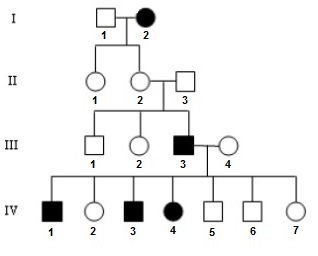
This pedigree represents the inheritance of hemophilia in this family. How many of the females have the hemophilia trait?
a)
8
b)
5
c)
2
d)
3
15.
Give the genotype for person II-1, for this autosomal trait.
a)
GG
b)
Gg
c)
gg
d)
we cannot be 100% sure of the genotype
16.
States that younger rocks lie above older rocks if the layers have not been disturbed
a)
Law of crosscutting
b)
Law of superposition
c)
Relative Dating
d)
Unconformity
17.
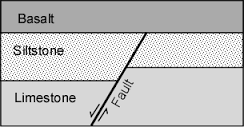
What are the relative ages of the features in order from oldest to youngest?
a)
Limestone, Basalt, Fault, Siltstone
b)
Siltstone, Fault, Basalt, Limestone
c)
Limestone, Fault, Basalt, Siltstone
d)
Limestone, Siltstone, Fault, Basalt
18.
If the half-life of a radioactive group of atoms is 100 years, then how old is the rock if there have been two half-lives?
a)
25 years
b)
200 years
c)
400 years
d)
800 years
19.
If 10 mg of iodine 131 is given to a patient, how much is left after 24 days? The half-life of iodine-131 is 8 days.
a)
1.25mg
b)
1.25g
c)
10g
d)
10mg
20.
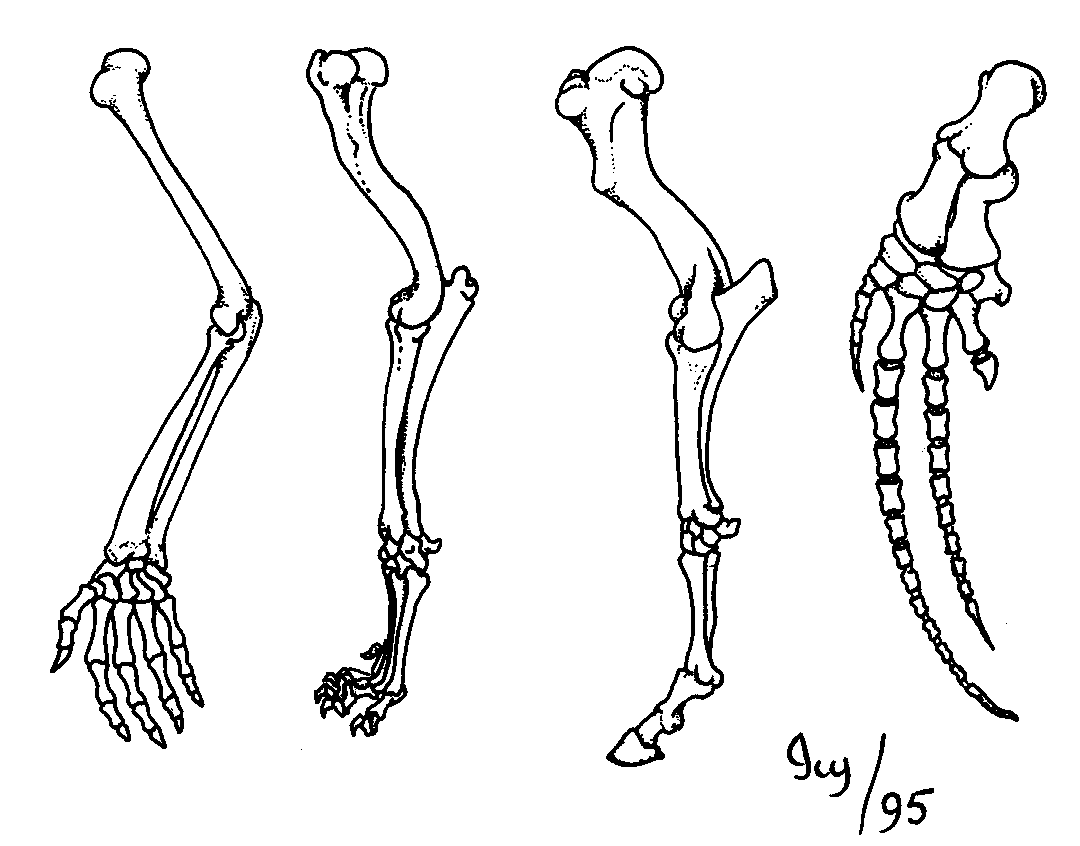
Structures with the same parts have different functions; suggests that organisms share a common ancestry
a)
vestigial structures
b)
homologous structures
c)
adaptive radiation
d)
fossil
21.
What does Darwin's theory of evolution suggest?
a)
species change over time
b)
extinct species are not related to living species
c)
different species can interbreed
d)
animals that look alike are most closely related
22.

Whales are aquatic mammals that contain a pelvis (hip) bone. Even though it does not aid in its movement, the function must have been used by a common ancestor of the whale. Thus, the pelvis is referred to as a(n)

a)

vestigial structure

b)

analogous structure

c)

homologous structure

23.
The ability of an organism to survive and reproduce in its specific environment 
a)
diversity.
b)
evolution
c)
adaptation
d)
 fitness
24.
Charles Darwin’s observation that finches of different species on the Galápagos Islands have many similar physical characteristics supports the hypothesis that these finches 
 
a)
have the ability to interbreed.
b)
acquired traits through use and disuse.
c)
all eat the same type of food.
d)
descended from a common ancestor.
25.
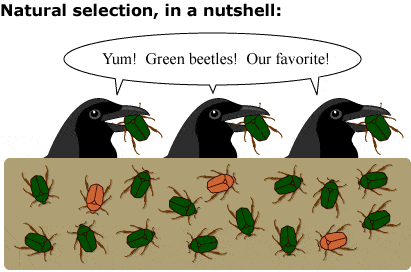
Which of the following is a factor in natural selection?
a)
Individuals of species compete with one another to survive.
b)
All species are genetically diverse.
c)
Individuals better able to adapt to changes leave more offspring.
d)
All are correct 
26.

Which of these is a condition that must be met for Hardy-Weinberg equilibrium?

a)

extremely small population size

b)

no natural selection

c)

gene flow

d)

nonrandom mating

27.

In generation 1, the recessive allele has a frequency of 0.6 and in generation 40, the recessive phenotype has a frequency of 0.36. Is the population is Hardy-Weinberg?

a)

No, the frequency changed from one generation to another.

b)

Yes, the frequency changed from one generation to another

c)

No, the frequency remained the same from one generation to another

d)

Yes, the frequency remained the same from one generation to another

28.
Some female peacocks prefer males with large, colorful tales while other female peacocks prefer males with no tail at all. Females are beginning to only mate with the type of males with the tail they prefer. What type of reproductive barrier is this?
a)
behavioral isolation
b)
hybrid sterility 
c)
temporal isolation
d)
mechanical isolation 
29.
The flowers of pink tulips open in the morning, while the flowers of lavender tulips open in the early afternoon. The bees that pollinate these tulips cannot carry pollen back & forth between the two types of tulips because of their flowers being closed at different times of day. What type of reproductive barrier is this?
a)
behavioral isolation
b)
hybrid sterility 
c)
temporal isolation
d)
mechanical isolation 
30.

Weathering and erosion both act on the surface of Earth. In what way is weathering similar to erosion?

a)

both are caused by freezing water

b)

wind and water are agents of both

c)

both move rocks

31.

Which of the following is an example of physical weathering?

a)

acid rain

b)

oxidation

c)

animals burrowing

32.
What is the carrying capacity of this population?
a)
100
b)
200
c)
300
d)
400
33.

Which of the following describes a population?

a)

The total number of people, animals, and plants in New York City

b)

The total number of apartments in New York City

c)

The total number of people living in New York City

d)

The amount of water in the Hudson River
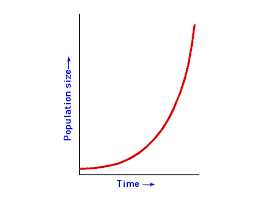
34.

What type of growth is shown in the diagram?

a)

exponential growth

b)

logistic growth

c)

predator-prey cycle

d)

boom-bust curve

35.

What is the starting source of energy for all food chains?

a)

grass

b)

sun

c)

bug

d)

mushrooms

36.

Bears eat fish, insects, plants, seeds, nuts and young elk. They are called __________.

a)

Franivore

b)

Carnivore

c)

Herbivore

d)

Omnivore

37.

The ecological role an organism performs in their specific environment is considered the organism's...

a)

Habitat

b)

Population

c)

Biome

d)

Niche

38.

Humans burn fossil fuels and wood, releasing carbon dioxide into the atmosphere. This carbon dioxide is then absorbed by trees for photosynthesis. These processes are contributory to which chemical cycle?

a)

The carbon cycle

b)

The water cycle

c)

The nitrogen cycle

d)

The phosphorous cycle

39.

How does the human body return carbon to the atmosphere in the carbon cycle?

a)

Waste products

b)

Photosynthesis

c)

Cellular respiration

d)

Formation of glucose

40.

In the carbon cycle, animals can release carbon back into the cycle through __________ or through __________.

a)

burning . . . photosynthesis

b)

fixation . . . decomposition

c)

decomposition . . . photosynthesis

d)

respiration . . . decomposition

e)

respiration . . . photosynthesis

41.

What kind of organism takes out the most carbon from the atmosphere?

a)

Plants

b)

Bacteria

c)

Animals

d)

Humans

42.
Organisms that play a role in the nitrogen cycle
a)
only plants
b)
only animals
c)
only bacteria
d)
plants, animals, & bacteria
43.
Organism that breaks down dead plants & animals and releases nitrogen back into atmosphere
a)
bacteria
b)
plants
c)
animals
d)
producers
44.

Plants return groundwater to the atmosphere through which process?

a)

evaporation

b)

sublimation

c)

transpiration

d)

condensation

45.
The average temperature of the surface of Earth has increased approximately 1°C in the past century. Which reason best explains this increase in temperature?
a)
lower levels of ozone in the atmosphere
b)
lower levels of nitrogen in the atmosphere
c)
higher levels of carbon dioxide in the atmosphere
d)
higher levels of oxygen in the atmosphere
46.
Which of the following have been linked to climate change?  
a)
droughts
b)
flooding
c)
melting of polar ice caps
d)
all of the above
47.
The main human activity that releases greenhouse gases is
a)
using bottled water
b)
burning fossil fuels
c)
texting on cellphones
d)
eating meat
48.

How much energy is moved from one trophic level to the next trophic level?

a)

100%

b)

1/2

c)

10%

d)

25%

49.

In general, algal blooms occur when

a)

toxins accumulate in shellfish.

b)

nutrients decrease in the water.

c)

nutrients increase in the water.

50.
Fill in the complementary bases according to the base-pair rule in DNA: A T C C A G
a)
T U G G T C
b)
T A G G T C
c)
T A C G T G
d)
T A C C A C