
Font size
 Worksheets
Quiz Evaluation of Teaching
Total questions: 15
Worksheet time: 15mins
Evaluation of teaching is a systematic procedure for reviewing the performance of a teacher in a classroom
True
False
What are the purpose of teaching evaluation?
(Choose two)
Help students to learn new things, acquire knowledge, and shape behaviour.
Assignment of precise ranks to all the teachers according to their abilities and contribution.
Improving the performance of teachers by
evaluating them at a fixed time interval.
Setting of clear,observable and measurable instructional outcomes/objectives
What is NOT one of the six criteria in teaching practice evaluation?
Communication skill
Classroom management
Time management
Personal qualities
Experiential learning theory primarily have 4 essential stages of learning ordered in a non-cyclic manner.
True
False
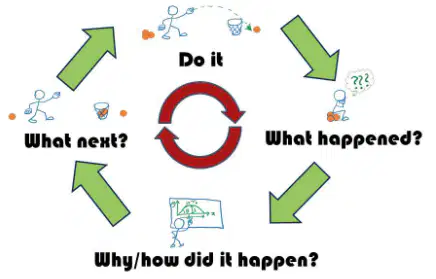
what is the reflective model shown in the picture?
Kolbs reflective model
Gibbs reflective cycle
Rofle reflective teaching model
What are the characteristics of assimilating learners?
(Choose two)
Enjoy problem solving
Analytical & logical
Emotional
Conceptual
A teaching session with good development and presentation must _____.
evaluate activities and provision of follow up work.
manage student behaviour and create an environment of respect.
demonstrate effective explanation skills that reflects subject matter competency.
Set clear, observable and measurable instructional outcomes/objectives.
Teachers can use diverse mediums to explain a theoretical concept to accommodate different learning styles.
True
False
Evaluation
Feelings
Analysis
Description
In Gibbs’ Reflective Cycle, what should you discuss under 'Conclusions'?
If it arose again what would you do?
What else could you have done?
What was good and bad about the experience?
What sense can you make of the situation?
So what, Then what, Now what
What, Now what, So what
What, Then What, Now What
What, So What, Now what
Then what
Now what
So what
What
Encourages thinking in a systematic way.
Allows practitioner to have a more balanced and precised judgement.
Easy to understand and easy to use
Limited to the perspective of just one person - the practitioner
Description
Evaluation
Conclusion
Analysis
Feelings
Description, Feelings, Evaluation, Analysis, Conclusion, Action plan
Description, Planning, Evaluation, Assessment, Analysis, and Action plan
Feelings, Ideas, Challenges, Strategies, Reflection, and Action plan
Feelings, Description, Evaluation, Strategies, Assessment, and Action plan

