
 Worksheets
Biogeochemical Cycles Practice Quiz
Total questions: 35
Worksheet time: 39mins
What is an example of an area that is likely to undergo primary succession?
Glaciers melt and leave exposed rock
Plants die from drought and decompose
Land is bulldozed and soil remains
Water vapor leaves a plant in the biosphere and goes into the atmosphere through
transpiration
respiration
precipitation
evaporation
____ happens when liquid turns into a gas on Earth's surface
evaporation
condensation
respiration
transpiration
reservoirs
water storage areas during the water cycle
places reserved for water usage by humans and animals
made from water and ice that are too big to remain suspended in air
made up of water droplets or ice crystals that are so small they remain suspended in the air
Where is groundwater stored?
in lakes and rivers
in underground lakes
in cracks and pores beneath Earth's surface
in mid-ocean ridges
Plants exhaling water into atmosphere.
Evaporation
Transpiration
Condensation
Precipitation
Water flowing downhill, through gravity, over the Earth's surface, collecting into streams and rivers.
Runoff
Precipitation
Groundwater
Evaporation
As water flows through the Water Cycle, it can be stored in various natural reservoirs including:
Atmosphere
Clouds
Soil
Aquifers
Glaciers
When solid dry ice becomes a gas this is called (solid goes straight to a gas without going through the liquid stage).
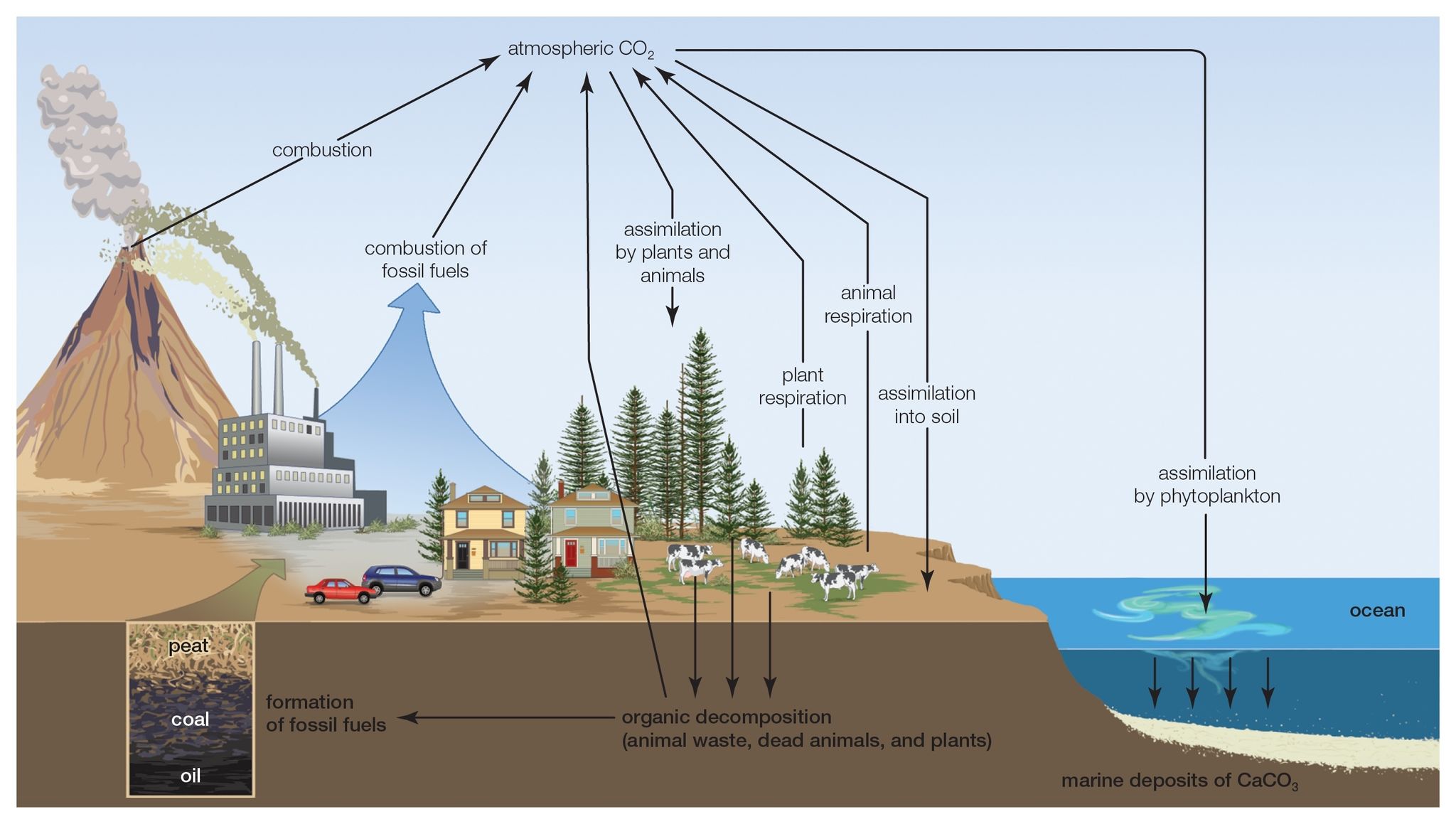
What converts nitrogen gas into a usable form for plants and animals?
bacteria
rain
fungi
car exhaust
How is nitrogen "fixed" into a usable form for plants?
Through action of bacteria only
Through lightning only
Through action of bacteria and lightning
Through photosynthesis
How do animals get the nitrogen they need?
From the air they breathe
From the water they drink
From the food they eat
From the sun
What is the process of combining nitrogen gas with other elements to make nitrogen into usable compounds?
nitrogen composition
nitrogen fixation
ammonia
denitrification
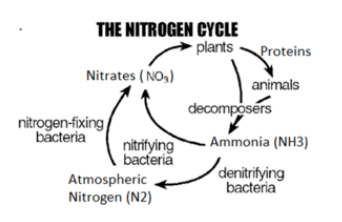
According to this diagram, animals get proteins from eating ________________________
decomposers
bacteria
plants
sunlight
The process that allows organisms to use nitrogen
assimilation
denitrification
fixation
ammonification
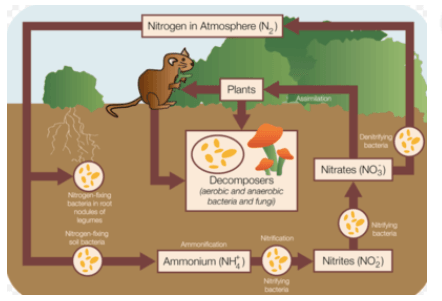
A correct path that nitrogen could take would be
air -> animals -> plants -> bacteria
animals -> air -> bacteria -> plants
bacteria -> air -> plants -> animals
air -> bacteria -> plants -> animals
Beside Carbon Dioxide, what other gas is a greenhouse gas?
water vapor
nitrgoen gas
carbon gas
glucose
List three ways that cause carbon to be released into the atmosphere as carbon dioxide?
burning of fossil fuels
exhaling
photosynthesis
cellular respiration
How much of our atmosphere is made up of nitrogen gas?
25%
55%
78%
95%
Nitrogen is important in the formation of _______. (Pick 3)
proteins
DNA
glucose
RNA
How do we get nitrogen into our bodies?
We absorb nitrogen from the air we breathe.
We absorb nitrogen from the food we eat.
We absorb nitrogen through our skin when we are outside.
There is no way we can get any nitrogen in our bodies.
What process of the nitrogen cycle occurs in the roots of plants?
Denitrification
Nitrogen fixation
Photosynthesis
Cellular Respiration
What lives in the roots of plants that fix the nitrogen so that plants can use the nitrogen?
bacteria
viruses
malaria
protists
_________ can also fix nitrogen gas for plants.
Lightning
People
Animals
Viruses
Certain bacteria and fungi called ________ convert nitrogen in dead plants and animals into ammonia.
producers
omnivores
predators
decomposers

Coal, natural gas, and oil are examples of _________
the carbon cycle
products of photosynthesis
good fuels for barbecues
fossil fuels

