
 Worksheets
Unit 8 Review
Total questions: 92
Worksheet time: 2hrs 49mins
During an endothermic reaction in a beaker if we are part of the surroundings and touched the beaker, it would feel _______.
Warm
Cold
Bubbly
Damp
Is this reaction endothermic or exothermic?
Is this reaction endothermic or exothermic?

This potential energy diagram (graph) represents an _________ change.
endothermic
exothermic
A change in enthalpy, ΔH, for a reaction is described as energy absorbed or released as ________.
light.
heat.
sound.
pressure.
A chemical reaction that absorbs heat from the surroundings is said to be __________ and has a __________ ΔH at constant pressure.
endothermic; positive
endothermic; negative
exothermic; negative
exothermic; positive
During an exothermic reaction, heat content in the surroundings increases because
heat energy is destroyed during reactions
the reaction absorbs heat energy
the energy contained in the reactants is lower then the products
the energy contained in the products is lower than the reactants

The graph represents the uniform heating of a substance, starting with the substance as a solid below its melting point. Which line segment listed below represents an increase in potential energy and no change in average kinetic energy?
Line segment AB
Line segment BC
Line segment CD
Line segment EF
Calculate ΔT when a substance goes from 10*C to 75*C
-65*C
75*C
10*C
65*C
Calculate A 50g sample is heated with 500 joules of energy and has a 10*C temperature change. Calculate it’s specific heat.
1 j/g*C
250000 j/g*C
500 j/g*C
10 j/g*C
4180 j of heat energy are added to change the temperature of water by 10*C. How many grams of water are being heated? cwater=4.18 j/g*C
4.18 j/g*C
10000g
174724g
100g
What heat energy is required to raise the temperature of a 1g sample of mercury (cHg=.16 j/g*C) by 100*C?
16j
.0016j
16000j
625 j

What type of reaction is this?
Endothermic
Exothermic
Allergic

What type of reaction is this?
Endothermic
Exothermic
Allergic

What does q stand for?
Heat-Joules
Mass-Grams
Specific Heat-J/g*C
Temperature Change-*C
What does c stand for?
Heat-Joules
Mass-Grams
Specific Heat-J/g*C
Temperature Change-*C
What does ΔT stand for?
Heat-Joules
Mass-Grams
Specific Heat-J/g*C
Temperature Change-*C
What does m stand for?
Heat-Joules
Mass-Grams
Specific Heat-J/g*C
Temperature Change-*C
Ice cream melting is an example of an __________ process.
endothermic
exothermic
Sweating is an __________________ process because heat is released.
endothermic
exothermic
Mass must always be in ________ for energy calculations.
kilograms
grams
joules
calories
What device is used to measure the amount of heat involved in a chemical reaction or physical process?
barometer
calorimeter
thermometer
A student measures the pressure and volume of an empty water bottle to be 1.4 atm and 2.3 L. She then decreases the pressure to 0.65 atm. What is the new volume?
2.1 L
5.0 L
8.2 L
3.9 L
A student inflates a balloon with helium then places it in the freezer. The student should expect
the balloon's volume to increase
the balloon's volume to decrease
the balloon's moles to increase
the balloon's moles to decrease
What is the pressure of a car tire that had an initial pressure of 1.8 atm but was heated from 38°C to 123°C?
0.9 atm
2.1 atm
1.6 atm
3.4 atm
Three gases are mixed together in a container with a total pressure of 4.8 atm. If two of the gases have pressures of 1.2 atm and 1.5 atm, what is the pressure of the third gas?
2.5 atm
1.8 atm
2.1 atm
1.3 atm
If a hairspray can is heated, what can be expected of the pressure of the gas inside the can?
The pressure will increase
The pressure will decrease
The pressure will remain constant
The pressure will equalize
Determine the temperature required for 0.0470 mol of gas to fill a balloon to 1.20 L under .998 atm pressure.
0 K
107 K
207 K
307 K
Pressure is
defined as the mass that an object exerts when at rest.
not a measurable in gases.
defined as the number of moles of substance divided by the mass of the substance.
created by the force of the gas particles impacting the walls of the container.
A sample of gas with a volume of 30.0 mL at 25.0oC is heated to 50.0oC. What is the new volume of the gas?
60.0 mL
15.0 mL
27.5 mL
32.5 mL
What is the pressure exerted by 5.00 moles of nitrogen gas contained in a 30.0 Liter container at 25.0 °C?
3670 atm
0.245 atm
4.08 atm
605 atm

What is the Standard for Temperature and Pressure?
273 K and 1 atm
273 C and 1 kPa
273 F and 1 mmHg
273 K and 1 Torr
The pressure on a tank containing 0.3 moles of oxygen is 4.5 atm, and the temperature is 150 K. What is the volume of the gas?
(R = 0.0821)
0.821 L
8.21 L
82.1 L
821 L
If you have 40 L of a gas at 6 atm, and 275K, how many moles will you have?
(R = 0.0821)
10.6 mol
0.1 mol
150.5 mol
81.2
A sealed container holds a mixture of Neon and Helium. The Neon has a Pressure of 2.25 atm. If the total Pressure in the container is 7 atm, what is the Partial Pressure of Helium?
4.75 atm
9.25 atm
3.11 atm
15.75 atm
What does the unit Liters, L, measure?
Volume
Pressure
Temperature
Moles
8 L of Helium gas are stored under a pressure of 3.3 atm. If there are 9.4 moles of Helium, what is the temperature of this sample of gas?
(R = 0.0821)
34.2 K
100 K
273 K
20.4 K

Gas particles are in constant motion. They travel in straight lines, and they constantly bounce off the walls of any container that holds them.
What does this constant bombardment of particles against the walls of the container create?
Pressure
Density
Temperature
Magnetism
A rubber tire holds 2.3 moles of CO2 at a temperature of 273 K. The volume of the tire is 8 L. What is the Pressure?
(R = 0.0821)
6.4 atm
412.4 atm
43.5 atm
3.1 atm

Which of the following set of conditions would allow a gas to behave ideally?
(HINT: Remember that gases like to spread far apart! Which conditions would allow the molecules to easily spread apart?)
High Temperature, Low Pressure
High Temperature, High Pressure
Low Temperature, High Pressure
Low Temperature, Low Pressure

Do molecules generally move faster at 45 C or 106 C?
45 C because molecules have more energy than in 106C
106 C because molecules have more energy than in 45C
106 C because molecules have less energy than in 45C
45C because molecules have less energy than in 106 C
Define ΔH
Change in Specific Heat; Heat by one Degree Celsius
Change in Temperature; the energy we calculate; Degree Celsius
Change in Enthalpy; the energy/heat we calculate
Change in Time; time travel
Define Exothermic
Energy is released; ΔH is negative; Going from Gas to Liquid, Liquid to Solid
Energy is absorbed; ΔH is positive; Going from Gas to Liquid, Liquid to Solid
Energy is released; ΔH is positive; Going from Solid to Liquid, Liquid to Gas
Energy is absorbed; ΔH is negative; Going from Gas to Liquid, Liquid to Solid
Define Endothermic
Energy is absorbed; ΔH is negative; Going from Liquid to Gas, and Gas to Liquid
Energy is released; ΔH is negative; Going from Solid to Liquid, and Liquid to Gas
Energy is released; ΔH is positive; Going from Solid to Liquid, and Liquid to Gas
Energy is absorbed; ΔH is positive; Going from Solid to Liquid, and Liquid to Gas
Specific Heat is..
the temperature initial minus temperature final
the amount of heat/energy required to raise 1 gram of a substance by 1°C (or K) aka "C"
the temperature final minus temperature initial
the item in a system with given weight in grams


What is true regarding CO2 for temperatures above 31 °C, past its critical point?
It can never be liquified.
It decomposes.
It has a high pressure.
It is a plasma.

What is the normal boiling point of this substance at standard pressure?
150 °C
100 °C
-50 °C
0 °C
What is the normal melting point of this substance at standard pressure?
150 °C
100 °C
-50 °C
0 °C

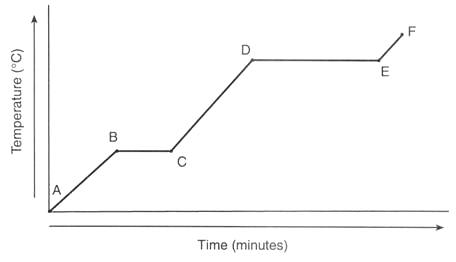




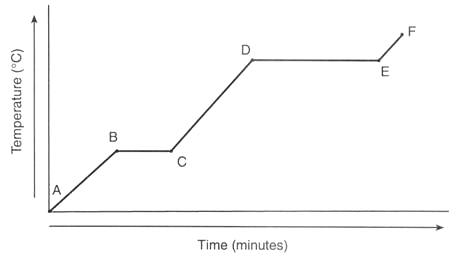
What is happening to the particles in the substance between points D and E?
Melting
Freezing
Vaporizing
Sublimating

Is the substance gaining or losing energy?
Gaining
Losing

Where on the graph are phase changes taking place?
1
2
3
4
5

Which equation represents Dalton's Law?
E = mc2
PV = nRT
P1 / T1 = P2 / T2
Ptotal = P1 + P2 + P3
A mixture of H, Ne, & O has a pressure of 12.4 atm. If Hydrogen measures 5.6 atm and Oxygen measures 2.0 atm, what is the pressure of Neon?
7.6 atm
4.8 atm
5.4 atm
12.0 atm
A container holds three gases: oxygen, carbon dioxide, and helium. The partial pressures of the three gases are 2.00 atm, 3.00 atm, and 4.00 atm, respectively. What is the total pressure inside the container?
900 atm
0.90 atm
9.00 atm
920 atm


