wayground logo

Free Printable Worksheets

Font size

S
M
L
XL
Worksheets

3 Curve Quiz Assignment

Total questions: 95

Worksheet time: 1hrs 11mins

Name
Class
Date
1.

What is a positive ion called?

a)

anion

b)

cation

c)

isotope

d)

covalent

2.

What is a negative ion called?

a)

anion

b)

cation

c)

covalent

d)

isotope

3.

How many electrons would a Nitrogen ion gain/lose? If it has 5 valence electrons.

a)

lose 5

b)

gain 5

c)

lose 3

d)

gain 3

4.

What is the ion formed from Sulfur? If it has 6 valence electrons.

a)

S+2

b)

S-2

c)

S+6

d)

S-6

5.

How many electrons would a Calcium ion gain/lose? If it has 2 valence electrons.

a)

lose 1

b)

gain 1

c)

lose 2

d)

gain 2

6.

If an atom loses electrons, the charge will be positive.

a)

true

b)

false

7.

A Bromine ion gains 1 electron, which of the following is the correct symbol for a Bromine ion?

a)

Br-1

b)

Br+1

c)

Br+7

d)

Br-7

8.
What is the charge of an atom that has lost one electron?
a)
-1
b)
-2
c)
+1
d)
+2
9.

An atom with 2 protons, 3 neutrons, and 4 electrons has a charge of ____.

a)

+2

b)

-2

c)

+3

d)

0

10.

If an element has 3 valence electrons, what charge will likely form on its ion ?

a)

+3

b)

+5

c)

-3

d)

-5

11.
Ions are: 
a)
atoms with a positive or negative charge
b)
atoms with no charge
c)
atoms with ONLY a positive charge
d)
atoms with ONLY a negative charge
12.

Na has 1 valence electron. It will have a charge of _______

a)

+1

b)

+2

c)

-1

d)

-2

13.

Be has 2 valence electron. It will have a charge of _______

a)

+1

b)

+2

c)

-1

d)

-2

14.

Iodine has 7 valence electron. It will have a charge of _______

a)

-2

b)

-1

c)

+1

d)

+2

15.

Oxygen has 6 valence electron. It will have a charge of _______.

a)

+1

b)

-1

c)

+2

d)

-2

16.

Cations are metals that form ____________ ions by __________ electrons.

a)

negative, losing

b)

negative, gaining

c)

positive, gaining

d)

positive, losing

17.

Anions are nonmetals that form ____________ ions by __________ electrons.

a)

negative, losing

b)

negative, gaining

c)

positive, gaining

d)

positive, losing

18.
Which group has a complete outer shell, and will not form ions or bond?
a)
Alkali Metals
b)
Transition Metals
c)
Halogens
d)
Noble Gases
19.

Group 7 always has ions with a charge of 

a)
+1
b)
+2
c)
-1
d)
-2
20.
Magnesium ion
a)
Mg+
b)
Mg2+
c)
Mg-
d)
Mg2-
21.
Valence electrons are: 
a)
Electrons farthest away from the nucleus
b)
Electrons closest to the nucleus
c)
Electrons that just come and go - they don't stay with the atom
22.

How many electrons would a Calcium ion gain/lose?

a)

lose 1

b)

gain 1

c)

lose 2

d)

gain 2

23.

Which types of elements from cations?

a)

metals

b)

nonmetals

c)

metalloids

d)

noble gases

24.

Which types of elements from anions?

a)

metals

b)

nonmetals

c)

metalloids

d)

noble gases

25.

How many electrons would a Nitrogen ion gain/lose?

a)

lose 5

b)

gain 5

c)

lose 3

d)

gain 3

26.

How many electrons would a Calcium ion gain/lose?

a)

lose 1

b)

gain 1

c)

lose 2

d)

gain 2

27.

What is the ion formed from Sulfur?

a)

S+2

b)

S-2

c)

S+6

d)

S-6

28.

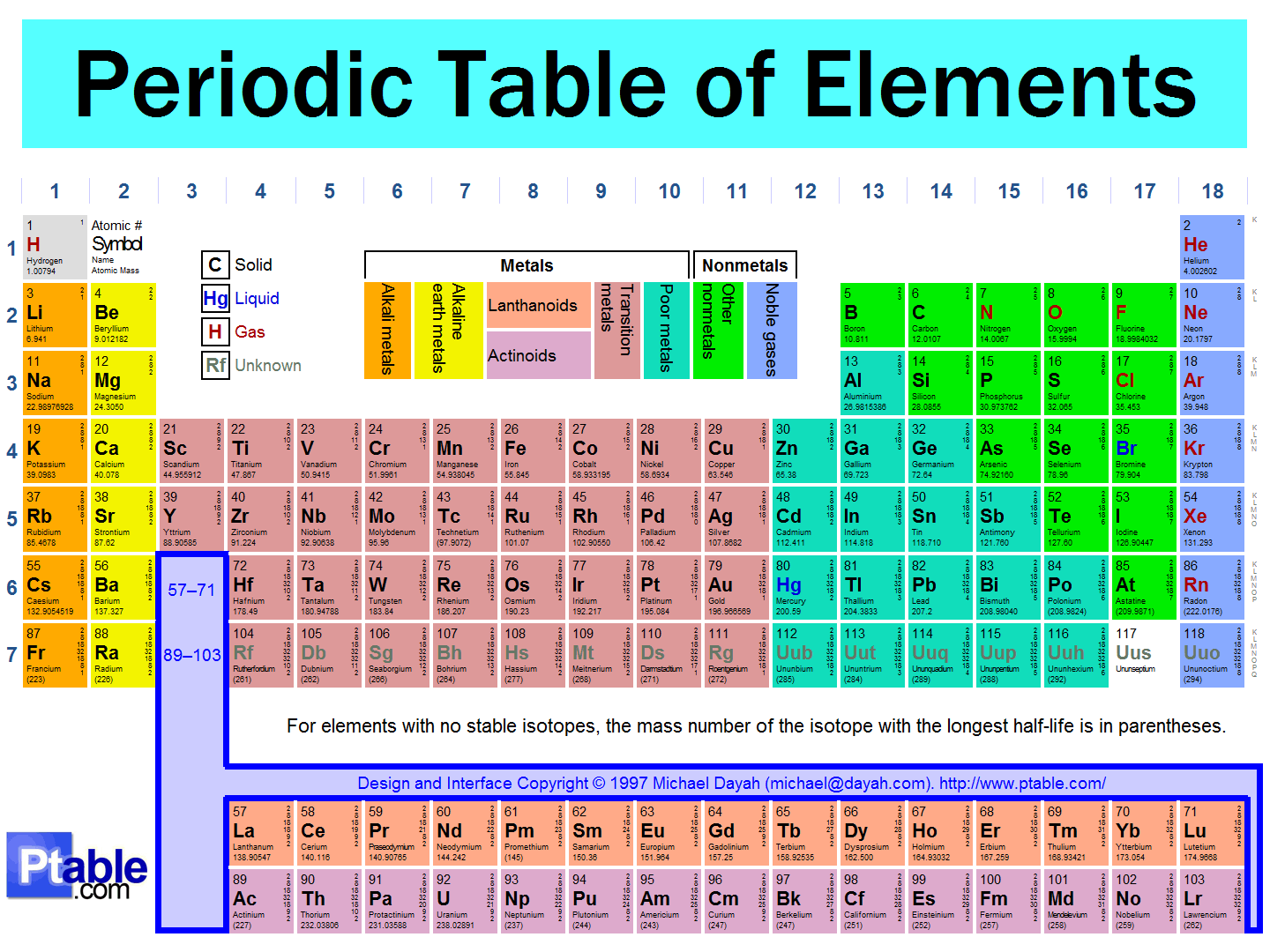
The vertical (up and down) columns in the Periodic Table are called

a)

groups

b)

towers

c)

periods

d)

atomic numbers

29.
The Modern Periodic Table of Elements is arranged by
a)
atomic mass
b)
atomic number
c)
valence electrons
d)
number of isotopes
30.
Elements in a ..................have similar chemical properties.  
a)
period
b)
group
c)
row
31.
Francium (Fr) has the lowest ionization energy in Group 1 because - 
a)
it has the smallest number of valence electrons
b)
it has the greatest atomic mass
c)
it has the greatest number of protons, so it attracts its electrons the strongest
d)
its 1 valence electron is very far from the nucleus, so little energy is needed to remove it
32.
Which has the greater Electronegativity: 
N or C?
a)
C
b)
N
33.
Electronegativity is...
a)
the ability of an atom to attract/ accept electrons
b)
the ability of an atom to lose electrons
c)
the energy required to remove an electron from a specific atom
d)
how easy it is to make friends. 
34.
As atoms of elements in group 16 are considered in order from top to bottom, the electronegativity of each successive element....
a)
decreases
b)
increases
c)
remains the same
d)
none of the above
35.
As you move across the periodic table atoms tend to get smaller because, ______________.
a)
the atoms have more mass.
b)
the atoms have less mass
c)
the atoms have more protons.
d)
the atoms have less electrons.
36.
Elements in the same column of the periodic table always have the same # of _______ as one another.
a)
Protons
b)
Neutrons
c)
Electrons
d)
Valence Electrons
37.
How many valence electrons are in an atom of K?
a)
3
b)
8
c)
4
d)
1
38.
Which of the following will have a larger radius than Zinc?
a)
Gallium
b)
Aluminum
c)
Magnesium
d)
Strontium
39.
Which of the following will have a higher electronegativity than arsenic (As)?
a)
Carbon (C)
b)
Neon (Ne)
c)
Antimony (Sb)
d)
Germanium (Ge)
40.
As you move down the periodic table atoms get bigger.  This is because ____________.
a)
The atoms have more mass.
b)
The atoms have more protons.
c)
The atoms have more energy levels
d)
The atoms have more neutrons
41.
As atoms of elements in group 16 are considered in order from top to bottom, the electronegativity of each successive element....
a)
decreases
b)
increases
c)
remains the same
d)
none of the above
42.
Electronegativity __________ from left to right within a period and __________ from top to bottom within a group.
a)
decreases, increases 
b)
increases, increases
c)
increases, decreases 
d)
stays the same, increases
43.
Atomic radius generally increases as we move __________.  
a)
down a group and from right to left across a period 
b)
up a group and from left to right across a period 
c)
down a group and from left to right across a period 
d)
up a group and from right to left across a period 
44.
Vertical columns of elements (families) on the periodic table with similar  properties
a)
groups
b)
periods
c)
quadrants
d)
rows
45.
Sodium (Na) and potassium (K) are in the same group on the periodic table. Based on their locations, which statement about sodium and potassium is true?
a)
Sodium is less electronegative than potassium. 
b)
Sodium has fewer energy levels than potassium. 
c)
Sodium has a larger ionic radius than potassium. 
d)
Sodium has lower ionization energy than potassium. 
46.
Which of these elements has the greatest atomic radius? 
a)
H
b)
N
c)
Cl
d)
Cs
47.
Ionization energy is...
a)
the energy required to add an electron to a specific atom
b)
how much energy it takes to remove an electron from an atom
c)
the energy required to shield the outer electrons from the nucleus
d)
a measure of the ability of an atom to attract electrons
48.
Electronegativity is...
a)
how good an atom is at attracting electrons
b)
the ability of an atom to lose electrons
c)
the energy required to remove an electron from a specific atom
d)
how easy it is to make friends. 
49.

How does atomic radius change as you move across a period (from left to right)?

a)

It increases

b)

It stays the same

c)

It decreases

d)

There is no way to know

50.

How does ionization energy change as you move across a period?

a)

It increases

b)

It stays the same

c)

It decreases

d)

There is no way to know

51.

Which has the highest ionization energy?

a)

Iron

b)

Fluorine

c)

Chlorine

d)

Calcium

52.

What is electronegativity?

a)

Ability for an atom to pull an electron towards itself

b)

Ability of an electron to attract other electrons

c)

Ability of a proton to attract an electron

d)

None of the above

53.

Why is Electronegativity important?

a)

It makes atoms gain electrons

b)

It makes bonding possible

c)

It makes atoms go into an excited state

d)

It makes atoms go into a ground state

54.

What are the least reactive elements on the periodic table?

a)

Alkali Metals

b)

Halogens

c)

Nobel Gasses

d)

Transition Metals

55.

Which of the following groups of elements have the highest ionization energy?

a)

alkali metals

b)

alkaline earth metals

c)

halogens

d)

noble gases

56.

According to the Octet Rule, to achieve stability atoms attempt to fill the outer S and P orbitals. How many electrons are required to accomplish this?

a)

2

b)

4

c)

6

d)

8

57.

Which of the following Groups on the Periodic Table has the lowest Electronegativity?

a)

Group 1

b)

Group 2

c)

Group 16

d)

Group 17

58.
What atom matches this electron configuration?
1s22s22p63s23p64s23d10
a)
Zinc
b)
Copper
c)
Nickel
d)
Germanium
59.
What electron configuration matches an oxygen atom?
a)
1s22s22p63s2, 3p64s23d104p5
b)
1s22s22p4
c)
1s22s22p6
d)
1s22s22p63s23p64s23d1
60.
The electron configuration of an atom is 1s22s22p6.  The number of electrons in the atom is 
a)
3
b)
6
c)
8
d)
10
61.
Which electron configuration belongs to Chlorine (Cl)?
a)
1s2s2p3s3p5
b)
1s2s2p3s3p6
c)
1s2s2p3s3p7
62.
Identify the Electron Configuration for Aluminum (Al)
a)
1s2s2p3s3p1
b)
1s2s2p3s3p3
c)
1s2s2p3s4p1
63.
Electrons occupy orbitals of lowest energy first is part of what electron configuration rule?
a)
Hund’s Rule
b)
Aufbau Principle
c)
Pauli Exclusion Principle
64.

What does Pauli exclusion principle state ?

a)

states that each electron occupies the lowest energy orbital available

b)

states that -no two electrons in the same orbital can have the same spin

c)

states that single electrons electrons with the same spin must occupy each-energy orbital before additional electrons with opposite spins can occupy the same orbitals

65.

What is the maximum number of electrons that an S orbital can have?

a)

1 electron

b)

2 electrons

c)

3 electrons

d)

4 electrons

66.

How many electrons can the d sublevel(orbital) hold?

a)

8

b)

10

c)

2

d)

4

67.

What is this element?

1s22s22p63s23p64s23d104p6

a)

Argon

b)

Krypton

c)

Selenium

d)

Bromide

68.
Which of the following is a p block element?
a)
Ca
b)
Ar
c)
Re
d)
Au
69.

There are 4 different types of subshells(orbitals) s,p,d,f

a)

true

b)

false

70.

Which area on the periodic table represents the electrons in the "d" sublevel?

a)

representative elements

b)

columns 3-8

c)

rare earth elements

d)

transition elements

71.
How many electron can be found in a p orbital?
a)
2
b)
3
c)
4
d)
6
72.
Which is the electron configuration for an oxygen atom?
a)
1s22s22p63s23p64s2
b)
1s22s22p4
c)
1s22s22p6
d)
1s22s22p63s23p6
73.
Which element is pictured?
a)
neon
b)
fluorine
c)
magnesium
d)
argon
74.
What do you start electron configuration with?
a)
1s2
b)
1d10
c)
1f14
d)
1p6
75.

How many electrons can a p orbital hold?

a)

6

b)

10

c)

8

d)

14

76.

In an electron configuration, what follows 4s?

a)

4p

b)

3d

c)

4s

d)

2f

77.

How many electrons at most are in the 4f sublevel?

a)

10

b)

8

c)

18

d)

14

78.
What electron configuration matches an oxygen atom?
a)
1s22s22p63s2, 3p64s23d104p5
b)
1s22s22p4
c)
1s22s22p6
d)
1s22s22p63s23p64s23d1
79.

Choose the correct shortcut configuration for iodine.

a)

[Ar]4s24d104p5

b)

[Kr]5s24d105p5

c)

[Xe]5s25d105p5

d)

none of the above

80.

Each row on the periodic table represents:

a)

an energy level

b)

a sublevel

c)

an electron

d)

an orbital

81.

Each orbital can hold how many electrons?

a)

5

b)

4

c)

8

d)

2

82.

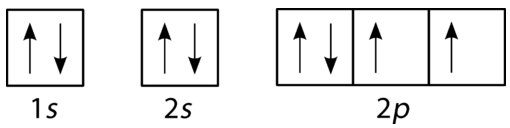
What is incorrect about this orbital diagram?

a)

Both arrows in the 2p box should be pointing up

b)

There is nothing incorrect with this diagram

c)

In the 2p box there should only be 1 electron in the first 2p box and one in the 2nd 2p box pointing in the same direction.

d)

All the arrows should be pointing up.

83.
What is the abbreviated electron configuration for barium?
a)
[Xe] 6s2
b)
[Rn] 6s2
c)
[Ar] 4s2 3d10 4p5
d)
[He] 2s2 3p1
84.
What is the noble gas configuration for Neon?
a)
[Ne]
b)
[He]2s22p6
c)
[F]2p1
d)
[Ne]2s21p6
85.

What is the shorthand configuration for Tin?

a)

[Xe]5s24d105p2

b)

[Xe]5s24d105p2

c)

[Kr]5p2

d)

[Kr]5s24d105p2

86.

What is the shorthand configuration for Lead?

a)

[Xe]6s24f145d106p2

b)

[Xe]6s25d106p2

c)

[Rn]6s25d106p2

d)

[Rn]6s24f145d106p2

87.
An electron occupies the lowest energy orbital that can receive it.
a)
Hund’s rule
b)
Pauli exclusion principle
c)
Bohr model of the atom
d)
Aufbau principle
88.
All orbitals of equal energy are occupied by one electron before any single orbital is occupied by a second electron.
a)
Aufbau principle
b)
Pauli exclusion principle
c)
Hund’s rule
d)
Core Notation
89.
Which element is pictured?
a)
neon
b)
fluorine
c)
magnesium
d)
argon
90.
This orbital diagram represents:  
a)
C
b)
B
c)
N
d)
O
91.
Which element is depicted from this orbital diagram
a)
Fluorine
b)
Neon
c)
Chlorine
d)
Argon
92.
This orbital diagram represents:  
a)
C
b)
B
c)
N
d)
O
93.
This orbital diagram represents:  
a)
C
b)
B
c)
N
d)
O
94.
What is the Pauli Exclusion Principle?
a)
An atomic orbital can only hold a maximum of 2 electrons, each with opposite spins
b)
An atomic orbital can hold a minimum of 6 electrons, each with opposite spins
c)
An atomic orbital can hold a maximum of 6 electrons, each with the same spin
d)
An atomic orbital can hold a minimum of 2 electrons, each with opposite spins
95.
Which element is depicted from this atomic orbital diagram?
a)
Carbon
b)
Nitrogen
c)
Oxygen
d)
Phosphorus