
 Worksheets
End of 7th Grade Assessment 2023
Total questions: 41
Worksheet time: 21mins
Name
Class
Date
1.
1. What is the first thing you should do if an accident occurs?
a)
Tell a friend
b)
Post on snapchat
c)
Tell an adult
d)
Scream
2.
2. Why are practical jokes not permitted in science class?
a)
Mrs. Schreiber does not have a sense of humor
b)
Jokes could lead to someone getting hurt
c)
You are too young for practical jokes
d)
Practical jokes are permitted
3.
3. When can we drink beverages in class?
a)
all the time, because Mrs. Schreiber is awesome
b)
Only water, and not near a computer or when working on a lab.
c)
NEVER EVER EVER
d)
On Tuesdays
4.
4. In which state of matter are particles packed tightly together in fixed positions?
a)
solid
b)
liquid
c)
gas
d)
all of the above
e)
5.
5. The change from liquid to solid, or the reverse of melting, is called
a)
melting
b)
freezing
c)
evaporation
d)
condensation
6.
6. Which of the following is a chemical property?
a)
color
b)
hardness
c)
lustre
d)
ability to rust
7.
7. Which subatomic particle has a negative charge?
a)
protons
b)
neutrons
c)
electrons
d)
all of the above
8.
8. Which subatomic particle has a neutral charge?
a)
protons
b)
neutrons
c)
electrons
d)
all of the above
9.
9. Which subatomic particle is NOT in the nucleus of an atom?
a)
protons
b)
neutrons
c)
electrons
d)
none of the above
10.
10. Which of the following substances would float when placed into a container of water?
a)
A. Cardboard and Dish Soap
b)
B. Glass and Dish Soap
c)
C. Glass and Apple
d)
D. Cardboard and Apple
11.
11. Which of the following substances would sink when placed into a container of water?
a)
A. Cardboard and Dish Soap
b)
B. Glass and Dish Soap
c)
C. Glass and Apple
d)
D. Cardboard and Apple
12.
12. Which of the following could be the chemical formula for a compound?
a)
A. Na
b)
B. CO2 (two is subscript)
c)
C. H2 + O2 (two is subscript)
d)
D. Au
13.
13. A(n) _______________ is a pure substance that cannot be broken down chemically.
a)
compound
b)
element
c)
mixture
14.
14. Which of the following determines the identity of an atom?
a)
protons
b)
neutrons
c)
electrons
d)
all of the above
15.
15. What are the rules for symbols on the Periodic table?
a)
Must be German
b)
One or two letters and English or Latin
c)
Three letters in Latin
d)
The letters must match the name of the chemical
16.
16. Which of the following statements is true regarding the atomic number of an element?
a)
A. The atomic number is the number of protons in an element.
b)
B. The atomic number is the number of neutrons in an element.
c)
C. The atomic number is the mass of the nucleus of an element.
17.
19. What is primary function of the nucleus?
a)
A. To store the DNA of a cell.
b)
B. To store water in the cell.
c)
C. To control the substances that leave and come into a cell.
d)
D. To convert molecules into energy for the cell.
18.
20. The ____________________ is the storage area of the cell.
a)
Cell wall
b)
vacoule
c)
mitochodria
d)
golgi bodies
19.
21. What is the primary function of the mitochondria in an animal cell?
a)
A. To store the DNA of a cell.
b)
B. To store water in the cell.
c)
C. To control the substances that leave and come into a cell.
d)
D. To convert molecules into energy for the cell.
20.
22. The ____________________ contain chlorophyll and make food from light energy.
a)
A. cell wall
b)
B. cell membrane
c)
C. chloroplast
d)
D. nucleus
21.
23. The ____________________ controls what comes in and out of the cell.
a)
A. cell wall
b)
B. cell membrane
c)
C. chloroplast
d)
D. nucleus
22.
24. Which of the following is an advantage of asexual reproduction?
a)
A. Requires a lot of energy and therefore produces small numbers of organisms.
b)
B. Does not require much energy and therefore produces many offspring.
c)
c. No genetic diversity means organisms are vulnerable to disease and environmental changes.
23.
25. Which of the following is an advantage of sexual reproduction?
a)
A. Only one parent is needed so all organisms can reproduce.
b)
B. Genetic diversity leads to better chances for survival when faced with disease and environmental changes.
c)
C. Requires two different parents so not all of the organisms will be able to reproduce due to competition.
d)
D. Does not require much energy and therefore produces many offspring.
24.
26. Through the process of ____________________ reproduction, offspring are produced from a single parent.
a)
asexual
b)
sexual
25.
27. A ____________________ is a male or female reproductive cell that contains half of the genetic materials of the organism.
a)
gamete
b)
offspring
26.
28. The process of female and male gametes joining to form a zygote is known as ____________________.
a)
gamete
b)
asexual
c)
fertilization
27.
29. Which two body systems work together to bring oxygen into the body’s cells and take carbon dioxide away?
a)
A. Nervous and endocrine
b)
B. Respiratory and digestive
c)
C. Respiratory and circulatory
d)
D. Muscular and skeletal
28.
30. Which two body systems work together to move nutrients into the body and waste out of the body?
a)
A. Nervous and endocrine
b)
B. Digestive and excretory
c)
C. Respiratory and circulatory
d)
D. Muscular and skeletal
29.
31. The _______________ system acts as a barrier to protect the body from the outside world.
a)
A. Nervous
b)
B. Integumentary
c)
C. Respiratory
d)
D. Muscular
30.
32. The _______________ system provides shape, support, movement, protection, blood cell production, and mineral storage.
a)
A. Nervous
b)
B. Integumentary
c)
C. Respiratory
d)
D. Skeletal
31.
33. Which part of the brain is responsible for reasoning, problem solving, social behavior and planning?
a)
cerebrum
b)
cerebellum
c)
brain stem
d)
frontal lobe
32.
34. The frontal lobes, where “executive functions” such as planning, working memory, and impulse control, are among the last areas of the brain to mature. At what age does the frontal lobe become fully mature?
a)
12
b)
65
c)
25
d)
14
33.
35. What type of doctor studies the nervous system?
a)
endocrinologists
b)
neurologists
c)
immunologists
d)
cardiologist
34.
36. The continual rising and falling (due to heating and cooling) of magma within the Earth are known as ____________________ currents.
a)
Pangaea
b)
Convection
c)
Fossil
d)
Tectonic plates
35.
37. The supercontinent that included all current land masses before they split apart was known as ____________________.
a)
Pangaea
b)
Continental Drift
c)
fossil
d)
tectonic plates
36.
38. A(n) ____________________ boundary is where two plates collide.
a)
convergent
b)
divergent
c)
transform
37.
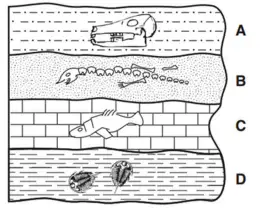
39. Which fossil layer is the oldest?
a)
A
b)
B
c)
C
d)
D
38.

40. Which fossil layer is the youngest?
a)
A
b)
B
c)
C
d)
D
39.

What number will go in front of the NH on the reactant side to balance the N in the equation?
a)
2
b)
1
c)
3
d)
0
40.

Look at this equation on the product side. How many S are there on the product side after the 4 was added?
a)
4
b)
8
c)
1
d)
2
41.

How many H are there on the reactant side?
a)
3
b)
6
c)
2
d)
1
100 %

