
NEW
Font size
 Worksheets
ExpePsych Icebreaker
Total questions: 15
Worksheet time: 5mins
A research design in which the investigator does not manipulate the independent variable but compares existing groups that differ on it.
Correlational Design
Non-Equivalent Groups Design
Quasi-Experimental Design
Cross Sectional Design
It is a knack of finding things that are not being sought.
Possibility Hypothesis
Inferential Hypothesis
Serendipity Hypothesis
Experimental Hypothesis
It is a simple explanation is preferred rather than a complex, highfalutin assumption in a study.
Appropriate Statement
Inductive Model
Falsifiable Statement
Parsimonious Statament
It is the extent to which the outcomes are consistent when the experiment is repeated more than once.
Validity
Manifest Content
Reliability
Position Preference
Ethnicity, car brands, and marital status are considered as
Ordinal Data
Nominal Data
Ratio Data
Interval Data
It analyzes data of variables collected at one given point in time across a sample population or a pre-defined subset.
Also known as transverse study, or prevalence study.
Quasi-Experimental Design
Cross-Sectional Design
Experimental Design
Experimental-Quantitative Design
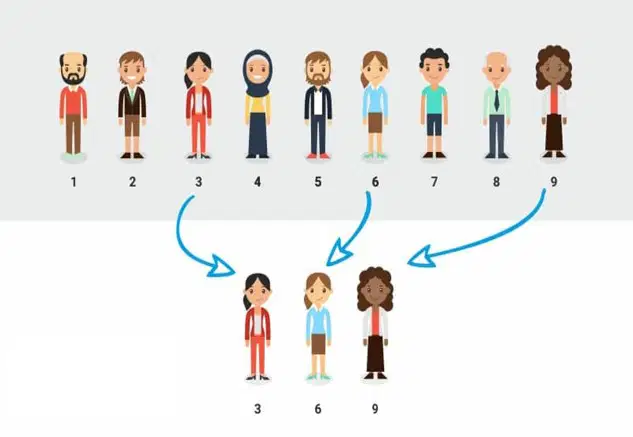
What sampling technique is used on the image presented?
Snowball Sampling
Simple Random Sampling
Stratified Random Sampling
Systematic Random Sampling
Cluster Sampling
A research design in which the same assessment measures are given to participants both before and after they have received a treatment or been exposed to a condition, with such measures used to determine if there are any changes that could be attributed to the treatment or condition.
Descriptive Design
Pre-test / Post-test Design
Longitudinal Studies
Cross-Sectional Studies
Non-Equivalent Groups Design
What is the middle name of your ExpePsych lecturer?
Manosa
Montemayor
Manaligan
Martinez
Marcos
It involves a descriptive record of an individual’s experiences and behaviors, or both kept by an outside observer.
Phenomenology
Case Studies
Field Studies
Archival Studies
Qualitative Studies
The following are considered as types of case studies EXCEPT
Collective Case Studies
Intrinsic Case Studies
Extrinsic Case Studies
Exploratory Case Studies
Descriptive Case Studies

What kind of sampling technique is depicted on the picture?
Stratified Random Sampling
Simple Random Sampling
Cluster Sampling
Purposive Sampling
Simple Random Sampling
It can help to determine which items seem to be measuring similar qualities, allowing researchers to drop some items that are less important or redundant.
Factor Loadings
Linear Regression Analysis
Regression Lines
Factor Analysis
Multiple Regression Analysis
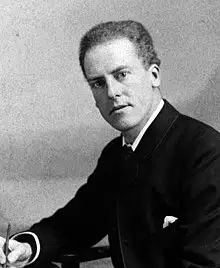
He is widely viewed as the founder of modern statistics. In addition to discovering numerous statistical concepts, he pushed to create statistics as a distinct discipline, founding the first ever university statistics department and the first academic journal focused on the field.
William Playfair
Carl Friedrich Gauss
Carl Gallagher
Adolphe Quetelet
Carl Pearson
When two behaviors are strongly related, the researcher can estimate a score on one of the measured behaviors from a score of the other.
Linear Regression Analysis
Multiple Regression Analysis
Factor Analysis
Path Analysis
Cross Lagged Panel Design

