
 Worksheets
P1 Spring US History Final Review 2022-23
Total questions: 85
Worksheet time: 43mins
Name
Class
Date
1.
Tammany Hall was the name of
a)
a famous settlement house
b)
a New York Customs House
c)
a New York City political machine
d)
the federal courthouse in New York City
2.
Jane Adams was know for
a)
starting a settlement house in Chicago
b)
winning the Noble Peace Prize
c)
fighting for racial equality
d)
all of the above
3.
The main goal of the Americanization movement was to
a)
limit the number of immigrants entering the country
b)
assimilate people of various cultures into the dominant culture
c)
improve the living conditions in American's largest cities.
d)
encourage people to move from the country to the city
4.
The main goal of the Chinese Exclusion Act was to
a)
decrease Chinese immigration
b)
create segregated classrooms
c)
settle a disagreement between China and the United States
d)
stop Chinese Americans from attending school in the United States
5.
The main immigration processing station in San Francisco was called
a)
Ellis Island
b)
Tammany Hall
c)
Angel Island
d)
Hull House
6.
Which of the following is an example of graft?
a)
using a threat of force to get people to vote for a particular candidate
b)
choosing your friends for political offices
c)
saying a project cost more than it did and keeping the difference for yourself
d)
using a cartoon to illustrate political fraud
7.
Which of the following is true of the Gentlemen's Agreement?
a)
It decreased Japanese immigration
b)
It resulted in segregated classrooms
c)
it caused anti-American rioting in Japan
d)
It prohibited aliens from working in industrial jobs
8.
What is a characteristic of the Gilded Age?
a)
Political Correctness
b)
Political Corruption
c)
Honest Businessmen
d)
Everyone moving out to farms for work
9.
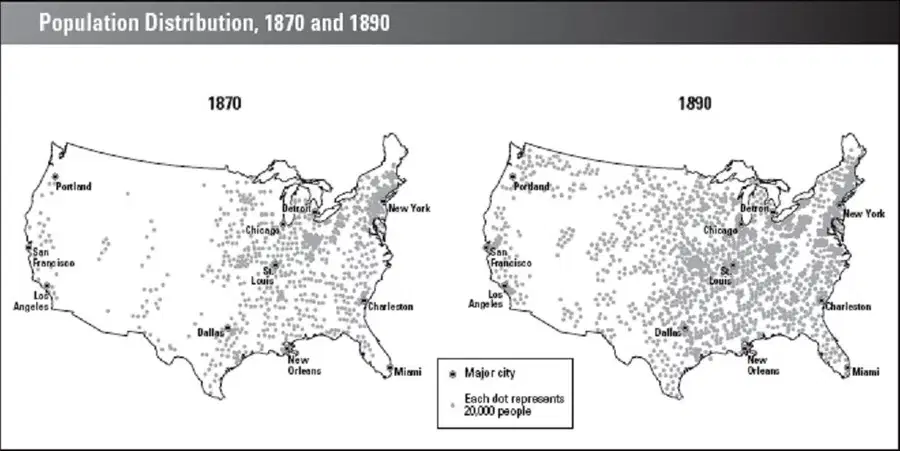
In 1870, which region of the United States was most densely populated?
a)
Southwest
b)
Southeast
c)
Northwest
d)
Northeast
10.
Which of the following was the main interest of the Social Gospel movement?
a)
religious reform
b)
political reform
c)
social reform
d)
economic reform
11.
Southern states sometimes used a grandfather clause to allow them to
a)
keep uneducated whites from exercising their right to vote.
b)
distinguish between recent immigrants and longtime citizens.
c)
keep African Americans from voting while allowing whites to do so
d)
deny voting rights to African Americans who passed the literacy test.
12.
Skyscrapers were made possible by the invention of
a)
the elevator and a steel framework.
b)
safer fire escapes.
c)
larger bricks and stronger cement.
d)
the airplane and the bicycle.
13.
Jim Crow laws were laws that,,,
a)
taxed voters.
b)
separated the races.
c)
denied citizenship to Asian immigrants.
d)
promoted discrimination against women.
14.
In the case of Plessy v. Ferguson, the Supreme Court ruled that
a)
lynching was a federal crime.
b)
school segregation was unconstitutional.
c)
voting rights could not be tied to any form of tax.
d)
racial segregation in public facilities was legal.
15.
Who expressed the belief that racism would end as blacks acquired practical work skills and proved their economic value to society?
a)
W. E. B. Du Bois
b)
Booker T. Washington
c)
Ida B. Wells
d)
William Torrey Harris
16.
Which of the following did not keep African Americans in the South from voting?
a)
poll taxes
b)
grandfather clauses
c)
the separate-but-equal doctrine
d)
literacy tests
17.
Which effect can be traced directly to the Supreme Court's ruling in Plessy v. Ferguson?
a)
Race riots broke out in New York and other large cities.
b)
Southern blacks lost their voting rights for 60 years.
c)
Lynching of African Americans continued into the 1920s.
d)
Racial segregation was permitted for nearly 60 years.
18.
How did George Eastman contribute to an explosion in the popularity of photography?
a)
by taking photographs of the Wright brothers' first flight at Kitty Hawk
b)
by inventing a camera that was larger and heavier than most
c)
by inventing a camera that could develop pictures on the spot
d)
by inventing a camera that used roll film instead of heavy glass plates
19.
1865 - abolished slavery and involuntary servitude
a)
13th Amendment
b)
14th Amendent
c)
15th Amendment
d)
16th Amendment
20.
1868, makes all persons born in the United States—including former slaves— citizens of the country and guarantees equal protection of the laws.
a)
13th Amendment
b)
14th Amendment
c)
15th Amendment
d)
16th Amendment
21.
This woman led a campaign against the lynching of African Americans
a)
Margaret Sanger
b)
Doroetha Dix
c)
Ida B. Wells
d)
Frances Willard
22.
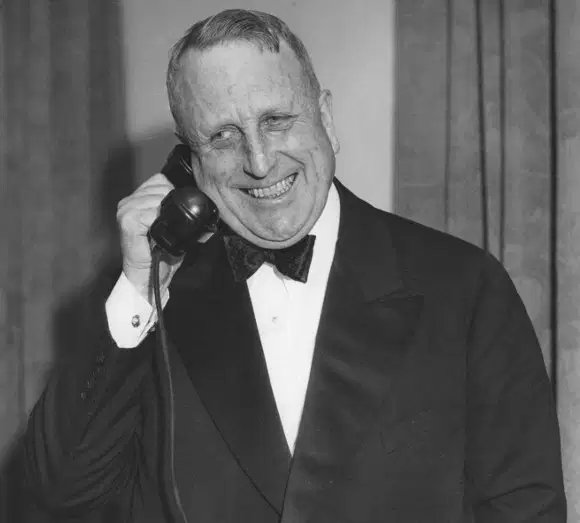
Owner of the New York Journal who published exaggerated news stories to increase circulation (get more readers)
a)
Ted Turner
b)
William Hearst
c)
William Tweed
d)
Thomas Nast
23.
What did the Wright Brothers design and invent that would rapidly change travel in the world?
a)
automobiles
b)
trains
c)
steamboats
d)
airplanes
24.
eporters, journalists, photographers, and authors who used the media to raise concerns about the negative effects of industrialization were known as
a)
muckrakers
b)
suffragists
c)
immigrants
d)
abolitionists
25.
The Sherman anti-trust act was passed to
a)
break up monopolies
b)
give equal rights to women
c)
help people living in poverty
d)
end racism
26.
Upton Sinclair's The Jungle is credited with exposing the unsanitary conditions in the food industry and helping to pass the
a)
Sherman Anti-Trust Act
b)
18th Amendment
c)
Pure Food and Drug Act
d)
Equal Rights Amendment
27.
Change in the constitution which gave women the right to vote.
a)
19th Amendment
b)
18th Amendment
c)
21st Amendment
d)
1st Amendment
28.
The Progressive goals did NOT include...
a)
Promote Moral Improvement
b)
Protect Social Welfare
c)
Create Economic Reform
d)
Fight to end world hunger
29.
The Federal Reserve System is a...
a)
State Banking System set up in 1915
b)
State Banking System set up in 1914
c)
National Banking System set up in 1915
d)
National Banking Sytem set up in 1913
30.
How did President Wilson address Civil Rights for African-Americans?
a)
Extending Segregation
b)
Passing the Civil Rights Act
c)
Legalizing lynching
d)
Ending Segregation in the miiitary.
31.
______________ is a name for false or exaggerated reporting
a)
Red-top
b)
Government
c)
Newspaper lying
d)
Yellow Journalism
32.
Exiled from Cuba at age 16, this rebel launched his Cuban Revolution from New York in 1883
a)
Che Gevara
b)
Jose Marti
c)
Valeriano Weyler
d)
Simon Bolivar
33.
Which of the following did not stimulate U.S. imperialism?
a)
need for a new source of cheap labor
b)
thirst for new economic markets
c)
desire for military strength
d)
a belief in the cultural superiority of the Anglo-Saxon culture
34.
How did the building of the Panama Canal support the United States efforts to become a world power?
a)
It gave the U.S. a colony in Central America
b)
It prevented Japan from attacking Hawaii
c)
It opened a new trade route to China
d)
It provided a shortcut between the Atlantic Ocean & the Pacific Ocean, opening up new trading opportunities
35.
From which country did America purchase Alaska from?
a)
Britain
b)
France
c)
Spain
d)
Russia
36.
The three factors that fueled American imperialism did NOT include...
a)
Desire for military strength
b)
Promotion of Social Welfare
c)
Thirst for New Markets
d)
Belief in Cultural Superiority
37.
The law that required truthful labels was the
a)
Pure Food and Drug Act.
b)
Meat Inspection Act.
c)
Sherman Antitrust Act.
d)
Interstate Commerce Act.
38.

The state of _____ granted full woman suffrage in 1893.
a)
Minnesota
b)
Utah
c)
Colorado
d)
California
39.
What was the primary motivation for passage of the Sixteenth Amendment?
a)
to curb the power of corporations
b)
to replace revenue lost by enacting lower tariffs
c)
to reduce the gap between rich and poor
d)
to create a war chest to pay for future wars
40.
World War I began in ____ and ended in _____.
a)
1914, 1917
b)
1917, 1918
c)
1914, 1918
d)
1915,1919
41.
How did the Zimmerman Telegram influence U.S. entry into World War I?
a)
It announced the czar's overthrow in Russia
b)
It revealed a proposed military alliance between Mexico and Germany
c)
It contained orders for German u-boats to attack British passenger ships
d)
It described Romania's plan to abandon neutrality
42.
The Fourteen Points reflected Woodrow Wilson's belief that-
a)
Intervention in the affairs of other nations were never justifiable
b)
Travel among nations should be regulated by an international organization
c)
No country should be allowed to spend more on defense than any other country
d)
Cooperation among international leaders was essential to world peace
43.
What does the I in M.A.I.N stand for?
a)
Isolationism
b)
Inspectionism
c)
Inception
d)
Imperialism
44.
WWI was the first total war in history. What is total war?
a)
everything was open to fighting, including civilians and cities
b)
the first time the army, navy, and air force were used together
c)
every country in the world was involved in fighting
d)
all of a country's money would go totally to war
e)
45.
Archduke Franz Ferdinand was heir to the throne in
a)
Germany
b)
Italy
c)
Austria-Hungary
d)
Serbia
46.
One of the first countries to jump to the defense of Serbia was:
a)
Russia
b)
Germany
c)
France
d)
Britian
47.
The following countries make up which alliance system: Austria-Hungary, Germany, & Ottoman Empire
a)
Triple Entente
b)
Allies
c)
Central Powers
d)
Axis
e)
48.
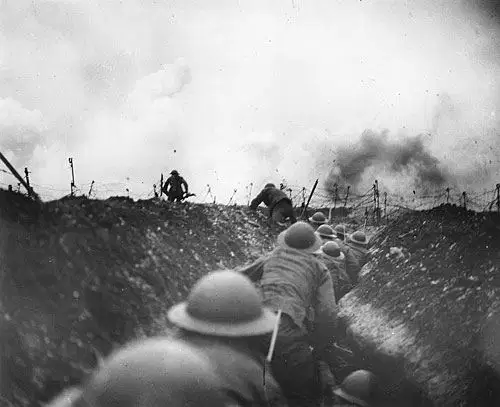
What was the land between two enemy trenches called?
a)
No Man's Land
b)
His brother's land
c)
Unfruchtbares Land
d)
Lebensraum
49.
Who was the president during WWI?
a)
Teddy Roosevelt
b)
William McKinley
c)
Herbert Hoover
d)
Woodrow Wilson
50.
Who was to accept the blame for the war according to the Treaty of Versailles?
a)
Great Britain
b)
France
c)
Germany
d)
Serbia
51.
A major goal of France and Great Britain at the peace treaty conference at the end of the war was to make sure Germany:
a)
was rebuilt and strong again
b)
could not rebuild its military strength
c)
became wealthy and industrialized
d)
strengthened its colonies
52.
The League of Nations was created after World War One; as an international, world wide:
a)
peace keeping organization
b)
banking system
c)
health organization
d)
delivery system
53.
What are two ways the Treaty of Versailles punished Germany severely?
a)
It divided Germany into four separate, occupied zones.
b)
It supported economic help given to Germany by the U.S.
c)
It took away German territory in Spain and Russia.
d)
It forced Germany to accept blame for the war and to pay reparations.
54.
What did the United States use to overcome the threat of German U-boats?
a)
airplanes
b)
groups of guarded ships
c)
ships flying neutral flags
d)
a fleet of American submarines
55.
Which of the following was a result of the Selective Service Act?
a)
African Americans could not become Army officers.
b)
Women could serve in combat positions.
c)
Troops were segregated by race.
d)
Men were required to register for military service.
56.
When did the United States Enter World War I
a)
January 1916
b)
April 1917
c)
April 1916
d)
November 1917
57.

In which country did most of the fighting shown on this map take place?
a)
Germany
b)
Belgium
c)
Luxembourg
d)
France
58.
The Schlieffen Plan was effective because it
a)
allowed Germany to fight on two fronts at once.
b)
prevented ships from entering waters around Britain
c)
resulted in years of trench warfare in France.
d)
allowed Germany to drive quickly toward the French capital.
59.
Gains made by American women during World War I include
a)
acceptance as full-fledged members of the U.S. Army.
b)
the beginnings of a movement for woman suffrage.
c)
equal pay for equal work in many war industries.
d)
increased support for women's right to vote.
60.
The war might have involved only two nations, Austria-Hungary and Serbia, if not for
a)
the American Expeditionary Force.
b)
imperialism.
c)
propaganda.
d)
the alliance system.
61.
He commanded the American Expeditionary Force (AEF).
a)
John J. Pershing
b)
Alvin York
c)
Eddie Rickenbacker
d)
Henry Johnson
62.
What unit, comprised of only African Americans, was the most decorated American unit of WW1?
a)
307th Battalion of the 77th Infantry Divion
b)
442nd Regimental Combat Team
c)
254th Infantry Batallion Queens Conquerers
d)
369th Infantry Regiment, "Harlem Hellfighters"
63.
Which of these helped create popular culture throughout the United States?
a)
the radio
b)
prohibition
c)
women's suffrage
d)
the KKK
64.
How did Prohibition contribute to the growth of organized crime?
a)
by making it easier for bootleggers to branch into other types of illegal activity
b)
by forcing police to enforce anti liquor laws
c)
by forcing farmers to grow grain for the production of alcohol
d)
by strengthening respect for the law
65.
Presidents Harding and Coolidge favored policies that
a)
supported the growth of business
b)
encouraged activism
c)
brought about social reform
d)
discouraged laissez faire
66.
At its heart, the Scopes Trial was a clash between
a)
religion and science
b)
biology and science
c)
evolution and science
d)
education and science
67.
Which of these limited immigration during the 1920s?
a)
National Origins Act
b)
KKK
c)
Scientific Management
d)
The Great Migration
68.
The demand for automobiles in the 1920s
a)
stimulated growth in many other industries
b)
led to a nationwide recession
c)
closed down the steel industry
d)
brought about the collapse of the suburbs
69.
The literature of the Harlem Renaissance
a)
explored the pains and joys of being black in America
b)
explored the origins of jazz
c)
was written by Marcus Garvey
d)
argued for the separation of races
70.
Involved transferring oil reserves from the Interior Department to private companies for profit
a)
Teapot Dome Scandal
b)
Scopes Trial
c)
Great Migration
d)
Jazz Age
71.
Which of these best describes the "New Woman" of the 1920s?
a)
They stayed home and cooked and cleaned
b)
They preferred the same fashions as their parents
c)
They wore shorter skirts, bobbed their hair, and went to speakeasies
d)
They rejected the idea of suffrage
72.
Change in the constitution which gave women the right to vote.
a)
19th Amend
b)
18th Amed
c)
21st Amend
d)
1st Amend
73.
Period in the 1920s when suspected communists and other radicals were arrested due to the fear of the spread of communism.
a)
Scopes Trial
b)
KKK
c)
Teapot Dome Scandal
d)
Red Scare
74.
Disillusioned poets and novelists who wrestled with the meaning of war and life.
a)
Harlem Renaissance
b)
Lost Generation
c)
flappers
d)
The Great Gatsby
75.
Secret organization that hated African Americans, Jews, Catholics, and immigrants.
a)
Ku Klux Klan
b)
Kool Kids Klub
c)
Kan Kan Klan
d)
Kit Kat Klan
76.
John T. Scopes challenged a Tennessee law that forbade the teaching of
a)
biology.
b)
evolution.
c)
creationism.
d)
fundamentalism.
77.
"Double standard" refers to
a)
lower wages women earned compared to those earned by men in the 1920s.
b)
amount of work that women did both at home and outside the house in the 1920s.
c)
unfair treatment of women in the workplace in the 1920s.
d)
stricter social and moral standards for women than for men in the 1920s.
78.
Jazz music was born in New Orleans and was spread to the North by such musicians as
a)
Paul Robeson.
b)
Zora Neale Hurston.
c)
Louis Armstrong.
d)
Langston Hughes.
79.
Nicola Sacco and Bartolomeo Vanzetti were charged with, and convicted of,
a)
receiving bribes.
b)
robbery and murder.
c)
treason.
d)
anarchy.
80.
Attorney General A. Mitchell Palmer believed that he needed to protect the American people from
a)
big business.
b)
political radicals.
c)
corruption and fraud.
d)
labor union members.
81.

What type of music was popularized during the Harlem Renaissance?
a)
Jazz
b)
Hip Hop
c)
Country
d)
Rock
82.
Which of the following leaders transformed the Soviet Union from a rural nation into an industrial power?
a)
Stalin
b)
Hitler
c)
Lenin
d)
Mussolini
83.
What is genocide, as practiced by the Nazis?
a)
the broadcasting of anti-Semitic ideas
b)
the deliberate extermination of a specific group of people
c)
the abuse of a nation's citizens by their own government
d)
the killing of people for the purpose of creating terror
84.
When did Britain and France adopt a policy of appeasement toward Germany?
a)
After Poland was divided
b)
when they declared war
c)
after France was invaded and divided
d)
before the war began
85.
Which group of people suffered 6 million deaths during the Holocaust?
a)
Nationalists
b)
Aryans
c)
Fascists
d)
Jews
100 %

