
Font size
 Worksheets
Az204 Bootcamp Quiz2 revised
Total questions: 45
Worksheet time: 1hrs 8mins
You have two Hyper-V hosts named Host1 and Host2. Host1 has an Azure virtual machine named VM1 that was deployed by using a custom Azure Resource
Manager template.
You need to move VM1 to Host2.
What should you do?
From the Update management blade, click Enable.
From the Overview blade, move VM1 to a different subscription.
From the Redeploy blade, click Redeploy.
From the Profile blade, modify the usage location.
Your company has an Azure subscription.
You need to deploy a number of Azure virtual machines to the subscription by using Azure Resource Manager (ARM) templates. The virtual machines will be included in a single availability set.
You need to ensure that the ARM template allows for as many virtual machines as possible to remain accessible in the event of fabric failure or maintenance.
Which of the following is the value that you should configure for the platformFaultDomainCount property?
10
30
Min Value
Max Value
Your company has an Azure subscription.
You need to deploy a number of Azure virtual machines to the subscription by using Azure Resource Manager (ARM) templates. The virtual machines will be included in a single availability set.
You need to ensure that the ARM template allows for as many virtual machines as possible to remain accessible in the event of fabric failure or maintenance.
Which of the following is the value that you should configure for the platformUpdateDomainCount property?
10
20
30
40
The API back end is hosted in an Azure App Service instance. You have implemented a RESTful service for the API back end.
You must configure back-end authentication for the API Management service instance.
Solution: You configure Basic gateway credentials for the HTTP(s) endpoint.
Does the solution meet the goal?
Yes
No
You are developing a solution for a public facing API.
The API back end is hosted in an Azure App Service instance. You have implemented a RESTful service for the API back end.
You must configure back-end authentication for the API Management service instance.
Solution: You configure Client cert gateway credentials for the Azure resource.
Does the solution meet the goal?
Yes
No
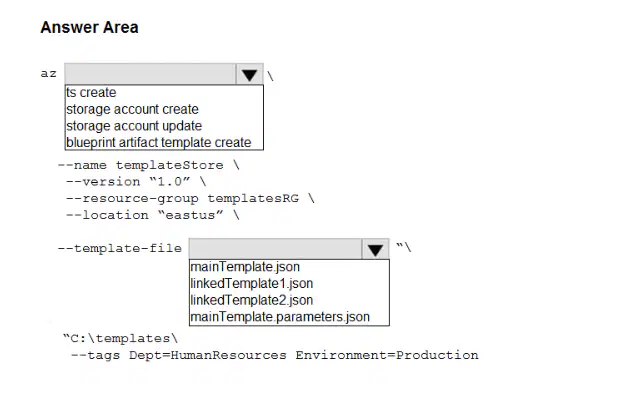
You are authoring a set of nested Azure Resource Manager templates to deploy Azure resources. You author an Azure Resource Manager template named mainTemplate.json that contains the following linked templates: linkedTemplate1.json, linkedTemplate2.json.
You add parameters to a parameters template file named mainTemplate.parameters,json. You save all templates on a local device in the C:\templates\ folder.
You have the following requirements:
• Store the templates in Azure for later deployment.
• Enable versioning of the templates.
• Manage access to the templates by using Azure RBAC.
• Ensure that users have read-only access to the templates.
• Allow users to deploy the templates.
You need to store the templates in Azure.
How should you complete the command? To answer, select the appropriate options in the answer area.
Box1:storage account create
Box2:linkedTemplate2.json
Box1:ts create
Box2:mainTemplate2.json
Box1:storage account update
Box2:linkedTemplate1.json

You are developing a service where customers can report news events from a browser using Azure Web PubSub. The service is implemented as an Azure Function App that uses the JSON WebSocket subprotocol to receive news events.
You need to implement the bindings for the Azure Function App.
How should you configure the binding? To answer, select the appropriate options in the answer area.
NOTE: Each correct selection is worth one point.
Box1:user
Box2:system
Box1:webSubPubConnection
Box2:connected
Box1:webPubSubTrigger
Box2:user
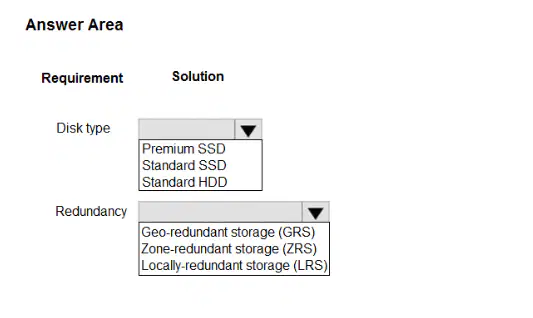
You are building a software-as-a-service (SaaS) application that analyzes DNA data that will run on Azure virtual machines (VMs) in an availability zone. The data is stored on managed disks attached to the VM. The performance of the analysis is determined by the speed of the disk attached to the VM.
You have the following requirements:
• The application must be able to quickly revert to the previous day’s data if a systemic error is detected.
• The application must minimize downtime in the case of an Azure datacenter outage.
You need to provision the managed disk for the VM to maximize performance while meeting the requirements.
Which type of Azure Managed Disk should you use? To answer, select the appropriate options in the answer area.
NOTE: Each correct selection is worth one point.
Box1:Premium SSD
Box2:GRS
Box1:Standard SSD
Box2:ZRS
Box1:Standard HDD
Box2:LRS
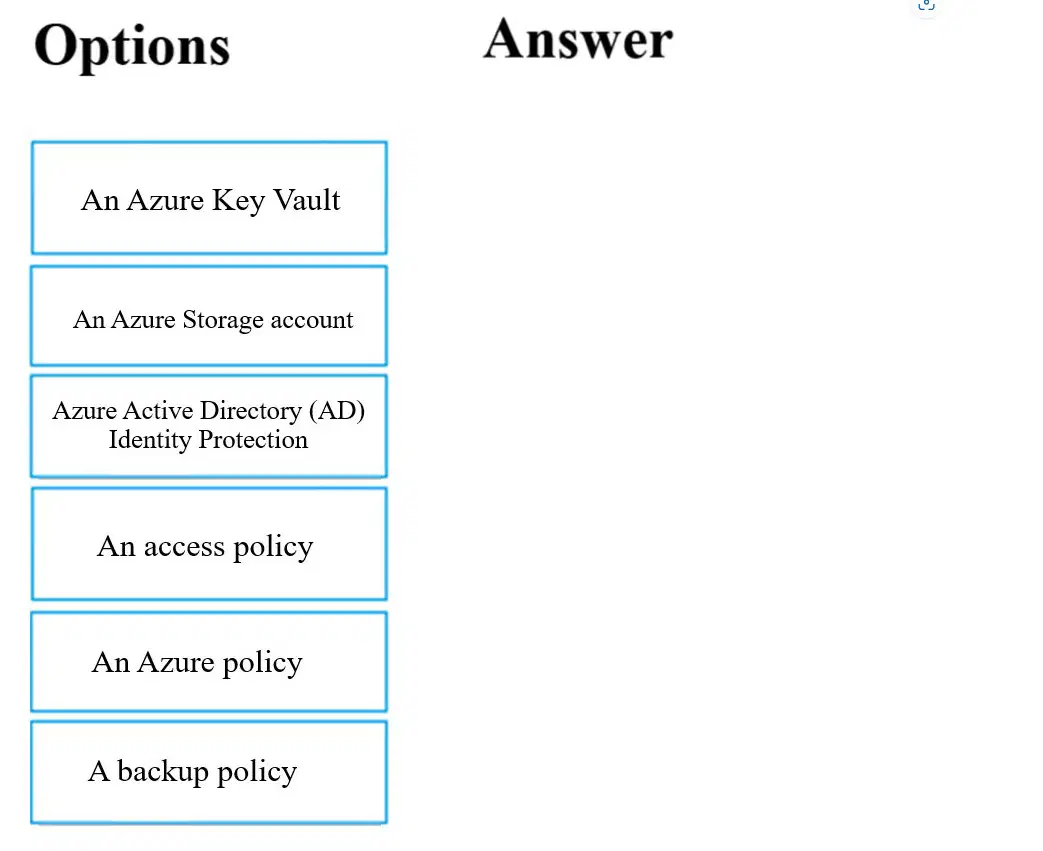
You have downloaded an Azure Resource Manager template to deploy numerous virtual machines. The template is based on a current virtual machine, but must be adapted to reference an administrative password.
You need to make sure that the password is not stored in plain text.
You are preparing to create the necessary components to achieve your goal.
Which of the following should you create to achieve your goal? Answer by dragging the correct option from the list to the answer area.
Select and Place:
Box1: An Azure Key Vault
Box2:An Azure policy
Box1: An Azure Key Vault
Box2:Abackup policy
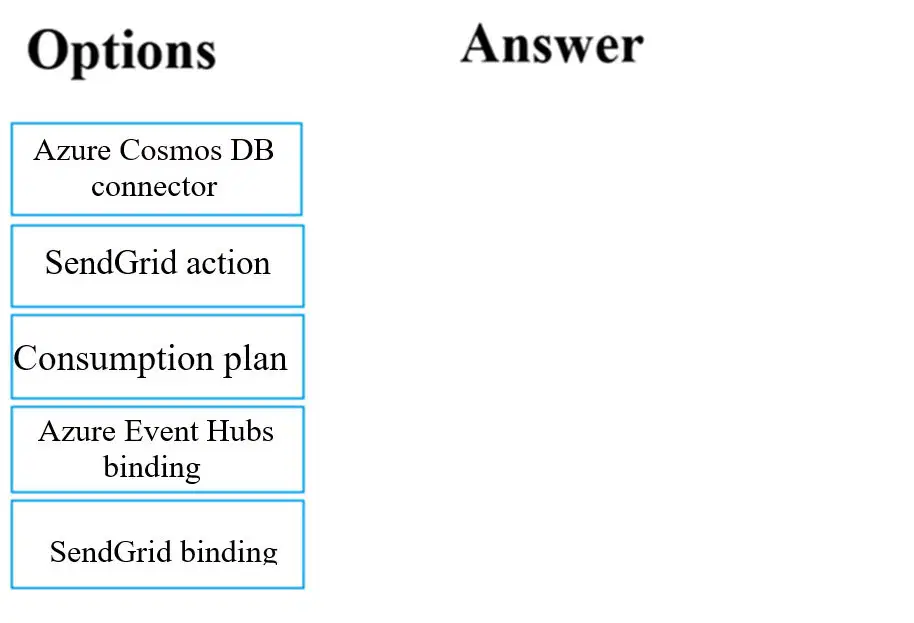
You are creating an Azure Cosmos DB account that makes use of the SQL API. Data will be added to the account every day by a web application.
You need to ensure that an email notification is sent when information is received from IoT devices, and that compute cost is reduced.
You decide to deploy a function app.
Which of the following should you configure the function app to use? Answer by dragging the correct options from the list to the answer area.
Box1:Consumption plan
Box2:SendGrid Action
Box1:Consumption plan
Box2:SendGrid Binding
You are developing an Azure solution to collect point-of-sale (POS) device data from 2,000 stores located throughout the world. A single device can produce
2 megabytes (MB) of data every 24 hours. Each store location has one to five devices that send data.
You must store the device data in Azure Blob storage. Device data must be correlated based on a device identifier. Additional stores are expected to open in the future.
You need to implement a solution to receive the device data.
Solution: Provision an Azure Event Grid. Configure the machine identifier as the partition key and enable capture.
Does the solution meet the goal?
A.Yes
B.No
You develop Azure solutions.
A .NET application needs to receive a message each time an Azure virtual machine finishes processing data. The messages must NOT persist after being processed by the receiving application.
You need to implement the .NET object that will receive the messages.
Which object should you use?
A. QueueClient
B. SubscriptionClient
C. TopicClient
D. CloudQueueClient
You develop Azure solutions.
You must connect to a No-SQL globally-distributed database by using the .NET API.
You need to create an object to configure and execute requests in the database.
Which code segment should you use?
A. new Container(EndpointUri, PrimaryKey);
B. new Database(EndpointUri, PrimaryKey);
C. new CosmosClient(EndpointUri, PrimaryKey);
You have an existing Azure storage account that stores large volumes of data across multiple containers.
You need to copy all data from the existing storage account to a new storage account. The copy process must meet the following requirements:
✑ Automate data movement.
✑ Minimize user input required to perform the operation.
✑ Ensure that the data movement process is recoverable.
What should you use?
A. AzCopy
B. Azure Storage Explorer
C. Azure portal
D. .NET Storage Client Library

You are implementing an order processing system. A point of sale application publishes orders to topics in an Azure Service Bus queue. The Label property for the topic includes the following data:
Box1:No Filter
Box2:CorrelationFilter
Box3:SQLFilter
Box4:SQLFilter
Box5:CorrelationFilter
Box1:SQLFilter
Box2:CorrelationFilter
Box3:SQLFilter
Box4:SQLFilter
Box5:No Filter
You are developing an Azure Cosmos DB solution by using the Azure Cosmos DB SQL API. The data includes millions of documents. Each document may contain hundreds of properties.
The properties of the documents do not contain distinct values for partitioning. Azure Cosmos DB must scale individual containers in the database to meet the performance needs of the application by spreading the workload evenly across all partitions over time.
You need to select a partition key.
Which two partition keys can you use? Each correct answer presents a complete solution.
NOTE: Each correct selection is worth one point.
A. a single property value that does not appear frequently in the documents
B. a value containing the collection name
C. a single property value that appears frequently in the documents
D. a concatenation of multiple property values with a random suffix appended
E. a hash suffix appended to a property value
You develop and deploy a web application to Azure App Service. The application accesses data stored in an Azure Storage account. The account contains several containers with several blobs with large amounts of data. You deploy all Azure resources to a single region.
You need to move the Azure Storage account to the new region. You must copy all data to the new region.
What should you do first?
A. Export the Azure Storage account Azure Resource Manager template
B. Initiate a storage account failover
C. Configure object replication for all blobs
D. Use the AzCopy command line tool
E. Create a new Azure Storage account in the current region
An organization deploys Azure Cosmos DB.
You need to ensure that the index is updated as items are created, updated, or deleted.
What should you do?
A. Set the indexing mode to Lazy.
B. Set the value of the automatic property of the indexing policy to False.
C. Set the value of the EnableScanInQuery option to True.
D. Set the indexing mode to Consistent.
You are developing a .Net web application that stores data in Azure Cosmos DB. The application must use the Core API and allow millions of reads and writes.
The Azure Cosmos DB account has been created with multiple write regions enabled. The application has been deployed to the East US2 and Central US regions.
You need to update the application to support multi-region writes.
What are two possible ways to achieve this goal? Each correct answer presents part of the solution.
NOTE: Each correct selection is worth one point.
A. Update the ConnectionPolicy class for the Cosmos client and populate the PreferredLocations property based on the geo-proximity of the application.
B. Update Azure Cosmos DB to use the Strong consistency level. Add indexed properties to the container to indicate region.
C. Update the ConnectionPolicy class for the Cosmos client and set the UseMultipleWriteLocations property to true.
D. Create and deploy a custom conflict resolution policy.
E. Update Azure Cosmos DB to use the Session consistency level. Send the SessionToken property value from the FeedResponse object of the write action to the end-user by using a cookie.
You are developing an application to store business-critical data in Azure Blob storage.
The application must meet the following requirements:
• Data must not be modified or deleted for a user-specified interval.
• Data must be protected from overwrites and deletes.
• Data must be written once and allowed to be read many times.
You need to protect the data in the Azure Blob storage account.
Which two actions should you perform? Each correct answer presents part of the solution.
NOTE: Each correct selection is worth one point
A. Configure a time-based retention policy for the storage account.
B. Create an account shared-access signature (SAS).
C. Enable the blob change feed for the storage account.
D. Enable version-level immutability support for the storage account.
E. Enable point-in-time restore for containers in the storage account.
You are updating an application that stores data on Azure and uses Azure Cosmos DB for storage. The application stores data in multiple documents associated with a single username.
The application requires the ability to update multiple documents for a username in a single ACID operation.
You need to configure Azure Cosmos DB.
Which two actions should you perform? Each correct answer presents part of the solution.
NOTE: Each correct selection is worth one point.
A. Create a collection sharded on username to store documents.
B. Configure Azure Cosmos DB to use the Gremlin API.
C. Create an unsharded collection to store documents.
D. Configure Azure Cosmos DB to use the MongoDB API.
You develop Azure solutions.
You must connect to a No-SQL globally-distributed database by using the .NET API.
You need to create an object to configure and execute requests in the database.
Which code segment should you use?
A. database_name = 'MyDatabase'
database = client.create_database_if_not_exists(id=database_name)
B. client = CosmosClient(endpoint, key)
C. container_name = 'MyContainer'
container = database.create_container_if_not_exists(
id=container_name, partition_key=PartitionKey(path="/lastName"), offer_throughput=400 )
You develop a web application that provides access to legal documents that are stored on Azure Blob Storage with version-level immutability policies. Documents are protected with both time-based policies and legal hold policies. All time-based retention policies have the AllowProtectedAppendWrites property enabled.
You have a requirement to prevent the user from attempting to perform operations that would fail only when a legal hold is in effect and when all other policies are expired.
You need to meet the requirement.
Which two operations should you prevent? Each correct answer presents a complete solution.
NOTE: Each correct selection is worth one point.
A. adding data to documents
B. deleting documents
C. creating documents
D. overwriting existing documents
You are developing a Java application that uses Cassandra to store key and value data. You plan to use a new Azure Cosmos DB resource and the Cassandra
API in the application. You create an Azure Active Directory (Azure AD) group named Cosmos DB Creators to enable provisioning of Azure Cosmos accounts, databases, and containers.
The Azure AD group must not be able to access the keys that are required to access the data.
You need to restrict access to the Azure AD group.
Which role-based access control should you use?
A. DocumentDB Accounts Contributor
B. Cosmos Backup Operator
C. Cosmos DB Operator
D. Cosmos DB Account Reader
You are developing a website that will run as an Azure Web App. Users will authenticate by using their Azure Active Directory (Azure AD) credentials.
You plan to assign users one of the following permission levels for the website: admin, normal, and reader. A user's Azure AD group membership must be used to determine the permission level.
You need to configure authorization.
Solution: Configure the Azure Web App for the website to allow only authenticated requests and require Azure AD log on.
Does the solution meet the goal?
Yes
No
You are developing a website that will run as an Azure Web App. Users will authenticate by using their Azure Active Directory (Azure AD) credentials.
You plan to assign users one of the following permission levels for the website: admin, normal, and reader. A user's Azure AD group membership must be used to determine the permission level.
You need to configure authorization.
Solution:
✑ Create a new Azure AD application. In the application's manifest, set value of the groupMembershipClaims option to All.
✑ In the website, use the value of the groups claim from the JWT for the user to determine permissions.
Does the solution meet the goal?
Yes
No
You are developing a website that will run as an Azure Web App. Users will authenticate by using their Azure Active Directory (Azure AD) credentials.
You plan to assign users one of the following permission levels for the website: admin, normal, and reader. A user's Azure AD group membership must be used to determine the permission level.
You need to configure authorization.
Solution:
✑ Create a new Azure AD application. In the application's manifest, define application roles that match the required permission levels for the application.
✑ Assign the appropriate Azure AD group to each role. In the website, use the value of the roles claim from the JWT for the user to determine permissions.
Does the solution meet the goal?
Yes
No
You provide an Azure API Management managed web service to clients. The back-end web service implements HTTP Strict Transport Security (HSTS).
Every request to the backend service must include a valid HTTP authorization header.
You need to configure the Azure API Management instance with an authentication policy.
Which two policies can you use? Each correct answer presents a complete solution.
NOTE: Each correct selection is worth one point.
A. Basic Authentication
B. Digest Authentication
C. Certificate Authentication
D. OAuth Client Credential Grant
You have an application that includes an Azure Web app and several Azure Function apps. Application secrets including connection strings and certificates are stored in Azure Key Vault.
Secrets must not be stored in the application or application runtime environment. Changes to Azure Active Directory (Azure AD) must be minimized.
You need to design the approach to loading application secrets.
What should you do?
A. Create a single user-assigned Managed Identity with permission to access Key Vault and configure each App Service to use that Managed Identity.
B. Create a single Azure AD Service Principal with permission to access Key Vault and use a client secret from within the App Services to access Key Vault.
C. Create a system assigned Managed Identity in each App Service with permission to access Key Vault.
D. Create an Azure AD Service Principal with Permissions to access Key Vault for each App Service and use a certificate from within the App Services to access Key Vault.
You are developing a medical records document management website. The website is used to store scanned copies of patient intake forms.
If the stored intake forms are downloaded from storage by a third party, the contents of the forms must not be compromised.
You need to store the intake forms according to the requirements.
Solution:
1. Create an Azure Key Vault key named skey.
2. Encrypt the intake forms using the public key portion of skey.
3. Store the encrypted data in Azure Blob storage.
Does the solution meet the goal?
Yes
No
You are developing a medical records document management website. The website is used to store scanned copies of patient intake forms.
If the stored intake forms are downloaded from storage by a third party, the contents of the forms must not be compromised.
You need to store the intake forms according to the requirements.
Solution:
1. Create an Azure Cosmos DB database with Storage Service Encryption enabled.
2. Store the intake forms in the Azure Cosmos DB database.
Does the solution meet the goal?
Yes
No
You are developing a medical records document management website. The website is used to store scanned copies of patient intake forms.
If the stored intake forms are downloaded from storage by a third party, the contents of the forms must not be compromised.
You need to store the intake forms according to the requirements.
Solution: Store the intake forms as Azure Key Vault secrets.
Does the solution meet the goal?
Yes
No
Your company is developing an Azure API hosted in Azure.
You need to implement authentication for the Azure API to access other Azure resources. You have the following requirements:
✑ All API calls must be authenticated.
✑ Callers to the API must not send credentials to the API.
Which authentication mechanism should you use?
A. Basic
B. Anonymous
C. Managed identity
D. Client certificate
You develop Azure solutions.
You must grant a virtual machine (VM) access to specific resource groups in Azure Resource Manager.
You need to obtain an Azure Resource Manager access token.
Solution: Use an X.509 certificate to authenticate the VM with Azure Resource Manager.
Does the solution meet the goal?
Yes
No
You develop Azure solutions.
You must grant a virtual machine (VM) access to specific resource groups in Azure Resource Manager.
You need to obtain an Azure Resource Manager access token.
Solution: Use the Reader role-based access control (RBAC) role to authenticate the VM with Azure Resource Manager.
Does the solution meet the goal?
Yes
No
You are developing a website that will run as an Azure Web App. Users will authenticate by using their Azure Active Directory (Azure AD) credentials.
You plan to assign users one of the following permission levels for the website: admin, normal, and reader. A user's Azure AD group membership must be used to determine the permission level.
You need to configure authorization.
Solution:
✑ Configure and use Integrated Windows Authentication in the website.
✑ In the website, query Microsoft Graph API to load the groups to which the user is a member.
Does the solution meet the goal?
Yes
No
You develop Azure solutions.
You must grant a virtual machine (VM) access to specific resource groups in Azure Resource Manager.
You need to obtain an Azure Resource Manager access token.
Solution: Run the Invoke-RestMethod cmdlet to make a request to the local managed identity for Azure resources endpoint.
Does the solution meet the goal?
Yes
No
You develop an app that allows users to upload photos and videos to Azure storage. The app uses a storage REST API call to upload the media to a blob storage account named Account1. You have blob storage containers named Container1 and Container2.
Uploading of videos occurs on an irregular basis.
You need to copy specific blobs from Container1 to Container2 when a new video is uploaded.
What should you do?
A. Copy blobs to Container2 by using the Put Blob operation of the Blob Service REST API
B. Create an Event Grid topic that uses the Start-AzureStorageBlobCopy cmdlet
C. Use AzCopy with the Snapshot switch to copy blobs to Container2
D. Download the blob to a virtual machine and then upload the blob to Container2
You are developing an ASP.NET Core website that uses Azure FrontDoor. The website is used to build custom weather data sets for researchers. Data sets are downloaded by users as Comma Separated Value (CSV) files. The data is refreshed every 10 hours.
Specific files must be purged from the FrontDoor cache based upon Response Header values.
You need to purge individual assets from the Front Door cache.
Which type of cache purge should you use?
A. single path
B. wildcard
C. root domain
Your company is developing an Azure API.
You need to implement authentication for the Azure API. You have the following requirements:
All API calls must be secure.
✑ Callers to the API must not send credentials to the API.
Which authentication mechanism should you use?
A. Basic
B. Anonymous
C. Managed identity
D. Client certificate
You are a developer for a SaaS company that offers many web services.
All web services for the company must meet the following requirements:
✑ Use API Management to access the services
✑ Use OpenID Connect for authentication
✑ Prevent anonymous usage
A recent security audit found that several web services can be called without any authentication.
Which API Management policy should you implement?
A. jsonp
B. authentication-certificate
C. check-header
D. validate-jwt
You are developing an Azure App Service REST API.
The API must be called by an Azure App Service web app. The API must retrieve and update user profile information stored in Azure Active Directory (Azure AD).
You need to configure the API to make the updates.
Which two tools should you use? Each correct answer presents part of the solution.
NOTE: Each correct selection is worth one point.
A. Microsoft Graph API
B. Microsoft Authentication Library (MSAL)
C. Azure API Management
D. Microsoft Azure Security Center
E. Microsoft Azure Key Vault SDK
You develop a REST API. You implement a user delegation SAS token to communicate with Azure Blob storage.
The token is compromised.
You need to revoke the token.
What are two possible ways to achieve this goal? Each correct answer presents a complete solution.
NOTE: Each correct selection is worth one point.
A. Revoke the delegation key.
security principle.
B. Delete the stored access policy.
C. Regenerate the account key.
D. Remove the role assignment for the
You develop and deploy an Azure Logic app that calls an Azure Function app. The Azure Function app includes an OpenAPI (Swagger) definition and uses an
Azure Blob storage account. All resources are secured by using Azure Active Directory (Azure AD).
The Azure Logic app must securely access the Azure Blob storage account. Azure AD resources must remain if the Azure Logic app is deleted.
You need to secure the Azure Logic app.
What should you do?
A. Create a user-assigned managed identity and assign role-based access controls.
B. Create an Azure AD custom role and assign the role to the Azure Blob storage account.
C. Create an Azure Key Vault and issue a client certificate.
D. Create a system-assigned managed identity and issue a client certificate.
E. Create an Azure AD custom role and assign role-based access controls.
You are developing a solution that will use a multi-partitioned Azure Cosmos DB database. You plan to use the latest Azure Cosmos DB SDK for development.
The solution must meet the following requirements:
✑ Send insert and update operations to an Azure Blob storage account.
✑ Process changes to all partitions immediately.
✑ Allow parallelization of change processing.
You need to process the Azure Cosmos DB operations.
What are two possible ways to achieve this goal? Each correct answer presents a complete solution.
NOTE: Each correct selection is worth one point.
A. Create an Azure App Service API and implement the change feed estimator of the SDK. Scale the API by using multiple Azure App Service instances.
B. Create a background job in an Azure Kubernetes Service and implement the change feed feature of the SDK.
C. Create an Azure Function to use a trigger for Azure Cosmos DB. Configure the trigger to connect to the container.
D. Create an Azure Function that uses a FeedIterator object that processes the change feed by using the pull model on the container. Use a FeedRange object to parallelize the processing of the change feed across multiple functions.

