
 Worksheets
PreCalculus Final Exam Things to Know Cold
Total questions: 86
Worksheet time: 3hrs 21mins
f(x)=x−51 Find the domain of f(x).
(−∞,5)U(5,∞)
[5,∞)
(−∞,5]
(−∞,∞)
Write the domain of f(x)=x2−16x
(−∞,0)U(4,∞)
[4,∞)
(−∞,0)U(0,4]
(−∞,−4)U(−4,4)U(4,∞)
Find the domain of g(x)=2x−4
(−∞,2)(2,∞)
[2,∞)
(−∞,2]
(−∞,21)(21,∞)

Even, odd, or neither?
Even
Odd
Neither

The function in the graph is:
Even
Odd
Neither
Is this an even, odd, or neither function?
f(x) = x4 + x2
Even
Odd
Neither

Infinite Nonremovable Discontinuity
Point Removable Discontinuity
Jump Nonremovable Discontinuity
Continuous at x=2

Infinite Nonremovable Discontinuity
Point Removable Discontinuity
Jump Nonremovable Discontinuity
Continuous at x=2

Infinite Discontinuity
Removable Discontinuity
Jump Discontinuity
Continuous at x=2


Quadratic - y=x2
Absolute Value - y=∣x∣
Square Root - y=x
Cube Root - y=3x

Cubic - y=x3
Cube Root - y=3x
Exponential - y=2x
Logarmithic - y=logx

Cube Root - y=3x
Cubic - y=x3
Exponential - y=2x
Rational/Inverse - y=x1

Rational - y=x1
Absolute Value - y=∣x∣
Linear - y=x
Quadratic - y=x2

Square Root - y=x
Exponential - y=2x
Logarithmic y=logx
Cube Root - y=3x
Vertical Dilation by a factor of 1/2
Horizontal Dilation by a factor of 1/2
Vertical translation up by 2 units.
Reflection across the x-axis.
f(x) = x2 to the graph of g(x) = (x + 4)2?
y = 5f(x)
Vertical Dilation by 5
Vertical Dilation by 1/5
Horizontal Dilation by 5
Horizontal Dilation by 1/5
y = - f(x)
The graph of y = f(x) was reflected vertically across the x axis.
The graph of y = f(x) was reflected horizontally across the y axis.
The graph of y = f(x) was shifted down.
The graph of y = f(x) was shifted up
y = f(- x)
The graph of y = f(x) was reflected vertically across the x axis.
The graph of y = f(x) was reflected horizontally across the y axis.
The graph of y = f(x) was shifted down.
The graph of y = f(x) was shifted up
What quadrant is -2π/3 in?
I
II
III
IV
sin 2π
23
22
21
1
cos 4π
23
22
21
1
23
−22
-1
1
cos 6π
22
−21
21
23
tan 0
undefined
1
0
-1
cosine is positive in
the 1st and 2nd quadrants
the 1st and 3rd quadrants
the 1st and 4th quadrants
the 2nd and 3rd quadrants
tanθ =
cosθsinθ
sinθcosθ
cosθ1
cotθ

Which of the following is NOT a pythagorean identity?
sin2x + cos2x = 1
1 - cos2x = sin2x
1 - sin2x = cos2 x
sin2x - cos2x = -1
csc x =
1/cosx
1/sinx
cot2x-1
1/secx
sec x =
1/cosx
1/sinx
1/cscx
1/tanx
cos x =
sin x
sin2x-1
1/sec x
1/csc x
sin x =
cos x
1/cosx
1/secx
1/cscx
State the quadrant in which the terminal side of the angle lies. 67π
Q1
Q2
Q3
Q4
State the quadrant in which the terminal side of the angle lies. 45π
Q1
Q2
Q3
Q4
State the quadrant in which the terminal side of the angle lies. −67π
Q1
Q2
Q3
Q4
State the quadrant in which the terminal side of the angle lies. 35π
Q1
Q2
Q3
Q4
State the quadrant in which the terminal side of the angle lies. 43π
Q1
Q2
Q3
Q4
State the quadrant in which the terminal side of the angle lies. 4π
Q1
Q2
Q3
Q4
Select the graph of the angle in standard position:
32π


Select the graph of the angle in standard position: 35π


Select the graph of the angle in standard position: 611π


Select the graph of the angle in standard position: 43π


Select the graph of the angle in standard position: 45π


Select the graph of the angle in standard position: 34π


Select the graph of the angle in standard position: −25π


Calculate the amplitude of the curve
2π
2
1
0
Calculate the period of the curve
4π
2π
2
0

Calculate the period of the curve
4π
2π
1
-1
cos x + 1 = 0
Solve sinθ = ½ on [0, 2π)
θ = π / 6, 7π / 6
θ = π / 6, 5π / 6
θ = 5π / 6, 7π / 6
θ = 7π / 6, 11π / 6
Solve cosθ=−23
on [0, 2π)
θ=3π,32π
θ=32π,34π
θ=6π,65π
θ=65π,67π

Write the equation in point-slope form of the line that passes through the point (4,-7) and has a slope of -1/4
y+7=−41(x−4)
y−4=−41(x+7)
y+7=4(x−4)
y−7=−41(x−4)


(x-2)(x-1)(x+1)(x-2)
(x-2)(x-1)(x+1)(x+2)
(x-2)(x-1)(x+1)(x+2)(x-4)
(x-2)(x-1)(x+1)(x+2)(x+4)


x=5,x=−3 (multiplicity of 2)
x=−3, x=5 (multiplicity of 2)
x=3, x=−5
x=5
What are the vertical and horizontal asymptotes of the following function?
f(x)=x−3x+1
VA: x=3
HA: y=1
VA: x=1
HA: y=3
VA: x=1
HA: y=-3
VA: x = -1/3
HA: y=1
VA: x=3
HA: y= -1/3
What are the vertical and horizontal asymptotes of the following function?
f(x)=3x+66x−1
HA: y = -2
VA: x = 2
HA: y = 2
VA: x = -2
HA: y = -6
VA: x = 2
HA: y = 1/2
VA: x = -6
HA: y = 2
VA: x = -1/2

What are the coordinates of the y-intercept, if one exists.
(0, 0)
(0, 1)
(0, -1)
there isn't one

Find the x-intercept(s), if one exists.
(1, 0)
(-1, 0)
(1, 0), (-1, 0)
(0, 0), (1, 0)

What is the equation of the vertical asymptote?
x = 0
x = 4
x = -1, x = 4
x = -1

What is the equation of the horizontal asymptote?
y = 0
y = -2
y = 2
There isn't one

What is the x-coordinate of the hole, if one exists?
-4
-3
3
there isn't one
Rewrite as an exponential: log28 = 3
32 = 8
23 = 8
28 = 3
83 = 2
Rewrite as an exponential: log7(491)=−2
7491=−2
(491)−2=7
7−2=491
(−2)7=491
Rewrite as a log: x = 11y
log11(y) = x
logy(11) = x
log11(x) = y
logx(y) = 11
log2x - 5log2y
log2(x/y5)
log2(xy5)
log2(x/y)5
log2(x/5y)
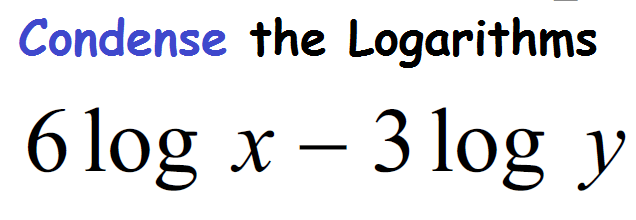
Condense the logarithms.
6logx−3logy
log (xy3)
log (x6 − y3)
log (x6/y3)
log (x6 + y3)

