
Font size
 Worksheets
Geography
Total questions: 121
Worksheet time: 1hrs 1mins
In 2018, how much waste did the UK produce?
200 million tonnes
225 million tonnes
250 million tonnes
275 million tonnes
What percentage of waste came from construction/demolition?
60%
62%
64%
68%
Calculate the percentage of waste that came from households.
(a)
How much food does the average person throw away in the UK?
59kg
69kg
79kg
89%
By how much has the value of food waste in the UK increased between 2006 and 2016.
£0.8 million
£800 million
£8 million
£80 million
What percentage of UK waste goes to landfill?
20%
45%
66%
77%
What percentage of waste in the UK is recycled?
30%
50%
What does the Chief Executive of Biffa blame for recycling rates stagnating in the UK?
Labelling of packaging is confusing.
There are different systems for recycling in different parts of the UK.
Recycling is not seen as a positive activity
There are aren't enough recycling centres in the UK.
What type of areas how low rates of recycling in the UK?
Remote rural areas like north Derbyshire
Urban areas in the middle of large cities like Newham in London
Rural counties like Devon
East Yorkshire.
How much plastic is exported from the UK to Malaysia?
(a)
China has banned imports of plastic waste. This has led to...
... increases in waste going to landfill.
...illegal dumping of waste.
...open burning of waste.
...serious air pollution and health problems.
...pollution of waterways.
Select the examples of circular waste systems.
Waste paper is pulped and made into paper bags.
Worn out tyres are thrown on a heap and burned.
Your old iPhone is reprocess and the gold and other metals removed and reused.
An old car is left to rust on scrap heap.
Methods of managing the coastline that involve the construction of significant structures to try and prevent or reduce natural processes are known as:
coastal management
hard Engineering
soft Engineering
Strategies used be people to prevent coastal erosion and flooding are known as:
coastal management
hard Engineering
soft Engineering
Methods of managing the coastline that involve understanding and working with natural processes rather than trying to prevent them are known as:
coastal management
hard Engineering
soft Engineering
What type of strategies are being used at Minehead, Somerset?
Hard engineering: Sea Wall
Hard engineering: Rock armour
Hard engineering: Revetment
Soft engineering: Managed retreat.
Managed retreat allows an area of land to flood to protect other areas. Why is managed retreat being used at Porlock?
There is a large town behind the beach, so it doesn't matter if it floods.
There is a holiday park behind the beach so it doesn't matter if it is eroded.
There is low quality farm land behind the beach so it doesn't matter if it floods.
Why are beaches important?
Beaches are not important.
They attract visitors, and therefor bring economic opportunities to an area.
They can protect the coastline from erosion by forming a barrier.
They can protect the area next to the beach form flooding.

In Bournemouth, groynes have been constructed across the beach. How do groynes work?
They trap sediment being carried by longshore drift and so build up the beach.
They form a barrier between the sea and the cliffs.
They absorb wave energy so the cliff is not eroded.
What can be the consequence of building groynes further along the coast? Tick all that apply
Beaches further along the coast will increase in size
The rate of erosion can increase.
Beach sediment is cut off so beaches further along the coast shrink.
There are no consequences further along the coast.
Identify the sea wall
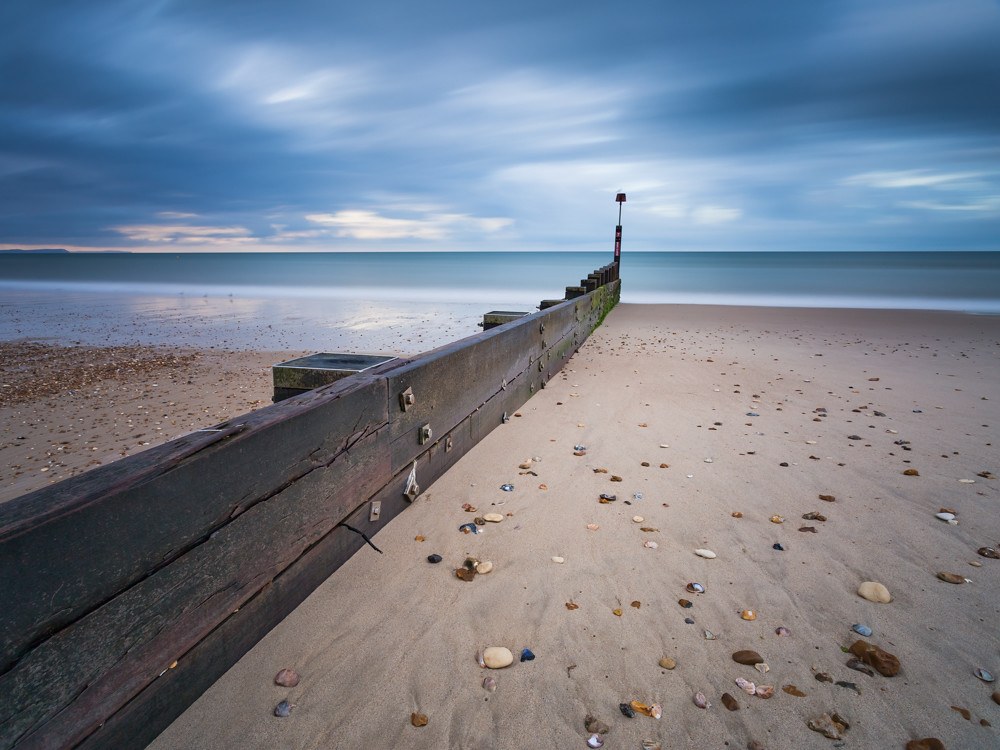
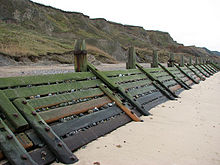
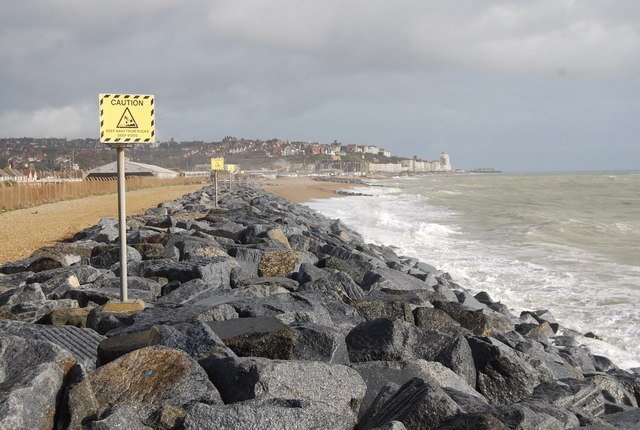
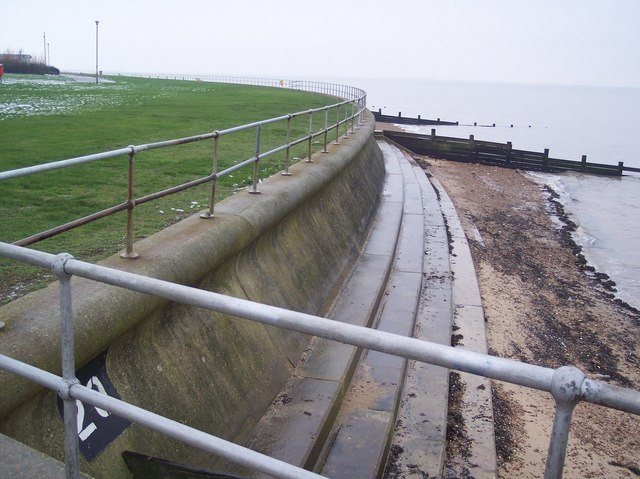
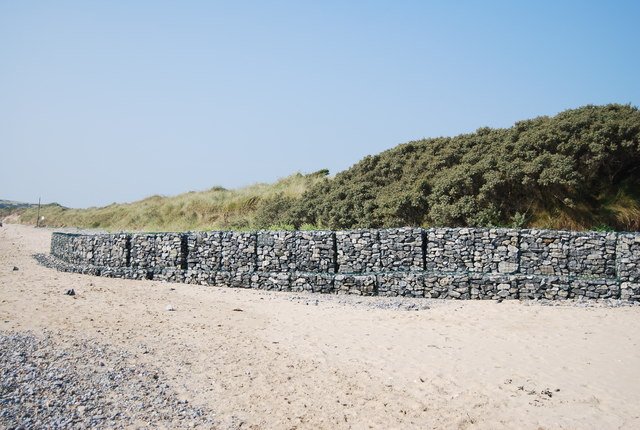
Identify the groyne
Identify the revetment
Identify the gabions
Identify the rock armour
Select all that apply. Sea Walls:
are places at the foot of cliffs or at the top of beaches.
are build across the beach sticking out from the coastline.
are often curved or stepped.
cost up to £1,000,000 per 100m
are usually constructed of wood
Select all that apply. Groynes:
are places at the foot of cliffs or at the top of beaches.
are build across the beach sticking out from the coastline.
are often curved or stepped.
cost around £150,000 each.
are usually constructed of wood
Sea walls require maintenance and are not good for wildlife.
True
False
Select all that apply: Rock armour
consists of large boulders placed at the base of the cliff or in front of a sea wall.
usually consists of resistant rocks like granite.
costs around £200,000 per 100m.
is often made from local stone.
is sometimes used alongside concrete tetrapods.
Select all that apply: Gabions
consists of large boulders placed at the base of the cliff or in front of a sea wall.
consist of metal cages filled with rocks
cost around £50,000 per 100m.
are used to stabilise cliffs
can break open because of the metal cage rusting.
Select all that apply: A revetment
is a sloping wooden structure built along the beach parallel to the cliffs.
breaks incoming waves and traps sediment.
cost around £200,000 per 100m.
helps accessibility to the beach
require a lot of maintenance.
Prior learning: Mass movement is the movement of material downslope due to gravity.
True
False
What type of erosion is the force of the water trapping air in cracks in the river beds, causing pieces to break away.
(a)
What type of erosion refers to rocks carried by the river bing hit into the bed and banks, causing it to wear away.
Abrasion
Attrition
Solution
In what direction does lateral erosion occur?
downwards
from side to side
Which key term refers to the movement of material by a river?
(a)
Which key term refers to the bouncing of pebbles along the river bed?
Saltation
Solution
Suspension
Traction
Which statements apply the the movement of material through traction?
large material
small material
High velocity
Low velocity
What key term is given to any material being transported by a river?
(a)
What key term refers to the removal of meanders from a river, so that the river can flow more quickly downstream?
(a)

Does this diagram show a river's cross profile or long profile?
Cross profile
Long profile
What key terms refers to a barrier built across a valley to control the flow of water downstream?
(a)

What is the key term that refers to a man-made lake, created by controlling the flow of a river in order to reduce flooding?
(a)
When the velocity of a river decreases which process will occur?
Erosion
Transportation
Deposition
An estuary is the ...... mouth of a river where it meets the..... Write the two missing words (separate the words with a space).
(a)

Which flood management strategy is shown in the image?
(a)
A flood (a) channel is a new channel build to divert some of the rivver's water to reduce the risk of flooding.

What is the name of a steep sided valley, formed as a waterfall retreats upstream?
(a)
Which statements apply to a hard engineering strategy?
Building artificial structures
Using natural materials
Expensive
Altering river processes
Working with river processes

What is the name of the graph shown?
(a)
Which statements apply to impermeable rocks or surfaces?
allows water to percolate (move) through them
does not allow water to percolate (move) through them
leads to rapid surface runoff
reduces surface runoff
Interlocking spurs are a series of hills on alternate sides of a valley around which a river (a)
What is the term given to the time between when peak rainfall and peak discharge occur in a storm event?
(a)
What key term refers to banks of sediemnt deposited on either side of a river bank, in the lower course?
(a)
The long profile of a river is the ..... of the river from the .... to the.....
(a)
What is a bend in the river called?
(a)
When a meander's neck becomes very narrow and eventually cuts through, what is the name of the landform created as the meander loop separates from the river?
(a)
Which statement correctly defines peak discharge?
The amount of water in a flood when the river bursts its banks
The largest amount of rainfall falling in an area over a certain period of time
The highest amount of water flowing in the river over a certain period of time
Which key term refers to all moisture falling from the atmosphere?
(a)
Adapt means...
to rely on
to change to fit a new situation
to change or make different
Check all of the ways in which people negatively impact the environment.
littering
planting trees
pollution
recycling
The ________________ in an area provide materials, food, and clothing for people settling there.
natural resources
natural hazards
human characteristics
People depend on _____________ to provide for their needs.
environment
entertainment
culture
government
True or false? People change how they live based on their environment.
True
False
The patterns that weather forms in an area over seasons and years is known as that region's ____________
Weather
Season
Climate
Global Warming
True or False: Climate on Earth never changes
True
False
Causes of Climate Change are
only human activity
a combination of natural and human forces
only natural forces

Trees help the Earth because...
...they absorb huge amounts of Carbon Dioxide (CO2) from the air and release oxygen back into it.
...they absorb huge amounts of oxygen from the air and release Carbon Dioxide (CO2) back into it.

Global warming has negative effects on plants, animals and human beings.
True
False
Which of the following increases GREENHOUSE GASSES? (click all answers)
deforestation
food production
extreme weather
using fossil fuels
Which of the following are the effects of global warming, or rising temperatures?
ocean warms
sea levels rise
droughts
ice caps melt
extreme weather
Earth's climate is constantly changing. However, man-made warming makes the temperature move too ______ for life to adapt.
slowly
fast
greedily
happily
If sea levels rise, places will
become dry
flood
get hotter
reduce ice
Which is NOT going to help reduce out carbon footprint?
eating local food
recycling
going everywhere by car
planting trees
Sustainability is making sure that the planet and its resources can continue to provide life.
True
False
Nigeria is the most populous country on the African Continent
True
False
The major religions in Nigeria are Islam and Hinduism
True
False
The longest and largest river in Nigeria is the River Niger
True
False
The Nigerian Hollywood industry is called "Nollywood"
True
False
Nigeria has always been an independent country
True
False
Boko Harem was responsible for the deaths of more than 400 people in and around Maiduguri in northeast Nigeria
True
False
The capital of Nigeria is called Kano
True
False
Nigeria consists of approximately 389 different ethnic groups
True
False
The age structure of 15-24 year olds make up 19.3 % of the total population
True
False

Is this rural or urban?: Dominated by natural or managed features such as grasslands, forests, crop fields
Urban
Rural

Is this rural or urban?: High population density
Rural
Urban
Is this rural or urban?: fewer services and less industry
Rural
Urban
Is this rural or urban?: lots of services and industry
Rural
Urban

Is this rural or urban?: dominated by human structures such as buildings, bridges, roads
Urban
Rural
Is this rural or urban?: Low population density
Rural
Urban
Is this urban or rural?: Major occupations are industrial, administrative and professional in nature
Rural
Urban
Rural or urban?: Low ethnic and cultural diversity
Urban
Rural
Urban or rural?: social mobility is high
Urban
Rural
Urban or rural?: People have a longer life expectancy (live longer)
Urban
Rural

Urban or rural?: high rate of pollution
Rural
Urban

Urban or Rural: It has a major International Airport
Rural
Urban
What is urbanisation?
Urbanisation is the process of economic and social growth that increases the population of a country or region.
Urbanisation is the process of economic and social change in which an increasing proportion of the population of a country or region live in urban areas.
Urbanisation is people living and working in large cities
A mega-city has a population in excess of .....
8 million
10 thousand
10 million
12 million
Land that has been used, abandoned and now awaits some new use is called a
greenfield site
brownfield site
Chances for people to improve their standard of living through employment are:
social opportunities
environmental opportunities
economic opportunities
What term is used to describe when people move from one area to another. In many LICS people often move from rural to urban.
(a)
What do we mean by natural increase?
Birth rate plus death rate
death rate minus birth rate
birth rate minus death rate
Which areas of the world are currently experiencing the fastest rates or urbanisation?
HICS
LICS
Which continent has the most Mega-cities?
Europe
North America
South America
Asia
Which of these factors cause urbanisation to occur? Tick all that apply.
Migration
Natural Increase
Economic Development (more jobs available)
Location (i.e coastal or a river)
Which of the following are push factors (reasons people leave an area)? - tick all that apply
Civil War
High Crime
More Wealth
Crop Failure
Which of the following are pull factors (encourage people to more to an area)? - tick all that apply.
More wealth
High crime
Good climate
Better services
How many of the most populated cities in the UK are found in England?
12/20
16/20
10/20
5/20
The highest population densities are found in cities...
True
False
Upland areas have high population densities
True
False
Which of these accurately describe Nigeria's location?
It is on the continent of Africa.
It is on continent of Europe.
It is on the west coast.
It is on the east coast.
It has a tropical climate, with rainy and dry seasons.
Tick all of the statements describing Nigeria's global importance that are TRUE.
It is the world's 21st largest economy.
It is a member of the European Union.
It is the 12th largest supplier of oil.
It is the 5th largest contributor to the United Nations' peace keeping missions around the world.
Tick all of the statements about Nigeria's importance in Africa that are TRUE.
It has one of the fastest growing economies in Africa.
It has the largest population in Africa.
It has low levels of productivity.
It has the highest farm output in Africa.
In 1960, Nigeria became (a) from the UK.
During the 1960s, Nigeria experienced civil (a) and political political instability.
Tick all of the statements about Nigeria's social context that are TRUE.
Nigeria does not suffer with fundamentalism or terrorism.
Nigeria is a multi-faith nation.
Nigeria is a multi-ethnic nation.
Nigeria is an unequal nation.
Tick all of the statements about Nigeria's cultural context that are TRUE.
Nigerian cinema is known as 'Nollywood'.
There are very few popular Nigerian authors.
The Nigerian football team has won the African Cup of Nations three times.
Nigerian music is popular across Africa.
Nigeria's natural environments are varied, with the (a) of the country being semi desert, whereas the south is has a tropical climate and rainforests.
Tick all of the statements about regional variations in Nigeria that are TRUE.
There are wide variations of wealth and development within Nigeria.
Rural areas have a greater share of public services.
GDP is generally higher in the South.
100% of children in urban areas go to school.
Regional variation in development have led to rural- (a) migration.

