
Font size
 Worksheets
Physics Semester 2 Final Review
Total questions: 100
Worksheet time: 33mins
Definition: Crest
The highest point of a transverse wave
The lowest point of a transverse wave
The center of a transverse wave
The distance between two points on a wave
Definition: Trough
The center of a wave
The resting position of a wave
The lowest point of a transverse wave
The highest point of a transverse wave
What is the frequency of a wave?
# of oscillations produced in a certain amount of time
The distance the wave oscillates from it's resting position
The lowest point of a transverse wave
Resting point of a wave - no wave movement
What is the amplitude of a wave?
Where there is no wave movement
The distance the wave oscillates from it's resting position
A disturbance that transfers energy from one place to another
The distance between two corresponding parts of a wave
What type of matter can waves travel through?
Solid
Liquid
Gas
All of the Above
If the wavelength of a wave increased, what would happen to the frequency?
decrease
increase
stay the same
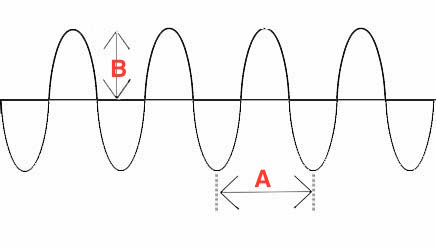
What property of this wave is represented by the letter "A"
amplitude
crest
trough
wavelength
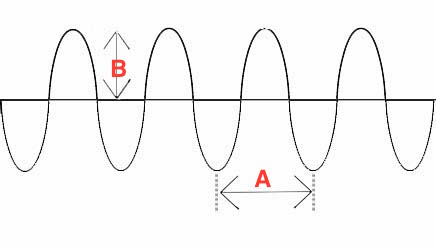

What unit is used to describe frequency of waves?
decibel
meters
hertz
Newtons
A substance through which a wave can travel is
a vibration
a longitudinal wave
a pitch
a medium
What is the unit for wavelengths?
Hertz
meters
meters per second
meters per second sqaured
As a wavelength increases, the frequency
decreases
increases
stays the same
fluctuates up and down
Light travels fastest through
the vacuum of space
water
air
glass
Distance between two adjacent crests or compressions in a series of waves
wave speed
amplitude
wavelength
velocity
sound travels as a(n)
transverse wave
longitudinal wave
electromagnetic wave
all of the above
A wave has frequency of 5 Hz and a speed of 25 m/s. What is the wavelength of the wave?
25 m
125 m
5 m
25 m/s
A guitar string vibrates with a frequency of 320 hz. If the wavelength of the vibration is 0.23 meters what is the speed of the wave?
320.23 m/s
1391.3 hz
73.6 m/hz
73.6 m/s
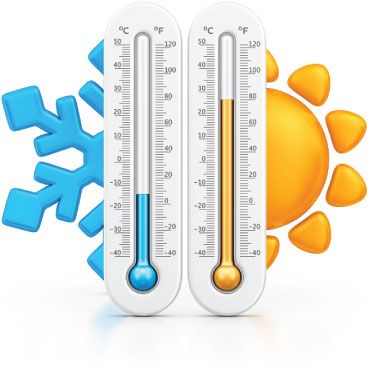
Warm
Cold
Doesn't Matter
Both
Sound travels FASTEST through which of these materials?
A type of gas, like helium
Empty space
A metal such as iron
Water

Does this wave demonstrate a TRANSVERSE WAVE or a COMPRESSIONAL/LONGITUDINAL WAVE?
(Look at particle motion compared to energy motion!)
Transverse Wave
Compressional/Longitudinal Wave

Does this wave demonstrate a TRANSVERSE WAVE or a COMPRESSIONAL/LONGITUDINAL WAVE?
(Look at particle motion compared to energy motion!)
Transverse Wave
Compressional/Longitudinal Wave
Which wave type does the medium move perpendicular (up/down) as the wave moves through it from left to right?
Compressional wave
Transverse wave
Electromagnetic wave
Which wave type ALWAYS needs a medium?
Mechanical wave
Electromagnetic wave
Neither wave type needs a medium
Do light waves need a medium to travel through?
NO
YES
Are sound waves transverse waves or longitudinal/compressional waves?
Transverse waves
Longitudinal/Compressional waves
Which are properties of a mechanical wave? (select all that apply!)
can be longitudinal or transverse
can move through outer space
must have matter to move
carries energy

The speed of light is:
300,000 km/sec
343 m/s
3.00e10 m/s
3,000,000 m/s

Which electromagnetic wave has the highest ENERGY?
Sound
Microwaves
X Rays
Gamma radiation

Complementary colors of light combine to give white light. Which one of the following pairs are complementary.
Red and Cyan
Green and Blue
Cyan and Green
Red and Blue
Which two are characteristics of sound waves: (pick 2).
Can travel through empty space
Travels in a compression and expansion pattern (like a slinky)
Must travel through a material
Travels in a straight line.
RGB together are known by which term?
The noncolors
The secondary colors
The primary colors
Pigments

If a car is red, which color of light is being reflected off the car and into our eyes?
Red
Green
Blue
White

Which is the correct color equation to make cyan?
R + B
W + B
G + B
R + G
If an opaque object appears magenta in the sunlight to our eyes, which color is being absorbed?
Red
Green
Blue
Which of the following are considered secondary colors?
Red, Blue, Green
Black, White, Yellow
Yellow, Magenta, Cyan
Red, Yellow, Green

Anthony is wearing a shirt that appears yellow to our eyes. Which color of light is being absorbed?
Green
Red
Blue
Yellow

Which is the correct color equation to make magenta?
R + G
G + B
R + B
W + R

What is the correct color equation to make yellow?
R + G
G + B
R + B
W + G
When an object gains electrons it becomes __________
Neutral
Positively charged
Negatively charged
Electrostatic force F exists between two point charges. If both charges are doubled, the force between the charges will be
F
4F
2F
F/4
Coulomb's law says that the force between any two charges depends
directly on the size of the charges
inversely on the square of the distance between the charges
both are correct
If the battery produced 12.6 Volts what would be the current flow for a 6 Ohm resistor?
2.1 Amps
2.4 Amps
1.71 Amps
15 Amps
Which of these are parts of the atom?
Protons, ProAthletes, Neutrons
Neutrons, Protons, Electrons
Mitochondria, Electrons, Protons
Oxygen
Which of these has a negative charge?
Proton
Neutron
Electron
Oatmeal
Which charge does a proton have?
Neutral
Negative
No charge- battery is dead
Positive
Neutrons have a ____________ charge.
Neutral, or no charge
Positive
Negative
Neutron? I don't know what that is!
What is a Series circuit?
Has only one path
Has more than one path
Allows energy to travel through easily
Has only one light bulb


How many paths does a series circuit have?
4
3
2
1

What does the following symbol represent?
Wire
Resistor
Battery
Switch
What are the poles of a magnet?
East/West
North/South
North/west
East/South
Where is the magnetic field strongest on a magnet?
The sides
The center
The poles
The top
What happens when you break a magnet?
It is not possible to break a magnet
It becomes 2 smaller magnets.
The poles separate
The magnet becomes stronger
When you break a magnet it becomes two smaller magnets. Why does that happen when a magnet is broken?
Because it is not possible to isolate the poles.
It is not possible to break a magnet.
Because its poles are the same
Like poles
attract
repel
create electrons
Unlike poles ________
attract
repel
create a large domain
Two north poles:
attract each other
have no effect on each other
repel each other
Electricity and magnetism are linked together.
True
False
The region surrounding a magnet, in which the force of the magnet can be detected is said to have ________________.
Magnetism
Magnetic field
Electromagnetism
Magnetic area
Which one is electromagnetism


If a piece of iron is placed inside the coil of wire, the magnetic field is greatly increased because the domains of the iron are aligned by the magnetic field of the current. This is called a _____________.
electromagnet
magnet
solenoid
Which of the following is the speed of a wave traveling with a wavelength λ, frequency f, and period T?
v=fλ
v=λf
v=λ⋅f
v=f⋅T
v=Tf
True/False: A light wave is a longitudinal (or compression) wave.
True
False
Which particle is a wave of light?
proton
neutron
electron
photon

A lightyear is:
How much light the Sun gives off in one year.
A year in which very little happens.
The time it take light to travel the distance from the Sun to the Earth.
The distance light travels in one year.

What is the ultimate source of electromagnetic waves?
T.V. Antennas
E.T. (Extra-Terrestrials)
Vibrating Charged Particles
Radios



