wayground logo

Free Printable Worksheets

Font size

S
M
L
XL
Worksheets

Physics revision 1

Total questions: 153

Worksheet time: 2hrs 26mins
Name
Class
Date
1.
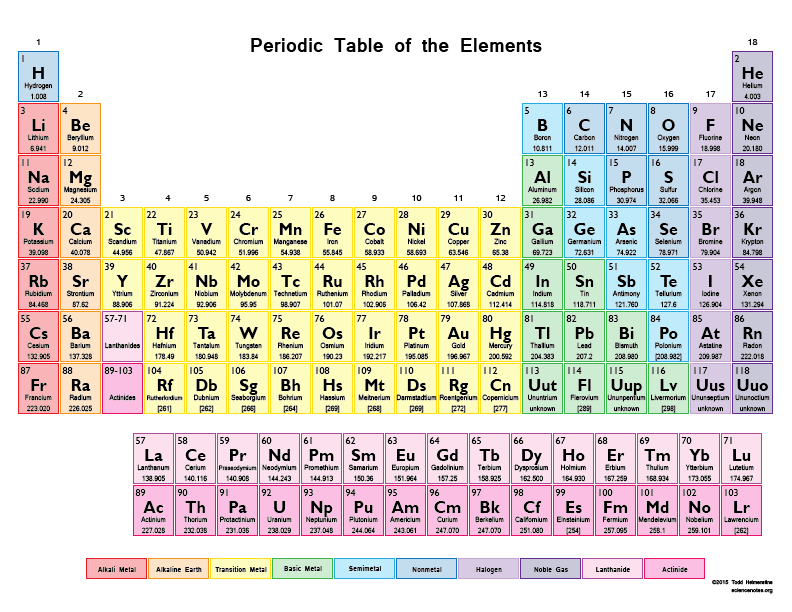
The Modern Periodic Table of Elements is arranged by
a)
atomic mass
b)
atomic number
c)
valence electrons
d)
number of isotopes
2.
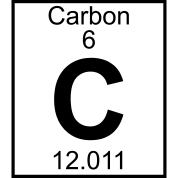
What does the 6 represent?
a)
atomic mass
b)
atomic number
c)
element name
d)
chemical symbol 
3.
What does 12.011 represent?
a)
atomic mass
b)
atomic number
c)
element name
d)
chemical symbol 
4.
These are found on the Periodic Table.
a)
Compounds
b)
Elements
c)
Mixtures
5.

the basic structural unit of matter

a)

atom

b)

matter

c)

element

d)

nucleus

6.

the positively charged subatomic particle contained in the nucleus of an atom

a)

proton

b)

neutron

c)

electron

d)

matter

7.

a subatomic particle, contained in the nucleus of an atom, having the same mass as a proton but no electrical charge

a)

proton

b)

neutron

c)

electron

d)

matter

8.

a negatively charged subatomic particle that orbits the nucleus of an atom

a)

proton

b)

neutron

c)

electron

d)

matter

9.

one or two letters that represent the name of an element

a)

element name

b)

element symbol

c)

atomic number

d)

atomic mass

10.

a grouping of elements based on similar properties, arranged by columns in the periodic table; also known as a group

a)

family

b)

period

c)

row

d)

isotope

11.

a row on the Periodic Table of Elements

a)

family

b)

period

c)

row

d)

isotope

12.
Most of the mass of an atom is found it its _____.
a)
electron cloud
b)
nucleus
c)
atomic number
d)
empty space
13.
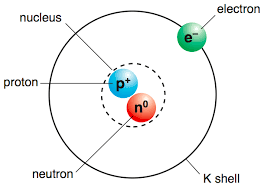
Which is an electron?
a)
A
b)
B
c)
C
14.
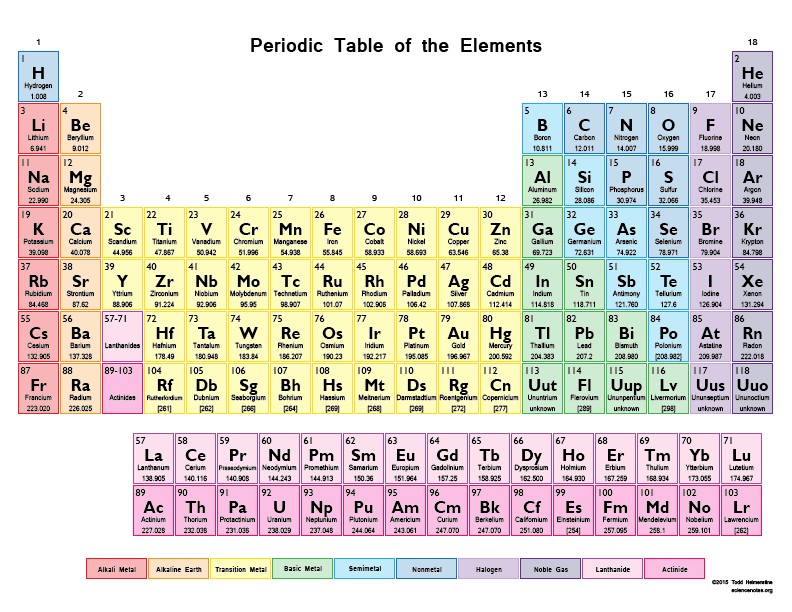
What is the number of protons that the element in this image contain?
a)
14
b)
7
c)
15
d)
18
15.

Which color on the image of the periodic table corresponds with the metalloids.

a)

bright yellow

b)

gold

c)

teal

d)

light blue

16.

The periodic table is mostly comprised of what type of element?

a)

Metals

b)

Nonmetals

c)

Metalloids

17.

Which elements are to the LEFT of the zigzag?

a)

metals

b)

nonmetals

c)

metalloids

18.

Which elements are colored red?

a)

nonmetals

b)

metals

c)

metalloids

19.
Silicon is a semiconductor and has properties of both metals and nonmetals. What type of element is Silicon? 
a)
Metal
b)
Nonmetal
c)
Metalloid
d)
Pretty
20.
All of these properties describe metals except...
a)
malleable
b)
conductors
c)
brittle 
d)
shiny
21.

the basic structural unit of matter

a)

atom

b)

matter

c)

element

d)

nucleus

22.

a collection of atoms of one type that cannot be broken down into simpler substances by ordinary chemical or physical means

a)

element

b)

subatomic particle

c)

electron

d)

matter

23.

the positively charged subatomic particle contained in the nucleus of an atom

a)

proton

b)

neutron

c)

electron

d)

matter

24.

a subatomic particle, contained in the nucleus of an atom, having the same mass as a proton but no electrical charge

a)

proton

b)

neutron

c)

electron

d)

matter

25.

a negatively charged subatomic particle that orbits the nucleus of an atom

a)

proton

b)

neutron

c)

electron

d)

matter

26.

an arrangement of the elements according to their atomic numbers so that elements with similar properties are in the same column and properties repeat from row to row

a)

Periodic Table of Elements

b)

Atomic Theory

c)

Isotopes

d)

Subatomic Particles

27.

one or two letters that represent the name of an element

a)

element name

b)

element symbol

c)

atomic number

d)

atomic mass

28.

a unique number for each element that equals the number of protons in an atom of that element

a)

element name

b)

element symbol

c)

atomic number

d)

atomic mass

29.

the mass of an atom, calculated by adding the number of protons and neutrons in the nucleus of the atom

a)

element name

b)

element symbol

c)

atomic number

d)

atomic mass

30.

a grouping of elements based on similar properties, arranged by columns in the periodic table; also known as a group

a)

family

b)

period

c)

row

d)

isotope

31.

a row on the Periodic Table of Elements

a)

family

b)

period

c)

row

d)

isotope

32.

one of several forms of a single element, which contains the same number of protons, but different numbers of neutrons

a)

isotope

b)

ion

c)

orbital

d)

nucleus

33.

an atom or group of atoms that has gained or lost one or more electrons and is now either positively or negatively charged

a)

isotope

b)

ion

c)

orbital

d)

nucleus

34.

What is the atomic number of Barium, Ba? (enlarge the periodic table)

a)

20

b)

38

c)

56

d)

88

35.

How many protons are in a sodium atom, Na? (tap to enlarge the periodic table)

a)

Sodium has 1 proton.

b)

Sodium has 3 protons.

c)

Sodium has 11 protons

36.

An element has the mass number 12 and atomic number 6. The number of neutrons in it is:

a)

6

b)

10

c)

4

d)

8

37.

If an atom has 10 electrons, how many protons does it have?

a)

0

b)

1

c)

10

d)

5

38.
Which row shows only single atoms?
a)
Top
b)
Bottom
c)
Both
d)
Neither
39.
Which row contains compounds?
a)
Top
b)
Bottom
c)
Both
d)
Neither
40.
Which row contains elements?
a)
Top
b)
Bottom
c)
Both
d)
Neither
41.
Which row contains molecules?
a)
Top
b)
Bottom
c)
Both
d)
Neither
42.
Which row would be a mixture if all the substances in it were mixed?
a)
Top
b)
Bottom
c)
Both
d)
Neither
43.
Which row contains only elements?
a)
Top
b)
Middle
c)
Bottom
d)
None
44.
Which row contains only molecules?
a)
Top
b)
Middle
c)
Bottom
d)
None
45.
Which row contains a mixture?
a)
Top
b)
Middle
c)
Bottom
d)
None
46.
Which row does not contain an element?
a)
Top
b)
Middle
c)
Bottom
d)
None
47.
Which row does not have a compound in it?
a)
Top
b)
Middle
c)
Bottom
d)
None
48.
A bowl containing metal shavings made of iron and copper would be classifed as a
a)
Pure substance
b)
Molecule
c)
Mixture
d)
Compound
49.
A balloon filled with carbon dioxide contains a
a)
Atom
b)
Element
c)
Mixture
d)
Compound
50.
A balloon filled with Helium (He) contains a
a)
Atom
b)
Element
c)
Mixture
d)
Compound
51.
A petri dish containing mercury (Hg) contains a(an)
a)
Atom
b)
Element
c)
Mixture
d)
Compound
52.
A pile of mercury II chloride is a(an)
a)
Atom
b)
Element
c)
Mixture
d)
Compound
53.
Air is a compound because if you list all the ingredients there's more than one capital letter
a)
True
b)
False
54.
HCN is made of 3 types of atoms
a)
True
b)
False
55.
Sulfuric Acid is made of 3 types of atoms
a)
True
b)
False
56.
Magnesium Oxide is made of 3 types of atoms
a)
True
b)
False
57.
Water is made of 3 types of atoms
a)
True
b)
False
58.
There are 3 atoms in every molecule of water
a)
True
b)
False
59.
There are 3 atoms in every molecule of magnesium oxide
a)
True
b)
False
60.

__________ are the substances present before the chemical reaction takes place.

a)

product

b)

elements

c)

compound

d)

reactants

61.

During a chemical reaction, matter cannot be _______ or created.

a)

bought

b)

changed

c)

destroyed

d)

made

62.

The _________ are the substances present after the chemical reaction takes place.

a)

reactants

b)

compound

c)

product

d)

elements

63.

The mass of the reactants must _______ the mass of the products.

a)

be less than

b)

be more than

c)

be the same as

d)

change

64.
In a chemical reaction, the mass of the reactants was 15g.  The mass of the products was 12g.  Did this chemical reaction follow the law of conservation of mass?
a)
Yes 
b)
No
c)
You can't tell with the given infomation 
65.

There are two reactants in a chemical equation, and one product. . The mass of the reactant 1 is 17g. The mass of reactant 2 is unknown. The mass of the product is 30g. What must the mass of the second reactant be, if the equation is to follow the law of conservation of mass?

Reactant 1 + Reactant 2 --> Product

a)

47g

b)

13g

c)

23g

d)

You cant tell with the given information

66.

Iron mixes with oxygen to make rust.


Fe + O2 --> Fe2O3


You mix 5 grams of iron(Fe) with an unknown amount of oxygen (O2). If you created 8 grams of rust (Fe2O3), how much oxygen (O2) did you add?

a)

3 grams

b)

13 grams

c)

40 grams

d)

1.6 grams

67.
What is the term for combining 2 or more atoms together?
a)
atoms
b)
elements
c)
molecules
d)
compounds
68.

What is the term for combining 2 or more DIFFERENT elements together?

a)

atoms

b)

elements

c)

molecules

d)

compounds

69.
What is the picture displayed?
a)
atom
b)
element
c)
molecule
d)
compound
70.
Are these molecules also compounds?
a)
YES
b)
NO
71.
Are these molecules also compounds?
a)
YES
b)
NO
72.
Hydrogen is a pure substance represented by the chemical symbol H. Which of the following best describes hydrogen?
a)
Hydrogen is an element made of two or more kinds of atoms.
b)
Hydrogen is a compound made of only one kind of atom.
c)
Hydrogen is a compound made of two or more kinds of atoms.
d)
Hydrogen is an element made of only one kind of atom.
73.
Carbon (C) and hydrogen (H) are pure substances. Each is made of only one type of atom, but carbon atoms are different from hydrogen atoms. Carbon and hydrogen chemically combine to form methane (CH4).
a)
methane is an element and carbon and hydrogen are compounds.
b)
carbon, hydrogen, and methane are all elements.
c)
carbon, hydrogen, and methane are all compounds.
d)
carbon and hydrogen are elements and methane is a compound.
74.
Where are protons and neutrons located? 
a)
in the nucleus
b)
in the electron cloud
c)
in the valence shell
75.
a)

Element only

b)

Compound only

c)

molecule only

d)

compound and molecule

e)

compound and element

76.
a)

Element only

b)

Compound only

c)

element and compound

d)

compound and molecule

e)

molecule only

77.
a)

Element

b)

Compound

c)

Molecule

78.
a)

Element

b)

Compound

c)

Atom

79.
a)

Element

b)

Compound

c)

Molecule

80.
Substance that cannot be broken into simpler substances
a)
element
b)
molecule
c)
gram
d)
proton
81.
Substances present at the start of a chemical reaction
a)
subscripts
b)
coefficients
c)
reactants
d)
products
82.
A student notices that an inflated balloon gets larger when it is warmed by a lamp. Which best describes the mass of the balloon as a result of this change?
a)
The mass of the balloon increases because the size of the balloon has increased.
b)
The mass of the balloon increases because the temperature of the balloon has increased.
c)
The mass of the balloon stays the same because the gas inside the balloon still has the same mass after it warms up.
83.
A 500-gram block of solid cheese is melted in a pot. Which is most likely the mass of the cheese after it is melted?
a)
500 grams, because the cheese does not gain or lose mass just because it was melted
b)
499 grams, because some of the cheese evaporates as it melts
c)
502 grams, because the cheese absorbs heat as it melts
84.
Bob puts 200 grams of ice into a pitcher with 900 grams of water. He gets distracted and comes back later to find that the ice has melted in the water. How many grams of water does Bob now have in the pitcher?
a)
200 g
b)
700 g
c)
1,100 g
85.
In a reaction A + B ----> C,  reactant A has 5g and product  C has 9g. How many grams does reactant B should have? 
a)
4g
b)
5g
c)
9g
d)
14g
86.
If a reaction starts with a total 75g of reactants it should produce 
a)
a total of 40g of products
b)
a total of 75g of products
c)
a total of 180 g of products
d)
None of the above
87.
In the reaction AB-----> A + B reactant AB has 12g and product B has 5g. How many grams should product A have?
a)
17g
b)
2g
c)
7g
d)
None of the above
88.
What is the tiniest particle in the entire universe?
a)
cells
b)
gases
c)
atoms
d)
liquids
89.
What is the picture displayed?
a)
atom
b)
element
c)
molecule
d)
compound
90.
What is the picture displayed?
a)
atom
b)
element
c)
molecule
d)
compound
91.
Hydrogen is a pure substance represented by the chemical symbol H. Which of the following best describes hydrogen?
a)
Hydrogen is an element made of two or more kinds of atoms.
b)
Hydrogen is a compound made of only one kind of atom.
c)
Hydrogen is a compound made of two or more kinds of atoms.
d)
Hydrogen is an element made of only one kind of atom.
92.

How many different elements are in the compound?

a)

12

b)

3

c)

24

d)

6

93.

Which one is a compound?

a)

Ni

b)

F

c)

Re

d)

NaCl

94.

What is the difference between Co and CO?

a)

CO is an element but Co is a compound

b)

Nothing is different. They are the same thing.

c)

CO is a compound and Co is only one element

d)

Co is not a pure substance

95.

What are the 3 subatomic particles of an atom?

a)

carbon atom, proton, electron

b)

quarks, neutrons, protons

c)

nucleus, protons, electrons

d)

protons, neutrons, electrons

96.

Which subatomic particle has a negative charge?

a)

proton

b)

neutron

c)

electron

97.

Which subatomic particle has a positive charge?

a)

proton

b)

neutron

c)

electron

98.
What subatomic particle(s) would be found orbiting the nucleus?
a)
Neutrons only
b)
Electrons only
c)
Protons and Neutrons
d)
Protons and Electrons
99.

Which subatomic particles contribute the most to the mass of an atom?

a)

Protons and Neutrons

b)

Protons only

c)

Electrons only

100.

Which subatomic particles contribute the least to the mass of an atom?

a)

Neutrons

b)

Protons

c)

Electrons

101.

Substances that are made up of ONLY one type of atom (element) or compound.

a)

Heterogeneous mixture

b)

Pure substance

c)

Suspension

d)

Homogeneous mixture

102.

Which of the following is classified as a pure substance?

a)

Lemonade

b)

Fruit punch

c)

ketchup

d)

Hydrogen

103.
What is matter?
a)
Anything that has mass and occupies space
b)
Anything that has mass
c)
Anything that is made of air
d)
ALL of them 
104.
Which of the following is a pure substance? 
a)
Water
b)
Sugar
c)

Gold

d)
ALL of them
105.

Which of the following is NOT a mixture?

a)

milk

b)

lemonade

c)

vegetable salad

d)

carbon

106.

Which of these is an element?

a)

Salt (NaCl)

b)

Water (H20)

c)

Oxygen (O)

d)

Carbon Dioxide (CO2)

107.

Which of these is a compound?

a)

Aluminium (Al)

b)

Carbon Dioxide (CO2)

c)

Nitrogen (N)

d)

Sand

108.

True or False: Elements and compounds are pure substances.

a)

True

b)

False

109.

Identify which images are HETEROGENEOUS MIXTURES! (Check all that apply)

a)
b)
c)
d)
110.

Solutions are ___________ mixtures.

a)

Solid

b)

Homogenous

c)

Heterogeneous

d)

Gas

111.
Max is hungry and he prepares cereal with milk. This is an example of a: 
a)
Homogeneous mixture
b)
Heterogeneous mixture
112.
What are the two types of Mixtures
a)
Elements and Subatomic Particles
b)
Protons and Electrons
c)
Atoms and Compounds
d)
Homogenous and Heterogeneous
113.
Two substances physically combined and that appears the same throughout is classified as
a)
A homogeneous mixture
b)
A heterogeneous mixture
c)
An element
d)
  A compound
114.

What type of mixture does this diagram represent?

a)

Homogeneous

b)

Heterogeneous

115.

This separation method is called...

a)

Magnetism

b)

Filtration

c)

Distillation

d)

Evaporation

116.

Which method can you use to separate sand and iron filings?

a)

Distillation

b)

Magnetism

c)

Filtration

d)

Evaporation

117.
What type of mixture is this?
a)
homogenous mixture
b)
chemical
c)
heterogeneous mixture 
d)
solid mix
118.

A mixture that contains two or more substances uniformly combined

a)

heterogeneous mixture

b)

homogeneous mixture

c)

suspension

d)

colloid

119.

Matter is classified in...

a)

Elements & Compounds

b)

Homogeneous & Heterogeneous

c)

Colloids & Suspensions

d)

Pure substances & Mixtures

120.
a)
heterogeneous mixture
b)
homogeneous mixture
121.

Water's chemical formula is

a)

H2O2

b)

H20

c)

H30

d)

H40

122.

True or false: The periodic table is where all the elements are found

a)

true

b)

false

c)

n/a

d)

n/a

123.

True or false: An atom of an element cannot be broken down into smaller pieces

a)

true

b)

false

c)

n/a

d)

n/a

124.

Chocolate cookies are what type of mixtures

a)

heterogeneous

b)

homogeneous

c)

none of the above

d)

all of the above

125.

True or false: Mixtures are substances that can be mixed together

a)

true

b)

false

c)

none

d)

all

126.

Compound substances (like H20), are made up of one element.

a)

True

b)

False

c)

both

d)

none

127.

Oil in water is what type of mixture

a)

heterogeneous

b)

homogeneous

c)

both

d)

none

128.

Coffee is what type of mixture

a)

heterogeneous

b)

homogeneous

c)

both

d)

none

129.

Substances can be

a)

liquid

b)

solid

c)

gas

d)

all of the above

130.

This type of mixture is

a)

heterogeneous

b)

homogeneous

c)

both

d)

none

131.

Gold is an example of a pure element substance

a)

true

b)

false

c)

both

d)

none

132.

A compound substance such as CO2 is

a)

2 or more different elements bound (attached) together

b)

one element solution

c)

all of the above

d)

none of the above

133.

The ocean water (salt water) mixture is

a)

homogeneous

b)

heterogenous

c)

both

d)

none

134.
In a chemical equation, is it true that -
a)
the reactant side and product side can have different numbers of atoms for each element
b)
there can be different elements on the reactant side and the product side
c)
an element or compound must be accompanied by a phase change
d)
the coefficients indicate the number of molecules of each reactant used and the number of molecules of each product made
135.
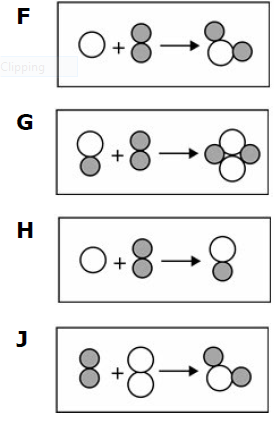
Which of the following models best demonstrates a balanced chemical equation?
a)
F
b)
G
c)
H
d)
J
136.
The reactants are on the left side of the chemical equation.
a)
True
b)
False
137.

How many atoms in all are in a molecule of serotonin?

C10H12N2O

a)
22
b)
24
c)
25
d)
4
138.
Coal contains carbon and other elements. Carbon dioxide forms when coal burns in the presence of oxygen. Which of these is the best evidence that a chemical reaction occurs when coal burns?
a)
The shape of the coal changes
b)
Oxygen is present
c)
A new substance is produced
d)
Coal is made up of more than one element
139.
Is burning wood a chemical or physical change?
a)
chemical
b)
physical
140.
Is glass breaking a chemical or phyiscal change?
a)
chemical
b)
physical
141.
Is hammering wood together to build a house a chemical or physical change?
a)
chemical
b)
physical
142.
Is a a rusting bicycle a chemical or physical change?
a)
chemcial
b)
physical
143.
Is melting butter for popcorn a chemical or physical change?
a)
chemical
b)
physical
144.
Is melting ice a chemical or physical change?
a)
chemical
b)
physical
145.
Is spoiling food a physical or chemical change?
a)
phyiscal
b)
chemical
146.
Is mixing lemonade powder with water a physical or chemical change?
a)
physical
b)
chemical
147.
Is mowing the lawn a phyiscal or chemical change?
a)
physical
b)
chemical
148.
Which of the following equations demonstrates an actual chemical reaction that forms a new substance? (HINT: it must follow the Law of Conservation of Mass)
a)
A
b)
B
c)
C
d)
D
149.
What is the left part of a chemical equation called?
H2 + O → H2O
a)
Reactants
b)
Products 
c)
Yields 
d)
Chemical Equation 
150.
Is this balanced?
2HgO → 2Hg + O2
a)
Yes
b)
No
151.
Is this balanced?
Al + O2 → 2Al2O3
a)
Yes
b)
No
152.
When materials combine to form new compounds it is a chemical change. Which example is a chemical change?
a)
baking powder fizzing
b)
water boiling
c)
ice melting
d)
sugar cube dissolving
153.
Which is an example of a chemical reaction?
a)
paper cut into small pieces
b)
chocolate melting in a pan
c)
flour and sugar mixed in a bowl
d)
cookies baking in an oven