
 Worksheets
AEF 2025 US Chapter 8 Review
Total questions: 100
Worksheet time: 3600secs
What was the Great Depression?
A period of economic success and an improving economy
The worst economic catastrophe in U.S. history
A period of time that witnessed American involvement in violent foreign wars
A hotly contested presidential election
Why did the stock market collapse in 1929?
Only wealthy Americans invested in the stock market
Investors inflated prices, and then sold shares very cheap, losing money
Investors refused to invest in the stock market
Investors bought shares cheap, and then sold stocks at a high price
What years did the dust bowl take place?
1910s
1920s
1930s
1950s
The Dust Bowl took place in the
The Costal Plains
The Great Plains
California
South Texas
The effect of the Dust Bowl on farmers was made even worse by...
The Great Depression
The New Deal
The Ice Age
The discovery of oil
Why was life more difficult for farmers during the Dust Bowl?
Their crops were dying because of the dust
Animals had no grass to eat
Had little access to water.
All of the above
The _________ Bowl was an effect of farmers over planting, high winds, drought and a loss of topsoil and arable land in the central part of the United States during the 1920s-1930s.
Super
Melting
Sand
Dust
What did many farmers in Texas do during the Dust Bowl?
They moved West to seek jobs
Started businesses in Texas
They had to grow cotton instead.
Nothing changed for farmers in Texas
What event valued stocks lower than their worth and caused lots of people to panic?
The first Day of school.
The stock market Crash
World War II
None of the above
Blue Friday
Black Tuesday
Red Monday
Black Saturday
Everything seemed to be faster in the 1920s which is why they were called what?
The Renaissance
The Roaring Twenties
The Dark Ages
A market where shares of ownership in many different companies are bought and sold is called what?
grocery store
Stock Market
Whataburger
Who was the 32nd President of the United States from 1933-1945. He won four presidential elections and led the government during most of the Great Depression and WWII.
George Washington
Franklin Roosevelt
Bill Clinton
What was the severe economic crisis that lasted from 1929-1945 on the US and other countries?
The Farmers Revolt
Great Depression
Civil War
What was the relief program called that helped people needing food, shelter, recovery to provide jobs, and reform to create new laws that made sure such a Great Depression never happened again?
The Handshake
The New Deal
Treaty of Versailles
What had a devastating impact on the remaining cotton plants and seeds AFTER the invading of the Boll Weevil? It was caused by no rain for long periods of time.
Boll Weevil
Drought
Dust Bowl
Lack of fertilizer
People rushed to the banks after the Stock Market crash and demanded all their money causing this to happen?
Stock market crash
Bank Failure
Checks and Balances
Bank reopening
The Dust Bowl occurred primarily because plowed land was left uncultivated and there was a terrible drought.
TRUE
FALSE
Blaming the president for their plight, newly homeless people established shantytowns they called Hoovervilles.
TRUE
FALSE
The Depression improved steadily during President Hoover’s administration.
TRUE
FALSE
. During the early 1930s, dust storms blackened the skies of the Great Plains for hundreds of miles.
TRUE
FALSE
President Hoover’s image was tarnished by the rout of the Bonus Marchers, as well as by the
lingering Depression.
public works funding.
emergency loans to states.
National Credit Corporation.
The stock market took its steepest dive on October 29, 1929, the day now known as
Red Thursday.
Black Tuesday.
Black Friday.
Bloody Sunday.
During the Depression, charities set up ____________________ to give poor people meals.
soup kitchens
communities
public works
dust bowls
During the Depression, newly homeless people put up communities of shacks that they called
hobo towns.
Hoovervilles.
Bonus Armies.
Okie towns.
Stock prices first began to decline in late 1929 because
stockbrokers stopped margin loans.
company earnings declined.
several companies went bankrupt.
investors began to sell their stock.
As a result of the stock market crash, some banks suffered more losses than they could absorb and
tried to attract more depositors.
had to approve more loans.
needed to increase interest rates.
were forced to close.
Which one of these was NOT an effect of the Great Depression?
Business failures
Bank failures
Unemployment
Rise in economic activity
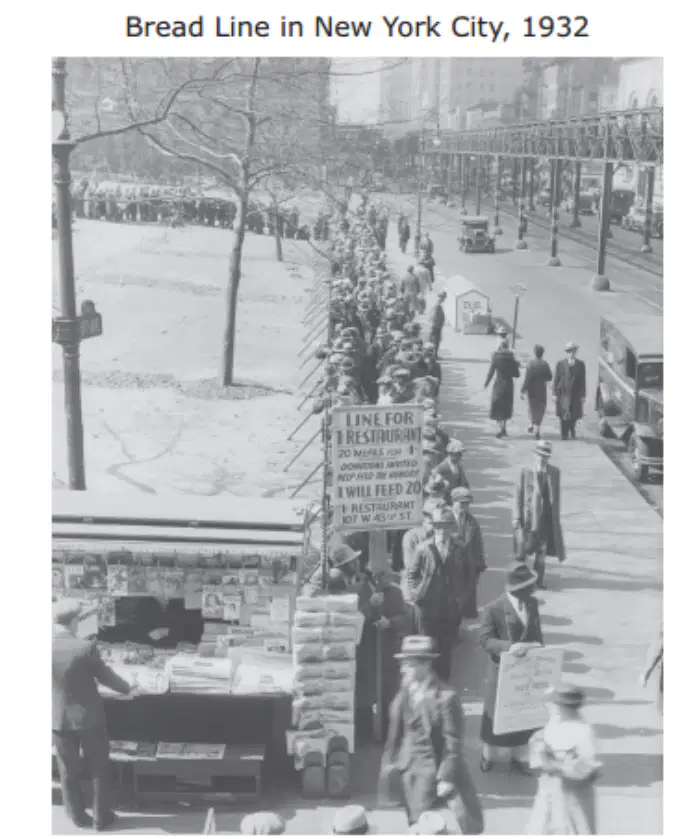
Lines like the one shown in the picture were partially the result of —
growing demand for payment of military pensions
a sudden increase in agricultural exports
the passage of the Selective Service Act
widespread business failures
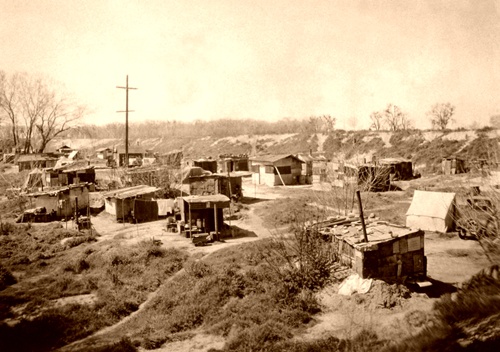
During the Great Depression, all across major cities, homeless Americans were building houses out of whatever they could find. These hand made houses were called....
Hoovervilles
Roosevelt Mansions
Truman Teepees
Madison McMansions
How did the Great Depression affect American society?
The price of agricultural goods decreased, causing an increase in demand for farm labor.
Manufacturing wages increased, causing businesses to concede to labor union demands.
Demand for luxury goods increased, causing overproduction in manufacturing.
Businesses were forced to close, causing widespread unemployment.
Which conditions are most characteristic of an economic depression?
too much money in circulation and high stock prices
high employment and increased real estate investments
large business investments and low taxes
high unemployment and overproduction


What problem were both the Civilian Conservation Corps (CCC) and the Works Progress Administration (WPA) developed to address?
Excessive stock market speculation
High unemploment
Increased use of credit
Overproduction of goods
What was one advantage that people in rural areas had during the Great Depression that people in the cities lacked?
the ability to grow food
the ability to live in shantytowns
the ability to obtain assistance at bread lines
he ability to relocate to the Pacific Coast states
Why was Black Tuesday such a significant day in American history?
It was the day when the stock market crashed.
It was the day when the Fed set the first monetary policies.
It was the day when the idea of speculation was first introduced.
It was the day when stock prices reached their highest rate of exchange.
Franklin D. Roosevelt took many actions during his “First Hundred Days” in the White House in 1933, but what was the FIRST thing he did?
close all of the nation’s banks and order inspections of those banks
end slavery
borrow money from China
desegregate the Military
Who created the New Deal?
Teddy Roosevelt
Franklin D Roosevelt
Herbert Hoover
Warren Harding
During the Stock Market crasch of 1929,
investors quickly bought more stocks to ensure a profit.
stock prices fell, causing billions of dollars to be lost.
stores hired more employees to capitalize on consumer demand.
banks loaned money to homeowners to cover their mortgages.
Which one of the following was NOT a cause of the Dust Bowl?
Drought
High Winds
Barb Wire
Overproduction
Many Americans lost their homes, so who did they blame on The Great Depression?
President Roosevelt
President Wilson
President Hoover
President Harding
What was the first priority for President Roosevelt when he started in office?
The Stock Market
Jobs
Banks
Help the Elderly
Which program renovated dams creating thousands of and jobs and hydroelectricity?
Glass Steagall Act
National Industrial Recovery Act
Tennessee Valley Authority
Civilian Conservation Corp
What happened to many people suddenly when they Great Depression started?
They became rich
They moved away
They became poor
They had a lot of children
Why could American’s not buy all the things that were being sold?
They lost money and weren’t making enough
There was too much product to buy
The bank bought everything
They didn’t want to buy them
Purchasing method introduced in the 1920s where people could buy things without having all of the money for it (basically credit, where they would pay back the price of the good with some interest each month)
Credit Cards
Debit Cards
Installment Plans
Debit Plans
1920s women who were known for their energetic freedom, both in fashion and mannerisms. Some had short “bob” haircuts and some experimented with cigarettes and alcohol. These were women learning to value their individuality and independence.
Flappers
Traditionalists
Hipsters
Bobbers
Speakeasies, gangs, and mobsters formed over the illegal sale and distribution of ___________, leading to violence, including homicide and burglary.
Vehicles
Washing machines
Model-Ts
Alcohol
Who was president when the stock market crashed?
Theodore Roosevelt
Woodrow Wilson
Herbert Hoover
Franklin Delano Roosevelt
What did it mean if you were a "speculator" during the 1920s? You . . .
majorly questioned actions of the government
bought stocks at great risk with the anticipation that prices will rise
watched America's greatest past time of baseball
majorly questioned actions of the banks
When the stock market "peaked," people frantically _______ their stocks.
Hid
Bought
Paid off
Sold
Who would lose money/their savings if the banks failed in the 1920s/30s?
Speculators
Big Business
Everyone
The working class
Which of the following is NOT one of the "Root Causes" of the Great Depression?
Uneven distribution of income
Credit and excessive debt
Mistakes by the Federal Reserves (National Banks)
WWI
Which president believed that federal government should NOT interfere in "free enterprise" (business).
Hoover
FDR
Which of the following was NOT one of the 3 "R's" of FDR's New Deal?
Relief
Recovery
Reform
Republican
Resulted from a combination of overproduction of wheat by farmers trying to make up for losses when crop prices dropped & terrible Great Plains drought of 1930s.
Superbowl
Dust Bowl
Drought Bowl
Dust Plate

Henry Ford produced a more affordable car primarily because his company….
Paid workers lower wages than his competitors.
Used foreign-made parts.
Developed a faster and less expensive method of production called the assembly line.
Offered a variety of options to buyers
What was the primary way flappers of the 1920s challenged the traditional role of women?
fought for increased job opportunities
pressured colleges and universities to accept female students
displayed fashions and behaviors that shocked mainstream society
helped female politicians win campaigns
What amendment gave women the right to vote?
16
18
19
21
What amendment banned alcohol (Prohibition)?
16
18
19
21
Why was the 1920s known as the "Roaring 20s?"
huge increase in immigration which led to fighting
economic depression
people were free to drink and party at their leisure
it was a time of cultural and social changes
Amendment that ended prohibition
16
18
19
21
What was one of the biggest reasons why the American economy boomed in the 1920s?
mass production led to goods being made faster and an increase in supply
the arrest of criminals who wouldn't stop killing people
the banning of alcohol
giving women the right to vote
Who was most directly affected by the Dust Bowl?
farmers
investors
industrial workers
WWI Veterans
What was President Herbert Hoover's response to the Great Depression?
He believed "rugged individualism" would solve the economy
He created mass welfare
He increased infrastructure to create jobs
He violated his policy of laissez-faire

The reason stock prices rose before the Great Depression
Deficit Spending
Buying on Margin
Federal Reserve System
Hawley-Smoot Tariff

How did overproduction of U.S. goods by manufacturers contribute to the Great Depression?
by prompting businesses to build factories in more locations
by encouraging businesses to employ more workers
by resulting in large unsold inventories due to market saturation
by causing an increase in prices of goods in foreign markets

How did participation in World War I affect U.S. agriculture at the end of the war?
The United States government offered opportunities for returning veterans in the agricultural sector.
The agricultural sector increased exports in order to raise profits.
Overproduction of farm goods during the war led to a collapse in agricultural prices
The United States government created free trade agreements to increase markets for agricultural products.

Which day is Black Tuesday? (a)

Which factor contributed to the trend shown on this graph?
low confidence in the stock market
low demand for stocks
strict government regulation of the stock market
buying of stocks on margin

What was the effect of the Hawley-Smoot Tariff?
It established the funds for the Reconstruction Finance Corporation.
It put limits on Allied war debts.
It opened international markets and stimulated world trade
It caused European countries to pass their own protective tariffs.


What was one reason African Americans moved to cities in the North and Midwest?
Lack of discrimination
Discovery of gold and silver
Better employment opportunities
Superior farmland
What were three causes of the Great Depression?
Prohibition
Debt due to buying using installment plans
Overspeculating on stocks
High tariffs
Which three artists are associated with the Harlem Renaissance?
F. Scott Fitzgerald
Langston Hughes
Bessie Smith
Georgia O’Keeffe
Duke Ellington
In the 1920s which new forms of entertainment became available to many Americans?
Radio and movies
Television and newspapers
Books and magazines
Advertising and telephones

