
 Worksheets
Chapter 3 Exploring Network Technologies and Tools
Total questions: 20
Worksheet time: 20mins
Question #2: A security analyst needs to make a recommendation for restricting access to certain segments of the network using only data-link layer security. Which of the following controls will the analyst MOST likely recommend?
MAC
ACL
BPDU
ARP
Question #3: An organization needs to implement more stringent controls over administrator/root credentials and service accounts. Requirements for the project include: Check-in/checkout of credentials The ability to use but not know the password Automated password changes Logging of access to credentials Which of the following solutions would meet the requirements?
OAuth 2.0
Secure Enclave
A privileged access management system
An OpenID Connect authentication system
Question #4: After segmenting the network, the network manager wants to control the traffic between the segments. Which of the following should the manager use to control the network traffic?
A DMZ
A VPN
A VLAN
An ACL
Question #5: A smart switch has the ability to monitor electrical levels and shut off power to a building in the event of power surge or other fault situation. The switch was installed on a wired network in a hospital and is monitored by the facilities department via a cloud application. The security administrator isolated the switch on a separate VLAN and set up a patch routine. Which of the following steps should also be taken to harden the smart switch?
Set up an air gap for the switch
Change the default password for the switch
Place the switch in a Faraday cage
Install a cable lock on the switch
Question #6: A large industrial system's smart generator monitors the system status and sends alerts to third-party maintenance personnel when critical failures occur. While reviewing the network logs the company's security manager notices the generator's IP is sending packets to an internal file server's IP. Which of the following mitigations would be BEST for the security manager to implement while maintaining alerting capabilities?
Segmentation
Firewall whitelisting
Containment
Isolation
Question #7: To mitigate the impact of a single VM being compromised by another VM on the same hypervisor, an administrator would like to utilize a technical control to further segregate the traffic. Which of the following solutions would BEST accomplish this objective?
Install a hypervisor firewall to filter east-west traffic.
Add more VLANs to the hypervisor network switches.
Move exposed or vulnerable VMs to the DMZ.
Implement a zero-trust policy and physically segregate the hypervisor servers.
Question #8: A cybersecurity administrator is using iptables as an enterprise firewall. The administrator created some rules, but the network now seems to be unresponsive. All connections are being dropped by the firewall. Which of the following would be the BEST option to remove the rules?
# iptables -t mangle -X
# iptables -F
# iptables -Z
# iptables -P INPUT -j DROP
Question #9: A network engineer needs to create a plan for upgrading the wireless infrastructure in a large office. Priority must be given to areas that are currently experiencing latency and connection issues. Which of the following would be the BEST resource for determining the order of priority?
Nmap
Heat maps
Network diagrams
Wireshark
Question #11: The facilities supervisor for a government agency is concerned about unauthorized access to environmental systems in the event that the staff WiFi network is breached. Which of the following would BEST address this security concern?
Install a smart meter on the staff WiFi.
Place the environmental systems in the same DHCP scope as the staff WiFi.
Implement Zigbee on the staff WiFi access points.
Segment the staff WiFi network from the environmental systems network.
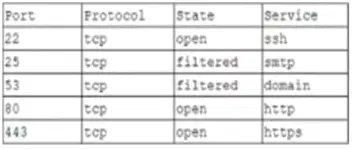
Question #12: A company is setting up a web server on the Internet that will utilize both encrypted and unencrypted web-browsing protocols. A security engineer runs a port scan against the server from the Internet and sees the following output: Which of the following steps would be best for the security engineer to take NEXT?
Allow DNS access from the internet
Block SMTP access from the Internet
Block HTTPS access from the Internet
Block SSH access from the Internet
Question #13: A manufacturer creates designs for very high security products that are required to be protected and controlled by the government regulations. These designs are not accessible by corporate networks or the Internet. Which of the following is the BEST solution to protect these designs?
An air gap
A Faraday cage
A shielded cable
A demilitarized zone
Question #15: An analyst is trying to identify insecure services that are running on the internal network. After performing a port scan the analyst identifies that a server has some insecure services enabled on default ports Which of the following BEST describes the services that are currently running and the secure alternatives for replacing them' (Select THREE)
SNMPv2 SNMPv3
Telnet SSH
HTTP HTTPS
POP.IMAP
Login.rlogin
TFTP.FTP
SNMPv1.SNMPv2
SFTP.FTPS
TLS.SSL
Question #17: A new vulnerability in the SMB protocol on the Windows systems was recently discovered, but no patches are currently available to resolve the issue. The security administrator is concerned the servers in the company's DMZ will be vulnerable to external attack; however, the administrator cannot disable the service on the servers, as SMB is used by a number of internal systems and applications on the LAN. Which of the following TCP ports should be blocked for all external inbound connections to the DMZ as a work around to protect the servers? (Select TWO)
135
139
161
443
445
Question #24: A company recently experienced an attack during which its main website was directed to the attacker’s web server, allowing the attacker to harvest credentials from unsuspecting customers. Which of the following should the company implement to prevent this type of attack occurring in the future?
IPSec
SSL/TLS
DNSSEC
S/MIME
Question #30: A system in the network is used to store proprietary secrets and needs the highest level of security possible. Which of the following should a security administrator implement to ensure the system cannot be reached from the Internet?
VLAN
Air gap
NAT
Firewall
Question #34: During an incident, a company's CIRT determines it is necessary to observe the continued network-based transactions between a callback domain and the malware running on an enterprise PC. Which of the following techniques would be BEST to enable this activity while reducing the risk of lateral spread and the risk that the adversary would notice any changes?
A. Physically move the PC to a separate Internet point of presence.
B. Create and apply microsegmentation rules.
C. Emulate the malware in a heavily monitored DMZ segment.
D. Apply network blacklisting rules for the adversary domain.
Question #39: A security analyst is responding to an alert from the SIEM. The alert states that malware was discovered on a host and was not automatically deleted. Which of the following would be BEST for the analyst to perform?
Add a deny-all rule to that host in the network ACL
Implement a network-wide scan for other instances of the malware.
Quarantine the host from other parts of the network
Revoke the client's network access certificates
Question #41: An organization has activated an incident response plan due to a malware outbreak on its network. The organization has brought in a forensics team that has identified an internet-facing Windows server as the likely point of initial compromise. The malware family that was detected is known to be distributed by manually logging on to servers and running the malicious code. Which of the following actions would be BEST to prevent reinfection from the initial infection vector?
Prevent connections over TFTP from the internal network
Create a firewall rule that blocks port 22 from the internet to the server
Disable file shanng over port 445 to the server
Block port 3389 inbound from untrusted networks
Question #50: A company wants to build a new website to sell products online. The website will host a storefront application that will allow visitors to add products to a shopping cart and pay for the products using a credit card. Which of the following protocols would be the MOST secure to implement?
SSL
FTP
SNMP
TLS
Question #55: Which of the following is required in order for an IDS and a WAF to be effective on HTTPS traffic?
Hashing
DNS sinkhole
TLS inspection
Data masking

