
 Worksheets
Waves
Total questions: 25
Worksheet time: 13mins
How are waves created?
*Ocean crashing noises*
something that sends things
When an object oscillates, and the energy is transmitted through a medium or field.
Ocean man, take me by the hand.
What is a medium?
The energy the wave is transmitting
The value separating the higher half from the lower half of a data sample
The material the wave travels in
The space the wave travels in
What happens to a medium/field's particles when a wave travels through it?
They are the wave
They become one with the wave
They move in the direction of the wave
They move around a central point in a pattern
What is a field?
The energy the waves are transmitting
A place to play sports
The space a wave travels in
The material a wave travels in
How does a pulse differ from a continuous wave?
A pulse is a single vibration, whereas a continuous wave is an ongoing oscillation
Pulse? Continuous waves?
A continuous wave is a single vibration, whereas a pulse is an ongoing oscillation
A continuous wave is a single vibration, whereas a pulse is the number of times your heart beats per minute.
Define amplitude accurately
The maximum motion distance of particles of the medium from the center point
The length of one wave from one point to the next corresponding point.
The time for one oscillation of the wave source
Number of oscillations per second
Define wavelength accurately
Number of oscillations per second
The maximum motion distance of particles of the medium from the center point
The length of one wave from one point to the next corresponding point
Number of oscillations per second
Define period accurately
The time for one oscillation of the wave source
Number of oscillations per second
The maximum motion distance of particles of the medium from the center point
The length of one wave from one point to the next corresponding point.
Define frequency accurately
The time for one oscillation of the wave source
The maximum motion distance of particles of the medium from the center point
The length of one wave from one point to the next corresponding point.
Number of oscillations per second
What do these equations represent:
f = T1
T = f1
The quadratic formula
The wave speed
The relationship between period and frequency
Equations? Frequency?

Which wave has the highest frequency?
1
3
2
4
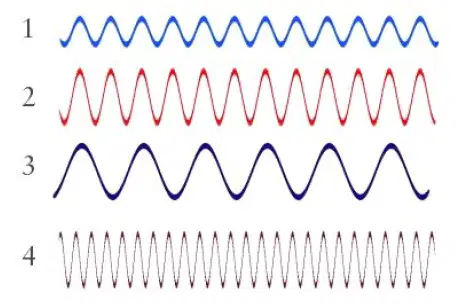
Which wave has the greatest wavelength?
1
3
2
4
As the frequency increases, the wavelength _________.
Increases
Stays the same
Disappears
Decreases
Define mechanical waves
Wave made of mechanical parts
Waves that requires a medium to travel through
Waves that don't requires a medium to travel through
Waves that maybe requires a medium to travel through
What is the highest point of a wave called?
The top
The trough
The crest
The frequency
What is the lowest point of a wave called?
The trough
The crest
The bottom
The period
Define electromagnetic waves
Waves that can travel through a vacuum
Waves that doesn't require a medium to travel through
Waves that require a medium to travel through
Electromagnetic? Waves?
A mechanical wave CANNOT travel through which of the following options?
Water
String
Air
Vacuum
Define transverse waves
Waves that can travel through a medium
The oscillation of the wave is diagonally to the direction.
The oscillation of the wave is parallel to the direction.
The oscillation of the wave is perpendicular to the direction.
Define longitudinal waves
Longitudinal? Transverse?
waves in which the oscillation moves parallel as the wave
waves in which the oscillation moves perpendicular as the wave
waves in which the oscillation moves diagonally as the wave
What does wave speed refer to?
I feel the need...the need for speed
The relationship between period and frequency.
The frequency of a wave
The rate at which energy is being transferred.
Select the correct formula(s) for wave speed
v = λf
Formula? Wave speed?
v = Tλ
x = 2a−b±b2−4ac
Kim made a wave in a spring by pushing and pulling on one end. The wavelength is 0.1 m, and the wave frequency is 2 hertz. What is the speed of the wave?
0.05 m/s
0.02
0.2 m/s
20 m/s
A wave is traveling at a speed of 2 m/s and has a frequency of 2 Hz. What is its wavelength?
0.5m
4m
1m
0.2m
CHALLENGE QUESTION:
Which states of matter do sound waves travel the fastest?
Hint: A wave works when the particles of an object oscillate, transmitting energy!
Solids
Liquids
Gases

