
 Worksheets
SOL Category 2 Review
Total questions: 37
Worksheet time: 28mins
A vaccine triggers your body to produce _____________ which help fight infections.
antibiotics
antibodies
antigens
Antibiotics only work against what organisms ?
viruses
bacteria
prions
Viruses can affect which types of organisms? SELECT ALL
plants
animals
bacteria
bricks
Influenza is caused by a ___________________.
virus
bacteria
prion
When a virus enters a cell and it immediately makes copies of itself this is called _______________________________.
remediation
replica
replication
A viruses are considered
Living
Non-living
Viruses need a ____________ in order to make copies of themselves.
bacterial cell
host cell
capsid
vaccine
Which cycle kills the host cell immediately?
Lytic
Lysogenic
During which cycle does a virus's genetic information become a part of the host cell's genetic information?
Lytic
Lysogenic
What is asexual reproduction?
1 parent
2 parents
Bacteria is an example of
asexual reproduction
sexual reproduction
When a cell divides and makes two cells...
It is binary fission
It is fragmentation
It is vegatative propagation
occurs when a second organism develops from an outgrowth of the original.
Vegetative propagation
Budding
Fragmentation
Binary Fission
Which widely accepted theory began to rise doubts as the existence of microorganism became to our knowledge.
The spontaneous combustion theory
The spontaneous generation theory
The spontaneous gravitational theory
The spontaneous mechanical theory
Theory that states that microscopic organisms named germs can cause disease in the human body.
The big bang Theory
Spontaneous Generation Theory
Germ theory of disease
The Pasteur Theory
Which levels of hierarchy form the scientific name?
Class and species
Order and genus
Phylum and species
Genus and species
Which organisational tool links organisms by their common ancestor?
Dichotomous key
Cladogram
Which kingdom is eukaryotic, multicellular and autotrophic?
Animalia
Fungi
Eubacteria
Protista
Which kingdom is the most diverse?
Animalia
Fungi
Eubacteria
Protista

You would find mushrooms in which kingdom?
Plant
Protists
Fungi
Animal
This kingdom contains multicellular autotrophs.
protist
plant
animal
fungus
These two kingdoms contain multicellular heterotrophs.
fungus and plant
plant and animal
fungus and plant
fungus and animals
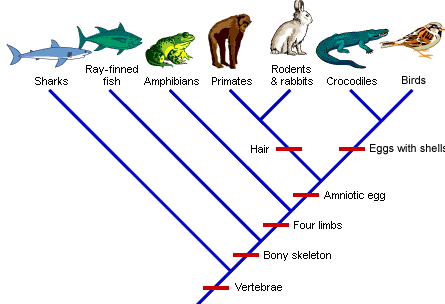
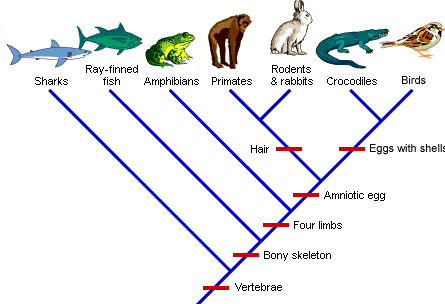


I am prokaryotic and am found everywhere. What kingdom do I belong to?
Bacteria
Archaebacteria
Fungi
Protista

These are tubelike cells that transport water and nutrients
xylem
cambium
veins
vascular tissue
Gymnosperms reproduce with
cones
fruit
flowers

