
 Worksheets
Homeostasis and Thermoregulation
Total questions: 35
Worksheet time: 26mins
Which process produces heat in every living cell?
Digestion
Respiration
Protein synthesis
Photosynthesis
How is heat transferred around the body?
Blood
Water
Sweat
Skin
Why is the human body's core temperature 37oC?
Optimum temperature for enzymes
No specific reason
To limit the enzymes rate of reaction
It's not 37oC
Which organ in the body produces the most heat?
Brain
Small intestine
Heart
Liver
What is homeostasis?
The maintenance of a constant internal environment
The maintenance of a constant external environment
The maintenance of an inconstant internal environment
Negative feedback
If the environment gets cold, we will often shiver in order to _______.
Homeostasis in the human body is often maintained by a _______.
The term for maintaining an internal temperature is _______.
thermoregulation
thermometer
homeothermal
homeostasis
True or False?
When you are cold, you shiver and your blood vessels (arterioles) constrict, which warms you up. When you are hot, you sweat and your blood vessels dilate, which cools you down.
True
False
Which is not a function of the skin?
What is the term to describe blood vessels near the surface of the body loosening up to release heat?
Vasoconstriction
Vasodilation
The region of the brain that monitors temperature is called the _______.
thermothalamus
centigrade
vasoconstrictor
hypothalamus
Which body systems are involved in regulating body temperature?
Integumentary, skeletal, and nervous
Circulatory, nervous, and digestive
Circulatory, nervous, and endocrine
Integumentary (skin), circulatory, and nervous

What would happen if your internal body temperature rose a little above normal?
You would die. Your internal body temperature must always be at exactly 36.9oC.
Your enzymes would be in a more optimal state, and you would be a little better at everything.
Your nervous system would send signals to your circulatory system and skin, which would cool you off by vasodilation and sweating.
It is impossible for your internal body temperature to change. Only your skin temperature would change.
When you get cut, your skin cells release hormones that signal platelets to come and stop the bleeding. Platelets then release more hormones that signal even more platelets to help stop bleeding. The hormone signals continue until the cut is closed.
What type of feedback response is this?
Positive Feedback Response
Negative Feedback Loop
A student walks into a cold room.
Which of the following happens to his body?
Sweating and vasodilation of blood vessels.
Shivering and vasoconstriction of blood vessels.
Sweating and vasoconstriction of blood vessels.
Shivering and vasodilation of blood vessels.

Diagram shows the cross section of human skin.
Which of the following will occur when the surrounding temperature drops below 10 ° C?
R constrict
Q relax
P erect
S become active
Choose the relevant corrective mechanisms when body temperature increases.
Hair lies flat
Hair stands erect
Blood vessel dilates
Blood vessel constricts
More sweats is produced
Choose the relevant corrective mechanisms when body temperature decreases.
Hair lies flat, blood vessel dilates
Hair stands erect, blood vessel constricts
Skeletal muscles move passively
Skeletal muscle move actively - shivering
Decrease sweating

Why does our hair stand erect during cold days?
To increase body metabolism
To trap air which acts as heat insulator
To allow more blood flow near skin surface
To cool down skin when sweat evaporates
When you are hot, your body sweats to cool you down. This means your temperature went above normal and your body sweats to counteract that change to bring you back to normal. What kind of feedback loop would this be?
Negative Feedback Loop
Positive Feedback Loop
Neutral Feedback Loop
Linear Feedback Loop
What do our sensory receptors detect?
Temperature
Pain
Pressure
All of the above
In which layer of the skin would you find sensory receptors?
Epidermis
Dermis
Hypodermis
The brain
What are ways through which the body loses heat?
(Select more than 1 option)
Evaporation of water in sweat
Warm air exhaled out
Hairs becoming erect
Vasodilation
Which of the following correctly pairs the hormone and the response that it causes?
Glucagon - stimulates body cells to take in glucose
Insulin - stimulates body cells to take in glucose
Pancreas - stimulates liver to release stored glucagon
Liver - stimulates pancreas to take in stored insulin
Glucagon causes muscles and the liver to release _____ back into the bloodstream.
glucose
glucagon
glycogen
insulin
Which hormone is released when blood sugar level gets too high?
glucose
glucagon
glycogen
insulin
Which organ plays a role in balancing the glucose level in the blood by releasing hormones like insulin or glucagon?
Stomach
Small intestine
Large intestine
Pancreas
What is the point of a feedback loop?
To provide the body with more energy
To provide the body with more food
To make sure the conditions in the body are always changing
To make sure the conditions in the body remain stable
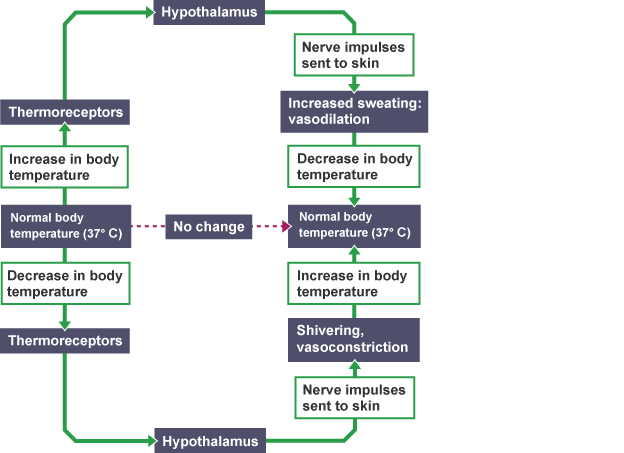
What are positive feedback loops?
Counteract changes that move above or below set values.
more common
regulate body temp
Purposeful pushes above normal set values.
What are negative feedback loops?
Purposeful pushes above normal set values.
Counteract a change to bring it back to normal set values
Are rare
Help with childbirth
______ in the Islets of Langerhans are cells that produces and secretes insulin.
Alpha Cells
Beta Cells
Islets of Langerhans
Pancreas Cells
Which disease is the result of insulin NOT being made by the pancreas?
Type 1 diabetes
Type 2 diabetes
Both

