
 Worksheets
LSU - Biomedical Diagnostic (Fall 2025- 2026)
Total questions: 50
Worksheet time: 32mins
No two people have been found with exactly the same fingerprint pattern.
True
False
How many times will your fingerprint pattern change throughout your life?
Three times
Your fingerprint pattern will change anytime you get a scar or due to skin disease.
The pattern will never change.
It will change as you grow from a baby to an adult.
Identify the WHORL fingerprint pattern.


Identify the loop fingerprint pattern.


Identify the arch fingerprint pattern.


What percentage of the population have a whorl pattern?
60% of the population
5% of the population
65% of the population
About 30% of the population
Which fingerprint pattern is the most common?
Loop
Arch
Whorl
Ridge
Which fingerprint pattern is the most rare?
Delta
Loop
Arch
Whorl

Label the diagram.
A: Ridge count area
B: Delta
C: Core
A: Delta
B: Ridge count area
C: Core
A: Core
B: Ridge count area
C: Delta
A: Core
B: Delta
C: Ridge count area
What is a delta?
A triangular region near a loop.
The centre of a whorl or loop.
It distinguishes one fingerprint from another.
A circular region near a loop.

What type of whorl is this?
Accidental
Double loop
Central pocket loop
Tented

What are the two patterns found in arches?
Circles and spirals
Plain and tented
Tented and looped
Right loops and left loops
How do you permanently erase fingerprints?
You can use chemicals.
You can use sandpaper.
You can only erase them temporarily, they will grow back.
If you have skin problems, they will be erased.
What is a latent fingerprint?
An impression left in soft material such as putty, wax or soap.
A fingerprint made by paint.
A fingerprint made by blood.
A fingerprint that is invisible to the eye.
What is a plastic print?
A fingerprint that is invisible to the eye.
A fingerprint that leaves an impression in wax, soap or dust.
A fingerprint made by touching paint.
A fingerprint made by touching plastic.
Which of these pictures shows a good example of eye contact?


Strong speeches...
A. contain regular eye contact.
B. are given by a speaker who whispers.
C. are given at a volume that can be easily heard.
D. Both A and C.

Appropriate gestures can help to emphasise your points when you are speaking.
False
True

What is body language?
Speaking to a live audience.
Looking at someone when communicating.
Using your body to communicate.
The strength of your voice when speaking.

What is eye contact?
Speaking to a live audience.
Looking at someone when communicating.
Using your body to communicate.
The strength of your voice when speaking.

The expression and variation in the sound of your voice is called:
Fluency
Impromptu
Eye Contact
Tone

Which of these is an example of fluent presentation?
Have you ever wondered what it would be like to travel to every single country in the world? Today I'm going to show you just that.
My… um... presentation is about… um… travelling to lots of… ah… different countries.
Yeah, I'm gonna tell you about travel and stuff, and… you know… about all these like really awesome countries.

When giving an oral presentation, you should:
Make regular eye contact with different members of the audience.
Look at the floor.
Choose a member of the audience and stare only at them for the whole presentation.
Keep your eyes on your notes.

When you present, the volume of your voice should be:
Very quiet so everyone has to pay attention to hear you.
Shouting volume - as loud as you can make it.
Loud enough that you can be heard clearly.
A presentation is better to listen to when your tone of voice:
Is a monotone.
Is expressive and varied.
Has an accent.
A good oral presenter speaks at what speed?
As quickly as possible to get the presentation done.
Very slowly so that everyone can make notes.
At a steady speed with no variation.
At a comfortable speed, with some variety of pace for emphasis.

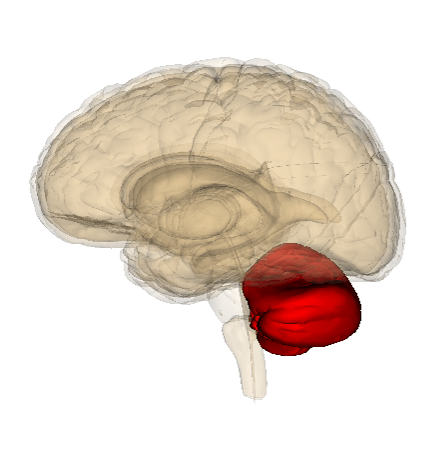


What lobe is bright pink in this picture?
Parietal
Frontal
Occipital
Temporal

What structure is GREY in this picture?
Cerebrum
Cerebellum
Brainstem
Pons

The cerebellum controls ____________
senses
movement, posture, balance and coordination


How are bacterial cells different from the cells of eukaryotes?
The bacteria are prokaryotes, and the genetic material is not contained in the nuclei.
The bacteria are eukaryotes, and the genetic material is not contained in the nuclei.
The bacteria are prokaryotes, and the genetic material is contained in the nuclei.
The bacteria are eukaryotes, and the genetic material is contained in the nuclei.
Tiny structures that produce proteins inside bacteria
bacteria
ribosomes
cytoplasm
endospore
Organisms that break down food large, complex chemicals in dead organisms into small, simple chemicals
ribosomes
flagelllum
conjugation
decomposers
Tiny single-celled organisms that live almost everywhere
ribosomes
cytoplasm
bacteria
virus
A whip-like structure that helps a bacterial cell to move
Flagellum
Conjugation
Endospore
Pasteurization
Bacteria are....(select all that apply)
Single-celled organisms
Multi-cellular organisms
Eukaryotes
Prokaryotes
What is the job of the cell wall in bacteria?
To provide protection
To make protiens
To hold organelles in place
To hold water and nutrients

