
 Worksheets
Camera Obscura and optic model EYW
Total questions: 28
Worksheet time: 2hrs 15mins
What colors does the green cholorophyll in leaves absorb?
all colors except green
red & green
white
green
if you shine a blue light on a black object, you see black, because
the blue light is absorbed
black reflects off of the object
all light reflects off of black
the green light is absorbed

Light is predictable because it will always travels in a _________ line.
Curvy
Straight
Backwards
Crazy
Why do we see the color white?
All colors are being absorbed.
All colors are being reflected.
All colors except for white are being reflected.
In order to see an object, light has to do what with an object?
Light travels from an objects and bounces off the light source.
Light bounces off an object and enters into your eye.
Create shadows so you can see the object
Only come from the sun.

How does light travel?
In a straight path going one direction.
In a curved path going one direction
In a curved path going all directions.
In a straight path going all directions.
What is a aperture?
A way to aim the camera.
A way of focusing light for a
sharp image.
A hole through which light
enters the camera.
A way to control how long
light enters the box.
A way to hold the film
in the correct place to receive the
focused light.
What does the term Camera Obscure actually translate to?
Dark space
Dark room or chamber
Dark area
None of these answers
Having observed the Camera Obscura in the classroom directly which one of the following is true?
The image is in black and white
The image is brighter when the aperture is larger
The image is brighter when the aperture is small
None of these statements is true.
Having observed the Camera Obscura in the classroom directly which one of the following is true?
The larger the aperture the brighter but also less focused the image is.
The image is brighter when the aperture is smaller
The image is exactly how it appears outside.
None of these statements is true.
What is an aperture?
A way to aim the camera.
A way of focusing light for a
sharp image.
A hole through which light
enters the Camera Obscura or camera.
A way to control how long
light enters the box.
A way to hold the film
in the correct place to receive the
focused light.

The image shows a simplified diagram of a pinhole camera.
Moving the camera further away from the object will make the image.
Smaller
Blurry
Bigger
Sharper
The image shows a simplified diagram of a pinhole camera.
making the box smaller will make the image:
Smaller
Blurry
Bigger
Sharper
Which camera below is the oldest ?
Camera Obscura
Digital Camera
Polaroid Instant Camera
iPhone 12
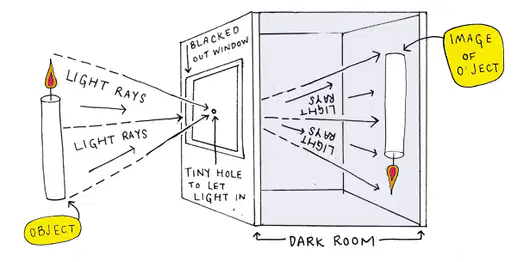
Why does a large hole create a blurry image in a camera obscura?
Because the hole allows too many light rays to enter, so overlaid images are created
Because the hole lets too few light rays in so the image is difficult to see
Because a large hole distorts the image
Because a large hole reduces the image's contrast

Why is no image cast on a wall opposite uncovered windows (as compared to the camera obscura where an image can be seen projected onto the wall)?
The wall absorbs all the light
The wall has images, but they are overlapped and are seen as white light

Why is the image in a pinhole camera inverted?
Because your eye reverses it
Because of the distance of the image from the aperture
Because it isn't a real image
Because light travels in a straight line

In this ray diagram, is the camera on the left or on the right?
left
right
impossible to tell
could be either
What does the point where the rays cross represent?
How big the image is
How big the photograph can be
The aperture where the light enters the camera
It is just a point in space where the light rays cross
What does d represent?
How far to place the camera from the object you want to photograph
How big the photograph can be
The size of the camera
The focal distance
What does f represent?
How far to place the camera from the object you want to photograph
How big the photograph can be
The size of the camera
The width of the photo paper
What does i represent?
How far to place the camera from the object you want to photograph
The height of the photo paper
The size of the camera
The width of the photo paper
You are using a pinhole camera to take a photo of a car. If you move your camera closer to the car, what will happen to the image on the film paper?
It will get larger
It will get smaller
It will get clearer
It will get fuzzier
You are using a pinhole camera to take a photo of a car. If you make the aperture smaller, what will happen to the image on the film paper?
It will get larger
It will get smaller
It will get clearer
It will get fuzzier
You are using a pinhole camera to take a photo of a car. If you adjust the film paper so it is closer to the aperture, what will happen to the image on the film paper?
It will get larger
It will get smaller
It will get clearer
It will get fuzzier
Which is the correct ray diagram for the following measurements?
focal distance of 6"
photo height of 4"
object to be photographed height of 10'


If you are taking a photo of an 8'x8' playhouse and your film paper is 4"x5"... which dimension of the film paper should you use as the image height?
5" since the object is large
4" since it is a square object and you want it to fit within both sides of the film paper
5" since it will allow you to fit the largest image
4" because it is a factor of 8'
You want to take a photo of a playhouse that measures 8'x8'. You have 4"x5" film paper and must take the photo from 20' away. What size focal distance should your camera have?
40"
10"
10'
6.25"

