
 Worksheets
Intro to Anatomy Review
Total questions: 69
Worksheet time: 36mins
Which of the following is considered a characteristic of living things?
Made of cells
Respond to Stimuli
Grow and reproduce
Use energy (metabolism)
Contain DNA
Which organelle is responsible for controlling what goes in and out of a cell?
Which organelle aides in cell division?
Centrioles
______________ move fluids across cell surfaces and ________ move the entire cell through extracellular fluid.
which organelles are both responsible for making proteins for the cell?
Rough ER and Ribosomes
Smooth ER and Golgi Apparatus
Organelle that holds the cells DNA and controls the cells activies
organelle that makes lipids, modifies different chemicals and stores Ca
Smooth ER
_______ organelle is responsible for processing proteins from the rough ER and sending them in ________ where they are needed outside the cell.
Golgi , vesicles
mitochondria, lysosomes
nucleus, peroxisomes
ribosome, lysosome
______ organelles store nutrients, water and Ions for the cell and ______ breaks down waste, dead organelles and kills foreign invaders
Organelle where cellular respiration takes place, or cell energy is made

Which structure below is matched to its NOT correct function inside the cell membrane?
the hydrophilic head and hydrophobic tails of a phospholipid
Carbs are imbedded for structure and signaling
Proteins are used solely for signaling
Proteins are used to create channels for transport and for signaling
Small, non polar, nutral molecules like water can _________ pass through the cell membrane, while Polar, large molecules have a ________ time passing through.
easily, harder
harder, easier
_______ is the macromolecule that is used for short term energy storage and functions in structure and cell signaling.
_______ is the macromolecule that is used in long term energy storage, makes up cell membranes, and protects and insulates the body
_________ is the information macromolecule that acts as the blueprint of life
Nucleic Acids
______ is a macromolecule that has many jobs in the body such as enzymes, signaling, structure and regulation etc.

Use the image to fill in the blanks in the paragraph
A. DNA
B. Chromosomes
C. Genes
D. Proteins
A. Proteins
B. DNA
C. Genes
D. Chromosomes
A. Chromosomes
B. Genes
C. DNA
D. Proteins
A. Genes
B. Proteins
C. DNA
D. Chromsomes
Place the terms below in order from largest to smallest (just type the numbers below in the correct order)
1. Tissue
2. Organism
3. Cell
4. Organ System
5. Organ
(a)
Which two processes are responsible for stem cells becoming needed body cells
differentiation
gene expression
mitosis
cell division
What is meant by the phrase form dictates function?
The way something is looks can tell you a lot about what its job or function is
looks are not connected at all to function
the function of something can be different than its appearance
this is a law of anatomy
Describe the relationship between response and stimuli in homeostasis
in _____ feedback loops the output of the system intensifies a response or amplifies it
In ____ feedback loops the output of a system causes a counter response to return to a set point or stabilize

use the feedback loops picture to answer the question below
How does the body respond when it gets to hot?
Sweat glands are activated and capillaries dilate
Muscles shiver and capillaries constrict
Muscles contract
capillaries dilate
Sweat gland cause shivering and capillaries constrict
______ act as biological catalysts by lowering the activation energy of a reaction to help reactions in our bodies to occur faster and to help regulate body processes
What is a concentration gradient?
How particles naturally want to move from areas of high concentration to areas of low concentration
how particles naturally want to move from areas of low concentration to high

The net movement of molecules from areas of high to low concentration
Simple diffusion
Facilitated diffusion
Osmosis
Endocytosis

Uses transport or channel proteins to aide in the movement of molecules from high concentration to low concentration
Simple diffusion
Facilitated diffusion
Osmosis
Endocytosis

Movement of water from areas of low ion concentration to areas of high ion concentration
Simple diffusion
Facilitated diffusion
Osmosis
Endocytosis

Uses energy to pump molecules through a protein channel from areas of low to high concentration
Molecular pumps
Endocytosis
Exocytosis
Pinocytosis

Uses energy and vesicles to move large particles into the cell
Molecular pumps
Endocytosis
Exocytosis
Pinocytosis

Uses energy and vesicles to move large particles out of the cell
Molecular pumps
Endocytosis
Exocytosis
Pinocytosis
Body system that supports, protects and aides in movement
includes: Bones, tendons, ligaments and cartilage
Cardiovascular system
Body system that aides in movement and stabilization
Includes: Skeletal, smooth and cardiac
Caridovasuclar System
Body system that collects, processes and responds to sensory input
Includes: Brain, spinal cord, nerves
Lymphatic System
Immune System
Body system that produces and regulates hormones
Includes: hypothalamus and glands
Muscular System
Integumentary System
Urinary System
Body system in charge of gas exchange and nutrient transport
Includes: heart, blood vessels, blood
Skeletal System
Cardiovascular System
Integumentary System
Body system in charge of gas exchange
Includes: lungs, diaphragm, trachea
Respiratory System
Endocrine System
Lymphatic System
Reproductive System
Body system that breaks down food and absorbs nutrients
Includes: stomach, esophagus, liver
Urinary System
Integumentary System
Body system that regulates water balance, blood pressure, filters and eliminates waste
Includes: Kidneys, bladder
Muscular System
Endocrine System
Body system that offers protection and controls our temperature and water loss
Includes: skin, hair and glands
Lymphatic System
Immune System
Body systems that filter and protect our bodies from foreign invaders
Includes: Spleen, Bone marrow, vessels
Lymphatic system
Immune system
Integumentary system
Endocrine system
Body system that develops, nurtures and protects offspring
Includes: Uterus, ovaries, testes
Reproductive system
Muscular system
Cardiovascular system
Lymphatic system

Body cavity 1
Cranial
Vertebral
Pleural
Pericardial
Body cavity 4
Cranial
Vertebral
Pleural
Pericardial
Body cavity 5
Cranial
Vertebral
Pleural
Pericardial
Body cavity 7
Ventral
Vertebral
Pelvic
Abdominal
Body cavity 8
Ventral
Vertebral
Pelvic
Abdominal

Which body plane is #1
Transverse
Frontal
Sagittal
Which body plane is #2
Transverse
Frontal
Sagittal
Which body plane is #3
Transverse
Frontal
Sagittal

What directional terms are shown for 1 and 2 A?
1. Superior
2. Inferior
1. Inferior
2. Superior
1. Proximal
2. Distal
1. Distal
2. Proximal
What directional terms are shown for 1 and 2 B
1. Medial
2. Lateral
1. Lateral
2. Medial
1. Deep
2. Superficial
1. Superficial
2. Deep
What directional terms are shown for 1 and 2 C
1. Proximal
2. Distal
1. Distal
2. Proximal
1. Superior
2. Inferior
1. Interior
2. Superior
What directional terms are shown for 1 and 2 D
1. Superficial
2. Deep
1. Deep
2. Superficial
1. Medial
2. Lateral
1. lateral
2. medial
The orbital region is ____ to the otic region
medial
lateral
superficial
proximal
the carpal region is _____ to the axillary region
proximal
distal
superior
deep
Type of body tissue that covers the body surfaces and lines body cavities
Epithelial
Connective
Muscle
Nervous
Type of body tissue that supports, protects, insulates and transports. Also binds of other tissues together
Type of body tissue that contracts to allow movement
Type of body tissue that aides in control, communication and coordination
Which of the following are types of connective tissue
cartilage
blood
bone
skeletal

which type of muscle attaches to bone and controls voluntary movements

Which type of muscle is involuntary and propels substances or objects through passageways
Which type of muscle is involuntary and involved in contracting to circulate blood
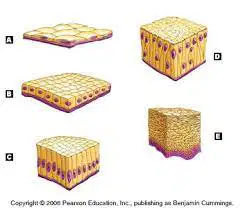
Which image shows squamous cells
A
B
C
D
Which image shows cuboidal cells
A
B
C
D
Which image shows simple columnar cells
A
B
C
D
Which image shows stratified cells
C
D
E
A

