
 Worksheets
07 - 02 & 03 - Byzantine Empire & S.W. Asia and N. Africa
Total questions: 127
Worksheet time: 1hrs 9mins
The Greek Roots of the Byzantine empire are reflected in it's
Language - Greek
Art - Mosaics
Engineering - Hagia Sophia
Economy - Trade
Which of the following issues divided the Western and Eastern Churches?
practices of animal sacrifices
practices such as scalping
authority of the pope
belief in Jesus
Why was Constantinople such a prosperous city?
located at the crossroads of trade
Great architecture
Strong autocratic rulers
The pope lives there


Who was the leader of the church in the Byzantine empire, Eastern Orthodox Church?
The pope
The patriarch
The emperor
The people

In 1054, the Eastern Orthodox Church and the Roman Catholic Church formally split. This is called:
Justinian's Code
Patriarch
Western Icons
East-West Schism

What emperor had the law code re-written and organized?
Charlemagne
Justinian
Theodora
Constantine
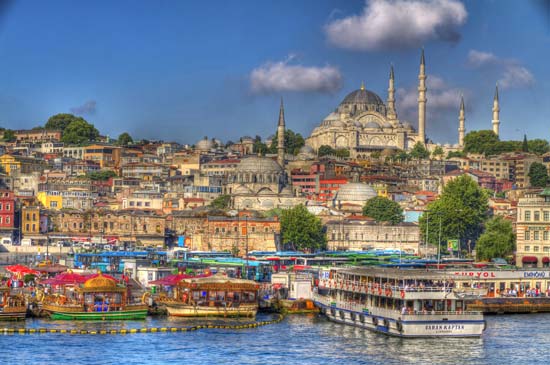
Why was Justinian's Code of laws important?
It established all rules regarding taxation.
It established codes regarding the Eastern Orthodox Church.
It formed the basis of European Law.
It established what entertainment acts were at Hippodrome.
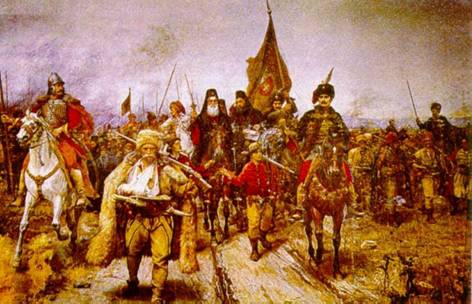
Who conquered the Byzantines in 1453?
The Franks
The Ottoman Turks
The Holy Roman Empire
The Mongols
Which Byzantine emperor rebuilt the Hagia Sophia, a masterpiece of Byzantine architecture?
Justinian
Constantine
Zeno
Irene
How did the Roman pope and the Byzantine patriarch deal with their religious differences?
Made a compromise
excommunicated each other
sent troops in to attack
rewrote the laws to include freedom of religion
Which of the following was followed by the Eastern Orthodox Church?
Practice of taxing non citizens
Use of icons for worship
Services conducted in Greek language
Use of Latin in the holy book
Which language was used by the Byzantine Church?
Italian
Greek
Latin
Russian
What is the title of the head of the Roman Catholic Church?
King
Pope
Tsar
Emperor

How did geography of the Byzantine Empire play a part in its decline?
few physical barriers left it unprotected
the sea trade allowed the economy to flourish
Africa tribes attacked through the Mediterranean Sea
Too many cross roads were built and pollution became a problem
Justinian had a code of ________ made.
rulers
law
conduct
faith
The city of _____________ was the capital of the Eastern Byzantine Empire.
Alexandria
Rome
Istanbul
Constantinople
Over time the Byzantine Empire became less Roman and more ?
Greek
Latin
Persian
Italian

What type of art is the picture?
montage
mural
mosaic
oil portrait

Justinain was known for building the __________.
Ankor Wat
Hagia Sophia
Colosseum
Parthenon
The world's first Christian Empire was?
Persian
Egyptian
Roman
Byzantine
Justinian was able to reconquer lands once held by the Western Roman Empire?
True
False
Roman Emperor _______________ made Christianity the main religion of the Roman Empire.
Diocletian
Galerius
Constantine
Augustus
Constantinople is now known as ?
Alexandria
Istanbul
Rome
Venice
Constantinople was a site of encounter because? 2 answers
only Christianity was allowed there
many religions and culture were shared
Trade routes from Asia and Africa passed through it
Trade routes from Europe and Asia passed through it
Cultural diffusion means?
sharing of secrets
sharing and spreading of culture
practice of one religion such as Christianity
As Roman influence faded in the Eastern Empire, which language became dominant?
Latin
Phoenician
Greek
Coptic
Who moved the capital city from Rome to the ancient city of Byzantium?
Justinian
Procopius
Justin
Constantine
What religion did Constantine promote in the Empire?
Christianity
Islam
Zoroastrianism
Polytheism
What led Justinian to revise the legal system of the Empire?
There was no legal system
The legal system was a mess
The legal system was already perfect
Justinian disliked law
What is the Hagia Sophia?
A marketplace
A temple to Zeus
A Church
A grainhouse
What did Justinian do after modernizing the military?
Reclaimed conquered lands
Disbanded the military
Invaded Asia
Formed an aliiance with Egypt
What is the name of a landmass that is surrounded on 3 sides by water?
Delta
Peninsula
Harbor
Plateau
After the capital was moved from Rome to Byzantium, what was the new name of Byzantium?
Old Rome
Constantinople
Corinth
Philippi
The Byzantine Empire connects which two continents?
Asia and Europe
Asia and Africa
Asia and Australia
Europe and Africa
Why was Constantinople such an economically successful city? (Economically successful = money!)
It was in the middle of nowhere
It was right next to the Mediterranean Sea
It was a crossroads of major trade routes
It was very pretty
Who is considered one of the best emperors of the Byzantine Empire because of his accomplishments in law and military?
Constantine
Justin I
Constantius I
Justinian
Which culture became the greatest influence on the Byzantine Empire?
Persian
Greek
Roman
Asian
Which art style used bits of colored stone or glass to create a picture, often religious?
Stone carving
Pottery
Glass blowing
Mosaics
What is the event in the year 1054 that marked the split between the Roman Catholic Church and the Eastern Orthodox Church?
The Great Rift
The Little Split
The Great Schism
The Large Dissent
Who has ultimate authority in the Roman Catholic Church?
The King
The Pope
The Priests
The Emperor
Who has ultimate authority in the Eastern Orthodox Church?
The Pope
The Priests
The Emperor
The Patriarch
What is the name of a religious picture used in worship?
Icon
Motif
Gallery
Instrument
Who was Theodora?
Constantine's wife
Justinian's niece
Constantine's sister
Justinian's wife
Who reunited the Eastern and Western halves of the Roman Empire, before they were eventually split again?
Constantine
Diocletian
Justin I
Augustulus
Theodora's influence on Justinian resulted in:
Limiting the people's freedoms
Increasing the number of gladatorial games
The creation of laws that protected women and children
The creation of laws that banned most religions
Constantinople is the capital city of what Empire?
Greek
Roman
Byzantine
Italian
What was the name of Justinian's wife?
Theodora
Helena
Cleopatra
Maya Angelou
Which part of the Roman Empire was the Byzantine Empire a part of and was free from Barbarian invasion?
North
South
East
West
Which geographic feature best describes the city of Constantinople?
Plateau
Peninsula
Mountain
Island
Peninsula means that water surrounds land on how many sides?
1
2
3
all sides
What 2 continents was Constantinople in the middle of?
North America and South America
Europe and Asia
Africa and Europe
Asia and Africa
What body of water separates Africa from Europe and was a central trading location for Constantinople?
Pacific Ocean
Black Sea
Red Sea
Mediterranean Sea
What made Constantinople a good location for a capital city?
It could easily borrow money from the rich Roman Empire to its west.
It had easy access to public transportation.
It had unpredictable and corrupt leaders.
It was located at the crossroads (center) of trade and was well protected.
Why was Constantinople a diverse and thriving city?
Cultural Diffusion
There was a lot of gold there
Proximity to the Pacific Ocean
Barbarians welcomed others there
Which was a MAN-MADE defense of Constantinople?
It being a peninsula
Creating catapults
Building high thick walls
Using cannons
How did Justinian and Theodora marry?
He changed the law to allow it
It was an arranged marriage
They were actually never married
She passed a law to allow it
What was the purpose of Justinian's Code?
To give the upper class more power
To prevent women from gaining rights
To allow all classes to be treated fairly
To promote the "eye for an eye" mentality
What was the name of the elaborate church built by Justinian?
St. Peter's Basilica
Hagia Sophia
Notre Dame
Taj Muhal
What were the two colors that were involved in the Nika Riots?
Pinks and Reds
Greens and Purples
Blues and Red
Greens and Blues
Which IS TRUE regarding the Nika Revolts and their aftermath?
Justinian had to convince Theodora to stay and fight.
After they were over, Justinian rebuilt the city.
He burned schools and hospitals after the fighting was over.
He gave away more territory to the Barbarians.


Defintion: Islam إسلام
A religion based off the teaching of people.
A religion based of the teaching of scriptures.
A religion based off the teaching of the Holy Bible.
A religion based on the teachings of the prophet Mohammed which stresses belief in one god (Allah),
What does Islams teach?
To believe in false Gods.
That Christians and Jews are people who follow sacred writings.
That people need to do their best to be a good human.
To believe in multiple Gods.

Definition: Allah الله
Holy book.
the one who submitted.
muslim song
Arabic word for God.

Define: Hijrah الهجرة
622, flight of Muhammad and his followers for Mecca to Medina. Year 1 on Islamic calendar
A destination in Muhammad discovered.
A journey from Byzantine to the Mediterranean Sea.
Muhammads personal journey to the Mecca.

Define: Muslim مسلم
A follower of Jesus.
A follower of the Catholic Church.
A follower of Christianity.
A follower of Islam, means "one who has submitted"
Who is Muhammad?
A jewish teacher and healer; founded Christianity.
A world famous comedian.
Arab religious, social and political leader; founded Islamic religion.
A prophet.
Muhammad began his teachings after he heard...
a voice.
a dog bark.
a lady tell him a secret.
knocks at the door.

Define: Ka’aba كعبة
An Arabic prophet.
The most sacred temple of Islam, located at Medina.
The most sacred temple of Islam, located at Mecca.
Arabic number.

Persian and Arab scholars borrow Arabic numbers from which culture and passed them on to Europeans?
Europeans
Greek
Romans
Hindu

Define: Pilgrimage الحج
A temple.
A journey to a place considered sacred for religious purposes.
A religious prayer in that takes place daily.
A type of special food.
stern rudders
What Arab invention helped make ships moveable?
navigation using the heavens
What skills is spoke of in the Quran?
Lateen sail
What support made Portuguese travels possible?
Define: Sunnah السنة
Direct words of Allah, revealed to Muhammad through the archangel Gabriel.
The primary sacred text, Allah.
A journey to the sacred place.
Customs of the prophet, things that the people said Muhammad did, never made it into the Qur'an.

Define: Mosque مسجد
A muslim place of worship.
A church.
A prayer.
A religion.

Define: Mecca/Makkah
العاصمة المقدسة
A city located near Italy.
A city in East Asia. Founded by Muhammad.
City in western Arabia; birthplace of the Prophet Muhammad, and ritual center of the Islamic religion.
The main city of Greece where leaders come together.

Define: Qur’an القرآن
Things Muslims did that never made it into the scriptures.
Islamic religion in which people worship Allah.
A place of worship.
Islam's primary sacred text, regarded by Muslims as the direct words of Allah.
Islam's primary sacred text, regarded by Muslims as the direct words of Allah.
Qur’an القرآن
A follower of Islam, means "one who has submitted".
Muslim مسلم
A Muslim place of worship.
Mosque مسجد
The most sacred temple of Islam, located at Mecca.
Ka’aba كعبة
Arabic word for God.
Allah الله

True or False?
Arab ship building was generally regarded as having both strengths and weaknesses.
True :)
False :(
What was the climate in Islam like for the Arabic person?
Easy, with plentiful resources. No one had to trade for resources.
Somewhat hard, but had enough resources to survive.
Hard, with harsh desert climates that encouraged trade and influences nomadic and sedentary lifestyles.

How did the harsh climate conditions effect the early Arabs who lived there?
They lived in huts.
They formed tribes.
They went towards water.
They couldn't survive.

Why were merchants so important and well respected in the Muslim culture?
They created wealth and were extremely skilled in business.
They were honest.
They never lied and followed all the words of Allah.
They were prophets.
Where did Islam originate?
Arabian peninsula
North Africa
China
India
The followers of Islam are calld
Christians
Muslims
Hindus
None of the above
Muslims pray _________ times a day.
3
7
1
5
According to the Islamic religion, Muslims believe _________ was the prophet.
Yathrib
Medina
Muhammad
none of the above
The sacred text is called the
Mosque
Quran
Torah
Sheikh
The Arabic word for "God" is..
God
Buddah
Allah
Muhammad
The _____________ is in the center of Mecca and it holds the black stone. It is where millions of Muslims make a religious journey to each year.
Medina
Mosque
Quran
Kaaba
A ____________________ is a building where Muslims worship.
Mosque
Synagogue
Ramadan
Arabia
Where did Muhammad and his followers leave to when they were forced out of Mecca?
Medinah
Afghanistan
Mecca
Jerusalem
What is the holy text of Islam that is written in Arabic?
Qur'an (Koran)
Bible
Torah
Vedas



