
 Worksheets
Fonologia Hata la 55
Total questions: 119
Worksheet time: 3570secs
What feature is incorrect in American accent?
ENGLISH: /p. t. k/ (voiceless plosives)
Strongly aspirated in initial position (word)
Unaspirated in middle position
Released in final position
Doesn´t exist
The sounds which have double active and passive articulators are the:
Homorganic
Fricative
Heterorganic
Africative
Spanish laterals have just one set of homorganic sounds.
Select one
True
False
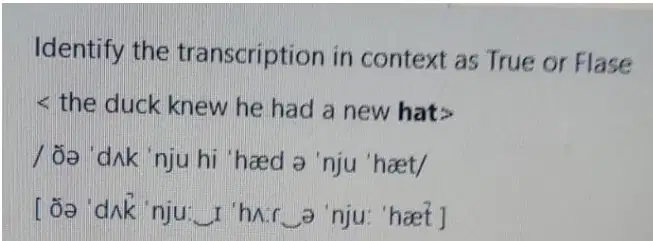
True or False
True
False
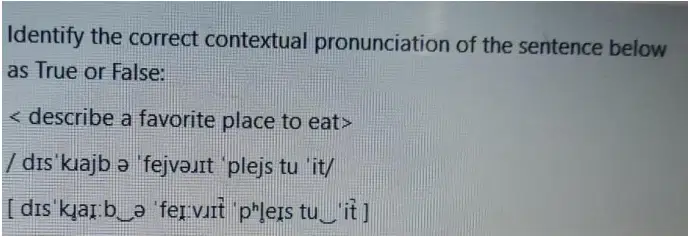
True or False
True
False
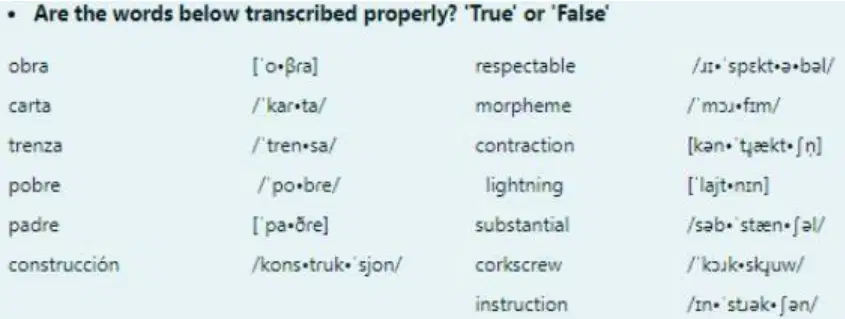
Are the words below transcribed properly?
<obra> <Carta>
True
False

Is the transcription true or false?
True
False
Nigeri is the country with the most languagues spoken in Middle East
True
False
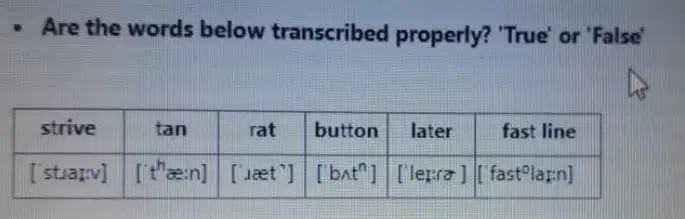
Are the words below transcribed properly? True or False
True
False
All voiceless and voiced plosives are liquids and they are a similarity between English andSpanish
True
False
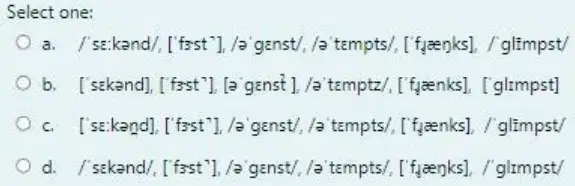
Choose the correct
<second>, <first>, <against>, <attempts>, <Frank´s>, <glimpsed>
a
b
c
d
The word < fraile> has a/an :
non-adjacent glide
Clusters
Deletion
Resyllabification
Two-initial-consonant clusters (CCV-) share mostly the same liquants and liquids: / p, b, k, g, f / + / l /; / p, b,t, d, k, g, f / + ; happen in:
Spanish and English
English
Spanish
none
It is a group of 2 or more adjacent consonants.
Regressive Assimilation
Resyllabification
Epenthesis
Clusters
It is the insertion of a vowel or consonant segment within a word
Aphesis
Epenthesis
Epithesis
Resyllabification
It is when a sound disappears or is not clearly articulated under certain circumstances
Epenthesis
Epithesis
Deletion
Resyllabification
Marked on //
Resyllabification
Regressive Assimilation
Aphesis
Deletion
It is the addition an extra consonant to the end of a word.
Epithesis
Juxtaposition
Aphesis
Metathesis
• It is when the assimilated sound precedes and is affected by the conditioning sound.
• It is when the final and initial sounds mutually condition…
Aphesis
juxtaposition
Regressive Assimilation
Syncope
It is the loss of an unstressed initial vowel or syllable
PROGRESSIVE ASSIMILATION
Aphesis
Linking
Metathesis
Less satirical //
Metathesis
Linking
Syncope
Juxtaposition
(It barely ever occurs with very young learners and beginner learners. It is a very uncommon process at this stage). It is the transposition of speech sounds
Metathesis
Linking
Juxtaposition
Regressive Assimilation
It is when the conditioning sound precedes and affects the following sound
PROGRESSIVE ASSIMILATION
Juxtaposition
Deletion
Clusters
It is when an unstressed sound or syllable is dropped out in a multisyllabic word.
Juxtaposition
Linking
Syncope
Aphesis
It is the connecting of the final sound of a word to the initial sound of the next.
Syncope
Linking
Epithesis
Resyllabification
Five-medial consonant orthographic clusters happen in:
English
Spanish
English and Spanish
None
It is a group of two or more adjacent and dissimilar symbols which really stand for just one sound.
Epithesis
Digraph
Juxtaposition
Metathesis
The cluster that starts with a voiceless, apico alveolar, fricative just happens in:
Spanish
Spanish and English
English
None
The Phonemic and phonetic distribution of ‘sorda, apico-alveolar, oral, fricative Select one:
Total and free variation.
Complementary and without variation.
Total and total, complementary and free variation
Complementary and conditional variation.
The following clusters barely ever happen in Spanish: /ʃɹ/ /θɹ/ /sm/ /sn/ /sp/ /st/
True
False
The / ʒ / phonemic and phonetic distribution is total.
True
False
The common sound in the tongue twister 'Roe sew a cold robe when Rose sold a snow-toe show' is:
/aw/
/ow/
/oj/
/aj/
When a 'voiced apico alveolar nasal occurs before a dorso velar', it becomes…..
It transforms into a dorso-velar nasal in both Spanish and English.
It becomes a dorso-velar sound in both Spanish and English.
When the dorso section of the tongue moves downwards from the high front position to the mind front position. Lip shape keeps spread. Jaw moves down slightly, ¿which sound is produced?
/yo/
/ya/
/ye/
/yu/
Affricate sounds use digraphs to be represented phonetically.
True
False
Write the appropriate word/phrases that concerns the sentences. It is a body of text, utterances, or other specimens considered more or less representative of a language.
Corpus Linguistics
Linguistic dataset
Speech data
Language specimen
Standard Spanish has 24 phonemes: 5 vowels, 19 consonants and 14 diphthongs.
True
False
Write the appropriate word/phrase. It is the branch of anthropology that compares and analyzes the origins, distribution, technology, religion, language, and social structure of the ethnic, racial and/or national divisions of humanity.
Ethnology
Cultural anthropology
Comparative anthropology
Social anthropology

The spellings: ............................... correspond to the sound:
/a/
/ɔ/
/o/
/u/
Spanish laterals have just one set of homorganic sounds
True
False
All voiceless and voiced plosive are liquids and they are a similarity between English and Spanish
True
False

The spellings: .......................... correspond to the
/a/
/ə/
/u/
/o/
The voiced, bilabial, nasal before a voiceless bilabial fricative change its:
Narrow condition
phonological condition
fricative condicion
broad condition
It is concerned with comparing languages in order to establish their historical relatedness.This may be known as comparative diachronic Linguistics as well
Ethnology
Psycholinguistics
phonological condition
Comparative Linguistics
It certainly studies, analyzes, and compares two or more languages descriptively in order to find out similarities and differences among them during the language learning process.
Psycholinguistics
Contrastive Linguistics
Philology
Comparative Linguistics
It is a discipline concerned with relations between messages and the characteristics of individuals who select and interpret them
Philology
Anthropological linguistics
Psycholinguistics
Contrastive Linguistics
It studies language change and language relationship.
Philology
It deals with the relationship between language and culture and has also been a major concern among linguists, especially anthropological linguists.
Anthropological linguistics
Choose the right answer: ................. is “voiced, dorso-palatal, nasal”
[ɲ ]
[n]
[m]
[ñ]
Laterals become..............after any voiced consonant in both Spanish and English Answer:
voiceless
Unvoiced
Palatal
Spread
The phonetic Spanish distribution of the `voiceless, apico-interdental, oral, fricative` is:
/s/ Total
/ɵ/ Total
/ʃ/ Total
/f/ Total
Is the language used by people who work in a particular area or who have a common interest.
Dialect
Slang
Jargon
Colloquialism
The phonetic distribution of the spanish voiced ,plosive bilabial oral is
Partial and complementary
Partial
Free variation
Total and complementary
The phonetic distribution of the spanish “voiced, plosive, bilabial, oral ” is: Select one:
total and complementary
partial and complementary
Partial
Free variation
The common pronunciation sound in the words below is:
< pneumonia, few, do, room, you, Luke, blue, fruit>
[ ʊ: ]
/ ʊ /
/u/
/ uw /
The spellings < ou >, < ow >, < ough> represent the sound: Select one:
[ɔɪ̯ : ]
[ aɪ̯ ː ]
/aw/
[ɔɪ̯ ]
Final clusters in English might increase their number of consonant sounds due to:
noun possessives, and 3 person singular
noun plurals, ans noun possessives
3 person singular, noun possessives, noun plurals
The difference in pronunciation which is used by speakers to distinguish different utterances in a language is known as:
contrast
diphthong
Monophthongs are just one vowel sound. They are classified as front, central and back sounds. The sound /i/ is featured by:
The front section of the tongue rises to make contact both sides of the upper lateral teeth. A groove is formed in the middle of it and the airstream flows throughout freely. The tip of the tongue touches the lower incisive teeth.
The tongue is positioned forward and high in the oral cavity with the sides in contact with the teeth laterally and the tip positioned behind the lower teeth. The lips are spread and retracted. The jaw moves up.
The dorso section of the tongue reaches the borders of the hard palate making a groove between the tongue and the palate. The jaw moves down more than in /i/ production. The tip of the tongue moves forward the lower front teeth.
The tongue is positioned forward and slightly lower than in the oral cavity for /i/, with the sides in contact with the teeth laterally and the tip positioned behind the lower teeth. The jaw moves up slightly lower than for /i/.lips are spread and retracted.
The type of notation that depends on the level of abstraction, the hearing limits and IPA conventions is:
Broad and narrow
Narrow
Broad
Orthographic
The spellings :< o >, < oo >, < u >, < ou >, , < a >, < e >, < eou >, < o>, < u >, cor respond to the sound:
/a/
/ ə /
/ow/
/eo/
When two or more allophones happen in the same position and don’t change the meaning of the phonological group, it is known as:
The phonemic distribution of Spanish voiceless plosives is
Complementary
Partial
Total
Free variation
The / ɪy / vowel distribution is:
Total
Complementary
Free Variation
Voiced Spanish plosives might be fricative. Voiced English plosives are not.
True
False
Voiceless English plosive sounds in final position might have a variation in pronunciation. That is because of free variation.
True
False
resaltador is a phonological group which has.......... assimilation process(es) which are
two / a dental plosive and a fricative bilabial
two / apico alveolar plosive and bilabial fricative after a vowel sound
one / a fricative plosive between vowel sounds
The process by means of which the dorso section of the tongue reaches the borders of the hard palate making a groove between the tongue and the palate. The jaw moves down more than in /i/ production , and the tip of the tongue moves forward the lower front teeth, corresponds to the < > production.
<a>
<e>
<o>
<u>
The voiced, bilabial, fricative sound occurs in middle position in not only Spanish but also English.
True
False
The production of the /e/ and /ɛ/ sounds differs in its:
vowel quality
muscle tension
voicing
lip shape
The features 'voiced, simple, mid-central, lax, neutral' correspond to:
[ɚ]
[ ə ]
[ɝ]
[ ʌ ]
It ignores as many as possible details and captures only the general aspects.
Broad Transcription
Orthographic transcription
Narrow Transcription
Phonemic and Phonetic Notation
There have been different points of view on what Linguistics is. They depend on many concerns that authors have taken into consideration. One of them says that "It certainly studies, analyzes, and compares two or more languages descriptively in order to find out similarities and differences among them during the language learning process." What type of linguistics does it refer to?
Contrastive
The spellings: < ew >, < o >, < oa >, < oe >, < ou >, < ow >, correspond to the sound:
/ew/
/aw/
/ow/
/ao/
The vowel spellings < a >, < au >, < aw >, < o >, < oa >, < ou> concern the sound:
/o/
/ ɔ /
[ õ ]
/ow/
The Diacritic “ h” means that a sound is:
Velarized
Voiceless
Strongly aspirated
Glottal
The tongue is retracted backward the oral cavity. The post dorso section of the tongue moves up toward the soft palate. The tip of the tongue reaches the lower tooth ridge. Lips are rounded. The information above belongs to the sound:
[ɔ: ]
/o/
The tongue base is retracted into the mouth cavity towards a mid-high velar position. Lips are rounded like pronouncing but saying . The lower jaw moves down making the mouth open a little bit more than the common /uw/ sound. Vocal folds vibrate. The information above refers to the sound:
/ ʊ /
Approximant sounds are clearly identified as semiconsonants or semivowels when they are part of a:
There are three pairs of homorganic plosives; however, one set differs in the passive articulator in the Spanish-English Contrast
True
False
This diphthong production is similar in both languages. The sequence shows how the tongue moves from the low-central position to the high-back position. The jaw moves up. The lips change their shape from neutral to rounded during this diphthong production. The information given above has to do with the sound:
/uy/
/ay/
/oy/
/aw/
It is a group of 2 or more adjacent consonants.
Cluster
The phonemic and phonetic transfer for the voiceless and voiced /t-d/ is:
Zero
Flapping
Nasalizatio
The following speelings: < ei >, < ey >, < i >, < ie >, < uy >, < y >, correspond to the sound:
/ay/
Write the appropriate word/phrase. It is based on sounds-pronunciation- and deals with symbols which represent consonant or vowel sounds:
Alphabetical Writing Language
Every 'apico alveolar' sound becomes dental in:
Palatal vowel sounds are the same as central vowel sounds.
English vowel sounds might be identified in their vowel quality due to their number of phonemic symbols.
True
False
The features: voiced, complex (adjacent glide), mid-back tense, rounded, lengthened, correspond to:
[ oṷ ]
[ oṷ:]
[ õ ]
[ɔ: ]
The vowel sounds that occurs in English and it is kind of difficult to be mastered by Spanish speakers are the:
high backs, high fronts, mid central, and low front
mid central, low central, and high fronts and backs
mid fronts, mid bak, and low central
The unit of Narrow Transcription is:
phoneme
contrastive
non-contrastively
allophone
The study focus of Linguistics is language. Concepts on it have been stated according to different points of view of researchers. Language is the system of human communication which consists of the structured arrangement of sounds or their written representation into larger units, eg. Morphemes, words, sentences, utterances. This point of view was presented by:
Heinle Dictionary
Nash
Richards
Wardhaugh
The spellings: < a >, < au >, < aw >, < o >, < oa >, < ou>, correspond to the sound:
/ɔ/
/au/
/ aw /
/o/
The process by means of which the tongue is positioned forward and high in the oral cavity with the sides in contact with the lateral teeth and the tip placed behind the lower teeth. Lips are spread and retracted corresponds to the sound:
Vowel /ɛ/
What is the spelling that corresponds to 'voiced, simple, low-front, lax, spread'
<a> <au>
<e> <au>
<a> <u>
<æ> <au>
Velar vowel sounds are the same as back sounds
True
False
The common vowel sound uttered in the tongue twister 'A Tudor who tooted a flute tried to tutor two tooters to say the two to their tutor, "Is it harder to toot or to tutor two tooters to toot?' is:
[ ũ ]
/uw/
[ ʊ: ]
/u /
Five-medial consonant cluster happens in:
What is the relevant parameter that makes a difference between /t-d/ SpanishEnglish sounds?
Passive Articulator
A way of speaking the language under certain circumstances produced by the environment and accepted by s small group of people.
Write the appropriate word/phrase. It is an arbitrary structured system of utterances-sounds, gestures, signs, and movements, written symbols, morphemes, words and sentences used for human communication:
Fonologia
/b,d,g/ becomes fricative in middle position after and .
True
False
The tongue is positioned back in a low-mid position with respect to the height. The jaw is slightly lowered. The lips are rounded but bigger than for /u/ and /ow/. This sound happens in language(s).
spanish and english
It means both languages have the same element but wit different function.
Compound word
Dialect
Zero transfer
Negative Transfer
The [ æ:] features are:
voiced, simple, low-central, tense, neutral, unlengthened
voiced, simple, low-front, lax, spread, lengthened
voiced, simple, low-central, lax, neutral, lengthened
voiced, simple, low-central, tense, neutral, nasal
The main trait of Spanish vowel allophones is that they might be ...............while in English, they could be .....................
unlengthened, nasals, and or open / lengthened or unlengthened
unlengthened, and or open / lengthened or unlengthened
unlengthened, nasal/ lengthened or unlengthened
The common sound in the words <calm, encore, not. knowledge> is:
The sound [ ã ]
The sound /a/
The sound / æ /
The sound [ æ:]
International Phonetic Association was created by language teachers in France in ................ . This association published officially the first version in .................. . Its main aim is to promote the scientific study of phonetics and the various practical applications of this science and its principle is “one symbol per every distinctive and relevant sound”. The latest version of The International Phonetic Alphabet revised and updated by IPA in ............... .
“voiced, simple, high-back, lax, rounded” corresponds to:
/æ/
/ũ/
/ʊ/
/g/
The processes that occur when vowels are followed by an implosive nasal consonant or when vowel sounds are found between two nasal consonant sounds, is known as:
What element makes the difference in the /t-d/ pronunciation between Spanish and English?
Manner
the active articulator
the passive articulator
Voicing
Which clusters happen just in English?
/pɾ/; /st/; /pɹ/; /bɹ/; /tɾ/; /bɾ/;
/∫ɹ/: /θɹ/: /sm/:/sn/: /sp/: /st/
/∫ɹ/: /θɹ/: ; /sm/: /tɹ/; /dɾ/; /dɹ/;
/kɾ/; /kɹ/; /gɾ/; /gɹ/; /fɾ/; /fɹ/;
<e, ee, ie, ei> correspond to:
vd, simple, mid-front, lax, spread
vd, simple, mid-front, tense, spread
vd, complex, high-front, tense, spread
vd, simple, high-front, lax, spread
The word < fraile> has a/an :
non-adjacent glide
adjacent glide
intersyllabic cluster
intrasyllabic cluster
Significant elements change meaning since they are:
intra-syllabic clusters
Allophones
Contrastive
The spellings < e >, < ea >, < ai >, < a >, < ie > deal with the sound:
[ ẽ ]
[ e ]
[ eɪ̯ : ]
/ ɛ /
The tongue twister 'A big black bug bit a big black bear, made the big black bear bleed blood' contains mostly a 'low-mid front' vowel sound.
Every voiceless English plosive is strongly aspirated when they happen in initial position. The same situation happens to voiceless Spanish sounds.
True
False
The notation system that ignores as many as possible details is known as:
narrow transcription
broad transcription
orthographic notation
phonetic transcription

