
 Worksheets
Unit One Quiz (Topics 1.1-1.6)
Total questions: 36
Worksheet time: 18mins
Federalists believed that the Articles of Confederation were a ________ and set up a ________ National Government.
Success, Strong.
Success, Weak.
Failure, Weak.
Failure, Strong.
In Federalist Paper #10, what is a faction?
a majority tyranny
the extended sphere
special interest groups
the new Constitution
How did James Madison view the existence of “faction” in America?
He feared faction and felt that there was no way to control it.
He liked faction and wanted the strongest faction to dominate
He refused to acknowledge that any factions existed in the new nation.
He feared faction but thought its effects could be managed by the existence of many competing factions.
The Anti-Federalists in Brutus #1 argue that the proposed constitution would create too _________ a republic, a system of government that has never successfully existed in history.
small
large
weak
divided
Brutus #1 argues that the proposed Constitution would create a republic so large that representation would be "so numerous as to be incapable of transacting public business." This is an argument against a _________ system.
elitist
pluralist
communist
fascist
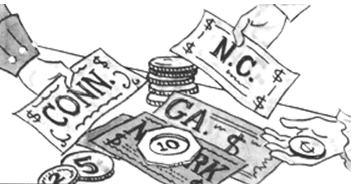
Under the Articles of Confederation, the national government consisted of _______________ branch of government.
3
2
1
4

What does Article I (1) establish?
Legislative Branch
Judicial Branch
Executive Branch
Supremacy of the Constitution
What does Article II (2) establish?
Legislative Branch
Judicial Branch
Executive Branch
Supremacy of the Constitution
What does Article III (3) establish?
Legislative Branch
Judicial Branch
Executive Branch
Supremacy of the Constitution
What does Article IV (4) establish?
The Constitution is Supreme
How to amend the Constitution
How to ratify the Constitution
Relationships between the states

The debates between Federalists and Anti-Federalists were primarily about:
The right of the people to rebel
The existence of slavery
The need to establish a standard currency
The scope of power of national government
The ideas of John Locke and the Declaration of Independence are similar in that both
recognize the right of monarch to determine their own form of government
support concept of natural rights and gov't built on consent of governed
seek common ideals in gov't through creation of constitutional monarchy
value the preservation of private property
The importance of Shay’s rebellion to the development of the US Constitution was that it
reinforced idea that slavery be outlawed in new constitution
convinced leaders that a strong national gov. needed to protect property, maintain order
convinced delegates at Constitutional Convention to accept Connecticut Plan
revealed need to add Bill of Rights to Const & creating checks and balances
The Connecticut (Great) Compromise provided for
all judicial appointments to be made by the President
all revenue bills to originate in the Senate
bicameral legislature with 1 house based state pop. & the other w/ equal representation
the elimination of the importation of slaves
Congress has the right to ʺmake all laws necessary and proper for carrying into execution" its powers is called
elastic clause
enumerated powers
heart of fiscal federalism
hyperpluralism
Which of the following explains one of the effects of the elastic clause?
allow the nat'l gov't to extend its powers beyond those enumerated in Constitution
powers not delegated by the Constitution to the U.S. are reserved to states
make the legislature the most powerful branch of the national government
allow state governments to nullify federal laws within their borders
The enumerated (or expressed) powers of Congress and the national government are those
specifically spelled out in the Constitution
not specifically spelled out in the Constitution, but acknowledged
involving taxes, spending, and fiscal policy
set out in the first ten amendments
The New Jersey Plan was a reaction by some states primarily to the fear that
the president could use a legislative veto
the Virginia Plan gave too much power to populous states
Hamilton's National Bank would threaten foreign investments
the national government had too much power under the Articles of Confederation

