
 Worksheets
Constitutional Principles ( Study guide)
Total questions: 86
Worksheet time: 44mins
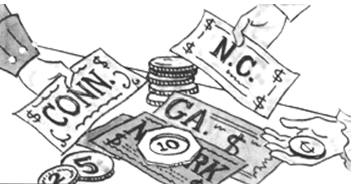
Shays' Rebellion represented...
a success of the Articles of Confederation
a failure of the Articles of Confederation
The main cause for many of the rules in the Articles of Confederation was that the delegates at the Continental Congress...
did not want to give the states too much power because they'd proven they were willing to rebel against a government.
wanted to create a government that was identical to England's government.
were concerned about giving the central government too much power because the King had used his power unfairly.
wanted to unify the states together, which included creating one army and one type of currency.
Who was the president under the articles?
George Washington
Each governor voted on a president
The most senior Senator
There wasn't one
Opposed the development of a strong federal government
Anti-Federalist
Federalist
Wanted a stronger national government
Anti-federatlist
Federalist
Mostly lived in rural areas
Anti-federalist
Federalist
Mostly lived in urban areas
Anti-federalist
Federalist
Opposed constitution until the Bill of Rights were included
Anti-federalist
Federalist
Proposed and supported the Constitution
Anti-federalist
Federalist
Included Thomas Jefferson, James Monroe, Patrick Henry, Samuel Adams
Anti-federalist
Federalist
Included Alexander Hamilton, George Washington, John Jay, John Adams
Anti-federalist
Federalist
Economy dominated by farmers and smaller rural communities, believed in local power
Anti-federalist
Federalist
Economy dominated by big business interests and wanted government to help regulate the economy
Anti-federalist
Federalist
Felt that states were free agents that should manage their own revenue
Anti-federalist
Federalist
Felt that many individual and different fiscal and monetary policies led to economic struggles and national weakness.
Anti-federalist
Federalist
Favored central banking and central financial policies
Anti-federalist
Federalist
Felt states should spend their money as they saw fit
Anti-federalist
Federalist
What series of essays were written by Hamilton, Jay, and Madison to convince people to ratify the Constitution?
Federalist Papers
Common Sense
Antifederalist Papers
The American Crisis
What was the Antifederalist response to the Federalist Papers?
Common Sense
Antifederalist Papers
The American Crisis
Walden
Who said this quote - "Your only remedy is such a national government as will make the country respectable; such a supreme government as can boldly meet the supremacy of proud and self-interested nations."
A Federalist
An Anti-Federalist
Who said this quote - “When the government fears the people, there is liberty. When the people fear the government, there is tyranny.”
A Federalist
An Anti-Federalist
Which group believed - we must start with a fresh document, fixing the Articles of Confederation isn’t enough.
Federalists
Anti-Federalists
Which group feared that the president might behave like a king?
Federalists
Anti-Federalists
Federalists and Anti-Federalists presented their opinions to the public through
newspapers
TV
Internet
Ratification (approval) of the Constitution happened once __/___ states agreed.
13/13
7/13
9/13
50/50
The Articles of Confederation had how many branches of government?
0
1
2
3
Which of the below scenarios would NOT accurately fall under the beliefs of the Articles of Confederation
States having the right to make their own decisions
Equal Representation 1 state = 1 vote
No President
Central bank to mint money
Which was a weakness of the Articles of Confederation?
Congress had no power to levy or collect taxes
US Bank regulated currencies
There was a bicameral congress
States & Federal Government split rights & responsibilities evenly
Which was NOT one of the key issues addressed at the Constitutional Convention
Representation
Slavery
Central Bank (Bank of US)
Trade
What was the resolution to the issue of slavery that was addressed at the Constitutional Convention?
The Great Compromise
The 3/5th Compromise
Abolishing Slavery
Ending tariffs
Which of the below created a bicameral legislature?
The New Jersey Plan
The Virginia Plan
The Great Compromise
The Bank of the United States (BUS)
These were the people who wanted to ratify the new Constitution
Federalists
Anti-Federalists
These people argued that the Constitution did not protect individual rights, and that a bill of rights was needed to protect freedom of speech, religion, and the press
Federalists
Anti-Federalists
Alexander Hamilton, James Madison, and John Jay
Federalists
Anti-Federalists
Wanted a weak national government that would not threaten states’ rights
Federalists
Anti-Federalists
Mostly urban; merchants, skilled workers, and laborers. Many lived in New England
Federalists
Anti-Federalists
When the Constitution was ratified in 1789, _____________ was unanimously elected 1st president
George Washington
Thomas Jefferson
Alexander Hamilton
John Adams
Georgia Washington created the first Cabinet. What is the presidential cabinet?
The Federal Courts
group of advisors who head departments
The Vice Presidents & Presidential secretaries
The White House
Who were the two most influential members of Washington's Cabinet that went on to be the main representatives of the first 2 political parties
John Adams & James Madison
Alex Hamilton & Thomas Jefferson
John Adams & Alex Hamilton
Sam Adams & Thomas Jefferson
Hamilton formed which party? (Supported strong central government & loose interpretation of constitution)
Federalist's
Democratic Republicans
Anti-Federalists
Republicans
Jefferson formed which party? (supported strong state governments & strict interpretation of the constitution)
Federalist's
Democratic Republicans
Anti-Federalists
Republicans
Declare war on another country
National Power
State Power
Shared Power
Maintain law and order
National Power
State Power
Shared Power
Regulate business within the state
National Power
State Power
Shared Power
Make marriage laws
National Power
State Power
Shared Power
Provide for public welfare
National Power
State Power
Shared Power
Establish foreign policy
National Power
State Power
Shared Power
Coin money
National Power
State Power
Shared Power
Levy (create and collect) taxes
National Power
State Power
Shared Power
Establish and maintain schools
National Power
State Power
Shared Power
Establish local governments
National Power
State Power
Shared Power
Admit new states
National Power
State Power
Shared Power
Establish post offices
National Power
State Power
Shared Power
Maintain the armed forces (army, navy, air force, marines)
National Power
State Power
Shared Power
Assume other powers not delegated to the national government or prohibited to the states
National Power
State Power
Shared Power
Provide for public safety
National Power
State Power
Shared Power
Regulate interstate and foreign trade
National Power
State Power
Shared Power
Set standard weights and measures
National Power
State Power
Shared Power
Borrow money
National Power
State Power
Shared Power
Establish courts
National Power
State Power
Shared Power
Charter banks
National Power
State Power
Shared Power
5th Amendment
No self-incrimination
No double jeopardy
Due process
The right to a jury trial in civil cases involving more than $20
No cruel and unusual punishment
No excessive bail
The right to a fair, speedy and public trial in criminal cases.
The right to a lawyer.
6th Amendment
No self-incrimination
No double jeopardy
Due process
The right to a jury trial in civil cases involving more than $20
No cruel and unusual punishment
No excessive bail
The right to a fair, speedy and public trial in criminal cases.
The right to a lawyer.
7th Amendment
No self-incrimination
No double jeopardy
Due process
The right to a jury trial in civil cases involving more than $20
No cruel and unusual punishment
No excessive bail
The right to a fair, speedy and public trial in criminal cases.
The right to a lawyer.
8th Amendment
No self-incrimination
No double jeopardy
Due process
The right to a jury trial in civil cases involving more than $20
No cruel and unusual punishment
No excessive bail
The right to a fair, speedy and public trial in criminal cases.
The right to a lawyer.
Writing false information about someone with the intent to cause harm
Libel
Slander
Criminal Cases
Civil Cases
False information about someone that is spoken with the intent to harm
Libel
Slander
Criminal Cases
Civil Cases
A court case that involves someone breaking a law and/or committing a crime
Libel
Slander
Criminal Cases
Civil Cases
A court case that is settling a dispute, it often involves money as a settlement
Libel
Slander
Criminal Cases
Civil Cases
giving testimony that can be used against you to show your guilt
Self Incrimination
Due Process
Criminal Cases
Civil Cases
fair treatment through the normal judicial system that is owed to you
Self Incrimination
Due Process
Criminal Cases
Civil Cases

