wayground logo

Free Printable Worksheets

Font size

S
M
L
XL
Worksheets

Hoff's incredible Yearly assessment quiz

Total questions: 154

Worksheet time: 4hrs 33mins

Name
Class
Date
1.
Steve wanted to see if the type of fertilizer made sunflowers grow larger. What is the independent variable 
a)
Type of fertilizer
b)
Size of sunflower
c)
type of sun flower
2.
Molly investigated if the age of students caused them to be better drivers. What is the independent variable?
a)
Type of car
b)
Skill of driving
c)
Age of student
3.
Sam wanted to know if the color of the chair you sat in when taking a test affected your test grade. What is the dependent variable.
a)
Color or chair
b)
Grade on test
c)
Age of students
4.
Robert wanted to know if the type of phone you used gave you better or worse service. What is the independent variable. 
a)
Location of phone call
b)
Type of phone
c)
How good the service was
5.
Sarah wanted to find out if the size of a car tire made it a smoother ride over bumps. What is the independent variable?
a)
Size of tire
b)
How smooth the ride was over bumps
c)
Type of car
6.
Penelope wanted to see if the temperature of the oven made cookies softer or harder. What is the independent variable.
a)
Hardness of cookie
b)
Type of oven
c)
Temperature of oven
7.
Dilcia wants to know how drinking milk affects how tall a Monica grows. Which is the independent variable?
a)
Monica's growth
b)
drinking milk
8.

A variable that you change or manipulate to affect the results in an investigation is the __________________?

a)

control variable

b)

dependent variable

c)

independent variable

d)

research variable

9.

The variable in an investigation that you are measuring is the _________________?

a)

control variable

b)

independent variable

c)

dependent variable

d)

research variable

10.
How many variables can be tested in a controlled experiment?
a)
one
b)
two
c)
three
d)
as many as possible
11.
Choose the best-written hypothesis that answers the question:
Question: Why is my room warmer during the day than at night?
a)
Sunlight is making my room warmer.
b)
Mr. Rivas has the heat turned on in the morning.
c)
If I close my blinds during the day, then my room will be cooler because sunlight cant get in.
d)
Sunlight actually cools down a room.
12.

True or False: a test may have more than one independent variable

a)

true

b)

false

13.

In any experiment, the independent variable ______________.

a)

remains the same to not mess up the experiment

b)

is purposely changed to test the hypothesis

c)

is known by the scientist before doing the experiment

14.

What is a hypothesis?

a)

A hypothesis is the right answer to an experiment.

b)

A hypothesis is the wrong answer to an experiment.

c)

A hypothesis is an educated guess.

d)

A hypothesis is a question.

15.

A hypothesis can be wrong in an experiment.

a)

true

b)

false

c)

only sometimes

16.
What is the part of the experiment that is left alone or “natural", and is used to compare back to?
a)
Independent Variable
b)
Dependent Variable
c)
Control Group
d)
Experimental Group 
17.
What type of graph is this?
a)
Line Graph
b)
Pictograph
c)
Bar Graph
d)
Histogram
18.

What is the Aim of an experiment?

a)

A statement that describes what the investigation is trying to find out

b)

A statement that tells you the results of the experiment

c)

A statement showing how you did the experiment

d)

A statement describing your observations throughout the experiment

19.

What is a Variable?

a)

Variations within the experiment

b)

The repeating of the experiment by classmates

c)

Anything that can change during an experiment

d)

Something that must be keep the same during an experiment

20.

The dependant variable

a)

Is the thing you measure

b)

Depends on the people/place doing the experiment

c)

Must not change during the experiment

d)

Is the thing you change on purpose

21.

The control group

a)

The parts of the experiment you keep the same

b)

The only group you collect data from

c)

The group you change on purpose

d)

Does not have the independent variable and is used for comparison

22.

When making an observation, you must use...

a)

Only Sight

b)

Smell & Touch

c)

ALL 5 Senses

d)

Only Taste

23.

This step of the scientific method is an educated guess or a prediction.

a)

Hypothesis

b)

Research

c)

Observation

d)

Conclusion

24.

the factor that is changed by the scientist in a science experiment.

a)

dependent variable

b)

independent variable

c)

constant

d)

hypothesis

25.

the factor that is measured in the science experiment.

a)

constant

b)

independent variable

c)

hypothesis

d)

dependent variable

26.

Counting the number of barnacles on a boat would be what type of data?

a)

qualitative

b)

quantitative

c)

quick

d)

quiver

27.

Describing the barnacles on a boat would be what type of data?

a)

qualitative

b)

quantitative

28.

Information you collect during an experiment is called (a)

a)

chart

b)

graph

c)

hypothesis

d)

data

29.

What is a scientific method?

a)

A process used by scientist to read investigations

b)

A method used by scientists analyze data

c)

A series of steps used by scientists to solve problem

d)

A process where all data gathered are analyzed

30.
Making a statement or claim about what will happen in the future based on past experience or evidence is called
a)
observing.
b)
inferring.
c)
predicting.
d)
classifying.
31.
In science, a hypothesis must be
a)
correct.
b)
manipulated.
c)
controlled.
d)
testable.
32.
What is the relationship between the independent variable and the dependent variable?
a)
As time increase, distance decreases
b)
As time increases, distance increases
c)
As time decreases, distance decreases
d)
As time decreases, distance increases
33.
A summary that explains whether or not the data support the hypothesis
a)
data
b)
conclusion
c)
hypothesis
d)
research
34.

What is NOT product of complete combustion?

a)

carbon dioxide

b)

water

c)

carbon monoxide

d)

water

35.

Combustion is classified as a/an:

a)

endothermic reaction

b)

exothermic reaction

c)

neutralisation reaction

d)

acid + metal reaction

36.

In an exothermic reaction, heat is ...

a)

absorbed from the environment

b)

released into the environment

37.
How many elements does PbNO3 have?
a)
2
b)
3
c)
4
d)
5
38.
How many nitrogen atoms does NH3 have?
a)
1
b)
2
c)
3
d)
4
39.
For the equation:
2H2 +  O2 --> 2H2O
How much H2O will be produced if we react 4g of H2 and 32g of O2?
a)
4g
b)
32g
c)
36g
d)
28g
40.

What are valence electrons?

a)

The total number of electrons in an atom

b)

The number of electrons in the outermost shell

c)

The number of electrons in the second shell

d)

The number of protons in the outermost shell

41.
The substances that are present before a reaction are the...
a)
reactants
b)
products
c)
both of these
d)
neither of these
42.
How many atoms are there TOTAL in:
H2SO4
a)
6
b)
5
c)
7
d)
3
43.
The substances that are present before a reaction are the...
a)
reactants
b)
products
c)
both of these
d)
neither of these
44.
___________________ are the elements or compounds that are formed in a chemical
reaction.
a)
Polymers
b)
Bonds
c)
Reactants
d)
Products
45.
_______________ can speed up the rate of reactions and/or lower the amount of energy needed for
the reaction to take place.
a)
Carbohydrates
b)
Fuel source
c)
Chemical
d)
Catalyst
46.
A change in which NEW substances are formed.
a)
Chemical change
b)
Physical change
c)
Casual change
d)
Formal change
47.
Element or compound?
H2O
a)
element
b)
compound
48.
Compounds break down into simpler substances in this type of reaction.....
a)
Double Replacement
b)
Single Replacement
c)
Synthesis
d)
Decomposition
49.
How many atoms are there TOTAL in:
H2SO4
a)
6
b)
5
c)
7
d)
3
50.
How many elements are in H2O?
a)
1
b)
2
c)
3
d)
4
51.
How many atoms of carbon (C) are in C6H12O6?
a)
3
b)
6
c)
12
d)
24
52.
Which of the following is a compound?
a)
Co
b)
O2
c)
C
d)
CO2
53.
Exothermic reactions...
a)
Absorb energy
b)
Release energy
c)
Release Color
d)
Absorb Color
54.
The only way you can be certain that a chemical reaction has occurred is by? 
a)
Light has been emitted 
b)
a colour change has occurred 
c)
bubbles appear 
d)
identifying one or more new chemical products 
55.
Heating up two reactants will make the reaction...
a)
stay the same
b)
go slower
c)
become constant
d)
go faster
56.
What is the rate of reaction?
a)
How fast a reaction is 
b)
How big a reaction is
c)
How loud a reaction is
d)
How much gas a reaction produces
57.
In the equation,          2Mg + O2 ---> 2MgO, which are the reactants?
a)
Mg and O
b)
MgO
c)
Mg and MgO
d)
O and MgO
58.
Balance this equation, Ca + H2O --> CaO + H2
a)
Ca + 2H2O --> CaO + 2H2
b)
2Ca + H2O --> CaO + H2
c)
Its balanced as it is
d)
Cannot be balanced
59.
What type of chemical reaction is this one?
Al(OH)3 --> Al2O3  + H2O
a)
Decomposition
b)
Combustion
c)
Synthesis
d)
Single Replacement 
60.

Why must chemical equations be balanced?

a)

So that the equation doesn't explode

b)

The reaction won't happen until it is balanced

c)

Based on the Law of Conservation of Matter, matter cannot be created or destroyed.

d)

Based on the Law of Conservation of Energy, energy cannot be created or destroyed.e

61.
The left side of the equation below is called
a)
Products
b)
Reactants
62.
The right side of the equation below is called the
a)
products
b)
reactants
63.
What type of reaction is illustrated below?
2HI --> H2  +  I2
a)
synthesis
b)
decomposition
c)
single replacement
d)
double replacement
64.
How many atoms of hydrogen (H), sulfur (S), and oxygen (O) are there in sulfuric acid (H2SO4)?
a)
H-6, S-4, O-4
b)
H-1, S-2, O-8
c)
H-2, S-1, O-4
d)
H-2, S-4, O-4
65.
What type of chemical reaction is this one?
C2H2 + O2 --> CO2 + H2O
a)
Decomposition
b)
Combustion
c)
Synthesis
d)
Single Replacement 
66.
Which of the following could indicate a chemical change? 
a)
All of the answers could indicate Chemical Change 
b)
a color change has occurred 
c)
bubbles appear 
d)
identifying one or more new chemical products 
67.
Evidence of a chemical reaction include:
a)
Phase change
b)
No new substance
c)
Bubbles forming
d)
Shape change
68.
3KOH + H3PO4 --> K3PO4 + 3H2O
a)
Combination
b)
Decomposition
c)
Single replacement
d)
Double replacement
69.
Acids react with
a)
water to produce bases and salts
b)
salts to produce bases and water
c)
neither bases, salts nor water
d)
bases to produce salts and water
70.

A substance is found to have the following characteristics:


Very bitter taste

Feels slippery to the touch

Produces OH- ions when dissolved in water


In what category would the substance be classified?

a)

acid

b)

base

c)

enzyme

d)

fatty acid

71.

HF is...

a)

an acid

b)

a base

c)

a salt

d)

an ionic compound

72.

HNO2

a)

a base

b)

a salt

c)

an acid

d)

an ionic compound

73.
Releases hydrogen in an aqueous solution.
a)
base
b)
strong base
c)
acid
d)
weak base
74.

KOH is ...

a)

an acid

b)

a base

c)

a salt

d)

an ionic compound

75.
Which has a pH below 7?
a)
Acid
b)
Base
76.
Which has a bitter taste?
a)
Base
b)
Acid
c)
flagella
d)
cila
77.

What pH is the strongest base?

a)

1

b)

7

c)

4

d)

14

78.
Human blood has a pH between 7.35 and 7.45. Which of the following best describes human blood?
a)
strongly acidic
b)
slightly acidic
c)
strongly basic
d)
slightly basic
79.
When dissolved in water, acids produce:
a)
bases
b)
salts
c)
hydrogen ions
d)
hydroxide ions
80.
Which type of ion does a base produce when it is dissolved in water?
a)
oxide
b)
oxygen
c)
hydrogen
d)
hydroxide
81.

How many mass extinctions have occurred on Earth?

a)

3

b)

4

c)

5

d)

6

82.
If an organism has a vestigial structure, that structure likely once had a function in a(n)
a)
close relative
b)
early ancestor
c)
unrelated organism
d)
embryological stage
83.
If an organism has a vestigial structure, that structure likely once had a function in a(n)
a)
close relative
b)
early ancestor
c)
unrelated organism
d)
embryological stage
84.
A remnant or trace of an organism from the past is called a _______.
a)
Ancestor
b)
Skeleton
c)
Fossil
d)
Imprints
85.
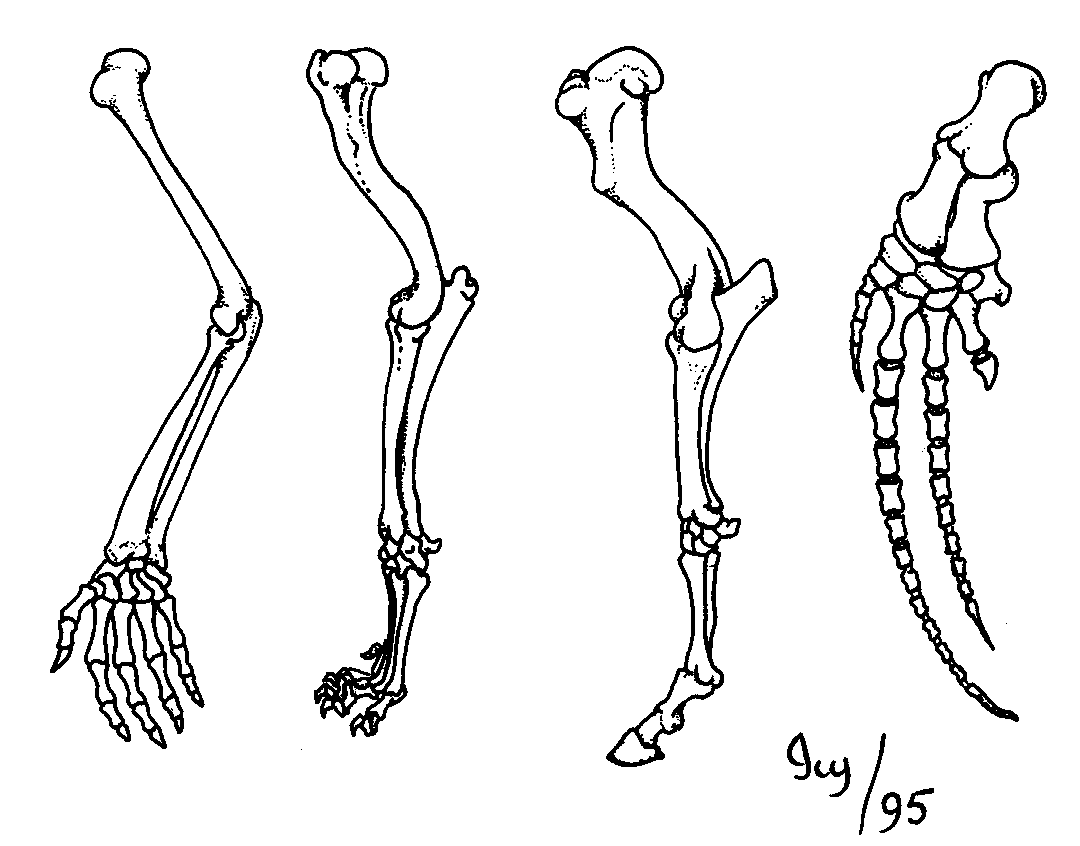
Structures with the same parts have different functions; suggests that organisms share a common ancestry
a)
vestigial structures
b)
homologous structures
c)
adaptive radiation
d)
fossil
86.

body parts in organisms that have the same functions, but have different structures

a)

analagous structures

b)

homologous structures

c)

vestigal structures

87.

body parts found in living organisms that no longer serve a purpose (not necessary for the organisms survival)

a)

analagous structures

b)

homologous structures

c)

vestigal structures

88.

selective pressure exerted by humans on populations in order to improve or modify particular desirable traits

a)

natural selection

b)

artificial selection

89.

a change in a population or species over time

a)

Common Ancestry

b)

Evolution

c)

Embryology

d)

Biogeography

90.

In finches (birds), what is the biggest advantage of having different shaped beaks?

a)

to look different from other species

b)

to protect itself from predators

c)

to be able to eat the food readily available in the environment

d)

to protect itself against prey

91.
Which of the following is a phenotype?
a)
Aa
b)
red hair
c)
heterozygous
d)
DNA
92.
Dominant alleles are represented by a:
a)
Male gene
b)
lowercase letter
c)
recessive trait
d)
capital letter
93.
How many boxes would say BB?
a)
1
b)
2
c)
4
d)
0
94.
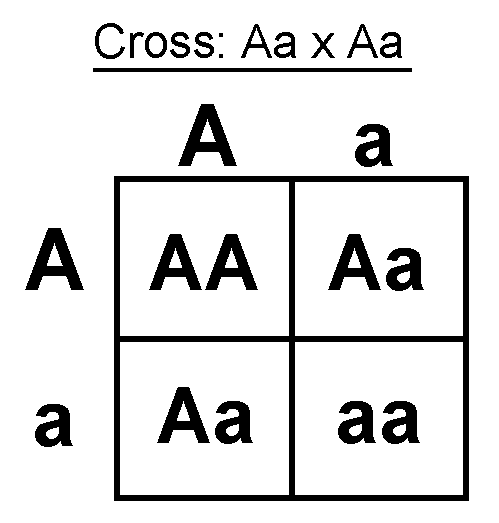
T - tall and t = short
In the punnett square below, what belongs in the missing square
a)
tt
b)
Tt
c)
Bb
d)
TT
95.
G = green, g = yellow
The genotype for a yellow plant is...
a)
GG
b)
Gg
c)
gg
d)
all of the choices result in yellow
96.
What allele combination should go in the missing box?
a)
AA
b)
Aa
c)
aa
d)
none of these
97.
If B = brown hair and b = blonde hair, what is the probability of brown hair?
a)
25%
b)
50%
c)
0%
d)
75%
98.
In rabbits, black fur (B) is dominant over brown fur (b). If a rabbit has brown fur, what can you conclude about its genotype?
a)
It is BB.
b)
It is Bb
c)
It is brown
d)
It is bb.
99.
A ________________________ is used to predict the possible genotype from certain parents
a)
Mendel Grid
b)
Genetic Tic Tac Toe
c)
Punnett Square
d)
Pedigree Plot
100.
What percent of offspring will have the recessive trait?
a)
25
b)
50
c)
75
d)
100
101.
What is a phenotype
a)
The genetic make up (code)
b)
The physical trait
102.
Both parents in this Punnet square
a)
are homozygous dominant
b)
are homozygous recessive
c)
are heterozygous
d)
have blue eyes
103.
The genotypic ratio here is
a)
25% blue eye 75 % brown eye 
b)
BB = 25% Bb = 50% bb = 25%
c)
BB= 50 % bb = 50%
d)
All brown eye
104.
The dominant trait is
a)
yellow pea seeds
b)
green pea seeds
c)
there is no dominant seed
d)
Jolly green giant
105.
To express the recessive trait you must be
a)
homozygous dominant
b)
heterozygous
c)
alleleerific
d)
homozygous recessive
106.
The process of changing the genetic material of a living organism 
a)
Genetic Modification
b)
Taxonomy
c)
Adapting
d)
Bioremediation
107.

This is the practice of producing a genetically identical cell or organism

a)

Cloning

b)

Gel Electrophoresis

c)

Genetic Engineering

d)

DNA Fingerprinting

108.

Why is Dolly the sheep considered a clone?

a)

the source of Dolly's DNA is a single cell taken from an adult donor

b)

the DNA molecules in each of Dolly's cells are different

c)

Dolly has a mix of genes from her foster mother and the sheep that donated a nucleus of one of its cells

d)

Dolly is genetically identical to her offspring

109.

The process that has been used for centruries to create purebred animals such as black labs is called

a)

recombinant DNA

b)

cloning

c)

selective breeding

110.

Problems with cloning are

a)

creating too many embryos that are unneeded

b)

premature aging and a high failure rate

c)

they have a tendency to overpopulate

111.

Which of the following is not a disadvantage of cloning?

a)

Cloning is expensive

b)

Increases food supply

c)

Reduces biodiversity

d)

Success rate in mammals is low

112.

A technology that replaces a defective or missing gene to treat a disease is called _____________.

a)

Genetic Engineering

b)

Gene Therapy

c)

Gene Cloning

d)

Gene Sequencing

113.

Issues that refer to people’s moral values or the code of conduct by which they live

a)

Social issues

b)

Legal issues

c)

Cultural issues

d)

Ethical issues

114.
The number of wavelengths that pass a point each second
a)
frequency
b)
wavelength
c)
pitch
d)
amplitude
115.
Material (matter) through which a wave travels
a)
medium
b)
Doppler Effect
c)
sound
d)
pitch
116.
How high or low a sound is; depends on the frequency (greater frequency= higher pitch)
a)
pitch
b)
frequency
c)
sound
d)
medium
117.
A wave in which the vibration is in the same direction as that in which the wave is traveling; sound waves
a)
longitudinal wave
b)
ocean wave
c)
transverse wave
d)
mechanical wave
118.
The part of a longitudinal wave where the particles of the medium are close together.
a)
rarefaction
b)
compression
c)
crest
d)
trough
119.
A part in a longitudinal wave where the particles are spread apart
a)
compression
b)
rarefaction
c)
crest
d)
trough
120.
As the fire truck approached Mary, the pitch of the siren got higher. Once the fire truck passed and moved away, the siren's pitch got lower. This change in pitch is because of a change in the sound wave's
a)
concussion. 
b)
amplitude. 
c)
reflection.
d)
frequency. 
121.
Which waves are the type that can give us suntans and sunburns?
a)
Infrared radiation
b)
Ultraviolet radiation
c)
Radio waves
d)
X-rays
122.
Which rays can be felt as heat?
a)
X-Rays
b)
Infrared Radiation
c)
Ultraviolet Radiation
d)
Microwaves
123.
Cancer can be treated with_______________waves.
a)
Penicillin
b)
Radio
c)
Infrared
d)
Gamma
124.
The blue section of the wave is measuring _________________.
a)
wavelength
b)
crest
c)
trough
d)
amplitude 
125.
_____________________light is the only type of EM wave detected by the human eye.
a)
Red
b)
Gamma
c)
Microwave
d)
Visible
126.
The orange line is measuring the _________________________.
a)
wavelength
b)
amplitude
c)
crest
d)
trough
127.
This type of Electromagnetic wave shows a break in bones.
a)
gamma ray
b)
x-ray
c)
brokenometer
d)
radio wave
128.
_______ carry the greatest amount of energy. 
a)
x-rays
b)
gamma rays
c)
infrared rays
d)
visible light
129.
Which wave has a greater frequency?
a)
A
b)
B
130.
Which kind of wave has the greatest frequency?
a)
gamma rays
b)
infrared
c)
ultraviolet
d)
microwaves
131.
The distance from one point to the next corresponding point on a wave is called the ________________.
a)
waveform
b)
peak
c)
amplitude
d)
wavelength
132.
What is the transfer of heat by movement of liquids or gases?
a)
Radiation
b)
Convection
c)
Conduction
d)
Heat
133.
What is a transfer of heat energy by electromagnetic waves?
a)
Radiation
b)
Convection
c)
Conduction
d)
Heat
134.
What is the transfer of heat by direct contact?
a)
Convection
b)
Electromagnetic waves
c)
Radiation
d)
Conduction
135.
What is a substance that does NOT conduct heat well?
a)
Conductor
b)
Insulator
c)
Convector
d)
Radiator
136.
What is a substance that DOES conduct heat well?
a)
Conductor
b)
Insulator
c)
Convector
d)
Radiator
137.
Carries energy from one place to another
a)
Waves
b)
Amplitude
c)
Frequency
d)
Crest
138.
The measurement of the distance the particles move from the resting point of the wave
a)
Wavelength
b)
Frequency
c)
Amplitude
d)
Crest
139.

The measurement of the length of a wave from one point of the wave to the next identical part of the wave (for example, top to top or bottom to bottom)

a)

Crest

b)

Amplitude

c)

Frequency

d)

Wavelength

140.

The number of waves that passes a certain point in a set period of time

a)

Frequency

b)

Amplitude

c)

Wavelength

d)

Amplength

141.
What kind of wave is pictured below?
a)
compressional wave
b)
transverse wave
c)
sound wave
d)
mechanical wave
142.
Top of the wave
a)
Wavelength
b)
Amplitude
c)
Trough
d)
Crest
143.
The measurement from one point of the wave to the next identical part of the wave (for example, crest to crest or trough to trough)
a)
Crest
b)
Amplitude
c)
Frequency
d)
Wavelength
144.

In a transverse wave, how do the particles move?

a)

They don't move

b)

Sideways

c)

Up and down

d)

In a square

145.

Which one shows the amplitude of a wave?

a)
b)
c)
146.
What do we call the part of a compressional wave that is spread a part?
a)
compression
b)
rarefaction
c)
crest
d)
trough
147.
The part of a longitudinal wave where the particles of the medium are close together.
a)
rarefaction
b)
compression
c)
crest
d)
trough
148.

Sound waves can travel through a vacuum because they don't require particles.

a)

True

b)

False

149.

In longitudinal waves, the parts where the coils are spread apart (B) are called what?

a)

rarefactions

b)

compressions

c)

wavelengths

d)

longitudes

150.

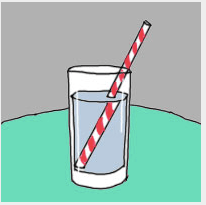
Why does the straw appear to be bent?

a)

light is reflected

b)

light is absorbed

c)

light is turned

d)

light is refracted

151.
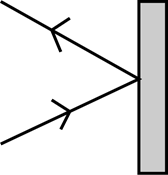
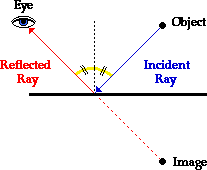
The illustration shows a light ray striking an object.
In the illustration, the light ray striking the object is-
a)
absorbed
b)
stopped
c)
reflected
d)
refracted
152.

What is the angle of reflection equal to?

a)

The angle of refraction

b)

The angle of incidence

c)

The angle of absorption

d)

The angle of light

153.

What is the angle of incidence?

a)

The angle at which light bends in water.

b)

The angle at which light hits a surface.

c)

The angle at which light is absorbed by an object.

d)

The angle at which light bounces off a surface.
154.
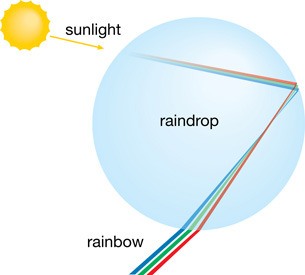
Light bending as it passes through a rain drop is an example of...
a)
Refraction
b)
Reflection