wayground logo

Free Printable Worksheets

Font size

S
M
L
XL
Worksheets

Econ - Benchmark 1 Review

Total questions: 72

Worksheet time: 36mins

Name
Class
Date
1.

When producers offer more of a good as its price increases and less as its price falls, this defines the

a)

law of demand

b)

law of supply

c)

change in demand

d)

change in supply

2.

The willingness and ability of a producer to make a product is referred to as

a)

quantity supplied

b)

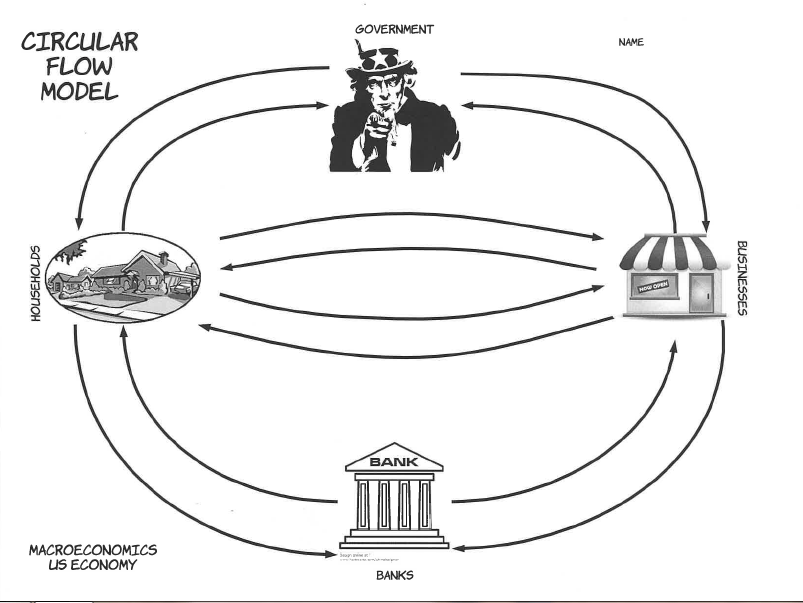
quantity demanded

c)

supply

d)

demand

3.

Movement along a supply curve demonstrates

a)

a change in quantity supplied

b)

a change in quantity demanded

c)

a change in supply

d)

a change in demand

4.

A shift in a supply curve demonstrates

a)

a change in quantity supplied

b)

a change in quantity demanded

c)

a change in supply

d)

a change in demand

5.

Which of these demonstrates an example of a supply curve? (More than one answer)

a)
b)
c)
d)
6.

Which of the following supply curves demonstrates a decrease in the quantity supplied?

a)
b)
c)
d)
7.

A decrease in supply is demonstrated by which of the following?

a)
b)
c)
d)
8.

A hurricane wipes out an orange crop in Florida, sharply affecting the supply of oranges. Which chart demonstrates this concept?

a)
b)
c)
d)
9.

The prices for houses steadily increase, causing more people to want to sell their homes. Which of these demonstrates this concept?

a)
b)
c)
d)
10.

What might cause the supply curve to shift left?

a)

price of a complementary good decreases

b)

large number of producers enter the market

c)

computer processing improves production

d)

a new law is passed requiring all new motorcycles to have back-up cameras

11.

Which of the following leads to an decrease in supply?

a)

an increase in the cost of raw materials

b)

diminishing marginal returns

c)

a decrease in the cost of raw materials

d)

a change in the law of supply

12.

Which of these do the producers of an item hope to achieve when adopting new technology?

a)

a shift of the supply curve for that item to the left

b)

repeal of the subsidy for that item

c)

inelasticity of supply of that item

d)

a shift of the supply curve for that item to the right

13.

Which of the following leads to an increase in supply?

a)

Gallery Furniture will raise prices on all wood furniture

b)

six new companies begin producing smart phones

c)

price of a complementary good goes down

d)

increased cyclical employment

14.

Which of these best describes the influence of high prices on the behavior of producers?

a)

High prices are an incentive for producers to produce more.

b)

Producers will use fewer raw materials and less labor

c)

High prices are an incentive for producers to produce less.

d)

Prices have no incentive for producers.

15.
Which of the following best describes the Law of Demand?
a)
As price goes down, demand goes down. (and vice versa).
b)
As price goes down, demand goes up (and vice versa).
c)
As demand goes down, supply goes up.
d)
As demand goes up, price becomes elastic.
16.
A table that lists the quantity of a good that a single person will buy at each price in a market.
a)
demand schedule
b)
market demand schedule
c)
elasticity chart
d)
supply and demand graph
17.
What is not an example of a substitute?
a)
Disneyland and Six Flags
b)
Peanut butter and jelly
c)
Hershey's and Nestle chocolate
d)
Microsoft Word and Google Docs
18.
Thousands of people leave a small town due to a factory closing down.  Sales at the local grocery store become slow. What causes this shift in demand?
a)
Prices or availability of substitutes
b)
Prices or availability of complementary goods
c)
Change in the weather or season
d)
Change in the number of buyers
19.
According to the Law of Demand, when the price of a good is lowered, demand __________.
a)
increases
b)
decreases
c)
stays the same
d)
fluctuates
20.
The demand curve always slopes
a)
down and to the right
b)
straight up and down
c)
down and to the left
d)
up and to the right
21.
Goods that are bought and used together are 
a)
complementary goods
b)
substitute goods
c)
income goods
d)
unrelated goods
22.
Demand can most likely be changed by
a)
consumer taste
b)
productivity
c)
the number of products
d)
the number of competition
23.
On a demand curve, an increase in demand causes the curve to shift
a)
shift to the right.
b)
shift to the left.
24.
If a consumer knows that a product will be going on sale this week, how will his/her CURRENT demand be affected?
a)
it will go up
b)
it will go down
c)
it will stay the same
d)
what does this have to do with the price of tea in China?
25.

A product may be amazing, but unless consumers are __ and __ to purchase it, it's not in demand.

a)

willing

b)

wishing

c)

able

d)

planning

26.
A new study has shown that avocados are extremely healthy. The demand for avocados has increased due to a change in
a)
market size
b)
price of a substitute good
c)
price of a complementary good
d)
tastes and preferences 
27.
The phrase "a change in demand" most directly implies a 
a)
movement along the curve
b)
movement along the price curve
c)
change in quantity demanded of a good
d)
shift in the demand curve
28.
Iceberg & romaine are two different types of lettuce. For most consumers, iceberg and romaine are 
a)
complements
b)
substitutes
c)
inferior goods
d)
resources
29.

In terms of resources, what do households provide for businesses?

a)

loans

b)

savings

c)

labor

d)

private goods

30.

What are the four main parts of the circular flow diagram?

a)

Product Market, Stock Market, Factor Market, Fish Market

b)

Product Market, House Market, Factor Market, Good Market

c)

Factor Market, Product Market, Households, Businesses

d)

Factor Market, households, Stock Market, super market

31.

Where are factors of production (land, labor, etc) exchanged in the circular flow model?

a)

Factor Market

b)

Product Market

c)

Firms

d)

Individuals

32.

Someone buys a car in exchange for a large amount of money. They have completed an exchange in which part of the circuclar flow model?

a)

Product Market

b)

Factor Market

c)

Firms

d)

Individuals

33.
In terms of resources, what do businesses provide for households?
a)
income
b)
sales
c)
taxes
d)
private goods
34.
In the circular flow model, the product market describes _____.
a)
stores that sell goods and services to households
b)
the government paying for public goods
c)
households selling their labor to businesses
d)
households receive income from businesses
35.
In this market, businesses buy resources they need to produce goods and services.
a)
factor market
b)
stores
c)
product market
d)
 businesses
36.
What do businesses provide for consumers according to the circular flow model?
a)
goods and services
b)
only goods
c)
only services
d)
taxes
37.
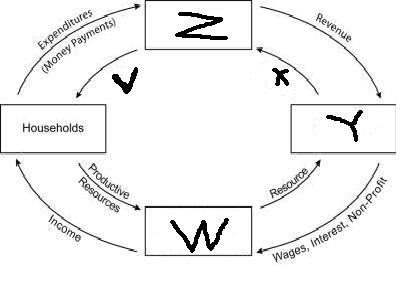
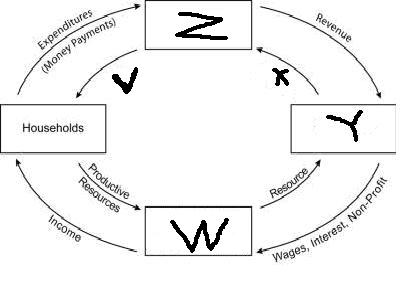
In the picture, what should replace W?
a)
Factor Market
b)
Product Market
c)
Consumers
d)
Firms
38.
IN the picture, what should replace Z?
a)
Factor Market
b)
Firms
c)
Product Market
d)
Consumers
39.

What causes a change in quantity demanded?

a)

A change in consumer income

b)

A change in production possibilities

c)

A change in the number of sellers

d)

A change in price

40.

In college people can major in a wide variety of fields including medicine, journalism, business and design among others. This is an example of the concept of

a)

scarcity.

b)

specialization.

c)

elastic demand.

d)

progressive taxation.

41.

Susan offers to trade her old iPod for Claudia's cell phone and Claudia accepts. Assuming both products work perfectly, we can conclude that

a)

both people have gained because the exchange was voluntary and non-fraudulent.

b)

Susan places the same value on cell phones as she does for iPods.

c)

neither party has gained because the exchange was fraudulent.

d)

Claudia is now happier than Susan.

42.

If a point lies on the curve this means the company/country/individual is being efficient. If a point lies inside the curve, what does that tell?

a)

They are being over efficient

b)

They are being inefficient

c)

It is not impossible with the given resources

d)

They are still efficient, just at another point

43.

A consumer would be best defined as...

a)

A person who purchases goods and services for personal use

b)

A business that consumes other businesses

c)

A business or person who creates a product to sell

d)

A person who purchases goods in order to resell them.

44.

A __________ is work people do for consumers.

a)

Service

b)

Goods

c)

Durable goods

d)

Consumers

45.
When society does not have enough resources to produce all the things people would like to have.
a)
Scarcity 
b)
Economic Growth
c)
Paradox of Value
d)
Want
46.
What is opportunity cost?
a)
your choice
b)
what you give up to make a choice
47.

The economic problem is that

a)

resources are limited and wants are limited.

b)

resources are unlimited and wants are limited.

c)

resources are limited and wants are unlimited.

d)

resources are unlimited and wants are unlimited.

48.
Economics is the study of how
a)
gov't allocates scare resources to satisfy people's unlimited wants.
b)
gov't supplies money to businesses to produce goods & services.
c)
people use their scarce resources to satisfy their unlimited wants.
d)
businesses supply unlimited goods & services with limited resources.
49.

Dollars are also known as...?

a)

votes

b)

rubles

c)

power

d)

ability

50.

In consumer sovereignty, _____ is king.

a)

Producer

b)

Consumer

c)

Government

d)

Business

51.

What is one advantage of a Command Economy?

a)

Individual freedom for everyone

b)

Health and public services are available to everyone at little or no cost.

c)

The government rarely interferes.

d)

Able to adjust to change gradually

52.

A large part of a command economic system is controlled by:

a)

a centralized power; federal government

b)

No one. It's an economy based off of individual freedom

53.

In a market economy, who answers the 3 economic questions?

a)

Buyers and sellers

b)

The government

c)

Traditions and customs

d)

Your mom

54.

A(n) ____ is a method a society uses to answer the 3 economic questions.

a)

Economic System

b)

Market Structure

c)

Type of Government

d)

Planning Board

55.

The idea that buyers and sellers willingly enter into economic transactions.

a)

Voluntary Exchange

b)

Rational Choice

c)

Consumer Sovereignty

d)

Free Enterprise

56.

What type of Economic System does the U.S. actually have?

a)

Mixed economy

b)

Command economy

c)

Traditional Economy

d)

Planned Economy

57.

In a market economy, ____ creates an incentive for individuals to work, save, & invest.

a)

Private Property Rights

b)

Factors of Production

c)

Free Enterprise

d)

The Invisible Hand

58.

The ____ are the resources necessary to create goods and services.

a)

Factors of Production

b)

Means of Assembly

c)

Free Enterprise

d)

Laissez Faire System

59.

In a Market Economy, who owns the Factors of Production?

a)

Individuals

b)

The government

c)

The president

d)

The military

60.

Which statement would be MOST important to include in a summary of the article?

a)

New companies rely on supply and demand to decide which goods they want to produce.

b)

People feel that the too much involvement in the economy by the government is not beneficial.

c)

The American economy is mostly a free-enterprise system with some control from the government.

d)

Much of the labor force in the United States is transitioning from farms to cities for work.

61.
What type of economic system allows government and private businesses to make economic decisions?
a)
Market
b)
Mixed
c)
Traditional
d)
command
62.
Most common type of economy in the world today
a)
Mixed
b)
Command
c)
Market
d)
Traditional
63.

The mixed economy has private and public sectors.

a)

True

b)

False

64.

Why do all societies have to make decisions about how resources will be used?

a)

People are greedy

b)

There are not enough resources for those who want them

c)

Resources are too expensive for most people

d)

Because there is a huge gap between the rich and poor

65.

Scarcity is defined as a limited supply of resources and...

a)

limited wants for those resources

b)

unlimited resources

c)

limited resources

d)

unlimited wants for available resources

66.

People usually specialize in a job a skill they are good at or like to do.

a)

True

b)

False

67.

When the production of a good or service is broken down into different steps with different workers performing each step, it is called ___________.

a)

division of goods

b)

division of labor

c)

division of skills

d)

division of steps

68.

The amount of work a worker can perform in a given period of time (e.g., customers served per hour) is referred to as ​ (a)  

Choose from the below words
worker productivity.
business productivity.
mass production.
standard of living.
gross domestic product.
goal setting.
69.

This characteristic of a mixed economy states that the vast majority of labor, resources, and capital goods are owned by individuals rather than by the government.

a)

Private Property

b)

Freedom of enterprise and choice

c)

Motive of Self-Interest

d)

Competition

70.
This economic system is based on competition, profits, and self-interest.
a)
Socialism
b)
Communism
c)
Capitalism
71.

The government pays for public goods and services through —

a)

donations from wealthy politicians

b)

donations from foreign nations

c)

revenue from sales and income taxes

d)

revenue from the lottery

72.

The ​ (a)   invests money into machines known as ​ (b)   and hires workers known as ​ (c)   to bring the raw materials known as ​ (d)   together to produce goods and services

Choose from the below words
entrepreneur
capital
labor
land
money