
NEW
Font size
 Worksheets
BY 324 Chapters 4 Exam 1 Review Questions
Total questions: 15
Worksheet time: 8mins
The study of phylogeny predominantly aims to
understand the branching relationships of populations as they give rise to new populations over time.
uncover evidence for natural selection.
provide a theoretical basis for Darwin’s idea of descent with modification.
classify organisms based on similarity.
Which of the following statements about pedigrees and phylogenies is true?
Only phylogenies show the splitting and recombining of branches or lineages over time.
Pedigrees tell us about the ancestry of individuals; phylogenies tell us about the ancestry of populations.
Both expand as one looks backward in time.
The nodes in a pedigree represent populations; the nodes in a phylogeny represent individuals.
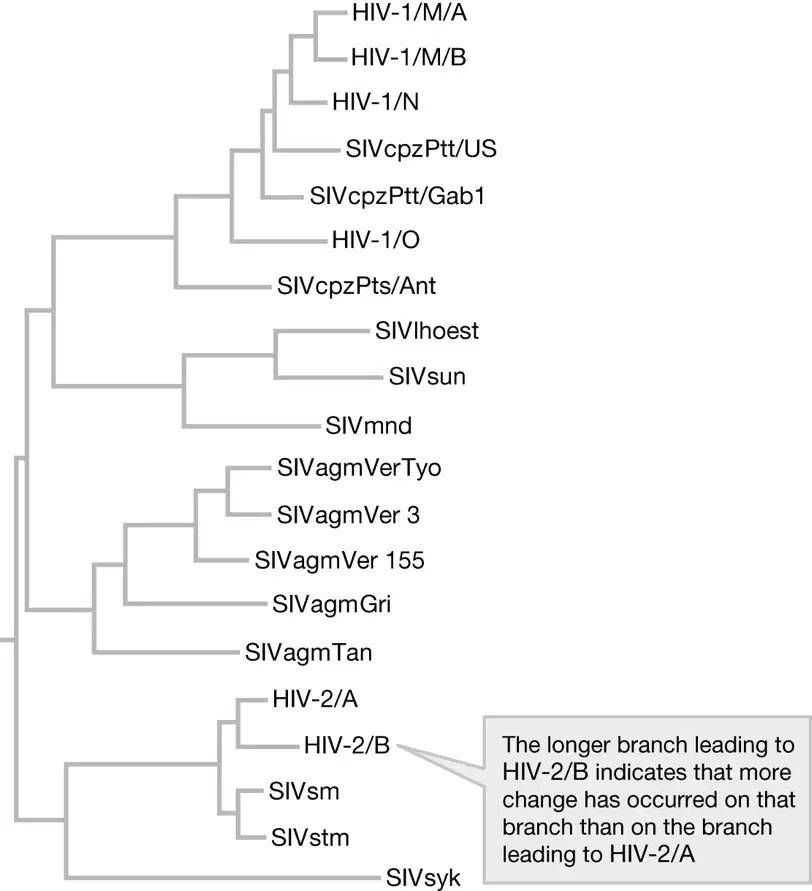
The following phylogeny shows the evolution of primate lentiviruses including human immunodeficiency viruses (HIV-1 and HIV-2) and simian immunodeficiency virus (SIV). Which of the following statements is true?
HIV originated once.
HIV-1 and HIV-2 are closely related.
HIV-2 is most closely related to SIVsm and SIVstm.
HIV-1 is more closely related to HIV-2 than to SIVsm
What is a polytomy?
a disjointed group that does not contain the common ancestor
a node with more than two branches arising from it
a phylogeny showing the evolutionary relationships and the amount of sequence change along each branch
a phylogenetic tree with a lot of branches
A paraphyletic group contains
the group’s most recent common ancestor but not all of its descendants.
neither the common ancestor of all of its members nor all descendants of that ancestor.
all descendants of the group’s most recent common ancestor and no other members.
unrelated members.

Based on the figure shown, the HIV strain that infected more than 400 children in a Benghazi hospital
is closely related to HIV strains from Cameroon and Ghana.
includes many different strains of widely divergent origin (an example of convergent evolution).
was a result of at least 44 separate introductions.
had 44 genes in its genome.
What is the fundamental idea behind parsimony?
The best phylogeny is the one that both explains the observed character data and posits the fewest evolutionary changes for a group of taxa.
The best phylogeny is the one that posits the greatest number of evolutionary changes for a group of taxa.
The computed number of morphological or molecular distances between taxa indicates their relatedness.
Morphological traits cannot be used to reconstruct phylogenetic history.
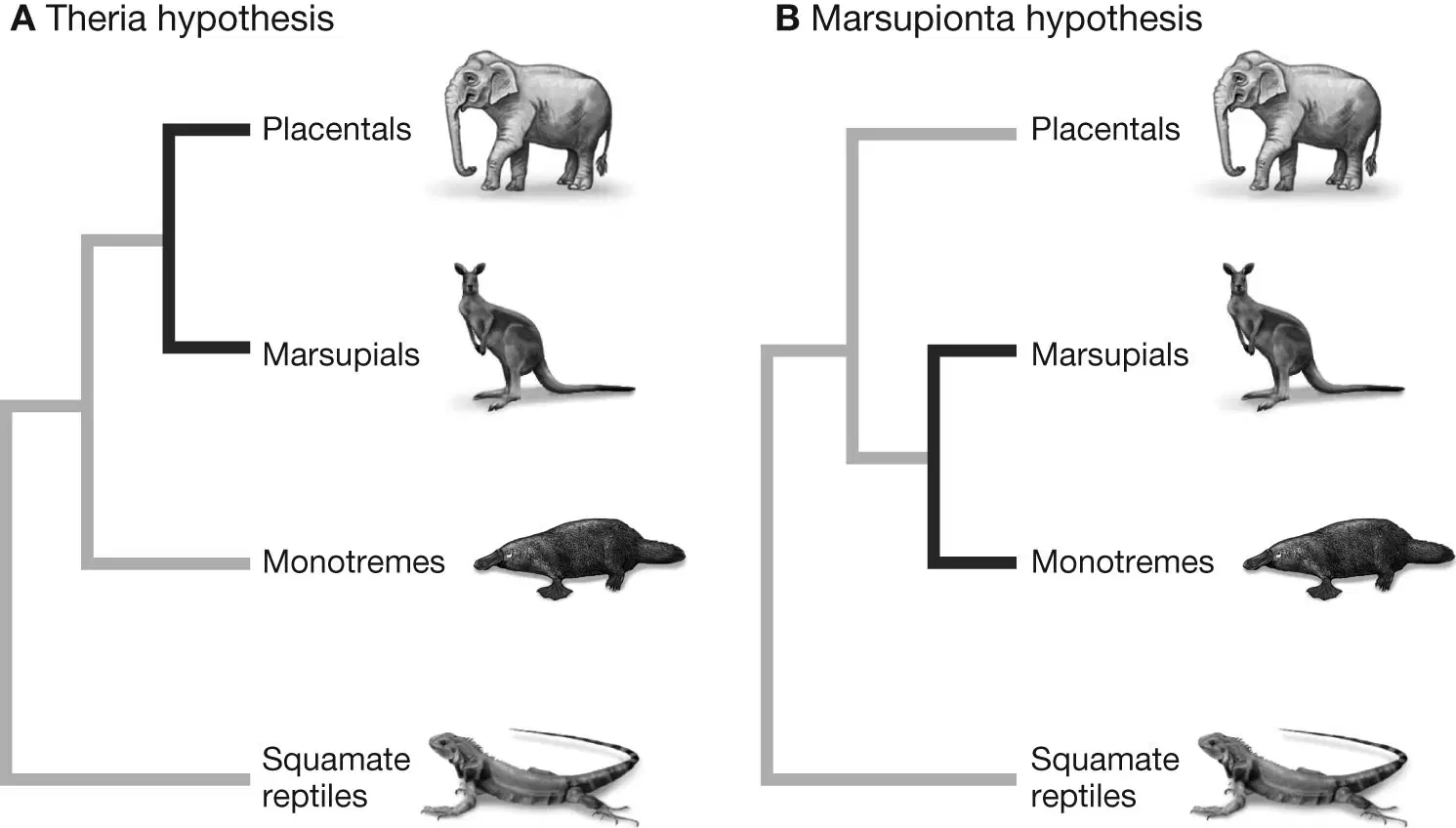
Based on the figure below, which of the following statements regarding the competing hypotheses is true?
The monotremes and marsupials are sister groups under the Theria hypothesis, and the placentals and marsupials are sister groups under the Marsupionta hypothesis.
The placentals and marsupials are sister groups under the Theria hypothesis, and the monotremes and marsupials are sister groups under the Marsupionta hypothesis.
The monotremes and marsupials do not form a sister group under either the Theria hypothesis or the Marsupionta hypothesis.
The monotremes and marsupials form a sister group under both the Theria hypothesis and the Marsupionta hypothesis.
A phylogenetic tree is best described as a(n)
mathematical model.
prediction.
hypothesis.
fact.

According to the phylogenetic tree shown, fungi are most closely related to which of the following?
plants
E. coli
animals
bacteria
The primary difference(s) between the processes of natural selection and artificial selection is/are
the mechanism for descent and modification is different.
that artificial selection focuses on nonheritable traits while natural selection focuses on heritable traits.
the selective agent and the period of time over which change occurs.
that artificial selection focuses on creating varieties while natural selection only produces species.
What was one of the ideas that separated Charles Darwin’s On the Origin of Species as a complete, scientific explanation for evolution when compared to all other previous attempts?
Darwin provided copious evidence that each species was completely unique.
Darwin recognized that species can occasionally spontaneously arise.
Darwin articulated a mechanistic explanation for the change in species over time and the match between organisms and the environment.
Darwin explained that each domain of living organisms has independent ancestry that diversified over much longer periods of time than previously recognized.
One constraint on what natural selection can achieve comes from the fact that it lacks foresight. This means that
traits that are beneficial in one environment are likely to be costly in another environment.
selection cannot adapt organisms perfectly to their surroundings because of physical constraints.
traits that increase the probability of higher fitness in the future are favored by selection.
selection favors changes that are immediately beneficial, not changes that may be useful sometime in the future.

According to this image, which two domains of life are most related?
Bacteria & Archaea
Archaea & Eukarya
Eukarya & Bacteria
What does phylogeny refer to?
The study of animal behavior in different environments.
The study of plant growth and development.
The evolutionary history and relationships among species.
The genetic manipulation of organisms in a laboratory.

