
 Worksheets
Chloe Test QnA 09162023
Total questions: 200
Worksheet time: 3hrs 55mins
Name
Class
Date
1.

A business analyst is developing a traceability matrix to determine whether or not any gaps exist and to identify any discrepancies.
Which critical field is needed to ensure that the traceability matrix is usable?
a)
Hierarchy
b)
Requirements description
c)
Status
d)
Owner
2.
A business analyst has been asked to investigate a problem. This investigation will provide input towards developing a business case. The business analyst wants to first understand the company’s current business processes.
Which technique should the business analyst use?
a)
MoSCoW
b)
RACI matrix
c)
Observation
d)
User stories
3.
The customer and the business analyst are collaborating in the development of a solution scope. It is important for the customer to:
a)
spend the time required to provide, clarify, and elaborate requirements
b)
communicate changes to requirements only when they are completely defined.
c)
perform an alternatives analysis for requirements implementation.
d)
challenge assessments of the cost and feasibility of requirements.
4.
A business analyst is leading a project to implement automated order entry software at a local pizza restaurant. The business analyst has very little information about the project: the ordering process takes too long and often ends in incorrect orders.
What step should the business analyst take next?
a)
Identify testing resources to support the implementation.
b)
Request information on the current ordering process and compare it with other companies.
c)
Select the software to implement and start working with the technical resources.
d)
Schedule a requirements gathering sessions with the manager of the ordering department.
5.
After a project was delivered, the business analyst learns of a project objective with no associated requirement. What would have helped determine this issue
before delivery?
a)
Context diagram
b)
Use cases
c)
Tracing requirements
d)
Process flow
6.
A business analyst is conducting a cost-benefit analysis of potential solution options. The stakeholders have indicated that the estimated growth rate is very important to them.
Which technique will allow the business analyst to determine this information?
a)
Net present value (NPV)
b)
Payback period
c)
Return on investment (ROI)
d)
Internal rate of return
7.
During user acceptance testing, a defect is logged by a user from a department that did not participate in the requirements analysis. To avoid this situation and minimize impact on the project, the user should have been:
a)
interviewed to understand how the user’s work would be impacted.
b)
involved in the development and sign-off of the business requirements.
c)
given the opportunity to review the user acceptance test scripts.
d)
identified as a stakeholder as part of the stakeholder analysis.
8.
A business analyst is reviewing a discrepancy report after a test session. The discrepancy report has revealed a defect that the business analyst must address.
Which of the following criteria should the business analyst use to identify the appropriate response to the defective test result?
a)
Perform an impact analysis and open a change request to include the revised requirement in the next baseline.
b)
Inspect the requirements traceability matrix to verify if the requirement is connected to a use case.
c)
Determine if the defect is in the solution developed, in the original requirement or in the test case.
d)
Verify that the corresponding requirement was appropriately signed off by the requesting stakeholder.
9.
During validation of a project solution, the business analyst discovers that a requirement has been altered. Instead of placing the company logo in the upper-left corner of the window, it is displayed in the upper-right corner. When the business
analyst asks the developer about the change, the developer says that one of the stakeholders asked directly for the change.
Which correct action should the business analyst take?
a)
Confront the stakeholder that requested the change
b)
Follow the change control process as defined in the business analysis plan.
c)
Discuss the change in the next stakeholder meeting.
d)
Ask the developer to correct the logo as stated in the requirement.
10.
A company is developing a new e-commerce platform to enter a new market segment. Development is well under way when the government issues a new set of regulations.
Which course of action should the business analyst take?
a)
Check the traceability matrix to identify affected use cases.
b)
Evaluate if the new set of regulations is aligned with the business case.
c)
Evaluate the impact of the change on the project schedule.
d)
Obtain management sign-off on the new set of regulations.
11.
Requirements elicitation for a project is occurring. The marketing, acquisition, and production departments want to include specific requirements. The CEO has a requirement to deploy in three months.
Which of the following actions will have a greater influence on the project success?
a)
Estimate the effort required for each requirement and develop as many functionalities as possible.
b)
Prioritize and develop the requirements of the marketing department since the project will impact a greater number of people.
c)
Conduct a stakeholder analysis and balance requirements by understanding the relative power associated with each stakeholder group.
d)
Explain the situation to the CEO and try to obtain an extension of the contract for the actual time necessary to develop the system.
12.
A stakeholder wants to modify an existing feature. Which of the following would be used to determine the scope of the change on the product?
a)
Sequence diagram
b)
Requirements traceability matrix
c)
Requirements attributes table
d)
Project schedule and cost baseline
13.
A company’s management team has decided to deploy a new product. However, there is concern that users may not accept a new product that forces them to change
existing practices.
The business analyst should:
a)
adhere to the project plan to achieve project objectives
b)
clearly communicate project objectives and attempt to defuse tensions.
c)
delay the application’s deployment until the conflicts have been resolved.
d)
voice user concerns to management and recommend that the project be closed.
14.
A business analyst is working with the project manager, company auditors, and project stakeholders to determine whether formal signoff should be required for the project. For which reason would the business analyst recommend formal signoff to the group?
a)
The organization follows an iterative project life cycle.
b)
The project impact is contained within a small department of the company.
c)
Errors in the product could result in financial solvency.
d)
The industry is unregulated.
15.
Through user acceptance testing, a software flaw was identified. What should the business analyst do next as part of the root cause analysis in order to analyze and resolve
the discrepancy?
a)
Create an interface analysis
b)
Create a Delphi estimation.
c)
Create a functional decomposition.
d)
Create a fishbone diagram.
16.
A national company with offices in every state in the country has deployed a solution to allow employees to view their health benefits online. The business analyst on the project team is validating solution results to assess whether or not the solution has achieved the desired business result.
Which is the best technique to gather information from employees regarding their satisfaction with the solution?
a)
Survey
b)
Organization modeling
c)
Focus groups
d)
Interface analysis
17.
A sponsor requests a new requirement. The business analyst explains that most of the information needed for this requirement does not exist and that the requirement cannot be implemented.The business analyst recommends deferring the requirement until the needed information is available and then adding it to a subsequent project. The sponsor agrees.
What should the business analyst do next?
a)
Mark the requirement as complete so that it is not forgotten.
b)
Ask the stakeholder to review the requirement before any other action is taken.
c)
Communicate that the status of this requirement has changed
d)
Bring the subsequent project to the change control board (CCB).
18.
What should a business analyst do after discovering that two solution
requirements conflict?
a)
Communicate the conflict to stakeholders and facilitate a resolution.
b)
Update the requirements baseline and upload it to the project repository.
c)
Perform an impact analysis and propose a lower-cost alternative,
d)
Consult the sponsor(s) and log the constraint.
19.
A business analyst is working on a project to implement a new call management system for a help desk. They expected the average time interval to answer a call to decrease over time, but the interval has increased instead.
Which technique should the business analyst use to investigate the problem?
a)
Observation
b)
Process modeling
c)
Root cause analysis
d)
Interviews
20.
In the middle of a project, a new requirement was added to the scope. The business analyst must determine if any impacts, dependencies, or risks are associated with the addition to the scope.
What task should the business analyst perform in order to identify these impacts?
a)
Manage requirements traceability
b)
Manage assumptions and constraints.
c)
Manage solution scope.
d)
Manage requirements prioritization.
21.
The business analyst wants to ensure that requirement changes can be formally tracked after the product is baselined. What will the business analyst need to evaluate the proposed change?
a)
Scope statement
b)
Impact analysis
c)
Requirements management plan
d)
Pareto analysis
22.
When a change request is received, the business analyst is responsible for:
a)
analyzing the impact on business and underlying systems
b)
prioritizing and scheduling the changes requested.
c)
ensuring that change-related incidents are minimized in production.
d)
analyzing the impact to the project schedule and budget.
23.
While preparing a business case, an experienced business analyst faces difficulty in deciding which of three different solution options to recommend. The senior vice president (SVP) who requested the business case favors an outsourced
solution; however, an analysis favors a custom-developed solution, either but internally or using contract labor.
To prepare the recommendation, what should the business analyst do?
a)
Perform solution evaluation.
b)
Recommend the SVP’s choice, as it is most likely to be adopted.
c)
Review the stakeholder analysis
d)
Formulate a weighted-ranking matrix.
24.
The software developers have delivered a completed solution. The quality assurance team has passed the solution. What should the business analyst do next?
a)
Evaluate the solution against the project charter.
b)
Conduct performance testing.
c)
Evaluate the solution with the sponsor(s)
d)
Conduct user acceptance testing.
25.
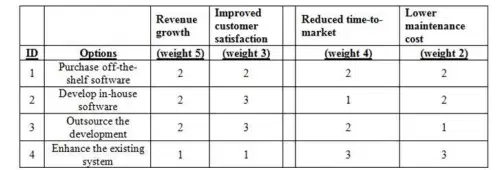
Which solution should be chosen according to the completed weighted-ranking matrix?
a)
Enhance the existing system.
b)
Purchase off-the-shelf software.
c)
Develop in-house software
d)
Outsource the development.
26.
The human resources, engineering, and marketing departments have provided feedback on the business needs for a new product. After analyzing the feedback from the three departments, it would be best to:
a)
collaborate on a product scope that aligns with the company’s objectives.
b)
vote on the product’s highest-value business needs.
c)
delegate the decision to be made by the product sponsor.
d)
negotiate to best meet each department’s objectives.
27.
A business analyst is assigned to the lead analyst role for a project. This project is one of the largest in the history of the company and includes several components and complex interfaces. The system in development will be used by a wide
variety of stakeholders.
Which tool should the business analyst use to trace the large number of requirements that will be generated by this project?
a)
Sequence diagram
b)
Configuration management system
c)
Process mode
d)
Data dictionary
28.
A firm implements SharePoint and the business analyst creates the requirements to develop a business analysis repository. In the requirements, the analyst describes a detailed workflow that includes appropriate stakeholders receiving email
notifications of certain activities. The SharePoint team needs to know which activities should trigger the notification workflow.
Which workflow trigger should the business analyst incorporate?
a)
Changes to test cases traced to requirements
b)
Change through project life cycle
c)
C. Any change to the requirements matrix
d)
Changes to stakeholder memberships
29.
Which of the following techniques contrasts the current and desired business views to analyze possible business changes?
a)
A. SWOT analysis
b)
B. Impact analysis SWOT analysis
c)
C. Gap analysis
d)
D. Trend analysis
30.
Midway through the requirements gathering phase, a stakeholder informs the business analyst that a requested requirement does not address the solution. The stakeholder wants to know who made the request. The business analyst spends
hours searching emails to identify the requestor.
What should the business analyst have documented?
a)
The source in the requirements traceability matrix
b)
The source in the RACI matrix
c)
Roles and responsibilities in the RACI matrix
d)
Sponsor approval in the requirements traceability matrix
31.
How can a SWOT analysis help when deciding between several possible options to address a business problem?
a)
It can help the project sponsor to determine the valuation of each option.
b)
It can help the stakeholders identify the strengths and weaknesses of each option.
c)
It can help the product owner to determine opportunity cost of not choosing an option.
d)
It can help the stakeholders to determine how to avoid the threats of each option.
32.
Two weeks prior to the delivery date, a customer changes the business requirements. What should the business analyst do?
a)
Deliver the existing product and then begin work on the requested changes.
b)
Ask the developers to implement the changes.
c)
Trace the requirements and measure the impact of the requested changes on the existing delivery date.
d)
Schedule a review by the change control board (CCB) to determine next steps.
33.
Which of the following can be used to determine if requirements align to the
product’s objectives?
a)
Activity network diagrams
b)
Five Whys
c)
Business use cases
d)
Context diagrams
34.
The business analyst is conducting a feasibility study to understand how well a potential solution fits into the organization. What kind of feasibility assessment is the business
analyst undertaking?
a)
Operational
b)
Time
c)
Technical
d)
Cost-effectiveness
35.
When determining the value of a business case, which tool or technique should be used?
a)
Feasibility analysis
b)
Variance analysis
c)
Cost-benefit analysis
d)
SWOT analysis
36.
A stakeholder has rejected a project’s deliverable because it does not meet the original business need is further determined that the deliverable does not meet the requirements identified in the baseline. What is the best approach to resolve this issue?
a)
Provide the stakeholder with a copy of the approved requirements baseline and move forward without making a change.
b)
Meet with the customer can apologize for misunderstanding the business’s need.
c)
Require development resources to work overtime to modify the deliverable to satisfy the stakeholder.
d)
Suggest re-estimating the requirement and following the change control process.
37.
A business analyst has been assigned to a project to implement a new phone system for a customer call center. The business analyst will need to create a business case.
Which of the following components will the business analyst use as input to the business case?
a)
Product scope
b)
Work breakdown structure
c)
Project timeline
d)
Project scope
38.
Which technique allows the collection of the maximum number of ideas on a subject from a group without considering the validity or practicality of the ideas?
a)
Prototyping
b)
Surveying
c)
Brainstorming
d)
Interviewing
39.
The business analyst receives multiple changes from different stakeholders during the requirements gathering phase of a project. How should the business analyst track the requirements throughout the lifecycle of the project to secure the
delivery of the expected solution?
a)
Record all the requirements in a matrix, review it regularly, and get approval from stakeholders.
b)
Perform inspections through the lifecycle of the project to detect any gaps and adjust the requirements baseline.
c)
Plan regular meetings with stakeholders to review the requirements baseline update and to discuss changes.
d)
Establish a risk traceability matrix and designate someone to manage each risk with the appropriate response.
40.
When a business analyst uses subject matter experts to define roles and identify influencers, which project artifact is created or updated?
a)
Stakeholder management plan
b)
RACI matrix
c)
Stakeholder register
d)
SWOT analysis
41.
Which of the following would be the best practice in
product validation?
a)
The evaluation criteria should be the same as what was used to measure the requirement.
b)
There should be two separate measurements for evaluating each functional requirement.
c)
The measurement of the requirement should be based on the average of two or more evaluations.
d)
Two or more testers should test the product using the same test cases so that their evaluations are consistent.
42.
An organization is evaluating the possibility of conducting business internationally. Which factors should be investigated at the onset of the initiative?
a)
Deliverables to be produced
b)
External dependencies
c)
Impacts on requirements baseline
d)
Change control processes
43.
Which technique or tool is used to obtain acceptance of the delivered product?
a)
Inspection
b)
Facilitated workshops
c)
Contextual inquiry
d)
Expert judgment
44.
Which of the following tools will help facilitate the decision-making process when stakeholders do not agree on the value of an initiative?
a)
Gap analysis
b)
Force-field analysis
c)
Feasibility analysis
d)
PEST analyst
45.
A major stakeholder wants to know how the implementation of new features in the development of a product is progressing. Which of the following should be reported to the stakeholder?
a)
Number of requirements tested and approved
b)
Distribution of project changes
c)
Requirements status during the project development cycle
d)
Number of requirements approved vs. number of requirements rejected
46.
The business analyst wishes to clarify the project’s key business drivers and ensure that requirements can be prioritized to provide maximum business value. Which question should the business analyst ask of stakeholders to help obtain this
clarification?
a)
How is the organizational chart structured?
b)
What is the business need?
c)
Which functional areas are impacted?
d)
Which stakeholders have the most influence?
47.
A business analyst captures an application’s current limitations and consults with end users to identify new features for the next version. What can be used to analyze this information and determine project scope?
a)
Root cause analysis
b)
Capability table
c)
As-is process
d)
Requirements traceability matrix
48.
A key component of the business analyst’s role during
acceptance testing is to:
a)
delegate execution of acceptance testing and defect identification to users.
b)
execute all acceptance tests on behalf of the user community.
c)
act as a resource only when users encounter difficulties while performing tests.
d)
assist the quality assurance department by defining acceptance criteria.
49.
A business analysis team has collected the main business requirements from the major stakeholders of a project. The team wants to be sure that each stakeholder has a clear understanding of the areas of analysis that will be in scope.
Which model should the team employ to ensure the most effective representation of analysis boundary?
a)
Context diagram
b)
Data flow diagram
c)
State diagram
d)
Entity relationship diagram
50.
The technology department identified a defect in the company’s software, which leads to an increase in human resource requirements to perform manual transactions as a workaround for tasks that should have been automateThe company
begins losing money, so it hires a business analyst to produce a business case that outlines the problem/opportunity, potential options, and a recommendation for how to proceed.
Which of the following analyses must the business analyst perform in order to complete the business case and arrive at a solid recommendation?
a)
SWOT
b)
Cost-benefit
c)
Risk
d)
Gap
51.
Company A would like to enter into a new market. The business analyst has been assigned to a project for which nobody in Company A has any prior experience. The project manager has asked the business analyst to assist in resource
planning.
What should the business analyst recommend to the project manager?
a)
Ask the sponsor for more resources.
b)
Review the business case to reconsider the project.
c)
Ask the developer’s team manager for more resources.
d)
Hire external subject matter experts for the core project team.
52.
A new project’s goal is to replace an existing system. What is an input into solution evaluation and decision making in this context?
a)
Cost-benefit analysis of the existing system
b)
New solution design specification
c)
Customer metrics on the existing system
d)
Technical readiness of the development team
53.
A project was in the design phase when the team received news of a new regulatory mandate that affects the project. The requirements have already been approved and baselineIf the new requirements are not included, the company will be out of compliance and may face monetary penalties.
What should the business analyst do next?
a)
Define the project scope
b)
Obtain approval from the project manager.
c)
Follow the change control process.
d)
Update the requirements
54.
The project manager is beginning to prepare for a test readiness review with the customer. The project manager knows that the customer will want a summary of requirements that have been rejected or deferreThe project manager has requested that the business analyst provide a list of rejected and deferred requirements.
What should the business analyst have done to complete this request?
a)
Limit the number of rejected requirements on the project.
b)
Set up a change control board to track the number of rejections.
c)
Track rejected requirements in the system requirements verification matrix.
d)
Spend more time up-front reviewing the requirements to limit rejections.
55.
The business analyst has worked with the stakeholders to capture their views of organizational improvement for the company. It would be best to align these with the:
a)
work breakdown structure.
b)
vision/scope document
c)
project charter.
d)
requirements traceability matrix.
56.
What should the business analyst do to ensure that all requirements meet a quality checklist before the development and testing phase?
a)
Negotiate with the client to standardize the requirements.
b)
Assign a verification method to each requirement.
c)
Validate the requirements deemed important by the stakeholders.
d)
Obtain approval from engineering for partial testing of the requirements.
57.
A company is in the final phases of implementing a project for a client. Which tool or technique could the business analyst use to iteratively validate the solution?
a)
Expected vs. actual results
b)
Expected vs. actual costs
c)
Schedule variance
d)
Quality variance
58.
The client produced a specification for a new product to be developed by Company Company A designed and successfully tested the new product against the test plan, yet the client does not agree that it meets the specification.
What could have caused this?
a)
The requirements matrix did not adequately track back to client requirements.
b)
The product design was not properly reviewed by the quality department.
c)
Requirement changes were not properly identified in the project charter.
d)
The product was not adequately tested in accordance with the test plan.
59.
A company is pleased with its delivered solution and reports that is has heard only minimal complaints for the first three months of use. How can the business analyst determine how well the solution meets the business case?
a)
Ask the sponsor for feedback.
b)
Survey the project.
c)
Conduct a user survey.
d)
Compare the results of day-in-the-life (DITL) testing and integration testing
60.
Once a new project has been identified, the business analyst works with project team members to define what will be included in and excluded from the new system. Which of the following has the business analyst defined?
a)
Business case
b)
Business requirements
c)
Solution design
d)
Solution scope
61.
Which of the following actions will contribute most to the success of the initial stage of the project?
a)
Interview stakeholders to clearly define the problem.
b)
Establish the change control process of the project.
c)
Define the acceptance criteria required during the acceptance phase.
d)
Document the requirements and obtain sign-off.
62.
A business analyst for Company A has been assigned to a three-year project to assist health insurance Company B with implementing and testing a new set of medical codes. The business analyst has identified many stakeholders who will participate in the project. For example, Company A will designate technical staff to write and code the requirements and provide a testing team to test the new functionality. The senior director of Company B will require weekly progress updates. The project manager from Company A will create project plans, schedule meetings, and provide meeting minutes.
In the scenario above, what is the role of the technical staff and testing team from Company A?
a)
Consult
b)
Responsible
c)
Accountable
d)
Inform
63.
Testing on a project has been completeIn order to proceed with deployment, a
decision is needed.
Who should the business analyst contact to review the testing results and get approval to proceed with deployment?
a)
The tester identified in the testing strategy
b)
The project manager identified in the project charter.
c)
The project sponsor identified in the scope document.
d)
The person identified in the RACI matrix.
64.
The business managers had clearly stated that the delivered website must simultaneously accommodate millions of users around the globe. However, within the first week of the production launch, the website crashes frequently.
This situation could have been averted if:
a)
critical business requirements were accommodated and tested.
b)
essential product requirements were captured and tested.
c)
quality attributes were captured and tested.
d)
nonfunctional requirements were identified and tested.
65.
The best way to ensure the integrity of requirements is to:
a)
implement version control, maintain a history of requirements changes, and track the status of each requirement
b)
establish a requirements baseline, establish a change control board, and label each requirement uniquely
c)
use a requirements management tool, measure requirements volatility, and maintain a history of requirements changes
d)
establish a change control board, track the status of each requirement, and use a requirements management tool.
66.
An insurance company embarks on a project to replace its current enrollment and billing software application, which will no longer be supported by the end of the calendar year. The new enrollment and billing application must be implemented before the current vendor contract ends. The business analyst gathers the initial requirements for the new enrollment and billing application. Based on the large volume of requirements, the business analyst realizes that the requirements will need to be prioritized. Which requirements prioritization method should the business analyst use for this project?
a)
Time-boxing
b)
Risk analysis
c)
Weighted ranking
d)
MoSCoW
67.
Projects have been managed well and completed on schedule and on budget. However, successful completion of the projects has not improved the company’s performance and profitability.
Which of the following should have been implemented to ensure that the projects would improve the company’s performance and profitability?
a)
A risk plan
b)
A strategies and goals analysis
c)
A project management plan
d)
A review with appropriate stakeholders
68.
During the initial phase of a project, which technique could assist in identifying and categorizing the stakeholders?
a)
Organization modeling
b)
Power/interest grid
c)
Business activity model
d)
RACI matrix
69.
A business analyst anticipates receiving requirements changes. What should the business analyst do to avoid scope creep?
a)
Meet with the stakeholder and discuss timeline impact.
b)
Define a requirements baseline and implement a change control process.
c)
Implement only the original requirements.
d)
Refer changes to the project manager.
70.
Which statement accurately depicts what changes can be made to requirements after they are baselined?
a)
Requirements can be changed through a defined process.
b)
Requirements cannot be changed once development begins.
c)
Requirements cannot be changed once user acceptance testing begins.
d)
Requirements can be changed only with sponsor approval.
71.
When faced with a tight timeline, the project sponsor suggests that the project team start development without creating traceability artifacts. What should the business analyst do?
a)
Negotiate for a quick approval of a reduced set of traceability artifacts.
b)
Explain the value of requirements traceability.
c)
Eliminate traceability activities for the project.
d)
Start development activities without traceability items.
72.
A business analyst assigned to review test output for a project realizes that an approved requirement has been misseWhich technique could the business analyst have used to ensure that requirements were
delivered as stated?
a)
Use cased
b)
Requirements management plan
c)
Traceability matrix
d)
Work breakdown structure
73.
After implementation of the product, the customer reports defects. What is the best course of action to take?
a)
Escalate the issue to the project manager since the acceptance was given by the customer.
b)
Do nothing since the solution is now the responsibility of the operations manager.
c)
Compare reported defects with user acceptance test results.
d)
Involve the end users and plan a new round of acceptance tests to check the gaps.
74.
A company has just finished the development work for a new software sales tracking application and is in the process of validating that the new application meets all of the acceptance criteria defined for the business requirements. During the
validation process, a stakeholder discovers that the application does not provide the selection criteria needed to produce the sales volume reporting required by the company’s financial department. The business analyst for the project
determines that the selection criteria needed was not specified in the system requirements or design specifications.
Which of the following tools and/or techniques might be used by the business analyst to determine how the selection criteria requirement was missed?
a)
Root cause analysis, fishbone diagram, and/or the Five Whys
b)
Scope modeling, Ishikawa diagram, and/or the Five Whys
c)
Root cause analysis, problem tracking, and/or benchmarking
d)
Cause and effect diagram, brainstorming, and/or the Five Whys
75.
A major stakeholder of a project is surprised to learn that a particular requirement was not implemented during the latest launch. The business analyst tells the stakeholder that the requirement status was changed to “deferred”.
What could have prevented the stakeholder from being surprised about the status change?
a)
The status should have been reviewed prior to project launch.
b)
The status should have been communicated to all project stakeholders.
c)
The status should have been updated in the traceability matrix.
d)
The status should have been communicated to the requirement’s source.
76.
Last year, a company registered a high number of complaints about its customer service. Which of the following tools or techniques can help to identify the high-priority changes needed to
improve that service?
a)
A work breakdown structure analysis of the service
b)
A cause-and-effect diagram
c)
A Pareto analysis
d)
A flowchart of the service
77.
The project sponsor needs to know which requirements will be implemented. Which of the following would be the most valuable for a business analyst to provide?
a)
Requirements baseline document
b)
Requirements management plan
c)
Requirements impact analysis
d)
Requirements traceability matrix
78.
A business analyst has received a test result report that shows evidence of defective functionality. The business analyst checks the test result again and verifies that the functionality behaves according to the
requirements.
At this point, the business analyst should first:
a)
let the users decide if the test result is acceptable.
b)
change the requirement according to the test result.
c)
verify that the test case is incorrect.
d)
ask the tester to perform the test again.
79.
A project that was ongoing well for the last few months has encountered a situation-regulatory authorities have deemed that the project does not meet their requirements. Although regulatory requirements were identified during an earlier
phase of the project, there is no substantial evidence to prove that the requirements were formally rejected.
This could have been avoided if:
a)
the customer met with regulatory authorities to verify that their requirements were also considered.
b)
a change control process for requirements and their statuses was followed.
c)
the project manager circulated the meeting minutes after the discussions with all the attendees.
d)
the project team documented customer requests and obtained sign-off.
80.
Company A has initiated a project to update their online ordering system. The business analyst has noticed that the purchasing department, a primary stakeholder, is excluded from the list of stakeholders.
In which reference material can the business analyst find information about the missing project stakeholders?
a)
Business analyst communication plan
b)
Business case
c)
Organizational chart
d)
Business analysis plan
81.
A startup company sells organic vegetable and fruit smoothies. Management is tracking a rapid decrease in sales of their best-selling juice, so they contract a business analyst to identify solutions in order to increase sales by comparing similar
products offered by competitors.
Which technique or tool should be used?
a)
Trend analysis
b)
Benchmarking
c)
Competitive analysis
d)
Focus group
82.
How should a business analyst determine whether a solution satisfies
business requirements?
a)
By conducting a brainstorming session with end users
b)
By evaluating the solution against the project charter
c)
By reviewing the results of user acceptance testing
d)
By reviewing the traceability matrix
83.
A new product was designed and delivered to the customer. The product exceeded customer expectations but did not meet the baseline budget for the product. What could be the issue?
a)
Risks identified in the risk management plan were not addressed properly.
b)
Requirements were not properly traced and monitored.
c)
There is no issue since the product exceeded the customer expectations.
d)
The sponsor approved the release of the product without reviewing the budget.
84.
A project team delivers a solution based on the approved requirements and is confident that it meets the defined acceptance criteriWhat should the business analyst do to
obtain signoff?
a)
Contact the sponsor
b)
No signoff is necessary
c)
Refer to the RACI matrix to identify who is responsible for signoff.
d)
Contact the stakeholder who provided the majority of requirements in the traceability matrix.
85.
Which function involves auditing both the quality requirements to resolve discrepancies and the results of quality control measurements to ensure that appropriate quality standards and operational definitions
are being used?
a)
Quality management
b)
Quality assurance
c)
Quality assessment
d)
Quality control
86.
What should the business analyst do during the first
steps of a project?
a)
Align the sponsor expectations along the project goals.
b)
Identify stakeholders and their interests.
c)
Identify the classes of users and their requirements.
d)
Evaluate the sources for requirements and prioritize them.
87.
A new business analyst has taken over on a project that is in the development phase. The project manager is looking for an update on requirements status.
What should the business analyst use to help communicate the status?
a)
Business analysis plan
b)
Traceability matrix
c)
Project charter
d)
Communication plan
88.
The project team has all the document control process and versioning in place to capture the requirements changes. The team ensures that the change is documented in the scope document, resulting in the changed work breakdown structure
(WBS) and schedule. However, a key requirement was not implemented in the release.
Which is a possible reason why the requirement was not implemented?
a)
The requirements management plan was not updated with the change.
b)
The requirements traceability matrix was not updated with the change.
c)
The scope management plan was not updated with the change.
d)
The schedule management plan was not updated with the change.
89.
In order to reduce product and project risk for a large, complex project, a business analyst is asked to help develop a change process that includes formal authorization and tracking throughout the life cycle of the project. The business analyst
needs a capability that will help ensure that the product conforms to approved requirements, changes can be documented, and the status of each change can be reported.
What should the business analyst use?
a)
Context models
b)
Work breakdown structure
c)
Configuration management system
d)
Traceability matrix
90.
A few months into a project, the business analyst determines that the costs are exceeding the perceived benefits. The business analyst wants to address the possible risks of having to
cancel the product.
Which of the following documents should be used?
a)
Stakeholder impact matrix
b)
Project charter
c)
Business analysis plan
d)
Business case
91.
During a requirements workshop, sponsors and managers from different departments express varying points of view and priorities about the product’s functions and requirements. The business analyst struggles with facilitating the group to
reach an agreement.
What should the business analyst have defined to avoid this?
a)
Decision-making process in the business analysis plan
b)
Decision-making process in the project management plan
c)
Communications approach in the business analysis plan
d)
Communications approach in the project management plan
92.
A business analyst is discussing the acceptance criteria for a new measurement system with the operations manager. The operations manager is particularly concerned about the accuracy of the new system because mistakes in data
measurements could be extremely costly to fix.
Which of the following is the best strategy to define the appropriate acceptance criteria?
a)
Quantify the risks associated with the measurement errors and update the risk register.
b)
Clearly define the maximum acceptable error rate for the new system.
c)
Ask the operations manager to formally accept the requirements documents.
d)
Plan a training session for the new system before it is handed over to the operations manager.
93.
The requirements baseline is ready for sign-off when the
requirements are:
a)
justified, clear, consistent, and verified.
b)
consistent, analyzed, complete, and validated.
c)
complete, clear, verified, and adopted.
d)
clear, consistent, complete, and validated.
94.
A business analyst has incorporated all the relevant feedback from stakeholders in the business analysis plan.
Which next step should the business analyst take?
a)
Start documenting requirements
b)
Start implementing the project.
c)
Store the document for safe keeping.
d)
Obtain approval on the plan.
95.
A financial company deployed a new online product to their customers to invest in the stock market. The company notices a problem regarding financial calculations and starts the problem analysis. The company discovers that the new rules
for taxes and fees were not implemented.
This problem could have been avoided by:
a)
involving a business analyst during all phases of system development.
b)
implementing an automated issue tracking system to facilitate the tracing of defects to the requirements.
c)
using a table that shows each applicable business rule with the implemented functional requirement.
d)
rolling back the operations using a contingency process in order to avoid loss and client dissatisfaction.
96.
A business analyst has been assigned to ProjectY. After a requirements gathering session, the project manager asks the business analyst to identify which requirements would be considered in scope and out of scope, based on the business
need.
What document should the business analyst use to determine the relationship of the requirement to the business need?
a)
Traceability matrix
b)
Requirements package
c)
Reliability matrix
d)
Requirements management plan
97.
A business analyst is planning the business analysis activities for a new payroll project. Due to a tight timeline, the analyst advises stakeholders that the requirements sessions should begin as soon as possible.
Which key factor drives the selection of business analyst activities to be included in the project?
a)
Project life cycle
b)
Payback period
c)
Communication plan
d)
Return on investment (ROI)
98.
Several interviews with stakeholders to develop an inventory management system in a new architectural environment have revealed a significant concern about system and architectural stability. In which tool should the business analyst
include this attribute to ensure that the requirement meets the acceptance criteria?
a)
Traceability matrix
b)
Interface analysis
c)
Stakeholder satisfaction survey
d)
Process modeling
99.
What should be done to ensure that the product design meets the
stated requirements?
a)
Review lessons learned results.
b)
Conduct multiple internal design reviews.
c)
Engage an experienced development team.
d)
Use a traceability matrix.
100.
The business analysts have concluded a requirements elicitation workshop. They now need to define rationale for each requirement.
Which of the following pairs of items would be important to include in the rationale?
a)
Reasons and assumptions
b)
Functional relationships and work breakdown structure code
c)
Product vision and operational relationships
d)
Stakeholder impact and design decisions
101.
A business analyst has captured all of the requirements from the various stakeholders within the organization and has compiled them into a complete list. After reviewing the list of requirements with the stakeholders, it is determined that the list of requirements is too large and will exceed the allotted budget. Which tool or technique should the business analyst use with the stakeholders to prioritize the requirements to determine which requirements are approved, deferred, or rejected?
a)
SMART Goals
b)
MoSCoW Analysis
c)
SWOT Analysis
d)
Timeboxing Analysis
102.
Once the requirements are compared to internal and external quality standards, what should the business analyst do next?
a)
Baseline the requirements.
b)
Set the priority of the requirements.
c)
Communicate the requirements to stakeholders.
d)
Ensure that the requirements are validated.
103.
Which tool provides combined functionality for business analysis and quality
assurance activities?
a)
Functional specification tool
b)
Solution quality assurance tool
c)
System use case modeling tool
d)
Requirements traceability tool
104.
Company A is working on implementing a new platform with multiple stakeholders. The business analyst has gathered the requirements and established a baseline. However, scope creep is a persistent problem.
What could the business analyst have established to help manage this situation?
a)
Configuration management system
b)
Sponsor signoff
c)
Change control process
d)
Communication plan
105.
Which of the following is the best approach to enable developers and product owners to be in constant communication so that changes or issues that occur during development are exposed and discussed as they develop?
a)
Iterative
b)
Waterfall
c)
Agile
d)
Linear
106.
A company is awarded a contract to design and build a custom product. The contract references a detailed technical specification. What is the best action to take to ensure the design meets customer requirements?
a)
Develop a test plan to verify that the product meets the performance requirements in the technical specification.
b)
Generate a design package for the product and ask the customer to verify that the design meets his or her technical needs.
c)
Create a system requirements verification matrix to trace the design to the technical requirements and include verification methods.
d)
Conduct a one-on-one interview with each member of the technical team to ensure that they understand the customer’s specification.
107.
A business analyst is trying to determine which analysis technique will be best suited to elicit information from a large number of users in a short period of time. Which elicitation technique is best suited for this purpose?
a)
Group brainstorming
b)
Facilitated workshop
c)
Ongoing observation
d)
Questionnaire
108.
A type of requirements document that would be the most valuable to a database administrator would be:
a)
an object diagram.
b)
an entity relationship diagram.
c)
a business process diagram.
d)
a data flow diagram.
109.
Which of the following is an example of a functional requirement?
a)
The system can be accessed from multiple locations.
b)
The system can handle 3,000 user requests concurrently.
c)
The system provides a user-friendly interface.
d)
The system is able to require passwords.
110.
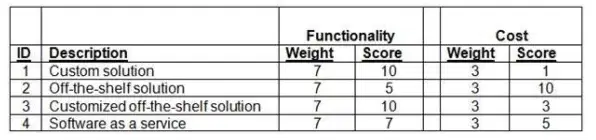
A company uses a prioritization range of 1–10, in which 10 represents the highest or best. According to the information from the table, which option should the business analyst recommend?
a)
3
b)
4
c)
2
d)
1
111.
Which of the following is a properly written requirement statement?
a)
The pot shall be usable in the oven or on the stove.
b)
The pot shall prominently display the company brand.
c)
The pot shall be manufactured in the following colors; yellow, red, brown, blue.
d)
The pot shall be lightweight and heat up quickly.
112.
A company is working on the next big release of their best-selling product. The requirements will be validated through in-person validation sessions.
What would be the most viable technique to use in this scenario?
a)
A use-case development session
b)
A review of the previous version
c)
A review of the solution prototype
d)
A brainstorming session
113.
A company wants to improve the service to its customers by reducing complaint response time by 40%. To achieve this goal, it is necessary to redesign and optimize their internal processes and support it with a new product. The client thinks that disruption and short-term loss of productivity is inevitable. Where can the business analyst best reflect the intangible costs associated with this change?
a)
In the requirements specification document
b)
In the balanced score card chart
c)
In the pay-back analysis
d)
In the business case
114.
The document that defines the process for managing requirements
revisions is the:
a)
project management plan.
b)
communications management plan.
c)
scope management plan.
d)
change management plan.
115.
Company A has set aside capital to invest an upgrade to their scheduling system. Documentation of the current structure was presented to the business analyst. However, the descriptions of certain steps are not documented clearly, and the business analyst has not been allowed to inspect the existing system. During elicitation, the business analyst asked questions of the schedulers as they performed functions in order to gain an understanding of the process.
Which type of elicitation technique did the business analyst use in this instance?
a)
Interview
b)
Active observation
c)
Simulation
d)
Participatory observation
116.
Which of the following best describes the function of the
requirements baseline?
a)
Tracks the progress of requirements documentation.
b)
Defines how the project will be scheduled.
c)
Provides the basis for the development scope.
d)
Controls the product development and evolution.
117.
How can a business analyst show progressive iterations of product development to stakeholders after the requirements baseline has been approved?
a)
Review performance data with the project sponsor.
b)
Conduct requirement walkthrough sessions.
c)
Create prototype proof-of-concept models.
d)
Talk to distinct testing groups to check testing status.
118.
What is a standardized, effective, and efficient way to manage changes to project documentation?
a)
A change control board
b)
A requirements traceability matrix
c)
A configuration management system
d)
A configuration verification and audit system
119.
During the project execution phase, the client requests the addition of a new feature. Which of the following would allow the business analyst to determine the impact for the specific requirement change?
a)
Requirements management tool
b)
Requirements traceability matrix
c)
Requirements cards
d)
Requirements baseline
120.
Which of the following is a method for requirements change control?
a)
Baselining
b)
Scope analysis
c)
Communication management
d)
Requirements management
121.
After several meetings with different groups of users, a business analyst has gathered the requirements for a large IT project. Now, the business analyst needs to document those requirements in a way that is clearly understood by the development team and provides enough information to check if the requirement has been met. Which of the following would work best in this case?
a)
Prototyping
b)
Flow chart
c)
User stories
d)
Functional specifications
122.
After conducting a brainstorming session with a group of project participants, the business analyst feels that the elicited requirements are biase. Which tool or technique could be used to gain an objective, first-handed insight into tasks and activities that are difficult to describe?
a)
Observation
b)
Document analysis
c)
Traceability matrix
d)
Questionnaires and surveys
123.
A system enhancement project has been initiated to address the concerns of an external group of stakeholders not included in the first release. What should be done to ensure stakeholder satisfaction with the enhancement?
a)
Provide all sign-off project documentation to the stakeholders for information purposes only.
b)
Solicit feedback and add requirements to the project backlog.
c)
Request that the project manager identify all affected project stakeholders.
d)
Engage all stakeholders early in the requirements gathering phase to define acceptance criteria.
124.
The quality function deployment is best suited to assist
in the process of:
a)
quality assurance by structuring the quality audits.
b)
relating the product features to customer value.
c)
quality control by determining the control charts and the run charts.
d)
controlling the effects between the quality functions.
125.
A business analyst is working on a project’s acceptance criteriIn an early collaboration with the company’s stakeholders, the business analyst identified several user groups within the company: “Purchaser,” “Shipper,” “Customer,” and “Agent”. The user groups categorize stakeholders with similar needs and create a detailed narrative.
Which technique did the business analyst use for evaluating the solution’s acceptance criteria?
a)
Job analysis
b)
Stakeholder analysis
c)
Persona analysis
d)
Risk analysis
126.
The test team is reviewing requirements that were written for Project They are having difficulty determining if the test results meet the project needs.
Which project artifact could the test team review to help identify acceptance criteria?
a)
Use cases
b)
Project scope
c)
Delphi outcome
d)
RACI chart
127.
A new project is in the planning phase. What should the business analyst consider with regard to planning the requirements change process?
a)
How requirement changes will impact the validation plan
b)
How requirement changes will be implemented
c)
How requirement changes will impact the requirements baseline
d)
How requirement changes will be communicated
128.
The business analyst has been assigned to a project involving a low number of stakeholders. Which technique should be used to elicit requirements?
a)
Interface analysis
b)
Document analysis
c)
Survey
d)
Interview
129.
The project team is working on the requirements specifications for a new product. The team reached a decision on which requirements will be included in the next release. A third of the stakeholders endorse one approach while no other approach achieved more than a quarter of the vote. Which decision role was used?
a)
Majority
b)
Unanimity
c)
Plurality
d)
Consensus
130.
After analyzing a set of requirements documents, it is determined that the requirements are not yet ready for peer review. This was most likely caused by:
a)
some requirements having not yet been discussed in a work group session.
b)
the requirements documents having not yet received sign-off from the sponsor.
c)
the requirements not providing all of the information needed to define the work.
d)
the requirements’ reference codes not tracing to the attribute numbers in the work breakdown structure.
131.
A business analyst is assigned to a business process re-engineering project. In addition to planning a workshop to elicit requirements, the business analyst wants to send out a survey to gather data to use in a statistical analysis on user satisfaction with the current business process.
Which of the following types of surveys would be most appropriate to create and why?
a)
An open-ended survey to allow users the opportunity to explain their opinions on the current business process
b)
A closed-ended survey to pose several multiple choice questions and ask the users if the current business process is correct
c)
A closed-ended survey using the Likert scale to rank specific areas of the current business process
d)
An open-ended survey to collect different opinions on the current business process
132.
The business analyst is in the process of implementing a solution for a customer. The team is having difficulty confirming if certain requirements have been met.
What could have caused this issue?
a)
Not all stakeholders were involved during requirements elicitation.
b)
The test engineer has not properly communicated requirements to the team.
c)
Requirements were not adequately reviewed with the project sponsor.
d)
Acceptance criteria for the requirements were not measurable.
133.
Which of the following techniques is used to identify ambiguous or
unverifiable requirements?
a)
Traceability matrix
b)
Resource checklist
c)
Fishbone analysis
d)
Team peer review
134.
Company A has been awarded a contract to finalize the development of a product that Company B was not able to finish. The business analyst is given a copy of the documentation left by Company B. To which of the following documents should the business analyst pay the most attention to ensure the project succeeds this time?
a)
Application design documentation
b)
Business use cases
c)
Test case documentation
d)
Clauses in the contract
135.
When managing a product backlog, which statement best describes how to determine the value of backlog items?
a)
The stakeholders provide recommendations with the product owner having the final say.
b)
The stakeholders follow the value-ranking criteria.
c)
The stakeholders provide input about backlog value when the item is first identified.
d)
The stakeholders do not typically play a major role.
136.
A business analyst created requirements for production of a product extract file for several systems. After reviewing the complex systems and dividing the processes into manageable tasks, the business analyst is able to identify the tasks required to implement the deliverable.
Which analysis technique has the business analyst used?
a)
Organization
b)
Decomposition
c)
Interface
d)
Dependency
137.
Which tool can be used to analyze how the system responds to various combinations of input conditions with the probability of each outcome?
a)
Weighted criteria
b)
Functional decomposition
c)
Decision tree
d)
Expected monetary value
138.
A project team has been assembled to streamline accounts payable processes in all divisions of the company. As part of the planning activities, the business analyst is working to identify stakeholders.
Which of the following techniques would the business analyst use to identify stakeholders?
a)
Prototyping
b)
State diagram
c)
Estimation
d)
Brainstorming
139.
A company is developing a new risk management system. The company expects the system to evolve in the near future due to changing government regulations.
Which approach will better cope with the requirements’ volatility?
a)
Multivoting
b)
Phased baselining
c)
Comparative analysis
d)
Storyboarding
140.
A business analyst has been assigned to a project that will design and build two new bridges and, at the same time, redesign a failing bridge for a local structural engineering company. All three bridges must be constructed and meet all safety requirements before flood season next spring.
How would the business analyst define the scope of this project?
a)
Perform a work breakdown structure.
b)
Perform a feasibility study.
c)
Perform a structured walkthrough.
d)
Perform process modeling.
141.
A stakeholder requests to add new critical requirements the day before the scheduled baseline requirements approval meeting. The stakeholder insists that these requirements must be taken into account despite time and budget constraints.
What is the most effective way to manage this situation?
a)
Postpone the baseline approval meeting, analyze the impact, and schedule a new meeting to discuss dependencies and priorities with stakeholders.
b)
Share the new requirements with all stakeholders and ask them to submit their comments before the meeting.
c)
Ask for more resources to manage this change and justify these additional resources with the value the change will give to the company.
d)
Discuss the change with stakeholders during the baseline approval meeting and ask them to approve the new baseline.
142.
The following requirement was included in a business requirements document: “An API shall be built to send data back and forth from the accounting system to the customer relationship system so that name and address data can be synchronized.” What should be done with this business requirement?
a)
It should remain because it specifies the reason why the business requirement is needed.
b)
It should be revised because it states a solution to the problem rather than the business need.
c)
It should be removed because it does not state how often the data should be synchronized.
d)
It should remain because it specifies the type of data and the source system.
143.
What is one benefit of documenting the change control process?
a)
Stakeholders understand the difficulty of managing requirements.
b)
Stakeholders know how to request changes.
c)
Stakeholders have a schedule of changes to be deployed.
d)
Stakeholders are shielded from how changes are assessed.
144.
A business analyst is working on a system enhancement project and has completed the requirements according to the requirements management plan. The business analyst is now ready to request approval from the stakeholders.
How should the business analyst obtain approval?
a)
Provide a defect tracking log for review.
b)
Conduct a formal or informal review of the requirements.
c)
Send an email requesting approval of requirements.
d)
Create and maintain an audit history log of changes to requirements.
145.
A project affects the marketing unit and procurement unit. The project manager gives the business analyst an overview of the project for the first time.
What should the business analyst do immediately after the discussion?
a)
Schedule time with the process owners.
b)
Develop an issues log.
c)
Put the information into a project plan.
d)
Assess the risks for the project.
146.
The business analyst generated a design specification for a new product. What is the best type of formal review to conduct with the customer to establish an approved
requirements baseline?
a)
Critical design review
b)
Production readiness review
c)
System requirements review
d)
Test readiness review
147.
A business analyst is working on a highly complex project and has elicited a large number of requirements from stakeholders in several departments. Due to the large number of requirements, the stakeholders have determined that they would like to prioritize them to minimize a potentially large scope.
Which technique could the business analyst use to manage requirements?
a)
Storyboarding
b)
RACI models
c)
SMART goals
d)
MoSCoW
148.
One of the main purposes for creating a requirements traceability matrix is to:
a)
track how requirements can be connected to the solution.
b)
provide test cases to validate solution deliverables.
c)
document stakeholder approval of project requirements.
d)
track the project solution scope.
149.
A business analyst and stakeholders have completed documentation of the acceptance criteria for the requirements of a new vehicle leasing database. A concern is raised that some of the key performance indicators may not validate the desired benefits of the implementation.
What should the business analyst do to ensure that the business need can be validated?
a)
Document a constraint
b)
Document a defect
c)
Document an assumption
d)
Document a business rule
150.
A business analyst is ready to begin requirements elicitation; however, stakeholders are not available to participate for another two weeks. Which elicitation technique should the business analyst use during this time?
a)
Brainstorming
b)
Benchmarking
c)
Document analysis
d)
Cost-benefit analysis
151.
To reduce the amount of time and effort needed to create a product specification for a project; the business analyst plans to reuse:
a)
risk assessments.
b)
qualitative analysis.
c)
quantitative analysis.
d)
requirements.
152.
Which document best provides the boundaries for product development?
a)
Scope document
b)
Project plan
c)
Scope definition
d)
Requirements baseline
153.
A business analyst in organization Y is assigned to elicit requirements in a project within a defined timeline. The business analyst has identified and invited key stakeholders to a requirements workshop. However, the stakeholders are not giving clear and concise requirements; their opinions about requirements are changing and conflicting with each other in the meeting. In the end, the business analyst could not elicit and define the requirements and therefore adjourned the
meeting.
Which tool or technique could have been used by business analyst to avoid this situation?
a)
Prototyping
b)
Document analysis
c)
Decision tree
d)
Surveys
154.
A business analyst from Company A has been assigned a project to document and identify requirements for a new commercial software implementation. The first step is to break down the business analysis deliverables into activities and tasks. Then, the business analyst will add an estimate of the time needed to complete the work.
Which type of estimation technique is the business analyst using?
a)
Analogous
b)
Bottom-up
c)
Delphi
d)
Parametric
155.
The project team is working on test scripts to test a solution. Which source can be used for building tests of end-to-end business processes across business functions and systems?
a)
Feature model
b)
Use case
c)
Prototype model
d)
Context diagram
156.
A business analyst has elicited, documented, and verified the requirements, discovering that there are not enough resources to deliver all the requirements. Which technique should the business analyst employ to rectify the issue?
a)
Hold a brainstorming workshop to build the rationale for the requirements.
b)
Perform traceability to find out where the requirements originated.
c)
Survey stakeholders on their likes and dislikes about the requirements.
d)
Ask stakeholders to vote on the requirements.
157.
A project’s requirements baseline is established and approved. A stakeholder then submits a new requirement through the change control process.
How can the business analyst determine the impact on existing requirements?
a)
Use time-boxing to defer the new requirement.
b)
Review the requirements traceability matrix.
c)
Update the use case documentation.
d)
Perform a stakeholder analysis
158.
Which tool should be used to improve the communication of product needs with the stakeholders and to improve their understanding?
a)
Requirements management tool that documents requirements and their properties and relationships.
b)
Workflow management tool that documents the flow of information
c)
Document management system and a relationship matrix that groups all related documents
d)
Modeling tool integrated into a version control feature that ensures that team knowledge is captured
159.
The sales team of a company has won a time-and-material project. The business analyst discovers that the sales team has underestimated the required budget and schedule.
Which course of action should the business analyst take?
a)
Accept the contract, and deliver only the requirements that fit within the budget and schedule
b)
Develop a requirements baseline document and use it to negotiate the scope in the contract.
c)
Refrain from working on the project and request that the customer cancel the contract.
d)
Accept the contract, and then notify the customer about the potential for a cost overrun.
160.
A business analyst is trying to complete the requirement documentation of a project and finds that the developers have started development. The business analyst should
first facilitate the:
a)
requirements acceptance with the customer.
b)
requirements gathering workshops with the stakeholders.
c)
requirements validation with the testers.
d)
requirements sign-off with the customer.
161.
Prior to the design phase, the project team needs to conduct a requirements review with the customer. To prepare for the review, it would be best for the team to:
a)
prepare a test procedure for the product to discuss at the requirements review.
b)
start designing the product to impress the customer with the amount of progress achieved early in the project.
c)
evaluate the requirements and highlight those that cannot be met or need to be deferred.
d)
request a contract amendment to delete any requirements from the contract that will be difficult to meet.
162.
A company wants to procure a tool to improve customer satisfaction and loyalty. Which of the following documents would provide basis for analyzing vendor products?
a)
Business case
b)
Project charter
c)
Survey
d)
Storyboard
163.
A company has completed a major project within time, cost, and scope and satisfied high-level quality standards and marketing requests. However, the product was considered a complete failure by shareholders and the market due to low return on investment.
From the business analysis perspective, the main reason for this business failure was a failure to:
a)
establish measurable success criteria in the business case.
b)
gather the appropriate usability requirements.
c)
set the product positioning.
d)
review and evaluate market expectations.
164.
When eliciting requirements, a good time to consider using the interviewing method is when:
a)
attempting to obtain sign-off on requirements form stakeholders.
b)
there are communication challenges among stakeholders.
c)
assembling a requirements traceability matrix.
d)
there is not enough time to gather requirements from many different sources.
165.
A business analyst is attempting to elicit requirements on a current project. The business subject matter experts (SMEs) from various departments in the company question how the solution will work with their various systems.
Which modeling technique should the business analyst use to depict how the solution will work with all of the company’s systems?
a)
Rules modeling
b)
Enterprise modeling
c)
Interface modeling
d)
Data modeling
166.
The business analyst has been assigned to a project which delivers functionality for a much larger solution. The project has many requirements but has not received adequate funding. In addition, the stakeholders’ views conflict.
Which tools and techniques should the business analyst use to maximize business value while establishing the requirements baseline?
a)
Decision trees, weighted matrix, and context diagrams.
b)
Traceability matrix, context diagrams, and scope document.
c)
Weighted matrix, process flow, and organizational chart
d)
Stakeholder register, decision tree, and capability matrix
167.
When modeling processes or analyzing tasks, business rules can be uncovered by asking about:
a)
work that may be performed out of sequence.
b)
reasons for choosing a particular course of action.
c)
tasks that overlap with each other.
d)
task transitions that hinder organizational performance.
168.
The customer generated a design specification for a new product. What is the best action to take to establish an approved requirements baseline with the customer?
a)
Create a requirements traceability matrix for review and approval by the customer.
b)
Create a requirements baseline approval form for the customer to review and approve.
c)
Request that the customer create a baseline of the requirements in the contract specification.
d)
Perform a variance analysis on the design specification and report the results to the customer.
169.
What can a business analyst use to track requirements documentation?
a)
Business rules matrix
b)
Version control system
c)
Data dictionary
d)
Affinity diagram
170.
Which tool is the most appropriate to aid in development of measurable and actionable requirements for a new project?
a)
Entity relationship diagram
b)
Network diagram
c)
Activity-on-node diagram
d)
Use case diagram
171.
A business analyst has started a project for a system enhancement. In order to determine how the requirements will be approved, the business analyst schedules a meeting with the stakeholders to discuss the proposed approval process.
Which measure of effective decision making allows the business analyst to finalize the process for requirement approval?
a)
The requirements validation process is documented.
b)
The requirements elicitation process is documented.
c)
The requirements verification process is documented.
d)
The requirements approval process is documented
172.
The business analyst is seriously concerned about the possibility of differing interpretations of data items mentioned in the requirements documents. Which course of action should the business analyst take to minimize the risk of misunderstanding?
a)
Plan a peer review of the requirements specification.
b)
Ask the development teams for a formal acceptance of the requirements specification.
c)
Write a data dictionary that accompanies the requirements specification.
d)
Hold a workshop with the development teams to explain the details of the requirements specification.
173.
A document is being created that will detail the customer’s needs for a product and will include a functional model, a data model, and a glossary of terms. This document is called a:
a)
business case.
b)
requirements specification.
c)
project charter.
d)
standard operating manual
174.
What are some of the components of a requirements management plan?
a)
Requirements work plan, prioritization process, and traceability matrix template
b)
Requirements definition, functional and non-functional requirements, and decision-making process
c)
Requirements definition, requirements attribute template, and traceability matrix template.
d)
Requirements work plan, requirements definition, and traceability matrix template
175.
The requirements traceability matrix should primarily be used to:
a)
identify the risks associated with dependent requirements.
b)
address the responsibility owner for each requirement.
c)
ensure that all requirements have been met.
d)
define a convention to map the requirements to their sources.
176.
A company is working on implementing a software application. They are converting their complex, in-house processes into the new system. The business analyst has been asked to analyze the processes. Which technique should be followed?
a)
MoSCoW
b)
Requirements traceability
c)
Feasibility analysis
d)
Interface analysis
177.
A company has developed a new product for a customer. The customer provided a specification, but the company did not produce the system requirements in the verification matrix.
The customer is having difficulty determining if the product is meeting the requirements during the test event because the:
a)
customer did not adequately review the test procedure before the test.
b)
test engineer is not communicating effectively with the customer.
c)
requirements in the technical specification are unclear and ambiguous.
d)
customer cannot make this determination until the entire test is complete.
178.
A business analyst is working on a project to update the user interface for a legacy procurement system. An end user raises concerns that the new solution will not support their core business processes.
How could the business analyst address the end user’s concerns about the new interface?
a)
Develop a prototype to gather functional requirements.
b)
Document the business data objects using an entity relationship diagram.
c)
Consult the stakeholder register to evaluate if the user has authority to influence the project.
d)
Develop a use case package to support the user interface.
179.
The stakeholders for a newly approved project are subject matter experts who are very knowledgeable in the client’s business and will provide the project requirements. The project team scheduled separate sessions with each subject matter expert to identify and prioritize the requirements.
Which technique is being used?
a)
Workshop sessions
b)
Delphi technique
c)
Brainstorming
d)
Idea and mind mapping
180.
An organization is in the process of replacing its current system. The business analyst is charged with ensuring that all current connections to other systems remain functional after the upgrade.
What analysis should the business analyst conduct to facilitate a successful migration?
a)
Systems
b)
Interface
c)
Document
d)
User interface
181.
The business analyst has completed the requirements gathering and documentation processes in developing a baseline document. Several signoffs are needed. During the joint review process with the key stakeholders, the stakeholders announce that they are still not ready to sign off due to a communication gap.
Which technique should the business analyst have followed to ensure consensus?
a)
The business analyst should have invited the key stakeholders to the meeting.
b)
The business analyst should have reviewed the requirements of the project sponsor first before reviewing other requirements.
c)
The business analyst should have performed a complete review of each requirement with the key stakeholders prior to the meeting.
d)
The business analyst should have performed a complete review of each requirement with one of the stakeholders’ peers before the meeting.
182.
For a large, highly complex project with significant risk, which elicitation technique should be used to analyze input to and output from the product?
a)
Interface analysis
b)
Risk analysis
c)
System analysis
d)
Dependency analysis
183.
A project team has been assembled to reduce production costs. The business analyst is working with the project team to review and approve requirements. A stakeholder from the assembly line area has an issue with one of the requirements since it is dependent on using existing equipment that is set to be retired within the next six months.
Which of these techniques would the business analyst use to manage issues identified by stakeholders with requirements to ensure that those issues are resolved?
a)
Interviews
b)
Problem tracking
c)
Process modeling
d)
Estimation
184.
A business analyst is documenting the acceptance criteria to support a minor modification in a user portal. The analyst submits the criteria for review, but it is deemed incomplete and returned.
What could have caused the documentation to be returned?
a)
The analyst did not include the scope document in the acceptance criteria paperwork.
b)
The analyst utilized user stories as a requirements document tool.
c)
The analyst failed to gather any baseline information.
d)
The analyst performed forward and backwards traceability.
185.
A business analyst is preparing a requirements management plan and needs to define a method to deal with a complex project with stakeholders who find it difficult to articulate their needs. Which method would best minimize requirements risk?
a)
Prototyping
b)
Stakeholder analysis
c)
Group decision making
d)
Questionnaires
186.
In the first few weeks after a large implementation of a new web-based application, a critical report failed. Further investigation determined that a worker had been using a field that was not supposed to be used. This issue was not identified in testing.
Which technique could have prevented this problem from occurring?
a)
Prototyping
b)
Use cases
c)
Document analysis
d)
Diagrams
187.
Requirements for a project have already been approved and finalized when a stakeholder approaches the project team with a change to one of their requirements. Which method of document control should the business analyst use to document changes in requirement(s) versioning?
a)
Project plan
b)
Statement of work
c)
Traceability matrix
d)
Problem or opportunity statement
188.
A company has launched a new online sales application and engaged a focus group to test how quickly the customer could place an order. The focus group also provided feedback on their satisfaction.
Which metrics tool should the business analyst use to record the results?
a)
Focus group
b)
Business completion
c)
Customer
d)
Sales and marketing
189.
A business analyst has been assigned to a project team that is redesigning the company’s website. The business analyst has been documenting the relationships between requirements and has found requirements that do not trace to a business need.
Which type of requirements are these?
a)
Tested
b)
Out-of-scope
c)
Implemented
d)
In-scope
190.
A project team has completed the system use cases along with accompanying screen mockups. The business analyst schedules a review meeting with the client team to walk
through the artifacts.
What is the purpose of this meeting?
a)
To validate that the system is aligned with the stakeholder requirements
b)
To verify that the documents are aligned with the transition requirements
c)
To validate that the documents are aligned with the solution requirements
d)
To verify that the system is aligned with the quality requirements
191.
After reviewing a business case, project goals, and objectives, a business analyst determines that the organization prefers taking an exploratory approach to finding the solution that best meets the business need. Which approach best aligns
with the business need for this organization?
a)
Change-driven approach
b)
Analytical approach
c)
Waterfall approach
d)
Plan-driven approach
192.
The business analyst is planning an approach to formally manage updates to requirements that may be requested by stakeholders. What should the business analyst do?
a)
Document changes as they occur.
b)
Obtain approval from the project sponsor.
c)
Develop a change control process.
d)
Hold firm on scope and reject changes.
193.
After completing the requirements, the project manager and business analyst realize that the project scope is not feasible in the projected schedule. The business analyst needs to review the amount of work the team is capable of delivering based on the approved project schedule.
Which prioritization technique should the business analyst use?
a)
Multivoting
b)
Time-boxing
c)
Weighted ranking
d)
SWOT analysis
194.
A new project is in the planning phase. The business owner believes that, since the timeline is aggressive, requirements elicitation should begin as soon as possible.
Which activity should the business analyst initiate before beginning requirements elicitation?
a)
Draft a high-level data model.
b)
Prepare the requirements traceability matrix.
c)
Document how the relevant systems interact.
d)
Define how the solution will be evaluated.
195.
A business analyst needs to estimate the effort associated with project requirements. However, the lack of detail is concerning.
What technique could the business analyst use to help alleviate this concern?
a)
Decomposition model
b)
Swimlane diagram
c)
Business analysis work plan
d)
Context diagram
196.
Change control systems include provisions to implement changes without formal review in the event of an emergency. When the provision is utilized:
a)
changes must still be documented and captured.
b)
the risk associated with the change is not evaluated.
c)
a change control board should be established.
d)
changes can be applied without further managerial involvement.
197.
A business analyst conducts an initial review to define scope. The analysis includes the review of the business case, project goals, and objectives to obtain the necessary and required context. Based on that information, the business analyst determines that this is a large project with multiple interfaces which could cost the company money that was not initially included in the budget.
What characteristics of the project are needed to determine the approach so that the business analyst can validate whether they will need to have a discussion about the budget?
a)
Selected project life cycle
b)
Business analysis deliverables to be produced
c)
Type of elicitation activities to be conducted
d)
Decision on the type of models to be used
198.
The project team is early in the development phase of a new product. The project will need to be completed on a tight timeline and with a lean budget.
What should the team do to reduce the risk of rework?
a)
Organize a new elicitation workshop.
b)
Perform a Pareto analysis on the requirements.
c)
Validate the requirements before continuing with development.
d)
Ask the project sponsor to prioritize the requirements.
199.
A company is developing a new product for a customer and is required to verify and validate the product against the customer’s acceptance test plan and requirements. The product was successfully verified against the acceptance test criteria, but the customer does not believe that the product meets the requirements.
This occurred because the customer’s acceptance test plan:
a)
was not formally accepted by the company.
b)
was incomplete and missing requirements.
c)
did not have measurable and testable requirements.
d)
was not included in the work breakdown structure.
200.
A project team has 120 days to deliver a solution, but the stakeholders have too many requirements for the delivery window. What requirements prioritization technique should be used to determine which requirements will be delivered?
a)
Multivoting
b)
MoSCoW
c)
Time-boxing
d)
Budget analysis
100 %

