wayground logo

Free Printable Worksheets

Font size

S
M
L
XL
Worksheets

Atomic Structure

Total questions: 105

Worksheet time: 1hrs 23mins

Name
Class
Date
1.
Which element has 31 protons ?
a)
Gallium 
b)
Germanium
c)
Gadolinium
d)
Polonium
2.
What number indicates the nucleus?
a)
1
b)
2
c)
3
d)
4
3.
Oxygen’s atomic number is 8. This means that an oxygen atom must have
a)
8 electrons
b)
8 protons
c)
8 neutrons
d)
a mass number of 8
4.
What number indicates an electron?
a)
1
b)
2
c)
3
d)
4
5.
Which statement best describes an electron?
a)
Smaller mass than a proton and a negative charge
b)
Smaller mass than a proton and a positive charge
c)
Greater mass than a proton and a negative charge
d)
Greater mass than a proton and a positive charge
6.
What number indicates the nucleus?
a)
1
b)
2
c)
3
d)
4
7.
What is at the center of every atom?
a)
An electron
b)
A compound
c)
A molecule
d)
A nucleus
8.
Which two particles make up the nucleus of an atom?
a)
Protons and Electrons
b)
Protons and Neutrons
c)
Molecules and Compounds
d)
Neutrons and Electrons
9.
What is the role of an electron in an atom?
a)
Electrons live inside the nucleus and carry a neutral charge.
b)
Electrons circle the nucleus and have a positive charge.
c)
Electrons circle the nucleus and have a negative charge.
d)
Electrons live inside the nucleus and have a negative charge.
10.
In an atom, what is the number of protons equal to?
a)
The number of electrons.
b)
The number of neutrons.
c)
The number of molecules.
d)
The number of nuclei.
11.
The particles with no charge in an atom are the _______.
a)
electrons
b)
neutrons
c)
protons
d)
protons and neutrons
12.
The positively charged particles of an atom are the ________.
a)
electrons
b)
protons
c)
neutrons
d)
protons & neutrons
13.
The negatively charged particles of an atom are the ______.
a)
electrons
b)
protons
c)
neutrons
d)
protons & neutrons
14.
An electron has this charge
a)
positive
b)
negative
c)
neutral
15.
A neutron has this charge
a)
negative
b)
positive
c)
neutral
16.
A proton has this charge
a)
negative
b)
positive
c)
neutral
17.
Most of the atom is filled with
a)
electrons
b)
empty space
c)
the nucleus
d)
protons
18.
An atom with atomic number 6 would have how many protons?
a)
6
b)
12
c)
3
d)
cannot be determined 
19.
How many electrons are in the element, Oxygen, with the atomic number of 8?
a)
7
b)
10
c)
8
d)
9
20.
What is at the center of every atom?
a)
An electron
b)
A compound
c)
A molecule
d)
A nucleus
21.
Which two particles make up the nucleus of an atom?
a)
Protons and Electrons
b)
Protons and Neutrons
c)
Molecules and Compounds
d)
Neutrons and Electrons
22.
The particles with no charge in an atom are the _______.
a)
electrons
b)
neutrons
c)
protons
d)
protons and neutrons
23.
The positively charged particles of an atom are the ________.
a)
electrons
b)
protons
c)
neutrons
d)
protons & neutrons
24.
The negatively charged particles of an atom are the ______.
a)
electrons
b)
protons
c)
neutrons
d)
protons & neutrons
25.
An electron has this charge
a)
positive
b)
negative
c)
neutral
26.
A neutron has this charge
a)
negative
b)
positive
c)
neutral
27.
A proton has this charge
a)
negative
b)
positive
c)
neutral
28.

Which letter represents the element's name?

a)

a

b)

b

c)

c

d)

d

29.

Which letter represents the element's atomic number?

a)

a

b)

b

c)

c

d)

d

30.

Which letter represents the element's atomic mass?

a)

a

b)

b

c)

c

d)

d

31.

Which letter represents the element's symbol?

a)

a

b)

b

c)

c

d)

d

32.

Which subatomic particle determines an atom's identity?

a)

Proton

b)

Neutron

c)

Electron

d)

Nucleus

33.

How are elements organized in the Periodic Table?

a)

Elements are ordered by atomic weight

b)

Elements are ordered by atomic number

c)

Elements are arranged alphabetically

d)

Elements are grouped color

34.

The image shows a portion of the periodic table. What does the shaded region represent?

a)

A family or group

b)

Metals only

c)

Metalloids only

d)

A period

35.

The image shows a portion of the periodic table. What does the shaded region represent?

a)

A family or group

b)

Metals only

c)

Nonmetals only

d)

A period

36.

What is illustrated in this photo?

a)

Metals

b)

Nonmetals

c)

Metalloids

d)

Noble Gasses

37.

Using the periodic table as a reference, which group of elements has similar chemical properties?

a)

C, N, O, F

b)

Mg, Ca, Sr, Ba

c)

B, Si, As, Te

d)

Na, Mg, K, Ca

38.

The diagram shows a model of an atom of a particular element. Which element is represented by the model?

a)

Helium (He)

b)

Beryllium (Be)

c)

Carbon (C)

d)

Magnesium (Mg)

39.

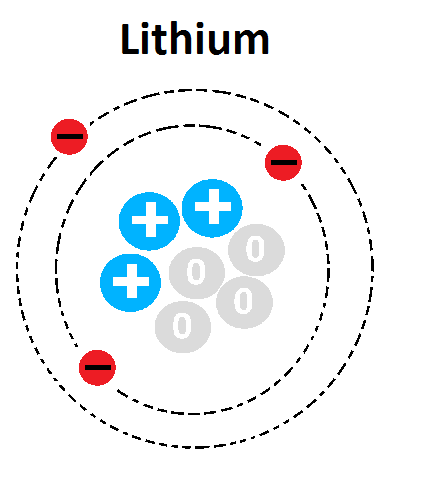
The diagram shows a model of an atom of a particular element. Which element is represented by the model?

a)

Helium (He)

b)

Lithium (Li)

c)

Carbon (C)

d)

Magnesium (Mg)

40.

The diagram shows a model of an atom of a particular element. Which element is represented by the model?

a)

Helium (He)

b)

Be (Beryllium)

c)

Carbon (C)

d)

Magnesium (Mg)

41.

Which subatomic particle determines an atom's identity?

a)

Proton

b)

Neutron

c)

Electron

d)

Nucleus

42.

How are elements organized in the Periodic Table?

a)

Elements are ordered by atomic weight

b)

Elements are ordered by atomic number

c)

Elements are arranged alphabetically

d)

Elements are grouped color

43.

The atomic NUMBER tells you what?

a)

number of electrons

b)

number of protons

c)

number of neutrons

d)

number of protons AND electrons in an element

44.

The atomic MASS tells you what?

a)

number of electrons

b)

number of protons

c)

number of neutrons

d)

the number of protons + neutrons

45.

How many PROTONS does Beryllium have?

a)

4

b)

9

c)

5

d)

13

46.

How many PROTONS does Boron have?

a)

11

b)

5

c)

16

d)

6

47.

How many NEUTRONS does Boron have?

a)

11

b)

5

c)

16

d)

6

48.

How many ELECTRONS does Fluorine have?

a)

19

b)

10

c)

9

d)

28

49.

How many NEUTRONS does Fluorine have?

a)

19

b)

10

c)

9

d)

28

50.

How many ELECTRONS does Beryllium have?

a)

4

b)

9

c)

5

d)

13

51.

An element with a mass of 7 amu and an atomic number of 3 would have how many protons?

a)

4

b)

7

c)

3

d)

cannot be determined 

52.

Which of these is the proton?

a)

A

b)

B

c)

C

d)

None

53.
B and C are found in the ______ of an atom.
a)
Energy levels
b)
Space
c)
Nucleus
d)
Outside
54.
A negatively charged particle that moves around the nucleus is a(n)
a)
proton
b)
neutron
c)
electron
d)
quark
55.
How many protons are in this element?
a)
79
b)
196
c)
117
d)
Cannot be determined
56.
How many electrons does potassium K contain? (click to see image)
a)
19
b)
39
c)
20
d)
40
57.
What does the 1.00794 stand for?
a)
Hydrogen
b)
atomic number
c)
atomic mass
d)
atomic explosion
58.
Which element has an atomic number of 1?
a)
Lithium
b)
Oxygen
c)
Hydrogen
d)
Francium
59.
Which element has an atomic number of 6?
a)
Carbon
b)
Nitrogen
c)
Xenon
d)
Sodium
60.
Which element has an Atomic Number of 10?
a)
Neon (Ne)
b)
Calcium (Ca)
c)
Gold (Au)
d)
Potassium (K)
61.
Which element has the HIGHEST atomic number out of the following? (HINT - They are all in the 1st column)
a)
Hydrogen (H)
b)
Lithium (Li)
c)
Sodium (Na)
d)
Potassium (K)
62.
Which element has the LOWEST Atomic Number out of the following? (HINT - they are all listed in the Halogen column)
a)
Bromine (Br)
b)
Chlorine (Cl)
c)
Iodine (I)
d)
Astatine (At)
63.
Which of the following elements are part of the Alkali Metals?
a)
Magnesium (Mg)
b)
Lead (Pb)
c)
Cesium (Cs)
d)
Helium (He)
64.
Which of the following elements are part of the Transition Metals?
a)
Manganese (Mn)
b)
Magnesium (Mg)
c)
Silicon (Si)
d)
Xenon (Xe)
65.
Which of the following elements is a Noble Gas?
a)
Lithium (Li)
b)
Argon (Ar)
c)
Boron (B)
d)
Bromine (Br)
66.
Which of the following elements is a Halogen?
a)
Carbon (C)
b)
Sodium (Na)
c)
Chlorine (Cl)
d)
Hydrogen (H)
67.
Fluorine has an atomic number of 9. How many protons does it have?
a)
4
b)
9
c)
12
d)
0
68.
Carbon has an atomic number of 6. How many protons does each atom have?
a)
4
b)
25
c)
6
d)
12
69.
Carbon has 6 protons. Carbon has an atomic mass of 12. How many neutrons does Carbon have?
a)
12
b)
0
c)
2
d)
6
70.
Calcium has an atomic mass of 40 amu. Calcium has 20 protons. How many neutrons does Calcium have?
a)
40
b)
20
c)
0
d)
15
71.
The atomic number of Helium is 2. Helium has an atomic mass of 4. How many neutrons does Helium have?
a)
4
b)
8
c)
1
d)
2
72.
Sulfur (atomic number = 16) has an atomic mass of 32. How many Protons and Neutrons does Sulfur have?
a)
P = 18, N = 14
b)
P = 16, N = 14
c)
P = 16, N = 16
d)
P = 30, N = 2
73.
Which is a definition of an element? 
a)
The simplest form of matter, made up of many atoms.
b)
The simplest form of matter. Each element is made up of one type of atom.
c)
Two or more atoms chemically bonded to one another.
d)
Water, Earth, Fire, or Air
74.
Which is the best definition of a molecule? 
a)
Marshmallows that are stuck together.
b)
A mixture of different elements.
c)
Two or more atoms chemically bonded together.
d)
The smallest form of matter, consisting of protons, neutrons, and electrons.
75.
A compound is...
a)
atoms of more than 1 element bonded together.
b)
a type of atom.
c)
when you combine Hydrogen with something.
d)
the largest element.
76.
CO2 (Carbon Dioxide) is a compound. What 2 elements are found in this compound?
a)
Calcium, Oxygen
b)
Chlorine, Osmium
c)
Carbon, Oxygen
d)
Silicon, Osmium
77.
What two elements are found in table salt (NaCl)?
a)
Nitrogen and Carbon
b)
Sodium and Chlorine
c)
Hydrogen and Chlorine
d)
Calcium and Nickel 
78.
Why is it called the "Periodic" Table?
a)
Because you always write a period after an element's name.
b)
Because the same elements are repeated over and over.
c)
Because the properties of elements are repeated periodically. 
d)
Because Mendeleyev thought it sounded cool.
79.
What is the name of this element?
a)
Helium
b)
Hydrogen
c)
Argon
d)
Silver
80.

What element is represented in this Bohr Model?

a)

Carbon

b)

Hydrogen

c)

Aluminum

d)

Lithium

81.
What is the name of this element?
a)
Lithium
b)
Boron
c)
Carbon
d)
Neon
82.

What is the atomic mass of this atom?

a)
1
b)
3
c)
4
d)
7
83.

What is the atomic number of this atom?

a)
2
b)
4
c)
6
d)
none of the above
84.

What is the atomic number of this element?

a)

17

b)

18

c)

35

d)

35.453

85.

How many electrons can fit on the 1st shell (orbital) for any Bohr Model?

a)

2

b)

6

c)

8

d)

10

86.

What is the atomic mass of this atom of chlorine?

a)

17

b)

18

c)

35

d)

35.453

87.
What does the nucleus of an atom contain?
a)
Electrons and neutrons
b)
Protons and neutrons
c)
Neutrinos and positrons
d)
Electrons and megatrons
88.

Which element does this Bohr model represent?

a)

Aluminum

b)

Silicon

c)

Magnesium

d)

Cobalt

89.

What is the atomic mass of this atom?

a)

9

b)

10

c)

19

d)

28

90.

How many electrons can go in the second energy level?

a)

2

b)

8

c)

18

d)

32

91.

What is the the outermost shell with electrons?

a)

Shells

b)

Isotope

c)

Orbit

d)

Valence

92.

How many valence electrons does an oxygen atom have?

a)

2

b)

6

c)

8

d)

16

93.

The unit used to express the mass of the particles in an atom.

a)

mi

b)

AMU

c)

Neutron

d)

Electron

94.

How many carbons are there in this molecule?

a)

1

b)

3

c)

4

d)

5

95.

What type of particles are found in the cloud surrounding the atom's nucleus?

a)

Neutral particles and positively charge particles

b)

Positive charge particles only

c)

Negatively charge particles and positively charge particles

d)

Negatively charge particles only

96.

Which of the following best describes a proton?

a)

It has a positive charge and the same mass as an electron

b)

It has a neutral charge and the same mass as an neutron

c)

It has a positive charge and the same mass as an neutron

d)

It has a negative charge and the same mass as an electron

97.
Where is most of the mass in an atom located?
a)
in the nucleus
b)
in the protons
c)
in the neutrons
d)
in the electrons
98.
The particles with no charge in an atom are the _______.
a)
electrons
b)
neutrons
c)
protons
d)
protons and neutrons
99.
The positively charged particles of an atom are the ________.
a)
electrons
b)
protons
c)
neutrons
d)
protons & neutrons
100.
The negatively charged particles of an atom are the ______.
a)
electrons
b)
protons
c)
neutrons
d)
protons & neutrons
101.
What is the mass number?
a)
the number of protons
b)
the sum of the number of protons and the number of neutrons in the nucleus of an atom 
c)
the number of electrons
d)
the number of neutrons
102.

Which of the following lists the two subatomic particles that contribute the most to the mass of an atom?

a)

Protons and electrons

b)

Protons and neutrons

c)

Neutrons and electrons

d)

Electrons and ions

103.

______ always gives the identify of the atom.

a)

Protons

b)

Neutrons

c)

Electrons

104.

Which subatomic particle has the smallest mass?

a)

Protons

b)

Neutrons

c)

Electrons

105.

Where are valence electrons located?

a)

Outermost energy level in the electron cloud

b)

Innermost energy level in the electron cloud

c)

In the nucleus