
 Worksheets
transfer function reduction
Total questions: 10
Worksheet time: 1hrs 4mins
If two blocks G1, G2 are connected in parallel to a summer,overall transfer function is
sum of individual gain G1+G2
product of individual gain G1G2
difference of individual gain G1/G2
closed loop gain G1G2 /(1+G1G2)
IDENTIFY THE COMPONENTS OF BLOCK DIAGRAM
BLOCK
SIGNAL
SUMMING POINT
BLOCK,SIGNAL,SUMMING POINT,TAKE OFF POINT
the overall transfer function of two blocks in parallel are
product of individual gain
sum of individual gain
division of individual gain
difference of individual gain
WHAT IS THE ANOTHER NAME FOR TAKE OFF POINT
RESISTOR
BRANCH POINT
SUMMING POINT
DOT POINT
Feedback control system are referred to as closed loop system.
Yes
no
yes or No
none

The closed loop gain of the system shown in the given figure is :
a) -9/5
b) -6/5
c) 6/5
d) 9/5

For the block diagram in the following figure, the transfer function C/R with negative feedback is
G1G2+G3
(1+G1G2)G3
G1G2G3/(1-G1G2)
G1G2G3/(1+G1G2)
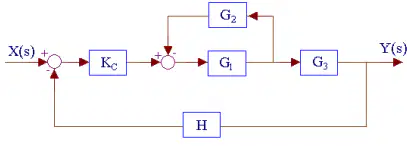
For the block diagram in the following figure, the transfer function Y(s)/X(s) is
1+G1G2+KCG1G3HKCG1G3
1+G1G2+KCG1G3HKCG1G2
1+G1G3+KCG1G3HKCG1G3
1+G1G3+KCG1G3KCG1G3

For the block diagram in the following figure, the transfer function Y(s)/U(s) is
1+G1(s)H2(s)+G1(s)G2(s)H2(s)G2(s)+G1(s)G3(s)
1+H1(s)G2(s)+G1(s)G2(s)H2(s)G1(s)G2(s)+G3(s)
1+G2(s)H1(s)+G1(s)G2(s)H2(s)G1(s)G2(s)+G2(s)G3(s)
1+G2(s)H1(s)−G1(s)G2(s)H2(s)G1(s)G2(s)+G2(s)G3(s)
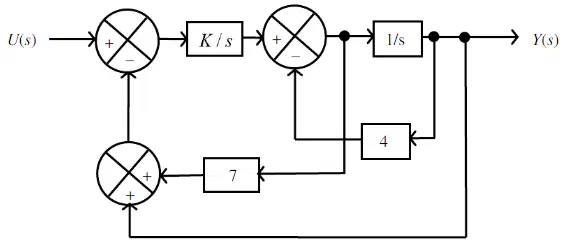
For the block diagram in the following figure, the transfer function Y(s)/U(s)
s2+7Ks+KK
s2+(4+7K)s+KK
s2−(4+7K)s+KK
s2+4Ks+KK

