
Font size
 Worksheets
Proofs Quiz I
Total questions: 104
Worksheet time: 3hrs 59mins
A convincing mathematical argument.
Postulate
Proof
Geometric Figure
Definitions
_____ is a proof that allows a prescribed form.
Formal Proof
Put the following in order of the steps needed to write a paragraph proof. (First to last.)
Given information
Statements and reasons
Final reason/answer
Paragraph proofs must be written in complete sentences.
True
False
Which are correct statements regarding proofs? Select three options.
In a paragraph proof, statements and their justifications are written in sentences in a logical order.
A two-column proof consists of a list statements and the reasons the statements are true.
A flowchart proof gives a visual representation of the sequence of steps without justifications.
A flowchart proof is a visual way of describing the statements and reasons for a proof.
A two-column proof lists only the given information and what is to be proven.
A paragraph proof
uses inductive reasoning to prove a statement.
contains a table with a logical series of statements and reasons.
uses a visual chart of the logical flow of steps needed to reach a conclusion.
contains a set of sentences explaining the steps needed to reach a conclusion.
“If the cloud is dark, then it will rain”. What is the hypothesis?
then it will rain
if the cloud is dark
it will rain
the cloud is dark.
“If the cloud is dark, then it will rain”. What is the conclusion?
then it will rain
if the cloud is dark
it will rain
the cloud is dark.
Which of the following is used to represent the hypothesis in a conditional statement?
p
q
x
y
Which of the following is used to represent the conclusion in a conditional statement?
p
q
x
y
Which of the following corresponds to the symbol notation below?
p→q
Conditional Statement
Converse
Inverse
Biconditional Statement
In a conditional statement, the if part is called the ______.
hypothesis
In a conditional statement, the 'then' portion is called a _____.
conclusion

Which of the following is true about the conditional statement below?
If you are flying, then you are in a
jet.
Hypothesis: you are flying
Conclusion: you are in a
jet
Hypothesis: IF you are flying
Conclusion: THEN you are in a
jet
Hypothesis: THEN you are in a
jet
Conclusion: IF you are flying
Hypothesis: you are in a
jet
Conclusion: you are flying
If you give me twenty dollars, then I will be your best friend.
Conclusion: you give me twenty dollars
Conclusion: I will be your best friend
Conclusion: then you probably should reevaluate your life
Conclusion: if you have lots of friends
The process of drawing logically certain conclusions by using an argument is known as ______.
Deduction
What reasoning makes proofs based on facts and evidence?
Deductive
Inductive
Refer to the following statement: "If a polygon is a quadrilateral, then it is a trapezoid."
What is the converse of this statement?
If a polygon is not a quadrilateral, then it is not a trapezoid.
If a polygon is not a trapezoid, then it is not a quadrilateral.
If a polygon is a trapezoid, then it is a quadrilateral.
A rectangle is also a quadrilateral.
When you interchange the hypothesis and the conclusion of a conditional statement it is called the _____.
Which of the following is the CONVERSE of the statement below?
If an object is a ring, then it is
made of gold.
If an object is made of gold, then it is a ring.
If an object is not a ring, then it is not made of god.
If an object is not made of gold, then it is not a ring.
There is no converse of the statement.
An example that proves a statement is false is called a _____.

When you add "not" to both parts of the conditional statement it is called the _____.
What kind of statement is, "if I have an iPhone, then I have a TikTok account"?
Inverse Statement
Converse Statement
Conditional Statement
Controversial Statement
In the conditional statement, "if I have an iPhone, then I have a TikTok account," what is the hypothesis?
I have a TikTok account
I have an iPhone
I don't have an iPhone
I don't have a TikTok account
In the conditional statement, "if I have an iPhone, then I have a TikTok account," what is the conclusion?
I have a TikTok account
I have an iPhone
I don't have an iPhone
I don't have a TikTok account
What is the converse statement of, "if I have an iPhone, then I have a TikTok account"?
If I have a TikTok account, then I have an iPhone.
If I don't have a TikTok account, then I don't have an iPhone.
If I have a TikTok account, then I have a Samsung.
If I have an iPhone, then I have an Instagram account.
What is the inverse statement of, "if I have an iPhone, then I have a TikTok account"?
If I have a TikTok account, then I have an iPhone.
If I don't have a TikTok account, then I don't have an iPhone.
If I don't have an iPhone, then I don't have a TikTok account.
If I have an iPhone, then I have an Instagram account.
What kind of statement is, "if you hate dogs, then you love cats"?
Inverse Statement
Converse Statement
Conditional Statement
Controversial Statement
In the conditional statement, "if you hate dogs, then you love cats," what is the hypothesis?
You love dogs.
You hate cats.
You love cats.
You hate dogs.
In the conditional statement, "if you hate dogs, then you love cats," what is the conclusion?
You love dogs.
You hate cats.
You love cats.
You hate dogs.
What is the converse of, "if you hate dogs, then you love cats"?
If you don't hate dogs, then you don't love cats.
If you love cats, then you hate dogs.
If you love hogs, then you hate rats.
If you hate dogs, then you hate everyone.
What is the inverse of, "if you hate dogs, then you love cats"?
If you don't hate dogs, then you don't love cats.
If you love cats, then you hate dogs.
If you love hogs, then you hate rats.
If you hate dogs, then you hate everyone.
What kind of statement is the following?
"If you make a lot of money, then you can buy a nice car."
Contrapositive Statement
Converse Statement
Conditional Statement
Controversial Statement
"If you make a lot of money, then you can buy a nice car."
What is the hypothesis?
You can't buy a nice car.
You make a lot of money.
You can buy a nice car.
You don't make a lot of money.
"If you make a lot of money, then you can buy a nice car."
What is the conclusion?
You can't buy a nice car.
You make a lot of money.
You can buy a nice car.
You don't make a lot of money.
What would be the converse of the conditional statement?
"If you make a lot of money, then you can buy a nice car."
If you can't buy a nice car, then you don't make a lot of money.
If you don't make a lot of money, then you can't buy a nice car.
If you can buy a nice car, then you make a lot of money.
If you make a lot of money, then you can buy a nice car.
What would be the inverse of the conditional statement?
"If you make a lot of money, then you can buy a nice car."
If you can't buy a nice car, then you don't make a lot of money.
If you don't make a lot of money, then you can't buy a nice car.
If you can buy a nice car, then you make a lot of money.
If you make a lot of money, then you can buy a nice car.
What would be the contrapositive of the conditional statement?
"If you make a lot of money, then you can buy a nice car."
If you can't buy a nice car, then you don't make a lot of money.
If you don't make a lot of money, then you can't buy a nice car.
If you can buy a nice car, then you make a lot of money.
If you make a lot of money, then you can buy a nice car.
The contrapositive is both the converse and inverse of a conditional statement. Type the contrapositive for the following statement:
"If I'm sleepy, then I'm lazy."
Conditional Statement
“If I live in Los Angeles, then I live in California.”
What is the p?
I don't live in California
I live in California
I don't live in Los Angeles
I live in Los Angeles
Conditional Statement
“If I live in Los Angeles, then I live in California.”
What is the q?
I don't live in California
I live in California
I don't live in Los Angeles
I live in Los Angeles
Conditional Statement
“If I live in Los Angeles, then I live in California.”
What is the ~p?
I don't live in California
I live in California
I don't live in Los Angeles
I live in Los Angeles
Conditional Statement
“If I live in Los Angeles, then I live in California.”
What is the ~q?
I don't live in California
I live in California
I don't live in Los Angeles
I live in Los Angeles
Conditional Statement p → q
What is the converse?
∼q → ∼p
q → p
∼p → ∼q
Conditional Statement p → q
What is the inverse?
∼q → ∼p
q → p
∼p → ∼q
Conditional Statement p → q
What is the contrapositive?
∼q → ∼p
q → p
∼p → ∼q
Conditional Statement
“If I live in Los Angeles, then I live in California.”
What is the p?
I don't live in California
I live in California
I don't live in Los Angeles
I live in Los Angeles
Conditional Statement
“If I live in Los Angeles, then I live in California.”
What is the q?
I don't live in California
I live in California
I don't live in Los Angeles
I live in Los Angeles
Conditional Statement
“If I live in Los Angeles, then I live in California.”
What is the ~p?
I don't live in California
I live in California
I don't live in Los Angeles
I live in Los Angeles
Conditional Statement
“If I live in Los Angeles, then I live in California.”
What is the ~q?
I don't live in California
I live in California
I don't live in Los Angeles
I live in Los Angeles
Conditional Statement p → q
What is the converse?
∼q → ∼p
q → p
∼p → ∼q
Conditional Statement p → q
What is the inverse?
∼q → ∼p
q → p
∼p → ∼q
Conditional Statement p → q
What is the contrapositive?
∼q → ∼p
q → p
∼p → ∼q
When you add 'not' to the converse it is called _____.
What would be the contrapositive of the conditional statement?
"If you make a lot of money, then you can buy a nice car."
If you can't buy a nice car, then you don't make a lot of money.
If you don't make a lot of money, then you can't buy a nice car.
If you can buy a nice car, then you make a lot of money.
If you make a lot of money, then you can buy a nice car.

Conditional statement: If it’s a right angle, then its measure is 90 degrees.
_________2. If the measure of the angle is not 90 degrees, then it is not a right angle.
converse
inverse
contrapositive
If a is related to b and b is related to c then a is related to c
transative property
subtraction POE
Given
Definition of right angle
Name the property of equality or congruence that justifies this statement.
Symmetric
Transitive
Substitution
Reflexive

Angles in a plane that have their vertices and one side (ray) in common but no interior points in common are called ___.

Statement 1: Mango is a fruit.
Statement 2: The box is full of fruits.
Conclusion: The box is full of mangoes.
Logically true. Realistically may or may not be true
Logically true. Realistically true
Logically false. Realistically may or may not be true
Logically false. Realistically true
Statement 1: All mangoes are a fruits.
Statement 2: All fruits have seeds.
Conclusion: Mangoes have seeds.
Inductive reasoning
Deductive reasoning
Inductivity
Deductivity
Statement 1: Mango is a fruit.
Statement 2: The box is full of fruits.
Conclusion: The box is full of mangoes.
Inductive reasoning
Deductive reasoning
Inductivity
Deductivity
Unproven statement based on an observation is called a ________.
Conjecture
A=B
C=D
A+C=B+D
Addition Property of Equality
Segment Addition Axiom
Angle Addition Axiom
__________________________
7n = 21 then n = 3
What property of equality is shown below?
10 + d = 25
10 + d -10 = 25 - 10
addition property of equality
subtraction property of equality
division property of equality
multiplication property of equality
What property of equality is shown below?
25 + d = 36
25 + d - 25 = 36 - 25
addition property of equality
subtraction property of equality
division property of equality
multiplication property of equality

Given: B is the midpoint of AC. What should you conclude?
AB + BC = AC
AB = BC
A is the segment bisector of BC
ABC is a straight angle
Justify the conclusion. If XY = MN, then XY ≅MN .
A-B-C-D Theorem
Definition of Congruence
CPCF Theorem
Segment Congruence Theorem
If PQ = RS then RS = PQ
If MN = OP and OP = QR, then MN = QR


39=39
If 31 = 2x - 5, then 2x - 5 = 31
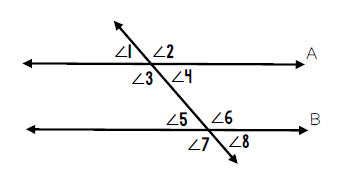
Angle 6 and Angle 7 are examples of which type of angle pair?
Alternate exterior angles
Alternate interior angles
Vertical angles
Corresponding angles
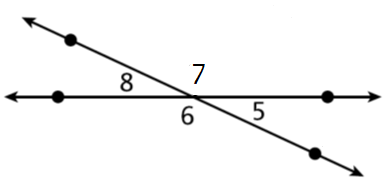
Which angles are vertical angles?
∠8 & ∠7
∠8 & ∠6
∠8 & ∠5


If two angles are vertical, then they are congruent
Vertical Angles Theorem
Def. of vertical angles
If two angles form a linear pair,
then they are supplementary
Linear pair → Supplementary
Congruent supplements theorem
Supplement theorem
If ∠ A is supplementary to ∠ B and ∠ C is supplementary to ∠ B, then ∠ A ≅ ∠ C
Congruent Supplements Theorem
Supplement Theorem

Supply the second reason.
Linear Pair Postulate
Alternate Interior Angles Theorem
Vertical Angles Theorem
Corresponding Angles Postulate


