
 Worksheets
MT 807 CHEM
Total questions: 45
Worksheet time: 54mins
Define the following: (8m)
a) activation energy
b) catalyst
c) rate of reaction
d) collision
Based on collision theory, explain how these factors affect the rate of reaction. (4 marks for each)
a) decrease in the concentration of the reactants
b)increase in pressure
c) larger particles
d) decrease in temperature
e) positive catalyst
Explain three applications of the rate of reaction in our daily life. (4m)
Which of the following reactions occurs at the highest rate?
Photosynthesis
Rusting of iron
Combustion of hydrogen in oxygen
Combustion of magnesium in oxygen
The following equation shows the reaction between calcium carbonate, CaCO3 and hydrochloric acid, HCl:
CaCO3(aq) + 2HCl(aq) → CaCl2(aq) + CO2 (g) + H2O(l)
Which of the following is the suitable method to determine the rate of reaction?
Change in the temperature of the solution with time
Change in the volume of carbon dioxide gas with time
Change in the mass of water with time
Change in the concentration of hydrochloric acid with time

Diagram 7 shows a graph of the volume of gas produced against time for the reaction between zinc granules and hydrochloric acid.
The gradient of the graph decreases with time because
catalyst is not used
volume of mixture decreases
temperature of reaction decreases
concentration of hydrochloric acid decreases
Which manufacturing of the following is not a characteristic of catalyst?
A catalyst is specific in its reaction.
A catalyst influences the quantity of product of a reaction.
The chemical property of a catalyst remains unchanged at the end of the reaction.
Only a little amount of a catalyst is needed to influence the rate of reaction.
Which of the following explains the meaning of effective collision?
The collision where its energy is less than the activation energy
The collision that has a low energy
The collision which takes place before a reaction
The collision that causes a reaction
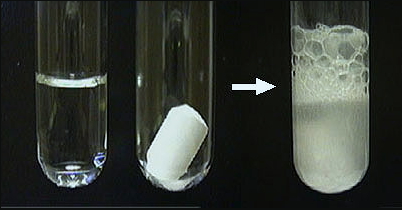
How could we make this reaction happen more quickly?
Decrease the concentration of the acid
crush the chalk to increase the surface area
Put the test tube in an ice bath
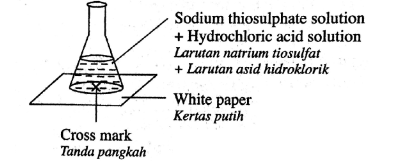
Diagram shows the apparatus set up for an experiment to determine the rate of reaction.
Which of the following techniques is the most suitable to determine the rate of reaction?
Record the time as soon as precipitate is formed
Record the time taken to obtain the maximum temperature
Record the times as soon as the cross mark cannot be seen
Record the times taken for the change of the pH value until a fixed pH value is obtained
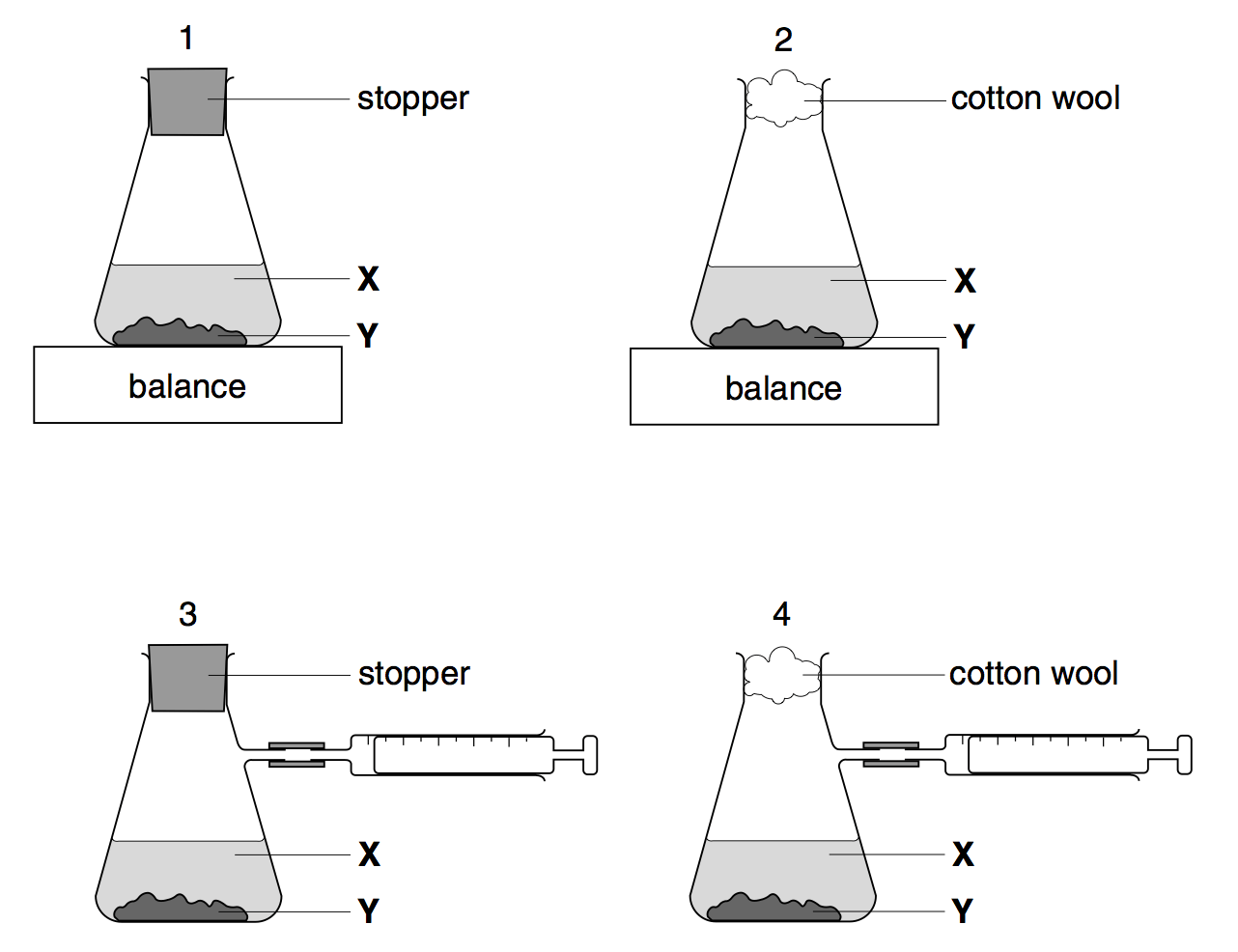
Which two diagrams show suitable methods for investigating the speed of the reaction?
What is used as a catalyst in the Contact process?
Apakah mangkin yang digunakan dalam proses Sentuh?
Iron filings
Serbuk besi
Vanadium(V) oxide
Vanadium(V) oksida
Sulphur
Sulfur
Water
Air
This method can use to collect gas produced ...
using a gas syringe system
downwards water displacement
using digital balance
List four factors that affects the rate of a reaction
temperature
concentration
surface area
volume
catalysts
A temperature increase causes the particles ......
to slow down
move faster
collide higher
in the right order

Why does a higher concentration increase the rate of reaction?
it increases the amount of reactants
it lowers the activation energy
it increases the energy of particle collisions
it increases the frequency of particle collisions
The ______________is required to break the bonds of the reactants.
Carbonic energy
Activation energy
Plutonic energy
Energi Gaib
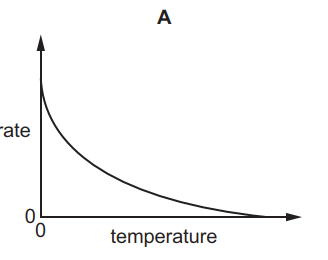
Which graph shows the effect of increasing temperature on the rate of reaction of calcium carbonate with dilute hydrochloric acid?
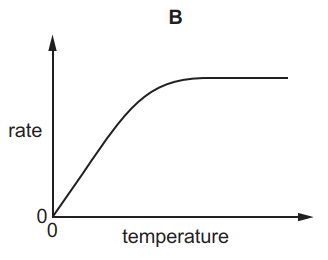
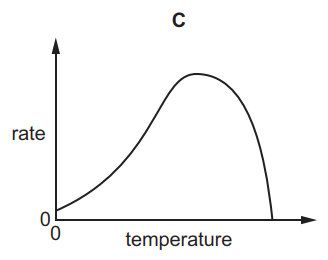
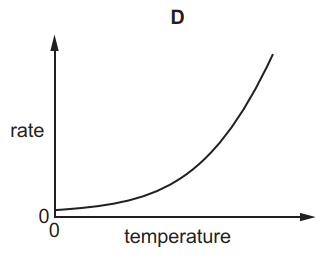

Reactions that give out heat to the surrounding are classified as one of the following:
Spontaneous
Exothermic
sluggish
The word for a substance that you react at the start of a chemical reaction...
Reaction
Reactant
Product
The result
The word for a substance created in a chemical reaction...
Reaction
Reactant
Product
Mass
Objects hitting each other
Collision
Catalyst
Explosion
Reaction
The speed at which a chemical reaction occurs
Fast
Slow
Rate
Ratio
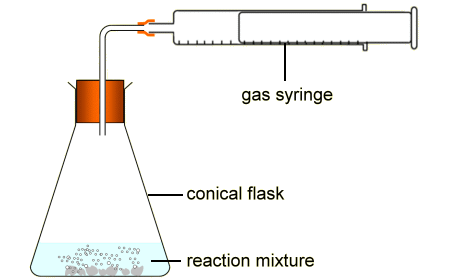
How is this equipment being used to measure the rate of reaction?
The gas syringe measures how much gas is produced in a certain time
The reaction mixture will increase in volume in a certain time
What are the observable changes used to measure the rate of reaction? (4m)
To slow down a chemical reaction you will do one of the following:
Place the reactants in hot water
Place the products in ice bath
Place the reactants in an ice bath
Keep stirring the reactants with a stirring rod
What is collision theory?
Molecules must collide in the correct orientation with enough energy to bond.
Molecules need enough energy to collide and react.
Atoms constantly collide and react.
The minimum energy needed for atoms to react
Would the reaction rate speed up or slow down: A tablespoon of powdered sugar placed into HCL.
Slow down
Speed up
Stays the same
Decreasing the concentration of a substance will usually........
Slow down the reaction
Speed up the reaction
Have no affect on the reaction
Which has more surface area?
Large chunks of chalk
Cube of sugar
Powdered sugar
Small chunks of sugar
What criteria must be met for reactant collisions to result in a successful product?
The reactants must collide with each other
The reactants must collide with enough energy and be in the right positions
The reactants must have enough energy to form the activated complex

