wayground logo

Free Printable Worksheets

Font size

S
M
L
XL
Worksheets

ch.2 l 1 to 3

Total questions: 79

Worksheet time: 6hrs 25mins
Name
Class
Date
1.
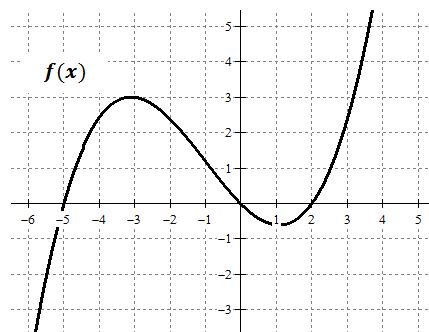
Over what interval(s) is f(x) decreasing?
a)
(-3, 1)
b)
(-∞, -5) ∪ (0, 2)
c)
(-∞, -3) ∪ (1, ∞)
d)
(-5, 0) ∪ (2, ∞)
2.
If (a,b) is a local maximum, then what will be true about f''(a)?
a)
It's positive
b)
It's negative
c)
It's zero
d)
Cannot be determined
3.
 If (a,b) is a local minimum, then what will be true about f''(a)?
a)
It's postive
b)
It's negative
c)
It's zero
d)
Cannot be determined
4.
The concavity of a function is described by its _______________.
a)
first derivative
b)
second derivative
c)
third derivative
d)
expression
5.
The slope of a function is described by its ____________.
a)
first derivative
b)
second derivative
c)
third derivative
d)
expression
6.
For a function g(x), g''(3)=-8 indicates that g(x) is ____________ at x=3.
a)
increasing
b)
decreasing
c)
concave up
d)
concave down
7.
For a function f(x), f'(-3) = 5 indicates f(x) is ___________ at x=-3.
a)
increasing
b)
decreasing
c)
concave up
d)
concave down
8.
Over what intervals is f(x) decreasing?
a)
(-∞, -1) ∪ (1, ∞)
b)
(-∞, -√3) ∪ (0, √3)
c)
(-1, 1)
d)
(-√3, 0) ∪ (√3, ∞)
9.
If a function's FIRST derivative is negative at a certain point, what does that tell you?
a)
The function is increasing at that point
b)
The function is decreasing at that point
c)
The concavity of the function is up at that point
d)
The concavity of the function is down at that point
10.
Use the sign chart for f'(x).
There is(are) ...
a)
a local maximum at x = -2.
b)
a local maximum at x = 4.
c)
local maxima at x = -2 and x = 4.
d)
no extrema.
11.
Use the sign chart for f'(x).  There is(are) ...
a)
a local maximum at x = -2.
b)
a local minimum at
x = -2 and a local maximum at x = 4.
c)
a local maximum at
x = -2 and a local minimum at x = 4.
d)
no extrema.
12.
Find the second derivative of the function:
f (x) =  2x - 5x6
a)
f ''(x)= 2 - 30x
b)
f ''(x) =  2-30x5
c)
f ''(x) = -30x5
d)
f ''(x) = -150x4
13.
Identify the critical points of the following function:
g(x)=2x3-3x2
a)
x=-1,1
b)
x=0,0
c)
x=0,-1
d)
x=0,1
14.
What is the maximum value of f(x) = x3 - 3x2 - 1 on the interval [-3, 2]?
a)
0
b)
-1
c)
2
d)
5
15.
How many extrema are in the picture?
a)
2
b)
3
c)
4
d)
5
16.
Let g(x) = (1/4)x4-4x3+24x2, for what values of x does the graph of g have points of inflection?
a)
x = -3 
b)
x = 0
c)
x = 4
d)
g has no points of inflection
17.
If f '(3) = 0 and f"(3) < 0, then which of the following must be true?
a)
There is a local max at x=3
b)
There is a local min at x = 3
c)
There is an inflection point at x = 3
d)
There is an x-intercept at x = 3
18.
On what interval(s) is the function
y = x^3 + 6x^2
concave down?
a)
(-∞,-4)
b)
(-∞,-2)
c)
(-2,∞)
d)
(0,∞)
19.
Where is the point of infection for the function y = x^3 + 6x^2?
a)
0
b)
-4
c)
-2
d)
4
20.
On what interval(s) is the function
y = x^3 + 6x^2
concave up?
a)
(-∞,∞)
b)
(-∞,-2)
c)
(-2,∞)
d)
(0,∞)
21.

What is the relative minimum x value of y = x^3 + 6x^2?

a)

-4

b)

0

c)

12

d)

4

22.
If f '(3) = 0 and f"(3) < 0, then which of the following must be true?
a)
There is a local max at x=3
b)
There is a local min at x = 3
c)
There is an inflection point at x = 3
d)
There is an x-intercept at x = 3
23.
The graph shown is the DERIVATIVE of f. From the derivative's graph, identify the interval graph where f (the original function) is concave up.
a)
(-1,1) & (3,4)
b)
(-3,-2)
c)
(-2,-1)
d)
(-3,-1) & (1,3)
24.
The concavity of a function is described by its _______________.
a)
first derivative
b)
second derivative
c)
third derivative
d)
expression
25.
For a function g(x), g''(3)=-8 indicates that g(x) is ____________ at x=3.
a)
increasing
b)
decreasing
c)
concave up
d)
concave down
26.
For a function f(x), f'(-3) = 5 indicates f(x) is ___________ at x=-3.
a)
increasing
b)
decreasing
c)
concave up
d)
concave down
27.
If a function's FIRST derivative is negative at a certain point, what does that tell you?
a)
The function is increasing at that point
b)
The function is decreasing at that point
c)
The concavity of the function is up at that point
d)
The concavity of the function is down at that point
28.

What are the intervals of the graph increasing for f(x) = 2x4- 4x2 + 1

a)

(-1,0)

b)

(0,1)

c)

(-∞,-1) and (0,1)

d)

(1,∞) and (-1,0)

29.
What is the maximum value of f(x) = x3 - 3x2 - 1 on the interval [-3, 2]?
a)
0
b)
-1
c)
2
d)
5
30.
Which graph is the derivative of the top graph?
a)
A
b)
B
c)
C
d)
D
31.
f' is given, which could be f?
a)
A
b)
B
c)
C
32.
Find the point(s) of inflection for f(x) = 2(x)1/5 + 3
a)
None
b)
x = 0
c)
x = 0, 2
d)
x = -2, 0, 2
33.
If f''(x)>0 over the interval (-7,1), then what will be true about f'(x)?
a)
It's constant
b)
It's increasing
c)
It's decreasing
d)
Cannot be determined
34.
List all of the critical values (x-locations of the critical points) of the function whose derivative is graphed.
a)
{-3, -1, 1}
b)
{-3, -1}
c)
{-4, -2, 0}
d)
Cannot be determined
35.
List all of the x-locations of the points of inflection of the function whose derivative is graphed.
a)
{-4, -2, 0}
b)
{-2, 0}
c)
{-2, 0, 1}
d)
Cannot be determined
36.
List all of the x-locations of the minimum points of the function whose derivative is graphed.
a)
{-2, 1}
b)
{-1, 1}
c)
{-1}
d)
Cannot be determined}
37.
List all of the x-values of the points of inflection of the function whose second derivative is graphed.
a)
{-3, 1}
b)
{-3, -1, 1}
c)
{-4, 2}
d)
Cannot be determined
38.
When f'(x) changes from negative to positive, there is(are) ...
a)
a maximum.
b)
a minimum.
c)
no extrema.
39.
Use the sign chart for f'(x).
There is(are) ...
a)
a local maximum at x = -2.
b)
a local maximum at x = 4.
c)
local maxima at x = -2 and x = 4.
d)
no extrema.
40.
Given the following graph of f', the derivative of f. For what x-value does f have a relative minimum?
a)
x=-1 and x=4
b)
x=-3
c)
x=1
d)
x=3
41.
When f'(x) changes from positive to negative, there is(are) ...
a)
a maximum.
b)
a minimum.
c)
no extrema.
42.

Find the intervals of concavity for

f(x) = x2 + 2x + 1.

a)

concave up: (-∞,∞)

b)

concave down: (-∞,∞)

c)

concave up: (2, ∞)

concave down: (-∞,2)

d)

concave up: (-∞,2)

concave down: (2, ∞)

43.
 If (a,b) is a local minimum, then what will be true about f'(a)?
a)
It's positive
b)
It's negative
c)
It's zero
d)
Cannot be determined
44.

Find the relative minimum values for f(x)=3x4-2x3-9x2

a)

-1

b)

0

c)

1.5

d)

-1 and 1.5

45.
Identify the interval from the derivative graph where the function is concave up.
a)
(-1,1) & (3,4)
b)
(-3,-2)
c)
(-2,-1)
d)
(-3,-1) & (1,3)
46.
The concavity of a function is described by its _______________.
a)
first derivative
b)
second derivative
c)
third derivative
d)
expression
47.

Over what interval(s) is f(x) concave up? (Be careful this is a graph of f'!)

a)

(-∞, -3) ∪ (1, ∞)

b)

(-3, 1)

c)

(-∞,-3) U (1, ∞)

d)

(-5, 0)U(2, ∞)

48.
Given the velocity function.  Over what interval(s) is the particle moving left?
a)
(0, 3) ∪ (8, 12)
b)
(0, 7) ∪ (10, 12)
c)
(0, 6) ∪ (10, 12)
d)
(3, 8)
49.
The acceleration function is the first derivative of...
a)
position
b)
velocity
c)
calculus
d)
particle motion
50.

If f'(x) = 0 what does that imply about the x value?

a)

It is a critical point, it is a possible max, min, or point of inflection.

b)

That the limit does not exist.

51.
Identify the critical points of the following function:
g(x)=2x3-3x2
a)
x=-1,1
b)
x=0,0
c)
x=0,-1
d)
x=0,1
52.
Over what intervals is f(x) decreasing?
a)
(-∞, -1) ∪ (1, ∞)
b)
(-∞, -√3) ∪ (0, √3)
c)
(-1, 1)
d)
(-√3, 0) ∪ (√3, ∞)
53.
Find the critical points of f(x) = 2x4- 4x2 + 1
a)
x= 0
b)
x = -1, 1
c)
x = -1, 0, 1
d)
no critical points
54.
What will be true at an inflection point?  (select the best answer)
a)
f(x)=0
b)
f'(x)=0
c)
f''(x)=0
d)
The function is undefined
55.
What are the asymptotes?
a)
x=1, x= 2, y =1, y= 2
b)
x= 2, x=-2, y = 1
c)
x=2 y =-1
d)
x=1 y =2, y =-2
56.
How is this function transformed from the parent function?
a)
Translated left and up
b)
Translated right and up
c)
Translated left and down
d)
Translated right and down
57.
What is the horizontal asymptote to this function?
a)
y=4
b)
y=0
c)
y=-2
d)
y=1
58.
What is/are the vertical asymptote(s)?
a)
x=-2
b)
x=2 and x=3
c)
x=-3
d)
x=3
59.
What is the horizontal asymptote?
a)
y = -4
b)
y = 1
c)
x = 1
d)
y = -6
60.
a)
y = 0
b)
y = 1/2
c)
y = 2
d)
None
61.
Find the horizontal asymptote.
a)
None
b)
y=-2
c)
y=2
d)
y=0
62.
What is the horizontal asymptote of this function?
a)
y=2
b)
x=1/2
c)
y=1
d)
y=1/2
63.
What is the Vertical Asymptotes? 
a)
x= -5
b)
x= 5
c)
x= 6
d)
x= -6
64.
What is the Vertical Asymptotes?
a)
x= -4
b)
x= -4,5
c)
x= -5,5
d)
x= 4
65.
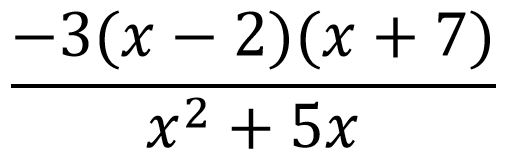
What are the Vertical Asymptotes of...
a)
x = 0, -5
b)
x=0, 5
c)
x = 2, -7
d)
x = -2, 7
66.
What is the hole?
a)
x= 4
b)
x= -4
c)
x= 5
d)
x= -5
67.
What is the Vertical Asymptotes? 
a)
x= -5
b)
x= 5
c)
x= 6
d)
x= -6
68.
Which asymptote(s) are determined by looking at the denominator?
a)
vertical
b)
horizontal
c)
slant
d)
none
69.

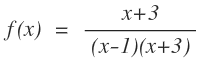
Find the vertical asymptotes and holes of the function.

a)

Holes: None;

VA: x = 1, -3

b)

Holes: x = -3;

VA: x = 1

c)

Holes: x = -3, 1

VA: None

d)

Holes: x = 1

VA: x = -3

70.
Find the hole of the function.
x2- 9x+20
___________
4x2 - 12x- 40
a)
x =5
b)
x=0
c)
x=4
d)
x=-2
71.

Where is there a hole on the graph of the function?

a)

x = 2

b)

x = -2

c)

There are no holes.

d)

x = 5

72.

How many vertical asymptotes does the function have?

a)

None

b)

1

c)

2

d)

3

73.

Find the vertical asymptotes and holes of the function.

a)

Holes: None;

VA: x = 1, -3

b)

Holes: x = -3;

VA: x = 1

c)

Holes: x = -3, 1

VA: None

d)

Holes: x = 1

VA: x = -3

74.

State the vertical asymptote.

a)

x = -2/5

b)

x = -5/2

c)

x = -5

d)

x = 2

75.

Find the coordinates of the hole.

a)

(-3, -3)

b)

(-3, 3)

c)

(3, -3)

d)

(3, 3)

76.
A hole occurs when....
a)
You wear pants that are too tight.
b)
A factor from the numerator cancels with a factor in the denominator.
c)
The degree of the numerator is one more than the degree of the denominator.
d)
The denominator cannot be factored.
77.

Where is the hole?

a)

x= 4

b)

x= -4

c)

x= 5

d)

x= -5

78.
What is the Vertical Asymptotes? 
a)
x= -5
b)
x= 5
c)
x= 2
d)
x= -2
79.
Name any holes of the function.
a)
x=0
b)
none
c)
x=1