wayground logo

Free Printable Worksheets

Font size

S
M
L
XL
Worksheets

Unit 1 Review*

Total questions: 54

Worksheet time: 31mins
Name
Class
Date
1.
Matter is defined as anything that occupies space and has
a)
shape
b)
odor
c)
mass
d)
color
2.
If a student reacts 24 g of magnesium with oxygen gas and the final product of magnesium oxide weighs 40g. How much oxygen was reacted?
a)
64 g
b)
840 g
c)
16 g
d)
24 g
3.
Which substance cannot be decomposed by a chemical change?
a)
N₂O
b)
H₂O
c)
Ne
d)
HF
4.
Which statement describes a chemical property of iron?
a)
Iron is a shiny metal
b)
Iron can be flattened into sheets
c)
Iron can be drawn into a wire.
d)
Iron combines with oxygen to form rust
5.
The diameter through the equator of Jupiter is about 143,000 kilometers. What is this distance written in scientific notation?
a)
143 x 10³ km
b)
1.43 x 10³ km
c)
1.43 x 10⁵ km
d)
143 x 10⁵ km
6.
Which type of change must occur to form a compound?
a)
Nuclear
b)
Chemical
c)
Physical
d)
Phase
7.
Which terms are used to identify pure substances?
a)
an element and a compound
b)
a solution and a compound
c)
an element and a mixture
d)
a solution and a mixture
8.
Which of the following represents a mixture?
a)
NaCl (aq)
b)
NaCl (s)
c)
NaCl (g)
d)
NaCl (l)
9.
Which measurement contains a total of three significant figures?
a)
0.010 g
b)
0.01 g
c)
0.01000 g
d)
0.0100 g
10.
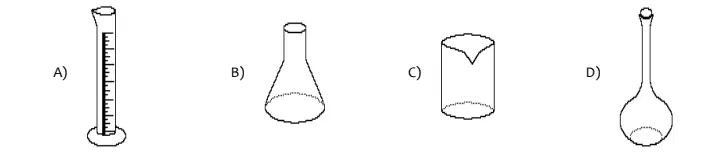
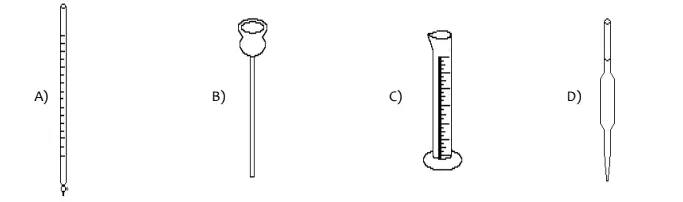
Which diagram represents a graduated cylinder?
a)
A
b)
B
c)
C
d)
D
11.
Which is a characteristic of all mixtures?
a)
Their composition is in a fixed ratio
b)
They are homogeneous
c)
They are heterogeneous.
d)
Their composition can be varied.
12.

Which is an Erlenmeyer flask?

a)
A
b)
B
c)
C
d)
D
13.
During a laboratory activity, a student combined two solutions. In the laboratory report, the student wrote "A yellow color appeared." The statement represents the student's recorded
a)
Conclusion
b)
Observation
c)
Hypothesis
d)
Inference
14.
Which of these terms refers to matter that could be heterogeneous?
a)
Element
b)
Compound
c)
Solution
d)
Mixture
15.
Which Kelvin temperature is equivalent to -24℃?
a)
297 K
b)
273 K
c)
249 K
d)
226 K
16.
When sodium chloride is dissolved in water, the resulting solution is classified as a
a)
homogeneous compound
b)
heterogeneous compound
c)
homogeneous mixture
d)
heterogeneous mixture
17.
Which substance can be decomposed by a chemical change?
a)
Cu
b)
Co
c)
C
d)
CH₄
18.
What is always conserved?
a)
Matter only
b)
Energy only
c)
Matter and energy
19.
What piece of laboratory equipment is this?
a)
Beaker tongs
b)
Test tube holder
c)
Crucible tongs
d)
Thermometer
20.
Which list of formulas represents compounds, only?
a)
H₂, N₂, O₂
b)
H₂, Ne, NaCl
c)
CO₂, H₂O, NH₃
d)
MgO, NaCl, O₂
21.
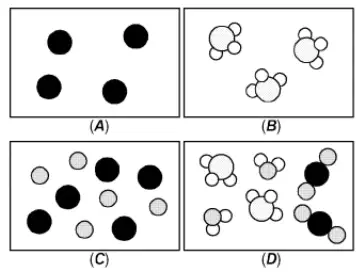
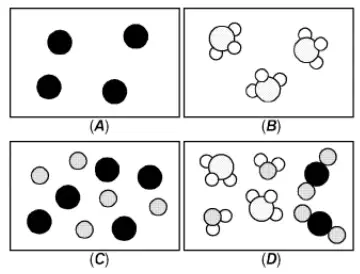
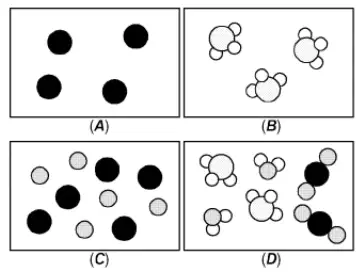
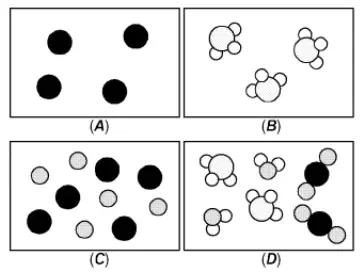
Which particle diagram above best represents a single element?
a)
A
b)
B
c)
C
d)
D
22.
Which particle diagram above best represents a single compound?
a)
A
b)
B
c)
C
d)
D
23.
Which particle diagram above best represents a mixture of elements?
a)
A
b)
B
c)
C
d)
D
24.
Which particle diagram above best represents a mixture of compounds?
a)
A
b)
B
c)
C
d)
D
25.
Flammable
a)
Physical
b)
Chemical
26.
Dissolving
a)
Physical
b)
Chemical
27.
Rusting
a)
Physical
b)
Chemical
28.
Liquid water has a density of 1 g/mL
a)
Physical
b)
Chemical
29.
Magnesium ribbon will react with air to produce a bright white light
a)
Physical
b)
Chemical
30.
Gold’s melting point is 1338 K
a)
Physical
b)
Chemical
31.
C₆H₁₂O₆(aq)
a)
Element
b)
Compound
c)
Heterogeneous Mixture
d)
Homogeneous Mixture
32.
Sand and Water
a)
Element
b)
Compound
c)
Heterogeneous Mixture
d)
Homogeneous Mixture
33.
Carbon dioxide
a)
Element
b)
Compound
c)
Heterogeneous Mixture
d)
Homogeneous Mixture
34.
Air
a)
Element
b)
Compound
c)
Heterogeneous Mixture
d)
Homogeneous Mixture
35.
Aluminum foil
a)
Element
b)
Compound
c)
Heterogeneous Mixture
d)
Homogeneous Mixture
36.
Heat is released.
a)
Endothermic
b)
Exothermic
37.
Heat is absorbed.
a)
Endothermic
b)
Exothermic
38.
How would you separate a mixture of saltwater and sand?
a)
Filter out the sand, then evaporate the water leaving the salt behind.
b)
Evaporate the water leaving the sand and salt behind, then use a magnet to separate them.
c)
Evaporate the water leaving the sand and salt behind, then separate using filtration.
d)
Filter out the salt, then evaporate the water leaving the sand behind.
39.

An unknown substance has a density of 4.87 g/mL. If the mass of a substance is 45 g, what is the volume of space that this object occupies? (Round to 2 decimal places and include a unit.)

(a)  

40.

A student finds the density of an aluminum block to be 2.873 g/cm³. Using the information on Table S, calculate the student’s percent error. (Round to 2 decimal places.)

(a)  

41.

Convert 345 K to Celsius

(a)  

42.
a)
Element
b)
Compound
c)
Mixture
43.
a)
Element
b)
Compound
c)
Mixture
44.

A student placed a small chip of limestone into a hydrochloric acid solution, and carbon dioxide gas was released. The carbon dioxide provided evidence that

a)

only a physical change occurred.

b)

a chemical change occurred.

c)

only a loss of mass occurred.

d)

the formation of an element occurred.

45.

What type of change is this?

a)

Chemical

b)

Melting

c)

Evaporation

d)

Condensation

e)

Sublimation

46.
Which of the following is an example of a precipitate?
a)
liquid evaporating into gas
b)
a solid formed from a frozen liquid
c)
a chunk solid formed from two liquids combining
d)
a liquid solution that contains two substances
47.

A student mixes yellow powder with water. Which observation would prove a CHEMICAL change occurred?

a)

The powder DISSOLVED in the water

b)

The water turned the COLOR yellow

c)

The bag's TEMPERATURE changed

d)

The STATE OF MATTER changed

48.

What seperation process is this?

a)

Evaporation

b)

Distillation

c)

Filtration

d)

Condensation

49.

Which of the following is a correct statement about distillation

a)

The components of the mixture have different densities

b)

The components of the mixture have different melting points

c)

The components of the mixture have different boiling points

d)

The components of the mixture form a heterogeneous mixture
50.

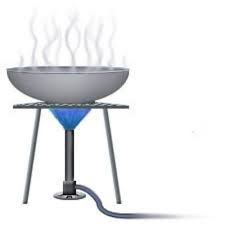
Name the separation technique shown in the diagram.

a)

evaporation

b)

distillation

c)

filtration

51.

Decide if each of the following phase changes in endothermic or exothermic.

Categorize the following

Melting/Fusion

Boiling/Vaporization

Sublimation

Freezing

Condensation

Deposition

Endothermic
Exothermic
52.

Match the following.

a)

Fusion

1.

Solid --> Liquid

b)

Sublimation

2.

Solid --> Gas

c)

Boiling

3.

Liquid --> Gas

d)

Deposition

4.

Gas --> Solid

e)

Freezing

5.

Liquid --> Solid

53.
Which example best describes a physical change?
a)
iron rusting
b)
charcoal burning
c)
an ice cube melting
d)
a marshmallow burning
54.
Identify the equipment shown here:
a)
graduated cylinder
b)
Erlenmeyer flask
c)
beaker
d)
volumetric flask