Wayground logo

Free Printable Worksheets

Font size

S
M
L
XL
Worksheets

The Complex Number System & Solving Quadratics by Factoring

Total questions: 160

Worksheet time: 12hrs 40mins

Name
Class
Date
1.

Rationalize the denominator:
523\frac{\sqrt{5}}{2\sqrt{3}}  

a)

156\frac{\sqrt{15}}{6}  

b)

1518\frac{\sqrt{15}}{18}  

c)

536\frac{5\sqrt{3}}{6}  

d)

5318\frac{5\sqrt{3}}{18}  

2.

What is the conjugate of:
5+75+\sqrt{7}  

a)

18

b)

5+75+\sqrt{7}  

c)

5−75-\sqrt{7}  

d)

32

3.

Rationalize the denominator:
2812\frac{2\sqrt{8}}{\sqrt{12}}  

a)

966\frac{\sqrt{96}}{6}  

b)

263\frac{2\sqrt{6}}{3}  

c)

29612\frac{2\sqrt{96}}{12}  

d)

4223\frac{4\sqrt{2}}{2\sqrt{3}}  

4.

Multiply:
(4+2)(4−2)\left(4+\sqrt{2}\right)\left(4-\sqrt{2}\right)  

a)

16−216-\sqrt{2}  

b)

4−24-\sqrt{2}  

c)

14

d)

18

5.

What is the conjugate of:
6−326-3\sqrt{2}  

a)

6+326+3\sqrt{2}  

b)

32+63\sqrt{2}+6  

c)

6−326-3\sqrt{2}  

d)

18

6.

What should you multiply 61−5\frac{6}{1-\sqrt{5}}  by to rationalize the denominator?

a)

-4

b)

1−51-\sqrt{5}  

c)

1+51+\sqrt{5}  

d)

−(3−35)2-\frac{\left(3-3\sqrt{5}\right)}{2}  

7.

What is the conjugate of:
8+368+3\sqrt{6}  

a)

8+368+3\sqrt{6}  

b)

36−83\sqrt{6}-8  

c)

8−368-3\sqrt{6}  

d)

36+83\sqrt{6}+8  

8.

Rationalize the denominator:
1410\frac{1}{4\sqrt{10}}  

a)

14\frac{\sqrt{1}}{4}  

b)

1040\frac{\sqrt{10}}{40}  

c)

14\frac{1}{4}  

d)

10400\frac{\sqrt{10}}{400}  

9.

Rationalize the denominator:
4121\frac{\sqrt{4}}{\sqrt{121}}  

a)

411\frac{4}{11}  

b)

484121\frac{\sqrt{484}}{121}  

c)

211\frac{2}{11}  

d)

2121121\frac{2\sqrt{121}}{121}  

10.

Divide:
103015\frac{10\sqrt{30}}{\sqrt{15}}  

a)

2303\frac{2\sqrt{30}}{3}  

b)

10210\sqrt{2}  

c)

20

d)

2102\sqrt{10}  

11.
Simplify.
a)
-5i
b)
5
c)
5i
d)
-5
12.
Multiply: 
(4 – 3i)(-7 – 2i)
a)
A.  -23 + 13i
b)
B.  -23 - 29i
c)
C.  -34 + 13i
d)
D.  -34 - 29i
13.
Simplify: 
(10+ 15i)-(48 - 30i)
a)
58 - 45i
b)
58 - 15i
c)
-38 - 15i
d)
-38 + 45i
14.
Simplify
2i - 7i + 10
a)
10 - 5i
b)
5i
c)
10 + 9i
d)
10 + 5i
15.
Find the sum.
(5-2i) + (-7+8i)
a)
-2+6i
b)
12+6i
c)
-35-16i2
d)
-35 -16i
16.
Find the sum.
(5-2i) + (-7+8i)
a)
-2+6i
b)
12+6i
c)
-35-16i2
d)
-35 -16i
17.
(2i)(3i)
a)
5i
b)
-5
c)
6i2
d)
-6
18.
(3i)(-2+4i)
a)
-6+12i
b)
-12-6i
c)
-2+7i
d)
12+6i
19.
a)

√2

b)

i√2

c)

i2√2

d)

-√2

20.
a)

A

b)

B

c)

C

d)

D

21.
a)

A

b)

B

c)

C

d)

D

22.
a)

A

b)

B

c)

C

d)

D

23.
a)

A

b)

B

c)

C

d)

D

24.
a)

A

b)

B

c)

C

d)

D

25.
a)

A

b)

B

c)

C

d)

D

26.
a)

A

b)

B

c)

C

d)

D

27.
a)

A

b)

B

c)

C

d)

D

28.
a)

A

b)

B

c)

C

d)

D

29.

Factor 3x2+15x3x^2+15x  

a)

3(x2+5x)3\left(x^2+5x\right)  

b)

3x(x+5)3x\left(x+5\right)  

c)

5x(x+3)5x\left(x+3\right)  

d)

x(3x+15)x\left(3x+15\right)  

30.

Factor x2−64x^2-64  

a)

(x−8)(x+8)\left(x-8\right)\left(x+8\right)  

b)

(x−4)(x+4)\left(x-4\right)\left(x+4\right)  

c)

(x−32)(x+32)\left(x-32\right)\left(x+32\right)  

d)

(x−16)(x+16)\left(x-16\right)\left(x+16\right)  

31.
Solve the equation using the zero product property.
3x ( 2x - 4) = 0
a)
x = -1/3 or x = -2
b)
x = 0 or x = 2
c)
x = 0 or x = -2
d)
x = -1/3 or x = 2
32.

Solve the equation by factoring.

a)

x = {-5,-3}

b)

x = {5,-3}

c)

x = {-5,3}

d)

x = {5,3}

33.
Determine the values of
a, b, and c for
the quadratic equation: 
4x2 – 8x = 3
a)
a = 4, b = -8, c = 3
b)
a = 4, b =-8, c =-3
c)
a = 4, b = 8, c = 3
d)
a = 4, b = 8, c = -3
34.
ax2+bx+c=0  is the standard form of a quadratic equation.
a)
True
b)
False
35.

Solve the equation by factoring.

a)

x = {-5,-3}

b)

x = {5,-3}

c)

x = {-5,3}

d)

x = {5,3}

36.
Classify the number 3
a)
Natural, Whole, Integer, Rational
b)
Whole, Rational
c)
Integer
d)
Rational
37.
Classify the number 0
a)
Whole
b)
Integer
c)
Rational
d)
All of the above
38.
-14 could NOT be which type of number?
a)
Integer
b)
Real
c)
Rational
d)
Natural
39.
Classify 17/10
a)
Whole
b)
Rational
c)
Natural
d)
None of the above
40.
What number below is a natural, whole, integer, rational, and real number ?
a)
-4
b)
5.1
c)
0.7
d)
3
41.
Classify 0
a)
Whole
b)
Integer
c)
Rational
d)
All of the above
42.
Classify the following:
 -78
a)
integer
b)
integer, real
c)
integer, whole, rational
d)
integer, rational, real
43.
How would 5/9 be classified?
a)
rational and real
b)
whole and integer
c)
only real
d)
only irrational
44.
Explain the error(s).
a)
-1.2 isn't an integer.
b)
-2 isn't a whole number and 3.4 isn't a rational number.
c)
-2 isn't a whole number and -1.2 isn't an integer.
d)
The numbers are graphed correctly.
45.
What type of number is  ⅛
a)
whole 
b)
rational
c)
irrational
d)
integers
46.
Classify the Number: -23
a)
Rational
b)
Real, rational, integer
c)
integer
d)
Real, irrational, whole
47.
How would 0.333333 be classified?
a)
rational and real 
b)
real and whole
c)
only integer 
d)
only irrational
48.
The set of rational numbers includes all the following except...
a)
-42
b)
5/0
c)
0
d)
14.7
49.
Classify √35.
a)
Rational, Integer
b)
Whole, Integer, Rational 
c)
Irrational, Integer
d)
Irrational
50.
Which number is an irrational number?
a)
√9
b)
√49
c)
√100
d)
√120
51.

36\sqrt{36}  

(a)  

52.

What perfect square can we take out of

8\sqrt{8}  ?


(a)  

53.

What is the perfect square that you can take out of

12\sqrt{12}  ?


(a)  

54.
Factor x2-6x-40
a)
(x-10)(x+4)
b)
(x+10)(x-4)
c)
(x-8)(x+5)
d)
(x+8)(x-5)
55.
Solve
x2 + 13x + 12 = 0
a)
x = -12, -1
b)
x = 12, 1
c)
x = 13, 1
d)
x = -13, -1
56.
Complete the Square and write in Vertex Form:
f(x) = x2 + 6x + 5
a)
(x + 3)2 - 4
b)
(x + 6)2 - 4
c)
(x + 3x)2 - 4
d)
(x + 3)2 + 9
57.
Solve by completing the square.
x2 + 4x= 12
a)
x = 2 and -2
b)
x = -6 and 2
c)
x = 6 and -2
d)
x = 1 and -1
58.
Solve by completing the square. 
 x2 − 10x - 11= 0
a)
x = −1 and 11
b)
x = 1 and −11
c)
x = −10 and 11
d)
x = −5 and 25
59.
ax2+bx+c=0  is the standard form of a quadratic equation.
a)
True
b)
False
60.
The quadratic equation can be used to solve quadratic equations that cannot be factored.
a)
True
b)
False
61.
Determine the values of
a, b, and c for
the quadratic equation: 
4x2 – 8x = 3
a)
a = 4, b = -8, c = 3
b)
a = 4, b =-8, c =-3
c)
a = 4, b = 8, c = 3
d)
a = 4, b = 8, c = -3
62.
Solve the equation: 
5x2 - 35x + 60 = 0
a)
x = 3,  -4
b)
x = -3,  4
c)
x = 3,  4
d)
x = -3,  -4
63.
Solve the equation:
4x2+2x - 6 = 0
a)
x = 1 & -1.5
b)
x = -1 & 1.5
c)
x = (-2 ±√92)/8
d)
x = (-2 ± √100)/8
64.
Factor x2-11x+24
a)
(x-3)(x-8)
b)
(x-2)(x-12)
c)
(x+3)(x+8)
d)
(x+2)(x+12)
65.
What is the vertex of the graph?
a)
(2, 4)
b)
(3, -1)
c)
(0, 8)
d)
(4, 2)
66.
Which of the following is not the same as "solution"?
a)
x-intercept
b)
roots
c)
zeros
d)
y-intercept
67.
Determine the values of
a, b, and c for
the quadratic equation: 
4x2 – 8x = 3
a)
a = 4, b = -8, c = 3
b)
a = 4, b =-8, c =-3
c)
a = 4, b = 8, c = 3
d)
a = 4, b = 8, c = -3
68.
How many zeros does this parabola have? 
a)
3
b)
2
c)
0
d)
1
69.
What are the x- intercepts?
a)
x= 0 and x= -4
b)
x= 0 and x= 4
c)
y= 0
d)
x= 2
70.
Solve:
x2 - 49 = 0
a)
x = -7, x = 7
b)
x = -7
c)
x = 7
d)
x = -7, x = 1
71.
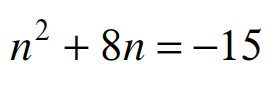
n² - 2n = 0
a)
n = 2 and 0
b)
n = -2 and 0
c)
n = 2
d)
n = 0
72.

Solve.

x² +12 = 5

a)

x = ± 49

b)

No Real Solutions

c)

x = ± √7

d)

x = ± 3.5i

73.
Solve by taking square roots:
5m2 + 1 = 6
a)
m = 0
b)
m = 1 or -1
c)
m = √7
d)
m = 7/5 m = -7/5
74.

What is the formula above primarily used for?

a)

Finding the axis of symmetry from standard form

b)

Finding the vertex from standard form

c)

Finding the vertex from vertex form

d)

Finding the y intercept from standard form

75.
What is the vertex?
a)
(2, 4)
b)
(3, -1)
c)
(0, 8)
d)
(4, 2)
76.
The graph of a quadratic function is called a
a)
Parabola
b)
Vertex
c)
Axis of Symmetry 
d)
Vertex Form
77.
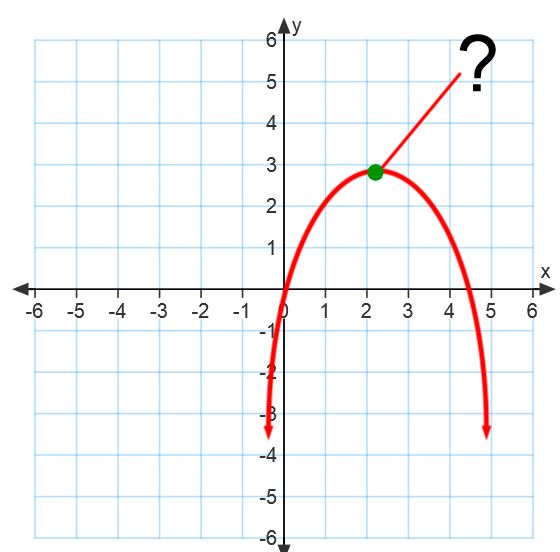
What is the green dot on the parabola called?
a)
maximum
b)
minumum
c)
roots
d)
zeros
78.
What is another word for zeros?
a)
y-intercepts
b)
roots
c)
vertex
d)
axis of symmetry
79.
If the graph of a quadratic does not intercept the x axis at any point, then it has:
a)
1 Real Solution
b)
2 Real Solutions
c)
Half a Solution
d)
No Real Solution
80.
The quadratic equation can be used to solve quadratic equations that cannot be factored.
a)
True
b)
False
81.
The discriminant is
a)
aX2  + bX  +  c
b)
b - 4ac
c)
b2 - 4ac
d)
b2 + 4ac
82.
If the discriminant equals 0, then the quadratic has:
a)
1 Real Solution
b)
2 Real Solutions
c)
Half a Solution
d)
2 Imaginary Solutions
83.
If the discriminant is positive, then the quadratic has:
a)
1 Real Solution
b)
2 Real Solutions
c)
Half a Solution
d)
2 Imaginary Solution
84.
Solve using the quadratic formula.
2x2 - 9x - 35 = 0
a)
x = 7/2, x = -6
b)
x = -5/2, x =5
c)
x = -3/7, x =6
d)
x = -5/2, x = 7
85.
Solve using the Quadratic Formula:
x2 + 4x + 3 = 0
a)
x = 1 and x = 3
b)
x = 6 and x = -2
c)
x = -1 and x = -3
86.
Solve using the quadratic formula.
2x2 - 9x - 35 = 0
a)
x = 7/2, x = -6
b)
x = -5/2, x =5
c)
x = -3/7, x =6
d)
x = -5/2, x = 7
87.
.How many zeros does this parabola have? 
a)
3
b)
2
c)
0
d)
1
88.
What is the degree of the monomial?
a)
3
b)
2
c)
1
d)
5
89.
What is the degree of the monomial?
a)
5
b)
3
c)
8
d)
9
90.
What is the degree of the monomial?
a)
2
b)
4
c)
6
d)
7
91.

What is the degree of the monomial ? 2x

a)

0

b)

1

c)

2

d)

3

92.

What is the degree of the monomial? 47

a)

0

b)

1

c)

2

d)

11

93.

What is the degree of the monomial? -6ab

a)

2

b)

3

c)

0

d)

1

94.

What is the standard form of the polynomial function

p(x) = - 2x4 + x6 + 3x + 1 ?

a)

p(X) = x6 - 2x4 + 3x + 1

b)

p(x) = 1 + x6 - 2x4 + 3x

c)

p(x) = x6 - 2x4 + 1 + 3x

d)

p(x) = - 2x4 + 3x + x6 + 1

95.

What is the standard form of the polynomial function

p(x) = 8x2 + 4x + 3x6 + 3 ?

a)

p(X) = 3x6 + 3 + 8x2 + 4x

b)

p(x) = 3x6 + 8x2 + 3 + 4x

c)

p(x) = 3x6 + 8x2 + 4x + 3

d)

p(x) = 3x6 + 3 + 4x + 8x2

96.

what is the degree of the polynomial

p(x) = 20x + 14x2 + 2x3

a)

20

b)

14

c)

3

d)

2

97.

what is the leading coefficient of the polynomial

p(x) = 20x + 14x2 + 2x3

a)

20

b)

14

c)

3

d)

2

98.

What is the name of this polynomial?

x2−7x+6x^2-7x+6  

a)

Constant Trinomial

b)

Linear Monomial

c)

Quadratic Binomial

d)

Quadratic Trinomial

99.

Which one of these polynomials is a Cubic Binomial?

a)

2x3−3x2+4x−22x^3-3x^2+4x-2

b)

2x32x^3

c)

5x3+85x^3+8

d)

3x2−4x+123x^2-4x+12

100.
Classify:
2x⁴+14x³−2x²
a)
Monomial
b)
Binomial
c)
Trinomial
d)
Polynomial
101.
Classify:
2n³
a)
Monomial
b)
Binomial
c)
Trinomial
d)
Polynomial
102.
Classify:
x³ + 3x
a)
Monomial
b)
Binomial
c)
Trinomial
d)
Polynomial
103.
Name and Classify the Polynomial:
3x²y + x + y
a)
quadratic trinomial
b)
cubic trinomial
c)
linear binomial
d)
quadratic binomial
104.
Name and Classify the Polynomial:
x² − 4
a)
quadratic binomial
b)
quadratic monomial
c)
linear binomial
d)
linear monomial
105.
What is the name for this polynomial? 3z
a)
Constant Monomial
b)
Linear Binomial
c)
Linear Monomial 
d)
Bionic Monomial
106.
What is the name of this polynomial? 6a4 + 7a3 + 8
a)
Linear Trinomial
b)
4th Degree Binomial
c)
2nd Degree Trinomial
d)
Quartic Trinomial 
107.
What is the name of this polynomial? 3x5 + 2
a)
Quintic Binomial
b)
5th Degree Monomial
c)
5th Degree Trinomial 
d)
Quintic Polynomial with Four Terms
108.
What is the name of this polynomial? 4x3 - 2x2 + 7x - 3
a)
Septic Polynomial with Four Terms
b)
Quadratic Polynomial with Four Terms
c)
Quintic Polynomial with Four Terms
d)
Cubic Polynomial with Four Terms
109.
If a polynomial is a constant, its degree is...
a)
1
b)
0
c)
-1
d)
98
110.
How many terms are in a binomial?
a)
0
b)
1
c)
2
d)
4
111.
What is the degree of this polynomial: 5x6 + 3x2 - 8x10
a)
2
b)
10
c)
6
d)
8
112.
If a polynomial is considered linear, its degree is... 
a)
2
b)
3
c)
1
d)
98
113.
Find the sum.
(3y2 + y3 - 5) + (4y2 -4y + 2y3 + 8)
a)
3y3 + 7y2 - 4y + 3
b)
4y2 + 3y3 - y + 3
c)
-y4 + 2y3 -y - 4
d)
4y3 + 3y2 -3y + 1
114.
Find the difference.
(7p + 4p3 - 8) - (-3p2 + 2 - 9p)
a)
-3p2 + 4p3 -15 + 9
b)
3p3 + 4p2 - p + 3
c)
4p3 -3p2 +16p -10
d)
4p3 +3p2 + 16p + 10
115.
Simplify the expression.
-3x2( 7x2 - x + 4)
a)
-21x4 + 3x3 -12x2
b)
7x2 - x + 4 (-3x2)
c)
21x4 + 3x3 + 12x2
d)
-12x2 + 3x3 -21x4
116.
Multiply.
(b+3)(b2+2b+1)
a)
b3+6b2+6b+3
b)
b3+5b2+7b+3
c)
4b3+8b2+3b
d)
3b3+6b2+3b
117.
Simplify:
(3x - 5) ( 4x2 - 2x - 3)
a)
12x3 - 26x2 - 25x + 15
b)
12x3 - 20x2 - 5x + 15
c)
12x3 - 20x2 - 6x + 15
d)
12x3 - 26x2 + x + 15
118.
Find the product:
(5n-8)(5n+8)
a)
25n2-64
b)
10n2
c)
5n2+16
d)
16
119.
Find the product:
(7r+5)(5r+3)
a)
35r2+46r+15
b)
12r+8
c)
78r3+15
d)
35r2+20r+15
120.
a)
1/m2
b)
m2
c)
m8
d)
1/m8
121.
a)
5p2 - 16p
b)
5p + 4
c)
5p - 4
d)
5p + 4p
122.
a)
4y6
b)
4y22
c)
30y6
d)
30y22
123.
Divide the polynomial by the monomial.
a)
15x9 - 8x3
b)
3x6 - 8x3
c)
-5x12
d)
3x6 - 40x3
124.
Simplify:
a)
2
b)
4√3
c)
2√3
d)
4
125.
a)
A
b)
B
c)
C
d)
D
126.
a)
A
b)
B
c)
C
d)
D
127.
Will my line be solid?
5 ≥ x
a)
Yes
b)
No
128.
Which point below is NOT part of the solution set?
a)
(0, 0)
b)
(5, 1)
c)
(-1, -3)
d)
(20, -5)
129.
Select the correct graph for each inequality.
a)
A
b)
B
c)
C
d)
D
130.
Match the system to the graph (solution set is on the left)
a)
y ≤ 3x   and  y ≤ -2x + 4
b)
y > 3x   and  y > -2x + 4
c)
y < 3x   and  y > -2x + 3
d)
y > 3x   and  y < -2x + 4
131.
Which of the following is not a solution to this system of inequalities?
a)
(0,-1)
b)
(0,3)
c)
(4,0)
d)
(6,-2)
132.
Which system of inequalities matches the graph?
a)
y > 2x - 4
y < 2
b)
y < 2x - 4
y < 2
c)
y > 2x - 4
y <  2 
d)
y < 2x - 4
y <   -2
133.
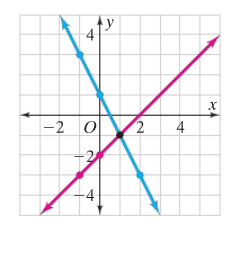
What is the solution to this system?
a)
(1, -1)
b)
(-1, 1)
c)
(0, -2)
d)
(2, 0)
134.
When you graph the exact same equation twice,
a)
you will have no solution. 
b)
you will have one solution.
c)
you will have infinite solutions. 
d)
you will graph a giraffe. 
135.
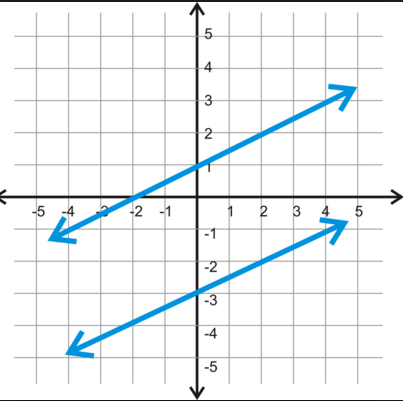
How many solutions will this system have? 
a)
No solution
b)
One Solution
c)
I Don't Know
d)
Infinitely Many Solutions
136.
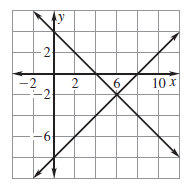
What is the solution to the system?
a)
(3, -1)
b)
(2, -6)
c)
No Solution 
d)
(6, -2)
137.
The solution to the system is
a)
(-2, -8)
b)
(-8, -2)
c)
(2, -8)
d)
No solution
138.
Solve the following system by graphing.  What is the solution?
a)
(3, -2)
b)
(3, -3)
c)
(-3, 2)
d)
(-3, -2)
139.
Solve the following system by graphing.  What is the solution?
a)
Infinity
b)
(3, 3)
c)
(3, -3)
d)
(-3, 3)
140.
What is the solution?
a)
(1, -1)
b)
(-1, 1)
c)
(0, -2)
d)
(0, 1)
141.
Solve the following system by graphing.  What is the solution?
a)
Infinite number of solutions
b)
(3, 3)
c)
(3, -3)
d)
(-3, 3)
142.
What is the solution to this system?
a)
(1, -1)
b)
(-1, 1)
c)
(0, -2)
d)
(2, 0)
143.
When you graph the exact same equation twice,
a)
you will have no solution. 
b)
you will have one solution.
c)
you will have infinite solutions. 
d)
you will graph a giraffe. 
144.
How many solutions will this system have? 
a)
No solution
b)
One Solution
c)
I Don't Know
d)
Infinitely Many Solutions
145.
What is the solution to the system?
a)
(3, -1)
b)
(2, -6)
c)
No Solution 
d)
(6, -2)
146.
The solution to the system is
a)
(-2, -8)
b)
(-8, -2)
c)
(2, -8)
d)
No solution
147.
Solve the following system by graphing.  What is the solution?
a)
(3, -2)
b)
(3, -3)
c)
(-3, 2)
d)
(-3, -2)
148.
Solve the following system by graphing.  What is the solution?
a)
Infinity
b)
(3, 3)
c)
(3, -3)
d)
(-3, 3)
149.
What is the solution?
a)
(1, -1)
b)
(-1, 1)
c)
(0, -2)
d)
(0, 1)
150.
Solve the following system by graphing.  What is the solution?
a)
Infinite number of solutions
b)
(3, 3)
c)
(3, -3)
d)
(-3, 3)
151.

Which graph is an exponential function?

a)

red

b)

blue

c)

green

d)

none

152.

Which graph corresponds to the exponential function y=4xy=4^x  ?

a)
b)
c)
d)
153.

This is an example of....

a)

an increasing exponential function

b)

a decreasing exponential function

c)

an increasing linear function

d)

none of the above

154.
Solve: 98-x = 27x-3
a)
x = 5
b)
x = -5
c)
x = 1/5
d)
x = -1/5
155.
Solve: 7-x = 49
a)
x = 1
b)
x = -1
c)
x = 2
d)
x = -2
156.
Sovle for x:
5-3x - 1 = 25
a)
x = -1
b)
x = -4
c)
x = -3
d)
x = 1
157.
Solve for x:
32x = 27x - 4
a)
x = 12
b)
x = 4
c)
x = -4
d)
x = 1
158.
Solve 33 = 34x + 2
a)
x = ¼
b)
x = -¼
c)
x = ½
d)
x = -½
159.
Solve 8 = 25x+7
a)
x = ⅘
b)
x = ¼
c)
x = -⅘
d)
x = -¼
160.
Solve for v:
2-v - 3 = 1
a)
1
b)
6
c)
-8
d)
-3