
 Worksheets
Newton's & Coulomb's
Total questions: 51
Worksheet time: 52mins
Two factors affecting the magnitude of the force of gravity between 2 objects are...
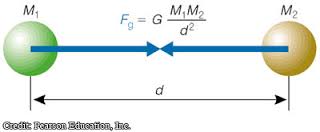

How is the gravitational force between to objects related to their mass
They are directly proportional
They are inversely proportional
They do not affect each other
They are equal

If the distance between 2 masses is increased then the force of gravitation between them will...
increase
decrease
stay the same

If the mass of either m1 or m2 is increased then the force of gravitation between them will...
increase
decrease
stay the same

Which of the following formulas is the correct equation for the law of Universal gravitation?
F=d2GM1M2
F=mg
F=m1m2Gd2
F= F=d2KQ1Q2
The reason why ocean tides happen is
Electrical forces between the sun and the moon
gravitational forces between the Earth and the moon.
Magnetic forces between the Earth and the moon
Motion of the moon around the earth
At what point is the force of gravity on an object greatest
At the center of the earth (Core of the earth)
At twice the distance from the surface of the earth
At the surface of the earth
The force of gravity ios the same irrespective of distance from the center of the earth
why does a bungee jumper feel weightless on their way down?
Because of Lack of support force as they fall
because they are really weightless
because their mass is negligible as they fall
because they are falling at constant velocity
Centripetal force, created by swinging something in a circle, acts in a direction--
along the path of motion
away from the center of the circle
toward the center of the circle
tangent to the circle

What did Newton say about the gravitational force between distant objects?
It is independent of distance
It is inversely related to distance squared
It is proportional to distance squared
It is inversely related to mass squared
It is zero, unless the objects are touching

Earth pulls satellite, and satellite pulls Earth. Which of the forces is stronger?
Earth pulling satellite
Satellite pulling Earth
Both the same
Not enough information to determine
Observers using different ___________________ may measure different velocities for an object in motion
frame of reference
relatives of motion
projectile motions
constant velocity
Coulomb's law says that the force between any two charges depends
directly on the size of the charges
inversely on the square of the distance between the charges
both are correct
According to Coulomb's Law, when the distance increases, the electrostatic force ____________.
increases
decreases
remains unchanged
has no relationship to distance
The Coulomb is the unit for:
Charge
Force
Distance
Mass

What happens to the force between two charged objects when you double the distance between them?
it doubles
it is cut in half
it quadruples
it is cut by 1/4
What is the unit for electrostatic charge?
Coulombs
Newtons
Meters
Joules
Coulomb’s law states that the force between two charged objects will __________ when the magnitude (value) of the object’s charge increases.
increase
decrease
stay the same
first increase, then decrease
The variable "r" in Coulomb's Law would have what units?
Joules
Coulombs
Newtons
Meters
Which is the value of the constant in Coulomb's equation?
ke = 9·10-9
ke = 9.8
ke = 6.67·10-11
ke = 9 ·109
What does "r" measure?
the distance between the two charged objects
the amount of charge carried by the objects
the amount of force between two charged objects
the constant value for forces between the objects
What does Fe stand for?
the electrostatic force
the symbol for iron
the constant for the charges
the charges of the particles
What will be the units of F (or Fe)?
Newtons
Meters
Coulombs
Joules

As the value of r increases, what happens to the value of F?
F increases
F decreases
F never changes, q does
Cannot know from the information
What does q measure?
the distance between the two charged objects
the amount of charge carried by the object
the amount of force between two charged objects
Why are there two q's in the equation?
because there are two charged objects
because there are protons and electrons
because the particles are moving away from each other
because the particles are moving towards each other
What can you do to increase the value of k?
change the force
change the distance
change the charge
nothing can be done to change the value of k; it is a constant
An attractive force exists between which two particles?
Two neutrons
An electron and a neutron
An electron and a proton
Two electrons
Coulomb's Law is __________ proportional.
directly
inversely
polymetrically
exponentially
Which setup of charged particles shown below has the two exert the most force on one another?


Since Coulomb's Law is written as
Fe=k⋅d2q1⋅q2 this means that as the distance between the two charged objects gets smaller, the electric force ---.gets weaker
gets stronger
changes unpredictably
does not change
One key difference between the way that Newton's Law of Universal Gravitation says gravity behaves and the way Coulomb's Law says the electric force behaves is ---.
there are two types of electric charge that can neutralize each other, but only one type of mass
the electric force depends on the distance between charges but the gravity force does not depend on the distance between masses
gravity can both attract and repel, but electric force can only attract
gravitational force can act over long distances, but electric force only acts over short (subatomic) distances

What direction will the charge in the middle move?
to the right
to the left
stay still
cannot be determined
Which of the following charges will attract each other?
-4 μC & -5 μC
4 μC & 5 μC
4 C & 5 C
-4 μC & 5 μC
Select Multiple Answers.
A negative force between two charges mean they:
Attract
Repel
Are the same sign
Are opposite signs

