
 Worksheets
Physics APA Review Quiz
Total questions: 56
Worksheet time: 5hrs 40mins

This graph shows the motion of a bus.
If the bus continues moving at the same speed, what is the total distance that it will have traveled in 7.5 minutes?
7500m/s
7500m
7000m
6500m

The graph illustrates the motion of an object moving in a straight line at constant speed.
What is the average velocity of the object?
4m/s
5m
5m/s
4m

A dune buggy is cruising along a beach. Its motion is recorded in the velocity versus time graph below.
What is the total distance the dune buggy traveled from 0 to 12 seconds?
100m
350m
440m
540m

A car moves along a test track in the + x-direction. The velocity versus time graph below records this, with line segments L through P identifying different stages of motion.
Which of the following correctly ranks the magnitudes of acceleration of the stages of motion of the car from greatest to least?
N > P > L > M
P > N > L > O
O > N > P > L
P > N > L > M
An airplane was moving 50 m/s to the north relative to the air at landing. The wind was blowing 5 m/s toward the south relative to the ground. What was the speed of the airplane relative to the ground at the time of landing?
40m/s
55m/s
50m/s
45m/s

To avoid a time delay, the larger jet refuels the smaller jet.
What must the speed of the two jets be relative to the ground?
The smaller jet must be faster to align with the fueling jet.
The fueling jet must be faster to avoid spilling.
The speed must change depending on altitude.
The speed must be the same for both jets.

A motorboat can travel 6 mph in still water. The diagram shows a person on the bank of a river observing a motorboat aimed upstream.
The person standing on the bank observes which motion of the motorboat?
The motorboat moves up the river at 6 mph.
The motorboat stays in the same place on the river.
The motorboat is pushed downriver by the water.
The motorboat will go 36 mph downriver if it turns around.
A heavy round rock and a light marble are simultaneously dropped from the same height. Why would they land at the same time?
Both are slowed equally by friction.
Both accelerate at the same rate.
They have equal kinetic energy.
They have equal volumes.

Spheres X and Y are rolling as shown.
Sphere Z rolls to the right at a rate of 1 m/s relative to Sphere X. What is the speed of Sphere Z relative to Sphere Y?
4 m/s
6 m/s
7 m/s
8 m/s
A car is moving at a constant speed of 16 kilometers per hour (km/hr) while traveling in a circle. Why is the velocity of the car changing?
because the direction of the car is changing
because the mass of the car is constant
because the speed is constant
because the time is changing
A 6-N force and an 8-N force act at a 90-degree angle to each other on the same object. What is the magnitude of the net force acting on the object?
(Hint use Pythagorean theorem)
2N
5N
10N
14N
A rock thrown to the right with an initial horizontal velocity of 4 m/s lands after 5 seconds. What horizontal distance has the rock traveled?
4m
9m
20m
100m
A driver in a car goes around a curve in the road. The radius of curvature for the road is 50.0 meters. The speed of the car is 24.6 m/s. What is the direction and magnitude of the centripetal acceleration on the driver during the turn?
4.92 m/s2, perpendicular to the car and pointing into the curve
4.92 m/s2, perpendicular to the car and pointing out of the curve
12.1 m/s2, perpendicular to the car and pointing into the curve
12.1 m/s2, perpendicular to the car and pointing out of the curve

What is the magnitude of the net force on the box?
5N
9N
4N
3N

Two forces act on a block that moves to the right with constant speed.
What is the magnitude of the force, F1, acting on the block?
5N
10N
15N
2N

The illustration shows the collision of two objects on a frictionless surface.
What is the velocity of the two connected objects after the collision?
15.3m/s
20m/s
12.5m/s
7.5m/s
What is the amount of force required to accelerate a 20 kg object at 5 m/s2?
17N
25N
4N
100N
Galileo designed experiments in which objects with different masses were dropped from the same height. Regardless of the mass, the objects appeared to hit the ground at the same time. What did Galileo conclude from these studies?
Acceleration due to gravity is independent of mass.
An object falls faster than another object that has lower weight.
The rate at which an object falls is inversely proportional to its mass.
The weight of an object is independent of its mass.
Physicists have described four basic forces in the universe. Which one of the four basic forces holds the protons together within the nucleus of the oxygen atom in a water molecule?
electromagnetic force
gravitational force
strong force
weak force
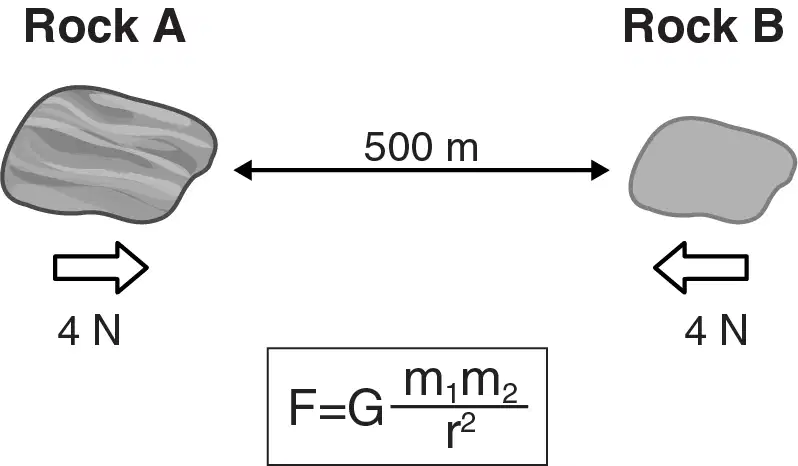
Two rocks are close to each other in space. An attractive force of 4 newtons (N) acts on each of the rocks.
If the distance between the rocks is reduced to 250 meters (m), what would be the force of attraction acting on each rock?
8N
16N
24N
32N
The gravitational force between the Sun and Earth is 179 times that of the gravitational force between Earth and the Moon. Which of the following is the main reason that the Moon has a stronger gravitational effect on Earth’s oceans and tides than does the Sun?
Mass plays a greater role in gravitational force than distance.
Distance plays a greater role in gravitational force than mass.
The mass of solids applies more gravitational force than the mass of gases.
The speed of the Moon’s orbit around Earth applies a stronger gravitational force on the oceans than does the Sun.
A robotic arm lifts a stack of cafeteria trays weighing 62 newtons (N). It moves the trays 2 meters (m). How much work has the robotic arm performed?
31J
17J
124J
64J

Students discussing the energy efficiency of a typical coal-burning power plant have drawn the diagram below. They must correctly label the input and output arrows that describe the energy conversion of the plant.
Which labeling is correct?
X: chemical energy out; Y: chemical energy in; Z: waste heat out
X: useful work out; Y: chemical energy in; Z: waste heat out
X: useful work out; Y: useful work in; Z: chemical energy out
X: waste heat out; Y: waste heat in; Z: chemical energy out
A book held 1 meter above the floor has potential energy. The book is dropped and hits the floor. Select all of the forms of energy into which the potential energy is converted.
Heat Energy
Sound Energy
Elastic Energy
Kinetic Energy
Chemical Energy
A wind power project has been proposed for the coastline in St. Lucie County. Windmills would be used to produce energy by converting wind energy into electricity. Electricity would be produced from which energy of the wind?
Potentinal
Chemical
Kinetic
Solar
A 10-kg rock falls from a height of 8.0 m above the ground. What is the kinetic energy of the rock just before it hits the ground?
80 J
98 J
320 J
780 J
What is the approximate momentum of a car with a mass of 1.20 × 10³ kg and a velocity of 30.0 km/h?
13.0 N.s
40.0 N.s
3.60 × 10⁴ N.s
5.40 × 10⁴ N.s
Which of the following explains the relationship between work and power when running or walking up a flight of stairs?
Running requires more work and more power than walking
Running requires less work and less power than walking.
Running requires the same amount of power, but more work than walking.
Running requires the same amount of work, but more power than walking.
A 3.00-kg cart with an initial velocity of +4.00 m/s collides inelastically with a 5.00-kg cart with an initial velocity of +2.00 m/s. The carts stick together when they collide. What is their speed after colliding?
0.75 m/s
2.00 m/s
2.75 m/s
3.00 m/s

A student did an experiment with a coffee heater to find out how efficiently 250 milliliters of water could be heated with electricity. The apparatus is shown.
The student heated the water for 600 seconds using electrical energy supplied at a rate of 150 joules per second. The water gained 73,200 joules of energy. How much energy was transferred to the surroundings?
350 J
488 J
16800 J
35700 J
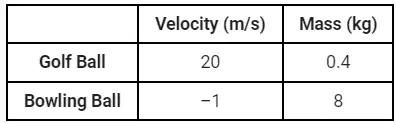
The table below shows the velocity and the mass of a golf ball and a bowling ball.
The golf ball and bowling ball undergo an elastic collision. What is the total momentum and energy of the system after the collision?
p=16 kg m/s , KE=84 J
p=16 kg m/s , KE= -74 J
p=0 kg m/s , KE= -74J
p=0 kg m/s , KE=84 J
A basketball bounces on the gym floor nine times and finally comes to a rest. Which of these BEST explains why the basketball rises to a lower height each time it bounces?
Gravity increases as the basketball bounces.
The floor adds energy to the bouncing basketball.
Energy is transferred from the basketball to the floor.
The air inside the basketball is heavier than the surrounding air.
A glass of water left in the sun becomes warm. Estella adds ice to the water to make it cool. What energy change occurs when ice is added to the warm drink?
The water loses heat to the ice, causing the ice to melt.
The water absorbs the cold temperature from the ice.
Since the ice is cold, it adds cold to the environment.
The melting ice causes the water to expand, cooling it.
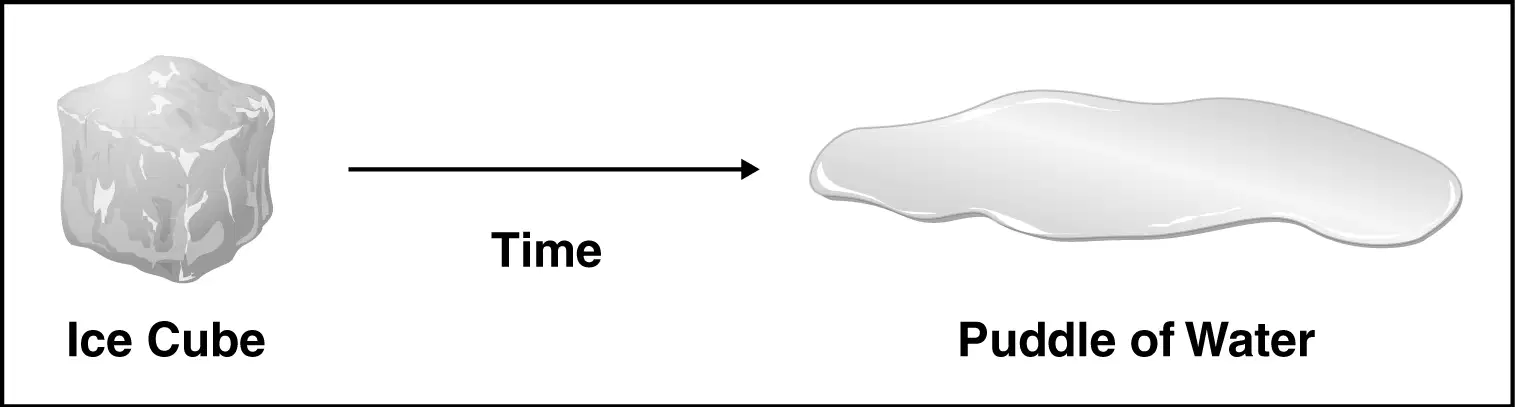
Entropy is a measure of the amount of disorder in a system. The concept of entropy can be applied to an ice cube melting.
Which statement BEST describes the puddle of water?
It is at minimum entropy and minimum order.
It is at maximum entropy and minimum order.
It is at minimum entropy and maximum order.
It is at maximum entropy and maximum order.
Computers have devices called heat sinks designed to lower the temperature of a computer by scattering produced heat into the surrounding area. Which type of energy is kept away from a computer by a heat sink?
electrical
chemical
thermal
nuclear
Select all media that can transmit a mechanical wave.
air
metal bar
rope
vacuum
water
What factor determines the pitch of a sound wave?
amplitude
frequency
speed
phase difference
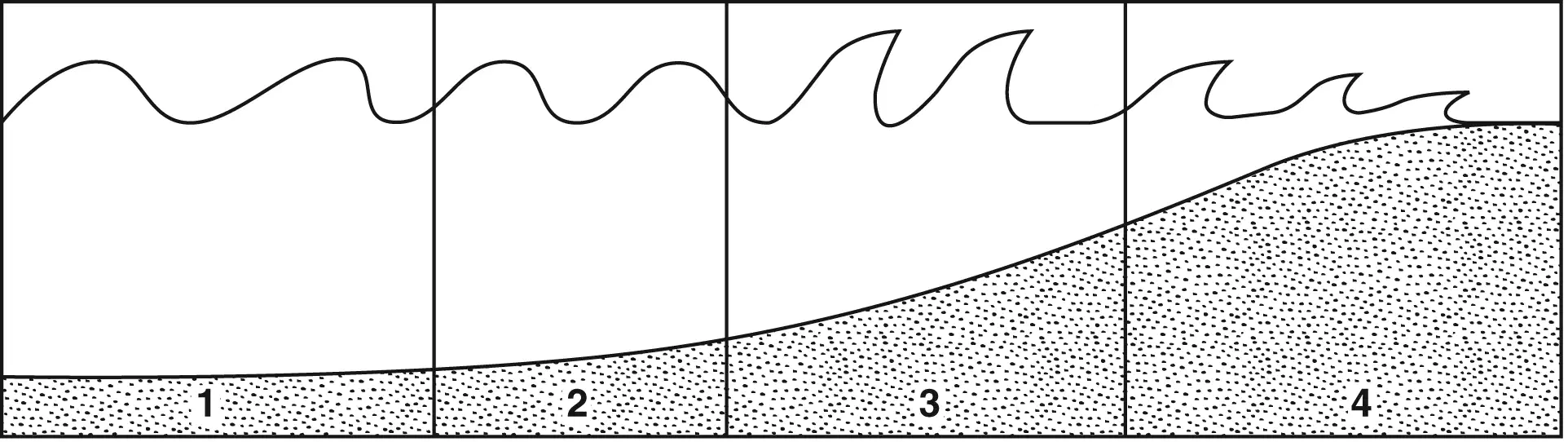
The diagram illustrates the interaction of waves with the ocean floor.
Which zone shows waves with the longest wavelength?
Zone 1
Zone 2
Zone 3
Zone 4
What is the frequency of a wave that travels 20 m/s with a wavelength of 200 meters?
0.20 Hz
0.10 Hz
10 Hz
4000 Hz
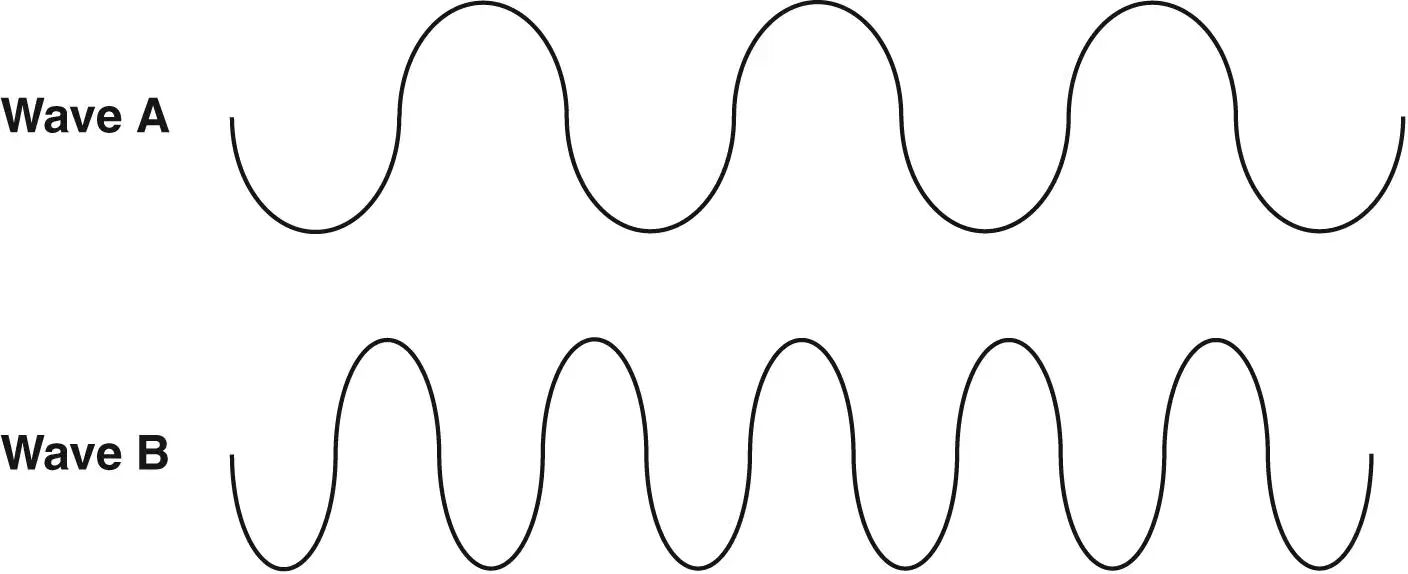
Two waves have the following waveforms.
Which conclusion can BEST be supported by the illustrations?
Wave A has higher frequency.
Wave A is an ultraviolet wave.
Wave B has greater energy.
Wave B is a visible light wave.
The frequency of a wave is measured in
Hertz
meters
hertz/second
meters/second.
Select all of the examples of a transverse wave.
light from a star
sound from a tuning fork
vibration of a guitar string
signal from a radio antenna
ripple on the surface of a pond
An apple appears red when struck by white light. This appearance is because the red light is reflected and the other colors are absorbed. What color will this apple appear to be when struck by blue light?
Black
Blue
Red
White
During the Doppler effect, which property of the sound wave changes?
amplitude
direction
energy
frequency
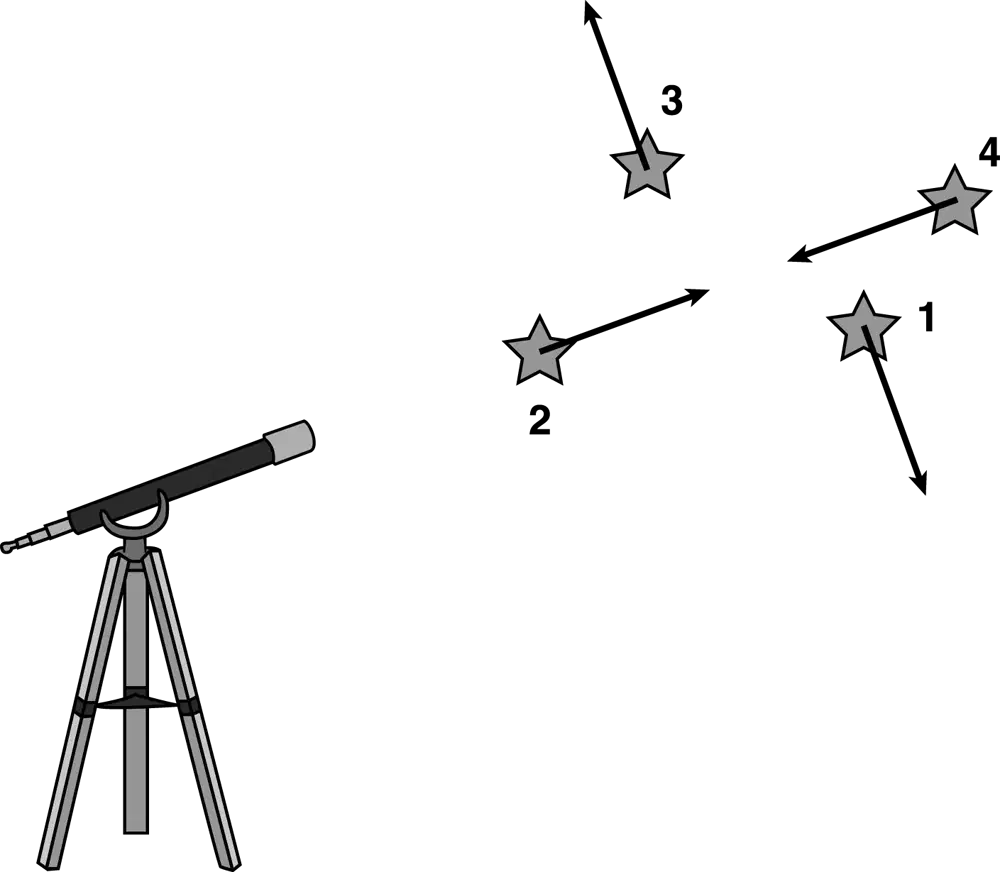
If an astronomer were to study the light from these four stars, in which star would the astronomer see greatest redshift of its light spectra?
Star 1
Star 2
Star 3
Star 4
Which of the following explains sound resonance?
At a position in space, two sound waves interfere constructively and produce a louder sound.
An object vibrating at a second object’s natural frequency forces the second object to vibrate.
At a position in space, two sound waves interfere deconstructively and produce an absence of sound.
An object’s motion towards an observer causes sound waves it emits to have a higher perceived frequency.
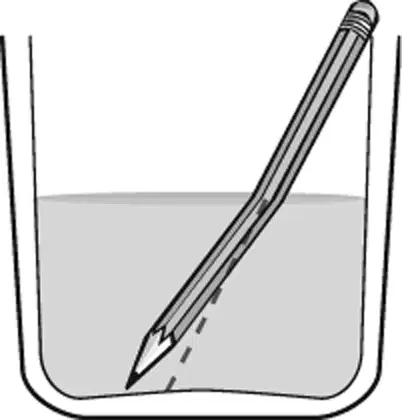
When a pencil is placed in a cup of water, the pencil looks bent.
reflection
refraction
interference
diffraction
A candle is 10 cm in front of a plane mirror. What is the apparent distance between the object and its image?
0 cm
5 cm
10 cm
20 cm

Which of the following describes the pairs of magnets?
The magnets in pair B are oppositely magnetized and have more single electrons in their outer shells since they have a stronger magnetic moment and magnetic field.
The magnets in pair A are oppositely magnetized and have fewer single electrons in their outer shells since they have a weaker magnetic moment and magnetic field.
The magnets in pair A are oppositely magnetized and have more single electrons in their outer shells since they have a stronger magnetic moment and magnetic field.
The magnets in pair B are oppositely magnetized and have fewer single electrons in their outer shells since they have a weaker magnetic moment and magnetic field.

The student places each magnet the same distance above a pile of metal paper clips and records the maximum number of paper clips each magnet collects. Based on the magnetic field lines shown, which magnet(s) will pick up the most paper clips?
Magnet A will collect the most paper clips since it has the most field lines, indicating it has the strongest magnetic field. Magnet B will collect the least number of paper clips since it has the least number of field lines.
Magnet D will collect the most paper clips since it has the most field lines pointing inward, indicating it has the strongest magnetic field. Magnet C will collect the least number of paper clips since it has the least number of field lines that push metal out.
Magnet A will collect the most paper clips since it has the most field lines pointing outward, indicating it has the strongest magnetic field. Magnet B will collect the least number of paper clips since it has the least number of field lines and will not pull metal in.
Magnets A and D will collect the most paper clips since they have the most field lines regardless of direction, indicating they have the strongest magnetic fields. Magnet C will collect the least number of paper clips since it has the least number of field lines.
Three resistors are connected in a combination of series and parallel. Resistor R1 is in series with the combination of resistors R2 and R3 in parallel. The resistors have resistance R1 = 15 Ω, R2 = 13 Ω, and R3 = 9 Ω. Determine the equivalent resistance of the combination of resistors.
9.70 Ω
20.3 Ω
15.2 Ω
20.6 Ω

Students are creating circuits using household items. The students create four setups. Each setup starts with a battery, a wire, and a variable object. The wire connects both sides of the battery to the variable object. The battery has internal resistance to avoid overheating.
The wire composition and variable objects used are listed in the table.
Which of the following is correct about the functionality of the setups?
Setup D is the only circuit that will function because it is the only wire made of a conductive material, and the current will flow through the resistors in series.
Setup C will function because the wire is made of a conductive material and the ionic solution conducts electricity, so current will flow.
Setup B will function better than setup D because resistors in parallel allow less current to flow through the circuit than resistors in series.
Setups B and C will function because the wires are made of highly conductive materials, and both variable objects allow current to flow.

A battery is placed in a circuit with four resistors. The electric field between the battery terminals forces the movement of charged particles along the wire.
Which of the following correctly labels the parts of the circuit, in order from A to E?
battery; direction of electron flow; resistors in parallel; resistors in series; direction of current
resistor; direction of current; resistors in parallel; resistors in series; direction of electron flow
battery; direction of electron flow; resistors in series; resistors in parallel; direction of current
battery; direction of current; resistors in series; resistors in parallel; direction of electron flow
Choose the option that identifies the correct terms, in order of their appearance in the sentences.
Electrons have a __________ charge. Protons have a __________ charge. Neutrons have __________ charge, and are found within the __________, along with __________. In a model of the electric force field between two charged objects, the vectors point away from each other for _____ charges. For ____ charges, the vectors point towards each other.
positive; negative; zero; nucleus; protons; opposite; like
negative; positive, zero; nucleus; protons; like; opposite
zero; positive; negative; nucleus; protons; opposite; like
zero; positive; negative; electron cloud; electrons; like; opposite

The image shows an electric field diagram for various point charges. Choose the option that labels charges 1-4 as positive or negative, and weak or strong, in order from left to right.
strong, negative; strong, positive; weak, positive; weak, negative
weak, positive; strong, negative; strong, positive; weak, negative
strong, neutral, strong, positive; weak, negative; strong, negative
weak, positive; strong, neutral; strong, negative; weak, negative
Two particles are interacting with each other. The objects are separated by 5.00 m. The charge of the first particle is -60.0μC . The charge of the second particle is -80μC .What is the magnitude of the total force experienced by either particle?
8.63 N
1.73 N

