
 Worksheets
Unit 8 Test Review (Nuclear Physics)
Total questions: 59
Worksheet time: 3590secs
Name
Class
Date
1.
The rate at which a radioactive element decays is its ____.
a)
quarter life
b)
whole life
c)
wonderful life
d)
half life
2.
Energy in the sun is produced as a result of nuclear ____ reactions.
a)
fusion
b)
fission
c)
waste
d)
sub
3.
Neutrons released in a fission reaction can strike other nuclei and cause a
a)
meltdown
b)
take down
c)
break down
d)
chain reaction
4.
Both a fusion reaction and a fission reaction produce
a)
heat (energy)
b)
light
c)
sound
d)
magnetism
5.
The three types of nuclear radiation in order of increasing penetrating power are
a)
alpha, beta, gamma
b)
alpha, gamma, beta
c)
beta, alpha, gamma
d)
gamma, alpha, beta
6.
The process by which nuclei having small masses are united to form a single larger nucleus is called nuclear ____.
a)
fusion
b)
fission
c)
reactivity
d)
waste
7.
Name the type of radioactive particle that can be stopped by a sheet of paper.
a)
alpha
b)
beta
c)
gamma
d)
lambda
8.
Name the most penetrating type of radiation.
a)
alpha
b)
beta
c)
gamma
d)
lambda
9.
What makes something radioactive?
a)
elements with an atomic number above 81
b)
an unstable nucleus
c)
contaminated sewage
d)
It decays over time
10.
If the half life of a radioactive element is 100yrs, how long would it take for the radioactivity to reduce by one half?
a)
200yrs
b)
100yrs
c)
50yrs
d)
300yrs
11.
What is nuclear fission?
a)
Big nucleus splits to small nuclei
b)
Small nuclei fuse into a bigger nucleus
c)
Stars
d)
Making compounds
12.
Barium-122 has a half-life of 2 minutes. A fresh sample weighing 80 g was obtained. If it takes 10 minutes to set up an experiment using barium-122, how much barium-122 will be left when the experiment begins?
a)
0.25g
b)
2.5g
c)
25g
d)
80g
13.
After the third half-life, how much of the sample is left?
a)
1/2
b)
1/3
c)
1/16
d)
1/8
14.
_______________ is the process by which unstable atoms emit radiation until they become stable.
a)
Radiation
b)
Chemical Reaction
c)
Radioactive Decay
d)
Isotopes
15.
The half life of a radioactive substance:
a)
increases with time
b)
increases then decreases with time
c)
decreases with time
d)
stays the same with time
16.
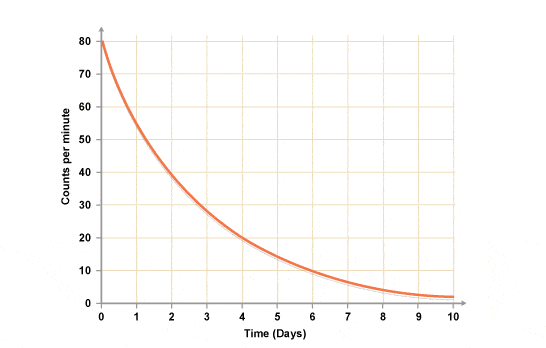
what's the half life of this substance?
a)
1 day
b)
2 days
c)
3 days
d)
4 days
17.

An isotope of an element has the same number of _________, but a different number of _________.
a)
Protons, electrons
b)
Protons, neutrons
c)
Electrons, neutrons
18.

What type of radioactive decay is shown here?
a)
Alpha decay
b)
Beta decay
c)
Gamma decay
19.

Which type of radiation releases an electron?
a)
Alpha radiation
b)
Beta radiation
c)
gamma radiation
20.

What particle is released when an unstable isotope undergoes alpha radiation?
a)
an helium nucleus
b)
an electron
c)
a photon of light
21.
Which process involves the splitting of large nuclei?
a)
alpha decay
b)
nuclear fusion
c)
beta decay
d)
nuclear fission
22.
What type of nuclear reaction occurs in the Sun?
a)
Nuclear fission
b)
beta decay
c)
alpha decay
d)
Nuclear fusion
23.
Which is NOT a characteristic of gamma radiation?
a)
High energized photon of light
b)
Can be stopped by a sheet of aluminum foil
c)
Is the most harmful type of radiation to humans
d)
Our use of protection is concrete, or several inches of lead
24.

What type of decay is shown here
a)
alpha decay
b)
beta decay
c)
gamma decay
25.
Name the most penetrating type of radiation.
a)
alpha
b)
beta
c)
gamma
d)
lambda
26.

In order of most to least penetrating radiation we have
a)
Alpha , Beta, Gamma
b)
Beta , Gamma , Alpha
c)
Gamma, Beta, Alpha
d)
Gamma, Alpha, Beta
27.
What makes something radioactive?
a)
elements with an atomic number above 81
b)
an unstable nucleus
c)
contaminated sewage
d)
It decays over time
28.
Alpha particles have...
a)
positive charged
b)
negative charged
c)
no charge
d)
radioactive charge
29.
Gamma particles have....
a)
positive charge
b)
negative charge
c)
neutral charge
d)
no charge
30.
Beta particles are...
a)
negatively charged
b)
no charge
c)
back at it again with the white vans
d)
positively charged
31.
In relation to the original atom, the atom that results from beta decay has an atomic number that is
a)
1 less
b)
1 more
c)
2 less
d)
the same
32.
A helium nucleus with two protons and two neutrons is called a(n) ____ particle
a)
alpha
b)
beta
c)
gamma
d)
lambda
33.
Neutrons released in a fission reaction can strike other nuclei and cause a
a)
meltdown
b)
take down
c)
break down
d)
chain reaction
34.
Each element with an atomic number greater than 83 is ____.
a)
stable
b)
synthetic
c)
lighter than air
d)
radioactive
35.
What fraction of radioactive atoms are left after 2 half lives?
a)
1 / 2 (half)
b)
1 / 4 (quarter)
c)
1 / 8 (eighth)
d)
1 / 6 (sixth)
36.
What fraction of radioactive atoms are left after 3 half live?
a)
1 / 2 (half)
b)
1 / 4 (quarter)
c)
1 / 8 (eighth)
d)
1 / 6 (sixth)
37.
What is nuclear fusion?
a)
Big nucleus splits to small nuclei
b)
Small nuclei fuse into a bigger nucleus
c)
Breaking compounds down
d)
Making compounds
38.
Alpha makes the atomic number decrease by how many?
a)
1
b)
2
c)
3
d)
5
39.
The half-life of Zn-71 is 2.4 minutes. If one had 100.0 g at the beginning, how many grams would be left after 7.2 minutes has elapsed?
a)
100.0g
b)
50.0g
c)
12.5g
d)
8.5g
40.

Which type of radioactive decay is occurring in this equation?
a)
Alpha decay
b)
beta decay
c)
gamma decay
d)
positron emission
41.
Beta particles have a _____ charge
a)
+1
b)
0
c)
-1
d)
+2
42.
Alpha particles have a _____ charge.
a)
+2
b)
0
c)
+1
d)
-1
43.
Takes two small nuclei and combines them into a larger nucleus
a)
fission
b)
fusion
44.
How many protons are present in one atom of carbon?
a)
6
b)
12
c)
7
d)
8
45.

Mass number of atom shown is
a)
3
b)
6
c)
9
d)
12
46.

How many protons and neutrons in 24X50 [Hint: Protons is the ATOMIC NUMBER or Number of the BOTTOM]
a)
P = 24 N = 50
b)
P = 24 N = 26
c)
P = 26 N = 24
d)
P = 50 N = 24
47.
Gamma rays damage human cells/tissue.
a)
True
b)
False
48.
If we start off with element 24X50 after an alpha decay we get another element Y that looks like
a)
22Y50
b)
22Y46
c)
20Y48
d)
26Y54
49.
TRUE or FALSE: gamma changes the atomic number.
a)
True
b)
False
50.
Isotopes of the same element have different ____________.
a)
numbers of protons
b)
numbers of electrons
c)
symbols
d)
numbers of neutrons
51.
When nuclei decay, massive amounts of __________ is released.
a)
energy
b)
electrons
c)
protons
d)
neutrons
52.
What is an alpha particle?
a)
2 protons
b)
2 neutrons
c)
2 protons & 2 neutrons
d)
hydrogen
53.
Carbon-14 decays by emitting a beta particle, producing
a)
boron-14
b)
carbon-12
c)
nitrogen-14
d)
beryllium-10
54.
Carbon-14 decays by emitting a beta particle, producing
a)
boron-14
b)
carbon-12
c)
nitrogen-14
d)
beryllium-10
55.
What is emitted when radium-226 decays to radon-222
a)
an alpha particle
b)
a beta particle
c)
a positron
d)
a neutrino
56.
What is emitted when potassium-40 decays to calcium-40?
a)
an alpha particle
b)
a beta particle
c)
a positron
d)
a neutrino
57.
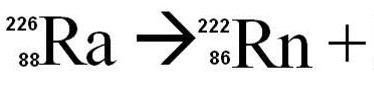
Complete the nuclear equation and determine the type of decay that is occurring in this reaction.
a)
alpha
b)
beta
c)
gamma
d)
none
58.
A helium nucleus with two protons and two neutrons is called a(n) ____.
a)
alpha particle
b)
electroscope
c)
beta particle
d)
gamma ray
59.
__________________is the time it takes for half of the radioactive atoms in an element to decay.
a)
dating range
b)
half life
c)
parent isotope
d)
daughter isotope
100 %

