wayground logo

Free Printable Worksheets

NEW

Font size

S
M
L
XL
Worksheets

Thermodynamics Review

Total questions: 60

Worksheet time: 1hrs 5mins

Name
Class
Date
1.

What is a conductor?

a)

a material that heat moves through easily

b)

a material that heat does not move through easily

c)

a material that turns cold when heated

d)

a tool for measuring temperature

2.

What is an insulator?

a)

a material that heat moves through easily

b)

a material that heat does not move through easily

c)

a material that turns cold when heated

d)

a tool for measuring temperature

3.

The faster molecules move,

a)

the higher the temperature

b)

the lower temperature

c)

the same temperature

4.

The slower molecules move,

a)

the higher the temperature

b)

the lower temperature

c)

the same temperature

5.

Temperature at which ALL molecules stop moving.

a)

100ºC

b)

0 K

c)

0ºC

d)

32ºF

6.
A measure of the average kinetic energy of the individual particles in an object is called:
a)
thermal energy
b)
conduction
c)
convection
d)
temperature
7.
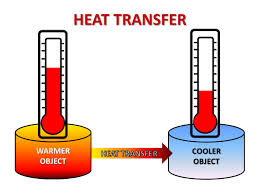
Heat transfers from an area of ____temperature to an area of ___ temperature.
a)
high to low
b)
low to high
c)
high to high
d)
It can travel high to low and low to high. 
8.
What is the definition of CONVECTION
a)
When heat transfers through waves.
b)
When heat transfers from objects that are touching.
c)
a  hot liquid or air that  expands, becomes less dense, and rises or becomes more dense, and sinks.
d)
Heat traveling from the sun
9.
Transfer of thermal energy through "space"
a)
conduction
b)
convection
c)
radiation
10.
Transfer of thermal energy through "flow"
a)
conduction 
b)
convection
c)
radiation
11.
Transfer of thermal energy through "touch"
a)
conduction
b)
convection
c)
radiation
12.

The amount of energy required to raise the temperature 1 K for every kilogram is called____?

a)

Thermal Energy

b)

Specific Heat

c)

Temperature

d)

Kinetic Energy

13.

What is the symbol for Thermal Energy?

a)

Q

b)

t

c)

m

d)

K

14.

What unit do you use to measure Thermal Energy?

a)

J/Kg*K

b)

Kg

c)

K

d)

J

15.

What is the symbol for Specific Heat

a)

Q

b)

t

c)

m

d)

c

16.

What does temperature measure?

a)

Potential Energy

b)

ºF

c)

Kinetic Energy

d)

Thermal Energy

17.

The units for specific heat are: Q=mcΔtQ=mc\Delta t  

a)

g /J C

b)

°C/g J

c)

kJ/g

d)

J/g°C

18.
What would be the effect on the particles if more heat is supplied to the system?
a)
They would slow down
b)
They would stop moving
c)
They would speed up
d)
There would be no effect
19.

If two objects have different temperatures when they come in contact, heat will flow from the warmer object to the cooler one UNTIL ____________

a)

one reaches a temperature of zero

b)

they both have an equal temperature

c)

one runs out of energy

20.

What is a tool that measures the heat of chemical reactions?

a)

calorimeter

b)

calorie

c)

Styrofoam™ cup

d)

thermometer

21.
Calorimeters use insulating materials to:
a)
encourage affordable materials in science experiments in schools.
b)
preserve the heat of the environment outside the Styrofoam cup.
c)
prevent heat from escaping to the environment.
d)
keep the liquid inside the Styrofoam cup from overheating.
22.

What does "ΔT" mean?

a)

A change in health

b)

A change in heat

c)

A change in height

d)

A change in temperature

23.

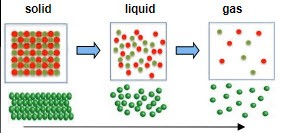
When thermal energy is increased in a solid, what change in state is happening?

a)

Melting

b)

Evaporation

c)

Freezing

d)

Condensation

24.

When thermal energy is decreased in a liquid, what change in state is happening?

a)

Melting

b)

Freezing

c)

Condensation

d)

Evaporation

25.

When thermal energy is decreased in a gas, what change in state is happening?

a)

Melting

b)

Freezing

c)

Evaporation

d)

Condensation

26.

Do particles (or the atoms) in a substance ever stop moving?!

a)

No

b)

Yes

27.

What happens to the movement of the particles in a substance when the thermal energy is decreased?

a)

Speed Up

b)

Slow Down

28.

What happens to the arrangement of particles as thermal energy is removed from a substance?

a)

The particles get farther apart.

b)

The particles get closer together.

29.
Dry ice is an example of what phase change.
a)
freezing
b)
melting
c)
vaporization/boiling
d)
sublimation
30.
Water vapor (a gas) forming frost (a solid) on the windshield of a car is an example of what phase change?
a)
melting
b)
sublimation
c)
condensation
d)
deposition
31.
What does "#1" represent on the graph? 
a)
solid phase
b)
melting
c)
liquid phase
d)
boiling 
32.
What does "#4" represent on the graph? 
a)
melting 
b)
liquid phase
c)
boiling
d)
gas phase
33.
What does "#2" represent on the graph? 
a)
solid phase
b)
melting
c)
liquid phase
d)
boiling
34.
What does "#5" represent on the graph? 
a)
solid phase 
b)
melting
c)
boiling
d)
gas phase
35.
What does "#3" represent on the graph? 
a)
melting
b)
liquid phase
c)
boiling
d)
gas phase
36.
Between what two points is the most energy being added to the system
a)
A -B
b)
B-C
c)
C-D
d)
D-E
37.
Which line segment demonstrates vaporization occurring?
a)
B-C
b)
C-D
c)
D-E
d)
E-F
38.
As substance goes from D to E what happens to the distance between the particles?
a)
particles get closer together
b)
particles disappear
c)
particles get far apart
39.
At what temperature is this substance melting?
a)
50C
b)
100C
c)
0C
40.
At point temperature does this substance finish melting?
a)
B
b)
C
c)
D
d)
E
41.
How long does it take this substance to change from a liquid to a gas?
a)
1 minute
b)
2 minutes
c)
10 minutes
d)
15 minutes
42.
Temperature is a measure of the...
a)
total energy in a substance
b)
total kinetic energy in a substance
c)
average potential energy in a substance
d)
average kinetic energy of molecules in a substance
43.
Heat transfer by conduction occurs when...
a)
particles bump into each other
b)
large numbers of atoms move from place to place
c)
atoms give off heat in the form of electromagnetic waves
d)
electromagnetic waves travel from place to place through a vacuum
44.
A substance with a high specific heat:
a)
Is always extremely hot.
b)
Requires a lot of energy to become hot.
c)
Is not heavy.
d)
Does not requires a lot of energy to become hot.
45.
The temperature of a glass of cold water will eventually...
a)
Match the temperature of the surrounding environment.
b)
Always be colder than the surrounding environment.
c)
Become warmer than the surrounding environment.
d)
Never change temperature.
46.
The first law of thermodynamics states that energy is
a)
created
b)
destroyed
c)
conserved
d)
created and destroyed
47.
Which law of thermodynamics states that absolute zero cannot be reached?
a)
1st
b)
2nd
c)
3rd
48.
How many laws of thermodynamics are there?
a)
a lot
b)
3
c)
4
d)
1
49.

I can't be created nor destroyed. What am I?

a)

energy

b)

air

c)

nothing

d)

a unicorn

50.
Entropy increases from solid, liquid to gas. Why?
a)
Molecular disorder increases
b)
Molecular randomness decreases
c)
Molecules are more energetic
d)
Molecules are more reactive
51.
The _____ Law of Thermodynamics says that heat always flows from an object with a higher temperature to an object of lower temperature naturally
a)
Zeroth
b)
First
c)
Second
d)
Third
52.
In physics, there is no such thing as
a)
heat
b)
cold
c)
energy
d)
temperature
53.
As a system becomes more disordered, entropy
a)
remains the same
b)
increases
c)
decreases
d)
cannot be determined
54.
What is "Entropy"?
a)
The tendency of objects to warm up
b)
The tendency of energy to spread out
c)
The tendency of energy to make heat
d)
The tendency of objects to do work
55.
In order for energy to be less concentrated what must be done?
a)
Heat released
b)
Reduce thermal energy
c)
Work
d)
Increase Radiation
56.

How does a refrigerator do Work?

a)

Moves heat from inside the fridge to the room

b)

Blows cold air into the fridge

c)

Uses convection cells

d)

It generates cold air

57.
It states that if two thermodynamic systems are each in thermal equilibrium with a third, then they are in thermal equilibrium with each other.
a)
First Law of Thermodynamics
b)
Second Law of Thermodynamics
c)
Third Law of Thermodynamics
d)
Zeroth Law
58.
At what temperature does water freeze in degrees Celsius?
a)
212 degrees
b)
100 degrees
c)
32 degrees
d)
0 degrees
59.
At what temperature does water boil in degrees Celsius?
a)
0 degrees
b)
37 degrees
c)
100 degrees
d)
212 degrees
60.

Which scale has no negatives units?

a)

Kelvin

b)

Celsius

c)

Fahrenheit

d)

My Scale