
 Worksheets
3/22/24 Magnetism & Electricity Test
Total questions: 60
Worksheet time: 30mins
What is magnetic force?
A force exerted by a magnet only when it physically touches an object
A force exerted by magnets that can be felt by objects around or near a magnet
A force exerted by electrically charged particles
A force exerted by magnets that makes an object become electrically charged
What is a magnet?
An object that produces magnetic force
An object that causes objects to become positively charged
An object that causes objects to become negatively charged
An object that attracts nonmetallic objects towards it
Magnetic objects are made of iron, nickel or cobalt
True
False
Complete the statement. The north pole of one magnet is __________ the south pole of a second magnet.
Attracted to
Repelled by
Attracted to or repelled by
Neither attracted to or repelled by
What is a magnetic material?
A material that produces a magnetic force
A material that is attracted to or repelled by a magnet
A material that becomes positively charged when a magnet is brought near it
A material that becomes negatively charged when a magnet is brought near it
How can you demagnetize a magnet?
By running a permanent magnet over it in different directions
By running a permanent magnet over it in the same direction
By heating, hammering or dropping it
By freezing it
What happens to the strength of magnetic field as you move away from the magnet?
The strength of the magnetic field increases
The strength of the magnetic field decreases
The strength of the magnetic field doesn’t change
What is responsible for creating a magnetic field around Earth?
Earth’s atmosphere
Earth’s crust
Earth’s mantle
Earth’s iron core
Earth’s magnetosphere is important because:
It deflects dangerous solar wind from the sun
It keeps us in orbit around the Sun
It keeps the moon in orbit around the Earth
It prevents extraterrestrial objects from crashing into Earth
Where is Earth’s magnetic South Pole located in relation to Earth’s geographic South Pole?
Earth’s magnetic South pole is located directly at Earth’s geographic South pole
Earth’s magnetic South pole is located ~10° from Earth’s geographic South pole
Earth’s magnetic South pole is located directly at Earth’s geographic North pole
Earth’s magnetic South pole is located ~10° from Earth’s geographic North pole
What type of particle exerts an electric force?
A positively charged particle
A negatively charged particle
A neutral particle
Both a and b
Complete the statement. Particles with opposite charges ________ and particles with the same (or like) charges ________.
Attract each other, repel each other
Repel each other, attract each other
Attract each other, attract each other
Repel each other, repel each other
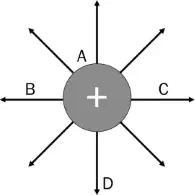
Where is electric strength the greatest around the positively charged particle?
A
B
C
D
Electric field lines always:
Point away from a positive charge and towards a negative charge
Point towards a positive charge and away from a negative charge
Point away from a positive or negative charge
Circle around a positive or negative charge
What happens if an object accumulates negative charges?
The object becomes positively charged
The object becomes negatively charged
The object tends to lose positive charges
The object becomes attracted to other objects that accumulate negative charges
Lightning is a powerful example of:
Accumulating electricity
Magnetic discharge
Electric discharge
Positive charges repelling negative charges
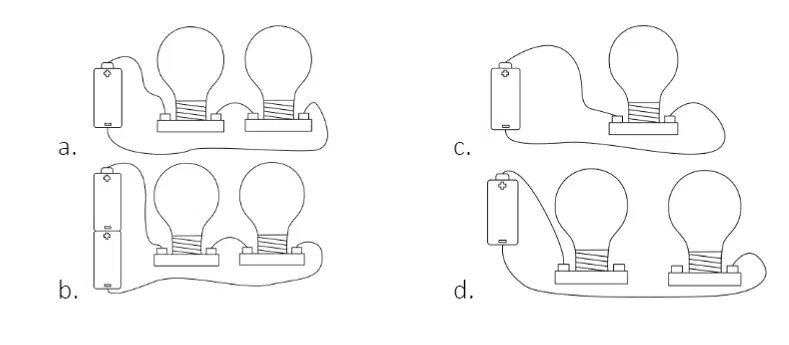
Which of the following is NOT a closed circuit?
The first circuit configuration
The second circuit configuration
The third circuit configuration
The fourth circuit configuration
What do we call the flow of charges around a circuit?
Resistance
Voltage
Current
Discharge
Which part of a circuit is responsible for “pushing” charges around a circuit?
Electrical devices
The wire
The power source (such as a battery)
None of the above – charges flow spontaneously
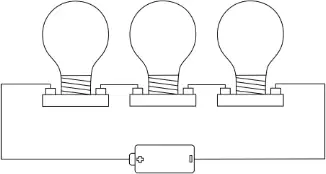
Below is a circuit of three lights. One bulb blows out. What happens to the other bulbs?
One bulb will light up but one will not
Both bulbs will light up, but not as bright
Both bulbs will light up with the same brightness as before the one bulb blew
The other bulbs will not light up
What is the “force” that pushes electrons around a circuit?
Voltage
Current
Resistance
What is a measure of the rate at which electrons flow around a circuit?
Voltage
Current
Resistance
Which of the following is measured in ohms?
Voltage
Current
Resistance
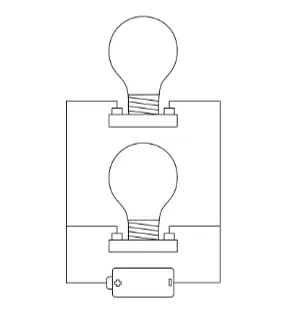
Below is a circuit of two lights. What would happen to the brightness of the bulbs if you added two more bulbs to the circuit in the same fashion as the other bulbs were added?
The brightness would increase
The brightness would decrease
The brightness of the bulbs would not change
The total current that flows through a series circuit of 3 bulbs is 9 amperes. How much current flows through each bulb?
3 amperes
9 amperes
12 amperes
27 amperes
What happens to total resistance of a parallel circuit when you add more devices to the circuit?
The total resistance increases
The total resistance decreases
The total resistance stays the same
What is electrical power?
The strength of the power source
The rate at which electric energy (electricity) is “pumped out” of the power source
The rate at which electric energy (electricity) is used by an electric device
The ratio of an electric device’s resistance to voltage
Which of the following is NOT a good conductor?
Copper
Silver
Plastic
Aluminum
What is an electromagnet?
A magnet created by an electric current
A magnet that causes an electric current to move through a wire
A magnet that resists current flowing through a circuit
A magnet that reduces resistances in a circuit
Which of the following materials is NOT attracted to magnets?
Iron
Aluminum
Nickel
Cobalt
How does increasing the number of coils in an electromagnet affect its strength?
The strength of the electromagnet decreases
The strength of the electromagnet increases
The number of coils does not affect the strength of the electromagnet
The electromagnet becomes a permanent magnet
How does the Earth's magnetic field protect us from solar radiation?
By reflecting solar radiation back into space
By absorbing solar radiation
By deflecting charged particles from the solar wind
It does not protect us from solar radiation
What causes the Earth's magnetic field?
The rotation of the Earth around the Sun
Magnetic minerals in the Earth's crust
The movement of molten iron in the Earth's outer core
Solar radiation
What would likely happen if the Earth's magnetic field suddenly disappeared?
The Earth would spin out of orbit
Compasses would point to the geographic North Pole
Increased levels of solar radiation would reach the Earth's surface
There would be no noticeable effect
Which component is used to resist the flow of current in a circuit?
Capacitor
Resistor
Inductor
Transistor
What happens to the voltage across components in a series circuit?
It is the same across each component
It decreases with each component
It increases with each component
It is divided equally across each component
What causes lightning?
Collision of clouds
Friction between the Earth and clouds
Electrical charges within a cloud
Magnetic fields of the Earth
What is the average temperature of a lightning bolt?
Approximately 20,000 degrees Celsius
Approximately 5,000 degrees Celsius
Approximately 30,000 degrees Celsius
Approximately 1,000 degrees Celsius
Which of the following materials acts as an insulator?
Copper
Gold
Rubber
Iron
Which of the following materials is the best conductor of electricity?
Copper
Wood
Rubber
Glass
What is the unit of electrical charge?
Watt
Ohm
Coulomb
Ampere
What device is used to measure electric current?
Voltmeter
Ammeter
Ohmmeter
Galvanometer
Which of the following is not a property of magnetic fields?
They have both a north and south pole
They can attract certain metals like iron
They can only exist in the presence of electric fields
They exert forces on moving electric charges
What happens when you cut a magnet in half?
Each half becomes a separate magnet with a north and south pole
One half remains a magnet, the other half loses its magnetic properties
The magnet loses its magnetic properties entirely
It creates an electric current
What is the formula for Ohm's Law?
V = I/R
V = I*R
R = V/I
I = V/R
What is the resistance of a circuit if the voltage across it is 10V and the current flowing through it is 2A?
5 Ohms
20 Ohms
8 Ohms
2 Ohms
If the resistance in a circuit is 4 Ohms and the current is 3A, what is the voltage across the circuit?
7V
12V
1V
0.75V
Using Ohm's Law, calculate the current flowing through a resistor with a resistance of 10 Ohms when a voltage of 20V is applied across it.
2A
200A
0.5A
10A
Why do like poles of magnets repel each other?
Because of the magnetic force between them
Due to gravitational pull
Because of the alignment of their atoms
Due to the electric field generated between them
What happens to the magnetic field lines when like poles of two magnets are brought close together?
They bend towards each other
They intersect
They repel and diverge from each other
They cancel each other out
How does the distance between two charged objects affect the electric force between them?
The force increases as the distance decreases
The force decreases as the distance increases
The force is not affected by the distance between objects
Both A and B are correct
Which of the following statements about magnetic poles is true?
Like poles attract and unlike poles repel each other.
Like poles repel and unlike poles attract each other.
Magnetic poles can exist independently of each other.
All magnetic poles are found at the geographic poles of the Earth.
How do animals such as birds and sea turtles use the Earth's magnetic field?
To predict weather changes
To generate electricity for navigation
To navigate during migration
To detect prey from long distances
What is the unit of electric charge?
Coulomb
Ampere
Ohm
Volt
How does the distance between two charged particles affect the electric force between them?
The force increases as the distance decreases
The force decreases as the distance increases
The force is not affected by the distance between particles
Both A and B are correct
What is the primary cause of static electricity?
Friction between two different materials
Heating a material to a high temperature
Applying a strong magnetic field
Submerging materials in water
How does adding resistors in parallel affect the total resistance of a circuit?
The total resistance increases
The total resistance decreases
The total resistance remains the same
The total resistance becomes zero
What is the primary function of a circuit breaker in an electrical circuit?
To increase the flow of current
To protect the circuit from overload by breaking the circuit
To decrease the resistance in the circuit
To convert AC to DC
What triggers a circuit breaker to trip and open the circuit?
A decrease in electrical resistance
An increase in voltage
An overload or short circuit causing excessive current flow
Manual operation by a user
Which of the following materials acts as an insulator?
Copper
Aluminum
Rubber
Gold

