wayground logo

Free Printable Worksheets

NEW

Font size

S
M
L
XL
Worksheets

Review Game: Kinematics 1D

Total questions: 57

Worksheet time: 1hrs 22mins

Name
Class
Date
1.

A feather is dropped on the moon from a height of 1.40 meters. The acceleration of gravity on the moon is 1.67 m/s2. Determine the time for the feather to fall to the surface of the moon.

Which number represents time?

a)

t = 1.40 s

b)

t = 1.67 s

c)

t = 2.54 s

d)

t = 1.29 s

2.

A car traveling at 22.4 m/s skids to a stop in 2.55 s. Determine the skidding distance of the car (assume uniform acceleration).

What number represents time?

a)

t = 2.55s

b)

t = 22.4m/s

c)

t= 0m/s

d)

t =?

3.

A bike accelerates uniformly from rest to a speed of 7.10 m/s over a distance of 35.4 m. Which number represents initial velocity?

a)

v0 = 0 m/s

b)

v0 = 7.10 m/s

c)

v0 = 35.4 m/s

d)

v0 = 9.8 m/s

4.
A _________ quantity is completely described by magnitude alone. A _________ quantity is
completely described by a magnitude with a direction.
a)
vector, scalar
b)
scalar, vector
5.
Speed is a __________ quantity and velocity is a __________ quantity.
a)
scalar, vector
b)
vector, scalar
6.
A hummingbird averages a speed of about 45 km/hour (Cool facts: They visit up to 1000 flowers per day, and reach maximum speed, while diving, up to 160 km/hour!). Ruby-throated hummingbirds take a non-stop trip across Gulf of Mexico in which they fly for 18 hours straight! How far is the trip across the Gulf of Mexico at their average speed?
a)
810 km
b)
2.5 km
c)
3.6 km
d)
360 km
7.

A car slows down from +32 m/s to +8 m/s in 4 s. The acceleration is

a)

-6 m/s^2

b)

-2m/s^2

c)

-8 m/s^2

d)

-4 m/s^2

8.
An airplane accelerates down a runway at 3.20 m/s/s
for 8 s until it finally lifts off the ground.
Determine the velocity at take-off.
a)
0.4 m/s
b)
25.6 m/s
c)
2.5 m/s
9.
What is speed?
a)
how far you go
b)
how much distance is covered over a period of time
c)
how fast you accelerate
d)
the change in the location of a object
10.
A change in velocity over time is known as:
a)
acceleration
b)
constant speed
c)
average speed
d)
displacement
11.
How do you calculate average speed?
a)
divide total time by total distance
b)
multiply total time by total distance
c)
divide total distance by total time
d)
subtract total time from total distance
12.
What is this graph representing?
a)
Constant Speed
b)
Acceleration (speeding up)
c)
Deceleration (slowing down)
d)
No motion
13.

At 60 seconds, how far had this object traveled?

a)

0 m

b)

10 m

c)

20 m

d)

40 m

14.

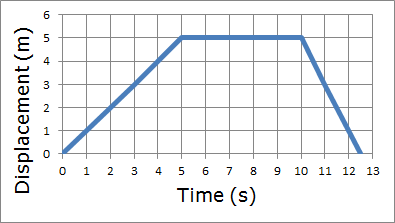
What is the person doing from 5 seconds to 10 seconds?

a)

Walking

b)

Running

c)

Standing Still

d)

Walking Fast

15.

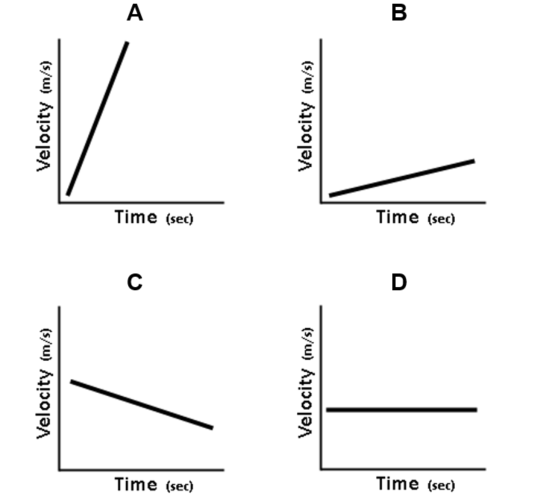
Which graph represents zero acceleration (constant velocity)?

a)

A

b)

B

c)

C

d)

D

16.
What is happening at D?
a)
Stationary
b)
Accelerating
c)
Fast steady speed; moving away from the starting position
d)
Slower steady speed; moving away from the starting position
17.
What is happening at A?
a)
Stationary
b)
Accelerating
c)
Slower steady speed; moving away from the starting position
d)
Steady speed; returning to start position
18.
What is happening at B?
a)
Stationary
b)
Accelerating
c)
Slower steady speed; moving away from the starting position
d)
Steady speed; returning to start position
19.
Which runner won the race?
a)
A
b)
B
c)
C
20.
Motion sensors recorded the following data about a runner during a cross-country race. During which segment of the race did the runner have the greatest speed?
a)
W
b)
X
c)
Y
d)
Z
21.
Which runner got a head start?
a)
red line runner
b)
blue line runner
22.
What is happening between 2 and 3 seconds?
a)
The object is not moving.
b)
The object is not accelerating.
c)
The object is slowing down.
d)
The object is speeding up.
23.

Find the displacement in the first 5 seconds.

a)

8 meters

b)

3 meters

c)

2 meters

d)

5 meters

24.

A dog runs with an initial speed of 7.5 m/s to a stop in 15 seconds. What is the dog's acceleration?

a)

-7.5 m/s2

b)

-7.5 m/s2

c)

-0.5 m/s2

d)

7.5 m/s2

25.
A car is traveling at 21.0 m/s. It slows to a stop at a constant rate over 5.00 s. How far does the car travel during those 5.00 seconds before it stops? 
a)
4.20 m
b)
52.5 m
c)
105 m
d)
158 m
26.
A roller coasters accelerates from an initial velocity of 6.0 m/s to a final velocity of 70 m/s over 4 seconds.  What's the acceleration?
a)
24 m/s2
b)
18 m/s2
c)
16 m/s2
d)
16 m/s
27.
The SI unit for length or distance is
a)
foot (ft)
b)
inch (in)
c)
mile (mi)
d)
meter (m)
28.
The SI unit for time is
a)
second (s)
b)
minute (min)
c)
hour (hr)
d)
year (yr)
29.
What is the SI unit for speed and velocity?
a)
Km
b)
s
c)
m/s
d)
m/s2
30.
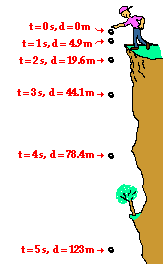
What happens to the velocity of a ball as it is dropped off a cliff? 
a)
It decreases at a uniform rate 
b)
It increases at a uniform rate 
c)
It is constant 
d)
It increases at a non-uniform rate
31.

What quantity is equal to the slope of this graph?

a)

Distance

b)

Displacement

c)

Acceleration

d)

Velocity

32.
During which interval is the object slowing down?
a)
A to B
b)
D to E
c)
E to F
d)
G to H
33.

What happened during A to B point?

a)

not moving

b)

increasing speed at a constant rate

c)

moving at a constant speed

d)

acceleration

34.
According to the graph how far does the person travel in the first 5 seconds?
a)
2 m
b)
10 m
c)
0 m
d)
5 m
35.
An object with an initial velocity of 3.50 m/s moves east along a straight and level path. The object then undergoes a constant acceleration of 1.80 m/s2 east for a period of 5.00 s. How far does the object move while it is accelerating?
a)
6.30 m
b)
17.5 m
c)
27.2 m
d)
40.0 m
36.
Describe the motion
a)
Speeding up;    Moving in negative direction
b)
Speeding up;   Moving in positive direction
c)
Slowing down;   Moving in positive direction
d)
Slowing down;   Moving in negative direction
37.
Describe the motion
a)
Speeding up;    Moving in negative direction
b)
Speeding up;   Moving in positive direction
c)
Slowing down;   Moving in positive direction
d)
Slowing down;   Moving in negative direction
38.

How long would it take a car, starting from rest and accelerating uniformly in a straight line at 5 m/s2, to cover a distance of 200m

a)

9.0s

b)

10.5s

c)

12.0s

d)

15.5s

39.
A cart travels with a constant nonzero acceleration along a straight line. Which graph best represents the relationship between the distance the cart travels and time of travel?
a)
1
b)
2
c)
3
d)
4
40.
What is the speed of the object from 4-10 seconds?
a)
2 m/s
b)
3 m/s
c)
8 m/s
d)
16 m/s
41.
Suppose an object is in free fall. Each second the object falls 
a)
the same distance as in the second before.
b)
a larger distance than in the second before.
c)
with the same instantaneous speed.
d)
with the same average speed.
42.
If you drop a feather and a coin at the same time in a tube filled with air, which will reach the bottom of the tube first?
a)
the feather
b)
neither
c)
the coin
43.
Consider drops of water leaking from a water faucet. As the drops fall they 
a)
remain at a relatively fixed distance from each other
b)
get farther apart
c)
get closer together
44.
In the absence of air resistance, objects fall at constant 
a)
speed
b)
velocity
c)
acceleration
d)
all of the above
45.

Ryan runs along the inside lane of a 400 m oval track exactly 4 times in 5.5 minutes. What is the magnitude Ryan's velocity?

a)

0 m/s

b)

0.21 m/s

c)

0.73 m/s

d)

4.85 m/s

e)

290.91 m/s

46.

A bike traveled 90 m in 10 seconds, 150 m in 20 seconds and then 110 m in 15 seconds to reach its destination. What is the bike's average speed?

a)

7.33 m/s

b)

7.78 m/s

c)

7.94 m/s

d)

9.43 m/s

47.

An object is thrown into the air at 60 m/s, straight up. What is its velocity at the highest point?

a)

0

b)

-9.8

c)

60

d)

-60

48.

An object is thrown into the air at 60 m/s, straight up. What is its acceleration at the highest point?

a)

0

b)

-9.8

c)

60

d)

-60

49.

Given a position vs. time graph, the slope of the line is equal to...

a)

position

b)

velocity

c)

acceleration

d)

area

50.

Given a velocity vs. time graph, the slope of the line is equal to...

a)

position

b)

velocity

c)

acceleration

d)

area

51.

Given a velocity vs. time graph, the area under the graph is equal to the object's ___.

a)

displacement

b)

velocity

c)

acceleration

d)

area

52.

A flat, horizontal line on a position vs. time graph means...

a)

no motion

b)

moving at a constant velocity

c)

moving at a constant acceleration

53.
For any given motion, the distance is ____.
a)
the direction which an object moves
b)
the scalar of the object's velocity
c)
how far out of place which the object finishes relative to the starting location.
d)
the amount of ground which is covered by the moving object.
54.
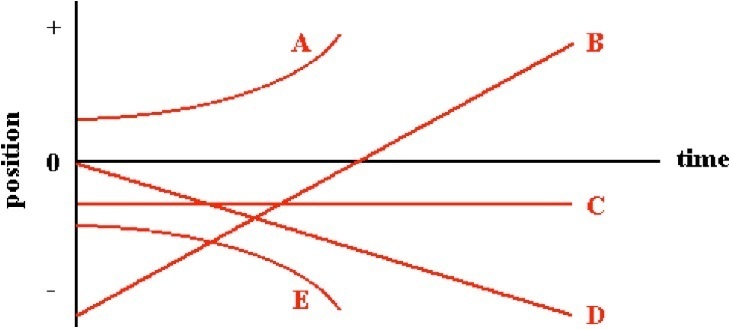
The motions of five objects - A, B, C, D, and E - are represented by lines on a position-time graph. Write the letter for the object that has the greatest constant velocity.
a)
B
b)
C
c)
D
d)
E
55.
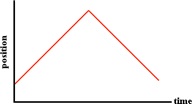
As represented by this position-time graph, this object is ____.
a)
speeding up, changing directions, and then slowing down
b)
accelerating, first with a positive and then with a negative acceleration
c)
speeding up and then slowing down, all while moving in the same direction
d)
moving in the positive direction and then in the negative direction, both at constant speed
56.
Acceleration is defined as ____.
a)
the rate at which the position changes
b)
the rate at which the displacement changes
c)
the rate at which the speed changes
d)
the rate at which the velocity changes
57.

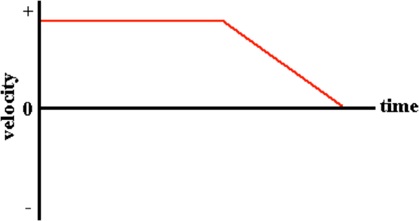
As represented by this velocity-time graph, this object is ____.

a)

at rest for several seconds and then accelerates in the negative direction

b)

moving at a constant speed and then slows to a stop

c)

at rest for several seconds and then moves in the negative direction

d)

... nonsense! None of these appropriately describe the object's motion