wayground logo

Free Printable Worksheets

Font size

S
M
L
XL
Worksheets

Electricity Review

Total questions: 52

Worksheet time: 3hrs 36mins

Name
Class
Date
1.
Electricity is the flow of _________.
a)
protons
b)
neutrons
c)
electrons
2.
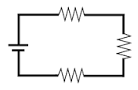
What type of circuit is pictured?
a)
series
b)
Parallel
3.
What type of circuit is pictured?
a)
series
b)
parallel
4.

is the opposition to the flow of charges in a material.

a)

Resistance

b)

Voltage

c)

Time

d)

Current

5.

In order to electrical current to flow through a wire the wire must be connected in a ____________ that includes a source of electrical current.

a)

averager matter

b)

Complete loop

c)

In an incomplete loop

d)

Interrupted Circuit

6.

If lamp 1 is unscrewed from its holder, what will happen to lamp 2?

a)

It will get brighter

b)

It will stay the same brightness

c)

It will go out

d)

Nothing will happen

7.

If lamp 2 is unscrewed from its holder, what will happen to lamp1?

a)

It will stay lit

b)

It will go out

c)

It will get dimmer

d)

It will dissapear

8.
this circuit is .....?
a)
open
b)
parallel
c)
closed
d)
The cutest little circuit evah!
9.

What unit is used to measure current?

a)

Ohms

b)

Omega

c)

Volts

d)

Amps

10.

What unit is used to measure resistance?

a)

Ohms

b)

Omega

c)

Volts

d)

Amps

11.

What is the resistance of a lightbulb that experiences 9 Volts and 3 amps of current?

a)

1/3 ohms

b)

3 ohms

c)

27 ohms

d)

9 ohms

12.

What is the voltage of a circuit with 4 ohms of resistance and 3 amps of current?

a)

12 V

b)

21 V

c)

4/3 V

d)

3/4 V

13.
What is the Voltage of a circuit that has a resistance of 5 Ω and a current of 2 A?
a)
25 V
b)
10 V
c)
2.5 V
d)
0.4 V
14.
How do you calculate voltage?
a)
Current X Resistance
b)
Resistance ÷ Current
c)
Current ÷ Resistance
d)
Measure it with a ruler
15.

What unit is used to measure the voltage?

a)

Ohms

b)

Omega

c)

Volts

d)

Amps

16.
What size resistor would produce a 3 Amp current flow with a 12 Volt battery
a)
1 Ohm
b)
3 Ohms
c)
4 Ohms
d)
12 Ohms
17.
What is resistance measured in?
a)
Ω (Ohms)
b)
V (Volts)
c)
A (Amps)
d)
W (Watts)
18.

Voltage divided by Resistance

(V / R)

a)

Current

b)

Power

c)

Ohms

d)

Watts

19.
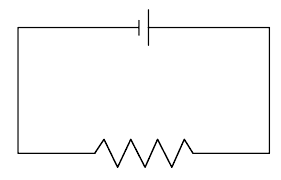
This circuit has a 24 volt battery and the resistor is 8 ohms. How many amps are running through the circuit?
a)
3 Amps
b)
192 Amps
c)
2 Amps
d)
4 Amps
20.
To complete a circuit the switch must be
a)
unattached
b)
open
c)
closed
d)
It depends
21.

What is this symbol?

a)

Battery

b)

Switch

c)

Bulb

d)

Resistor

22.

What is this symbol?

a)

Switch

b)

Battery

c)

Bulb

d)

Resistor

23.

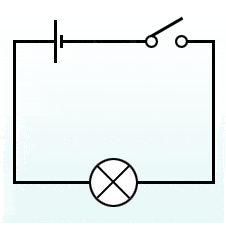
This switch is open.

a)

True

b)

False

24.

If the switch is open in a series circuit, then...

a)

...electricity will flow.

b)

....electricity will NOT flow.

25.
The picture shows an electrical circuit. This circuit is a series circuit because: 
a)
It has 3 light bulbs.
b)
The same current flows through all three light bulbs.
c)
It uses a single battery.
d)
The electrical current is divided between the three light bulbs.
26.
In a parallel circuit if one of the light bulbs burns out the rest _________.
a)
stop the flow of electricity
b)
 can still light up
c)
 will go out
d)
of the light bulbs burn out also
27.
What kind of circuit is this?
a)
Series
b)
Consecutive
c)
Parallel
d)
Training
28.
What is one benefit of using a parallel circuit?  
a)
It gets confusing.
b)
If battery powered the battery will last longer.
c)
If one bulb goes out it does not  affect the others. 
d)
It is easier to set up
29.
Which of the following answer choices correctly describes the image? 
a)
Series circuit - Bulbs are lit
b)
Series circuit - Bulbs are off
c)
Parallel circuit - Bulbs are lit
d)
Parallel circuit - Bulbs are off
30.
What will happen if one light bulb is removed from this circuit?
a)
The other bulbs will go out.
b)
The other bulbs will stay on
c)
The other bulbs will get dimmer.
d)
The battery will become stronger.
31.
a)

Battery

b)

Lines

c)

Resistor

d)

bulb

e)

switch

32.
a)

lightbulb

b)

Resistor

c)

battery

d)

switch

33.
If two charges repel each other, the two charges must be
a)
Positive and neutra
b)
Positive and negative
c)
positive and neutral
d)
negative and negative
34.
An object becomes charged when the atoms in the object gain or lose
a)
electrons
b)
protons
c)
neutrons
d)
all of the above
35.
Objects that have opposite charges
a)
are attracted to each other, and the force between the objects pulls them together.
b)
are attracted to each other, and the force between the objects pushes them apart.
c)
are repelled by each other, and the force between the objects pulls them together.
d)
are repelled by each other, and the force between the objects pushes them apart.  
36.
A region around a charged particle that can exert a force on another charged particle is called an
a)
electric pulse.
b)
electric charge.
c)
electric force.
d)
electric field.
37.

Bending water with a charged balloon is an example of what type of phenomenon

a)

electric field

b)

static electricity

c)

electrical circuit

38.
Electrical charge built up on the surface of an object is called _________________.
a)
static electricity
b)
current electricity
c)
lightning
d)
electrons
39.
What types of charges attract?
a)
Positive and Positive
b)
Positive and Neutral
c)
Negative and Neutral
d)
Positive and Negative
40.
Two objects with LIKE static charges will
a)
attract each other
b)
even out in the end
c)
repel each other
d)
cause a spark
41.

Electric lines of force about negative point charge are

a)

Circular, anticlockwise

b)

Circular, clockwise

c)

Radial, outward

d)

Radial, inward

42.
At which point is the electric field the strongest
a)
A
b)
B
c)
C
d)
D
43.
Consider the electric field lines shown in the diagram below. From the diagram, it is apparent that object A is ____ and object B is ____.
a)
+,+
b)
+,-
c)
-,+
d)
-,-
44.

Based on the arrangement of the electric field lines in the diagram, what are the charges?

a)

both charges are the same

b)

the charges are opposite

c)

they are neutral; no charge

45.

Which diagram correctly shows the electric field around a negative charge?

a)

A

b)

B

c)

they are both positive

46.

Which diagram correctly shows the field lines between two like charges?

a)

A

b)

B

c)

Both

d)

Neither

47.
The electric field surrounding a positively charged object is
a)
Away from the charge
b)
Toward the charge
48.

Which diagram represents the electric fields of a negative point charge, shown by º

a)
b)
c)
d)
49.

which is the field for opposite charges

a)
b)
c)
d)
50.

Which of the following figures represent the electric field lines due to a single negative charge?

a)

a

b)

b

c)

c

d)

d

51.
If two charges repel each other, the two charges must be
a)

Positive and Positive

b)

positron and negative

c)

negative and neutral

d)

negative and positive

52.

This switch is closed

a)

True

b)

False