wayground logo

Free Printable Worksheets

Font size

S
M
L
XL
Worksheets

Structure of Cells and Organelles

Total questions: 50

Worksheet time: 1hrs 15mins

Name
Class
Date
1.

Simple cells that have no nucleus or membrane bound organelles

a)

Prokaryotes

b)

Eukaryotes

c)

Plant cells

d)

Animal cells

2.
Which organelle receives proteins and materials from the ER and packages them and distributes them?
a)
ribosomes
b)
lysosome
c)
nucleolus
d)
golgi body
3.

This organelle is responsible for digesting waste within the cell.

a)

Lysosome

b)

Vesicle

c)

Smooth ER

d)

Undulipodia

4.

What are the folds of membrane inside the mitochondria called?

a)

Mesosome

b)

Cristae

c)

Thylakoids

d)

Plasma membrane

5.

Which organelle modifies, sort , store and transport proteins?

a)
b)
c)
d)
6.

What is this organelle?

a)

Undulipodia

b)

Cilia

c)

Centriole

d)

Spindle

7.
Which of these is NOT a part of the Cell Theory?
a)
All cells are independent.
b)
Cells are the basic unit of living things. 
c)
All living things are one or more cells.
d)
Cells come from cells.
8.
Which of the following is found inside a prokaryote?
a)
cytoplasm
b)
DNA
c)
ribosomes
d)
all of these
9.
How can the cytoskeleton of a cell be described?
a)
Transport system
b)
Semifluid material
c)
Selectively permeable series of membranes
d)
A framework and anchor for organelles
10.

which organelle contains pigment?

a)

Golgi Body

b)

Nucleus

c)

Cytoplasm

d)

Chlorplast

11.

Which of the following is NOT a permanent tissue?

a)

xylem

b)

collenchyma

c)

meristem

d)

epidermal

12.

Where can the lateral meristem or cambium be found?

a)

between xylem and phloem tissue

b)

under the epidermis

c)

between the ground tissues

d)

between the stem and root

13.

The plant tissue responsible for transportation of substance is

a)

vascular tissue

b)

meristematic tissue

c)

epidermal tissue

d)

ground tissue

14.

Which of these tissues have thick cell walls? (Tick all that applies)

a)

collenchyma tissue

b)

parenchyma tissue

c)

sclerenchyma tissue

d)

xylem tissue

15.

What type of cells are shown here? Note: These are alive at maturity.

a)

Parenchyma

b)

Sclerenchyma

c)

Collenchyma

d)

Meristem

16.

Which of the following cells make up phloem tissues? (Tick all that applies)

a)

sieve tube

b)

tracheids

c)

companion cell

d)

parenchyma

17.

Lateral meristem cells consist of

a)

cork cambium

b)

cork

c)

vascular cambium

d)

cortex

18.

Which of the following are dead cells? (Tick all that applies)

a)

tracheids

b)

sieve tubes

c)

companion cells

d)

xylem vessels

19.
Identify:
a)
Pseudostratified
b)
Simple cuboidal
c)
Transitional
d)
Simple Squamous
20.

Which muscle type can contract rapidly with great force, BUT tires easily and must rest after short periods of activity.

a)

skeletal

b)

smooth

c)

cardiac

21.
Nervous tissue
a)
Tissue that is responsible for lining, covering, and glandular tissue
b)
Tissue responsible for protecting, supporting, and binding together other body tissues
c)
Tissues that contracts and shortens to produce movement
d)
Tissue that receives and conducts electrochemical impulses from one part of the body to another
22.
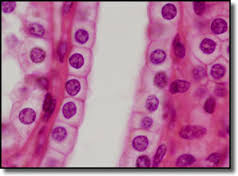
Name this tissue
a)
Bone
b)
Cartilage
c)
Blood
d)
Adipose
23.
Which connective tissue contains a gel-like matrix and is found in the nose, ear, and at the end of bones.
a)
Bone
b)
Cartilage
c)
Blood
d)
Adipose
24.

Which of the following is NOT a function of epithelial tissues?

a)

covering exposed surfaces

b)

producing glandular secretions

c)

lining internal passageways

d)

contracting to produce movement

25.

Where are fats stored in the Body?

a)

Areolar Tissue.

b)

Blood.

c)

Stratified Squamous Epithelium Tissue.

d)

Adipose Tissue.

26.

Bone matrix is rich in

a)

fluoride and calcium

b)

calcium and phosphorus

c)

phosphorus and potassium

d)

calcium and potassium

27.

Which tissue provide flexibility and elasticity in plants

a)

parenchyma tissue

b)

sclerenchyma tissue

c)

xylem tissue

d)

collenchyma tisssue

28.

The most common type of ground tissue is

a)

epidermis

b)

collenchyma

c)

sclerenchyma

d)

parenchyma

29.

'cells change their shapes and structure to become specialised cells' in which zone does this changes take place

a)

zone of differentiation

b)

zone of cell division

c)

zone of elongation

30.

Plant tissues responsible for growth is the .....

a)

vascular tissue

b)

meristematic tissue

c)

epidermal tissue

d)

ground tissue

31.

plant secondary growth is controlled by

a)

vascular cambium

b)

apical meristem

c)

root meristem

d)

phloem

32.

Used in places where diffusion needs to occur, such as blood vessels and air sacs in the lungs

a)

Simple cuboidal

b)

Simple columnar

c)

Simple Squamous

d)

Stratified Squamous

33.

Lines ducts and glands

a)

Simple columnar

b)

Simple cuboidal

c)

Simple squamous

d)

Stratified squamous

34.

What type of muscle(s) is involuntary?

a)

skeletal and smooth

b)

cardiac and skeletal

c)

smooth and cardiac

d)

skeletal and longitudinal

35.

Some of the leukocytes have granules in their cytosol that consist of a variety of chemicals involved in defending the body. Which of the following cells typically do NOT contain granules?

a)

Basophils

b)

Eosinophils

c)

Neutrophils

d)

Monocytes

36.
What is part 1?
a)

eye piece/ocular lens

b)
body tube
c)
arm
d)
coarse adjust
37.
What will be the total magnification if the ocular lens is 10X and the objective lens is 40X?
a)
40X
b)
10X
c)
100X
d)
400X
38.

What piece contains a high-power magnifying lens (40x)?

a)

HIgh-power Objective

b)

Eyepiece

c)

Low-power Objective

d)

Stage

39.
Which microscope delivers the highest overall magnification possible?
a)
Scanning Electron (SEM)
b)
Transmission Electron Microscope (TEM)
c)
Light Microscope
d)
Dissecting Microscope
40.
Electron microscopes use a beam of _________________ to produce an image magnified up to 100,000 or more
a)
Sunlight
b)
Lasers
c)
Electrons
41.

Which type of microscope is the MOST suitable for observing the surface of a virus?

a)

Transmission Electron Microscope

b)

Confocal Microscope

c)

Light Microscope

d)

Scanning Electron Microscope

42.
Which electron microscope provides details of a cell's internal structures?
a)
Scanning Electron Microscope (SEM)
b)
Transmission Electron Microscope (TEM)
c)
Light Microscope
d)
Dissecting Microscope
43.
Based on these results whose blood was found in the blood stain at the crime scene?
a)
Bob
b)
Sue
c)
John
d)
Lisa
44.
Why do the fragments of DNA in gel electrophoresis travel away from the negative electrode?
a)
DNA is negatively charged so attracted to the positive end of the unit
b)
DNA is positively charged to attracted to the negative end of the unit
c)
the agarose gel in negatively charged
d)
the agarose gel is positively charged
45.
Which is the primary purpose of using restriction enzymes in gel electrophoresis?
a)
It allows the strands of DNA to be cut into various lengths for testing
b)
It restricts the number of base pairs that can be tested in a sample
c)
It makes the testing simpler by moving the strands into the gel faster
d)
It charges the DNA strands
46.
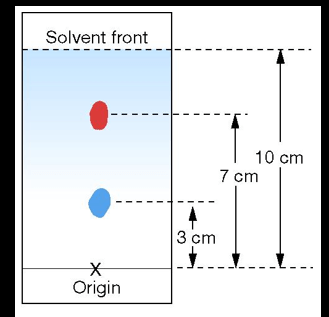
The Rvalue  for the blue component is 
a)
0.3
b)
0.7
c)
10
d)
3
47.
In paper chromatography, the MOST soluble solute .......
a)
does not move from the start point
b)
stays closest to the start point
c)
travels furthest away from the start point
d)
can be found in the middle of the chromatogram
48.
A student extracts the colour from some green smarties and uses paper chromatography to separate components colours. She finds blue has a Rf =0.38 and yellow Rf =0.75 this suggests 
a)
the yellow is more strongly adsorbed onto the stationary phase and is less solublein the mobile phase.
b)
the yellow is more strongly adsorbed onto the stationary phase and is more soluble in the mobile phase.
c)
the blue is more strongly adsorbed onto the stationary phase and is less solublein the mobile phase.
d)
the blue is more strongly adsorbed onto the stationary phase and is less solublein the mobile phase.
49.

After centrifugation, sublimate

a)

dissolves completely

b)

remain suspended in a liquid

c)

settles at bottom

d)

depends upon pH of sublimate

50.

Which of the following centrifugation is used to separate certain organelles from whole cell?

a)

Electrophoresis

b)

Chromatography

c)

Differential centrifugation

d)

All of these